
Last Updated: August 31, 2026
Introduction
Yoga arm balance poses are really tough. They are also very rewarding. To do these poses you need to be strong, flexible and able to move your body in ways. You also need to be able to focus and be patient.
Lots of people who do yoga like to try arm balance poses because they look really cool.. The good thing about these poses is that they help you learn to control your body focus your mind and be more aware of how you move.
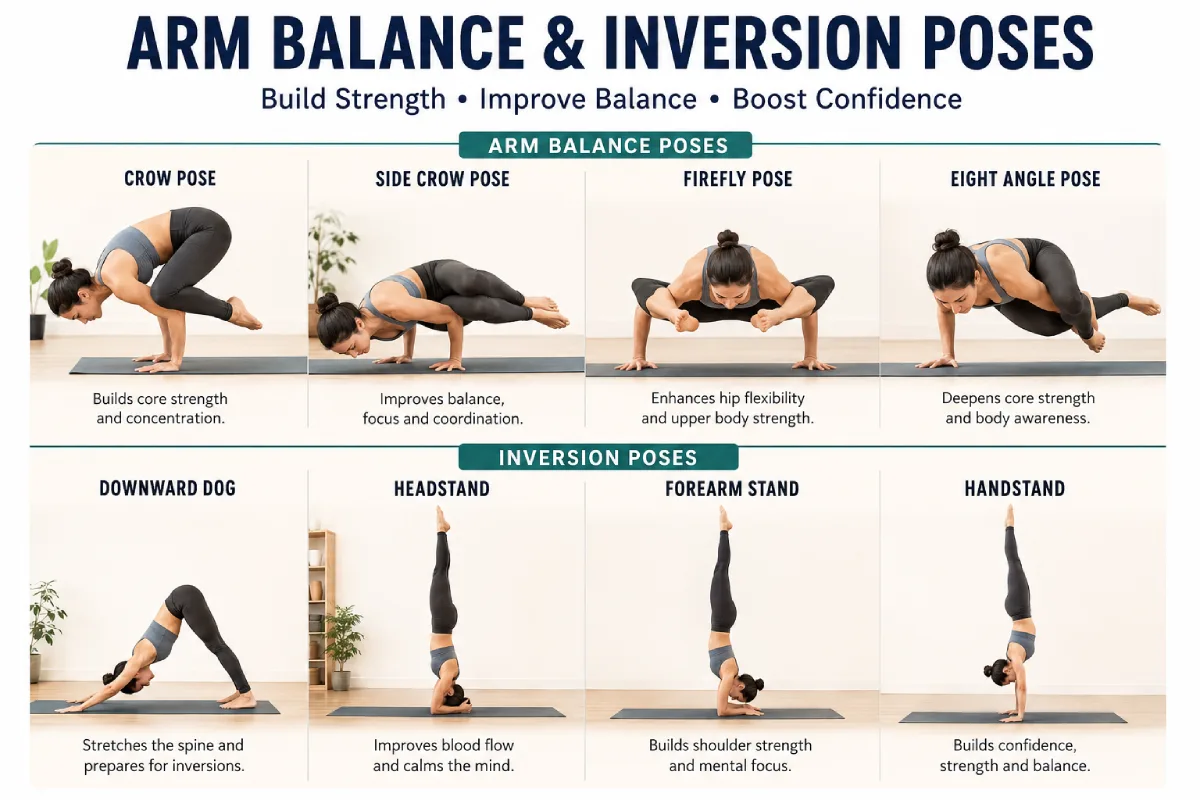
From Crow Pose and Side Crow to Handstand and Forearm Stand these poses make you do things that might be hard, for you. They also help you build strength in your whole body. Inversion poses are among the most challenging yoga movements and require balance, strength, and confidence. Explore our Difficult Yoga Poses Guide to discover more advanced postures.
What Are Arm Balance & Inversion Poses?
Arm balances are when you use your arms and hands to hold up part or all of your bodys weight. This can be really challenging. Inversions are poses where your head’s lower than your heart. This means your body is in the position of how it normally is. You are basically down when you do inversions, with arm balances or other types of inversions.
Common examples include:
- Crow Pose “Bakasana”
- Side Crow “Parsva Bakasana”
- Firefly Pose “Tittibhasana”
- Eight-Angle Pose “Astavakrasana”
- Handstand “Adho Mukha Vrksasana”
- Forearm Stand “Pincha Mayurasana”
- Headstand “Sirsasana”
These postures are frequently viewed as steps within a practice of more complex yoga as the exercises that they entail requires significant physical effort and focus. Many of the most advanced yoga postures incorporate inversion techniques that test stability and body control. Learn more in our Advanced Yoga Poses .
Benefits of Arm Balance & Inversion Poses
Build Functional Upper-Body Strength
Unlike traditional gym exercises that isolate muscle groups, yoga arm balances develop integrated strength throughout the:
- Shoulders
- Arms
- Wrists
- Chest
- Core
- Upper back
The body learns to stabilise itself as a connected system.
Improve Core Stability
An important element in maintaining stability within advanced yoga arm balances is having a solid core. Through consistent practice, it strengthens:
- Deep abdominal muscles
- Obliques
- Lower back stabilisers
- Pelvic floor muscles
Enhance Body Awareness
Balance on hands demands good control over the body positioning. The better body alignment and fluidity of movement skills may also be improved through practice.
Increase Confidence
It builds the confidence of moving towards very advanced postures, overcoming that fear, self-doubt.
Improve Focus and Concentration
Inversions and Arm balances are intensely arresting. Even momentary mental or physical interruptions can completely rock our foundations, therefore it’s not only for strength where they command our full focus, but also, of course, how incredibly mindful. Shoulder, hip, and spinal mobility are essential for performing inversion poses safely and effectively. Explore our Mobility-Based Yoga Poses.
Advanced Yoga Arm Balances: Popular Poses
Crow Pose (Bakasana)
Crow Pose is often considered the gateway to arm balancing.
Key Requirements:
- Core engagement
- Wrist strength
- Hip mobility
- Focus
Difficulty Level: Beginner-Intermediate
Side Crow (Parsva Bakasana)
This twisting variation adds rotational strength and coordination.
Benefits:
- Strengthens obliques
- Improves spinal mobility
- Enhances balance awareness
Firefly Pose (Tittibhasana)
Firefly requires exceptional hamstring flexibility and upper-body strength.
Challenges:
- Hip flexibility
- Arm strength
- Core control
Eight-Angle Pose (Astavakrasana)
This pose combines twisting, arm balancing, and leg positioning.
Skills Required:
- Coordination
- Core strength
- Hip mobility
Yoga Handstand: Building Towards Balance
Why Practise Handstands?
Benefits may include:
- Improved shoulder strength
- Enhanced body awareness
- Better balance control
- Increased confidence
Handstand Progression Workflow
| Stage | Focus Area |
| Stage 1 | Shoulder mobility |
| Stage 2 | Core strengthening |
| Stage 3 | Wall-supported holds |
| Stage 4 | Controlled kick-ups |
| Stage 5 | Balance drills |
| Stage 6 | Freestanding handstand |
Common Handstand Mistakes
- Overarching the lower back
- Holding the breath
- Kicking too aggressively
- Lack of shoulder engagement
- Poor wrist preparation
It’s often better to stick with what works than to move onto more complex variations too quickly. Practicing with a solid core will help with balance and alignment during headstands, handstands, etc. Read our Core-Intensive Yoga Poses.
Advanced Inversion Poses
Forearm Stand “Pincha Mayurasana”
Forearm Stand removes wrist pressure while placing greater demand on the shoulders.
Key Benefits:
- Shoulder stability
- Core engagement
- Balance development
Headstand (Sirsasana)
This king among asanas needs very accurate teaching and alignment.
Important Considerations:
- Avoid excessive neck pressure
- Engage shoulders actively
- Build strength gradually
Scorpion Pose (Vrschikasana)
Scorpion combines deep backbending with inversion control.
Requirements:
- Shoulder mobility
- Back flexibility
- Balance mastery
Hardest Yoga Balance Poses
Many practitioners eventually aspire to some of the most difficult arm balance yoga poses.
Comparison of Advanced Poses
| Pose | Difficulty | Primary Challenge |
| Crow Pose | Moderate | Balance |
| Side Crow | Moderate-High | Rotation |
| Firefly Pose | High | Flexibility |
| Eight-Angle Pose | High | Coordination |
| Handstand | High | Balance Control |
| Forearm Stand | High | Shoulder Strength |
| Scorpion Pose | Very High | Flexibility + Balance |
These rankings vary depending on an individual’s mobility, strength, and experience. Most inversion poses should be learned gradually through structured progressions and skill development. Discover more in our Yoga Pose Progressions.
Difficult Arm Balance Yoga Poses and Their Challenges
Press Handstand
One of the most advanced entries into handstand.
Challenges include:
- Exceptional core strength
- Hip compression
- Shoulder control
Flying Pigeon Pose
Combines hip opening with arm balancing.
Requires:
- External hip rotation
- Balance
- Upper-body stability
Dragonfly Pose
A complex twisting arm balance demanding significant mobility and coordination.
One-Arm Handstand
Considered an elite-level yoga skill.
Necessary foundations:
- Years of handstand practice
- Exceptional shoulder stability
- Advanced balance control
Essential Preparation for Arm Balance & Inversion Poses
Warm-Up Sequence
Before practising inversions:
- Wrist mobilisation
- Cat-Cow stretches
- Plank variations
- Downward Dog
- Shoulder activation drills
- Core engagement exercises
Strength Foundations
Focus on:
- Planks
- Hollow body holds
- Push-ups
- Dolphin Pose
- Boat Pose
Mobility Foundations
Important areas include:
- Shoulders
- Wrists
- Hamstrings
- Hips
- Thoracic spine
Realistic Expectations and Progress Timeline
Many yoga students underestimate how long to practice to achieve mastery levels in yoga.
What Beginners Should Expect
0–3 Months
- Improved shoulder strength
- Better wrist tolerance
- Basic Crow Pose attempts
3–12 Months
- Consistent Crow Pose
- Early Side Crow progress
- Supported inversions
1–3 Years
- Handstand development
- Forearm Stand practice
- More advanced arm balances
3+ Years
- Advanced transitions
- Scorpion variations
- Press Handstand work
Progress rates vary considerably between individuals.
Safety Considerations
Arm balances and inversions are not suitable for every practitioner.
Exercise caution if you have:
- Recent wrist injuries
- Shoulder instability
- Neck issues
- Uncontrolled high blood pressure
- Eye conditions affected by pressure changes
Working with a qualified yoga instructor can help reduce injury risk and improve technique.
Conclusion
Arm Balance and Inversion Poses are really tough. They are also very rewarding when you do them right. If you want to get good at Crow Pose or if you want to do a handstand in yoga or if you want to try some of the Inversion Poses you have to practice all the time get ready the right way and know what to expect.
When you build up your strength and you can move better and you know your body well then you can do the hard Arm Balance yoga poses safely.. The good thing is, you will get better at balancing and you will be more coordinated and you will feel more confident, over time. Arm Balance and Inversion Poses are worth trying because they help you in many ways. Recovery practices can help reduce strain on the shoulders, neck, and wrists after inversion training sessions. Learn more in our Yoga Recovery.