
From the outside, yoga might seem peaceful and simple. But underneath some of its calm appearance lie very difficult yoga poses that necessitate an immense combination of balance, strength, flexibility, coordination and concentration.
If you’ve worked your way up from basic poses and feel ready to test your yogic abilities, complex yoga postures may offer a significant level of challenge. Challenging postures allow you to discover what your body can do, build body awareness and establish control. It doesn’t have to hurt, however.
Pushing yourself before your body is ready should generally be avoided.
We will dive into the top 25 hardest yoga poses in the world, including a break down of how difficult each pose is to get into and a look at what strength and flexibility you will need to hold even the least demanding of them all. Let’s start our 25 hardest yoga poses challenge, whether it’s your advanced yoga poses with flexibility or just a guide about different yoga positions – this will surely prove more challenging than just the standard Warrior Pose. Mastering challenging postures requires strength, balance, flexibility, and consistent practice. Explore our Advanced Yoga Poses to learn some of the most demanding yoga movements.
What Are Difficult Yoga Poses?
What are advanced yoga positions? These can include inversions, arm balances, and very tight hip opens along with advanced backbends or they could be a blend of several of the practices. They call for a whole lot of dexterity. They call for a great deal of flexibility, strength, balance and control and body command.
The challenge of a particular pose can vary dramatically from person to person. A posture that feels fairly simple to a flexible person, for example, may be exceptionally difficult for someone with restricted shoulders or hips.
Some advanced poses are most reliant on flexibility, and others rely most heavily on upper body strength and balance.
For example:
| Type of challenge | Skills commonly required |
| Arm balances | Wrist, shoulder and core strength |
| Inversions | Balance, shoulder stability and body awareness |
| Backbends | Spinal, shoulder and hip mobility |
| Hip openers | Hip flexibility and control |
| Standing balances | Leg strength and concentration |
| Advanced twists | Mobility and controlled rotation |
| Combined poses | Strength, flexibility and coordination |
You shouldn’t just want to get a specific shape. Focus on the correct posture, control the breath and safely build up the poses.
Many difficult yoga poses involve inversions that test body control, coordination, and confidence. Read our Inversion Poses for detailed techniques and benefits.
25 Hardest Yoga Poses
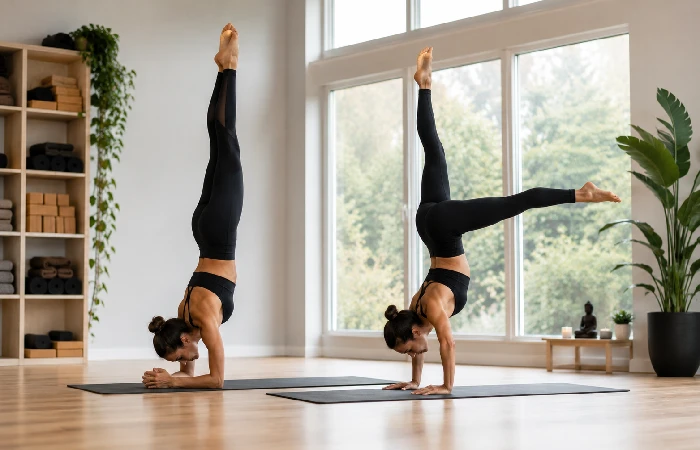
One of the most inspiring yoga locations, this advanced posture is often a goal for various yogis.
1. Handstand — Ado Mukha Vrksasana
The handstand is probably the most widely known ‘advanced’ yoga posture. The person performing the pose uses the hands as a support and balances in an inverted position. This requires considerable wrist, shoulder and core strength.
Balance is another major challenge. There is such a wide range of movement that can affect your body’s position, causing you to tip and come out of a handstand, even the most practiced can lose control.
Main challenges:
- Shoulder strength
- Wrist stability
- Core control
- Balance
- Body awareness
Beginners should learn handstand fundamentals with professional instruction and appropriate support rather than repeatedly kicking up without control.
Flexibility and joint mobility are essential for performing advanced yoga movements safely. Learn more in our Mobility-Based Yoga Poses.
2. Forearm Stand — Pincha Mayurasana
Pincha Mayurasana is a forearm balance that requires substantial shoulder strength and control.
It supports the body on the forearms rather than hands. The balance will still seem as if it is an easy procedure when done by an knowledgeable yoga poser but one requires practice for getting steady at that point upside down.
It is particularly demanding for people with limited shoulder mobility.
Works on:
- Shoulders
- Core
- Upper back
- Balance
- Concentration
Wall-supported practice can help practitioners understand the alignment before attempting the pose independently.
3. Scorpion Pose — Vrschikasana
A difficult yoga pose as it is a combination of an inversion and an extreme backbend. The practitioner uses their forearms for support and walks their feet towards their head. This means that the practitioner needs to have not only control of the inversion but a lot of mobility in the spine and shoulders.
Because the posture syndicates several difficult elements, it should usually be tried only after developing a strong basis.
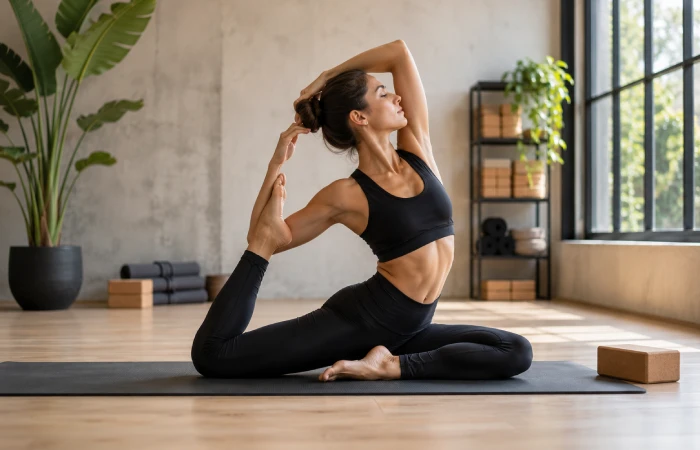
4. King Pigeon Pose — Eka Pada Rajakapotasana
King pigeon pose- Pigeon’s advanced cousin involving a great stretch down the spine along with hip and shoulder mobility to truly extend up and out in each leg.
This is one of the most challenging advanced yoga poses for flexibility.
Important areas include:
- Hip flexors
- Quadriceps
- Shoulders
- Chest
- Spine
Flexibility should develop gradually. Pulling aggressively on the foot or forcing the spine into extension can create unnecessary stress.
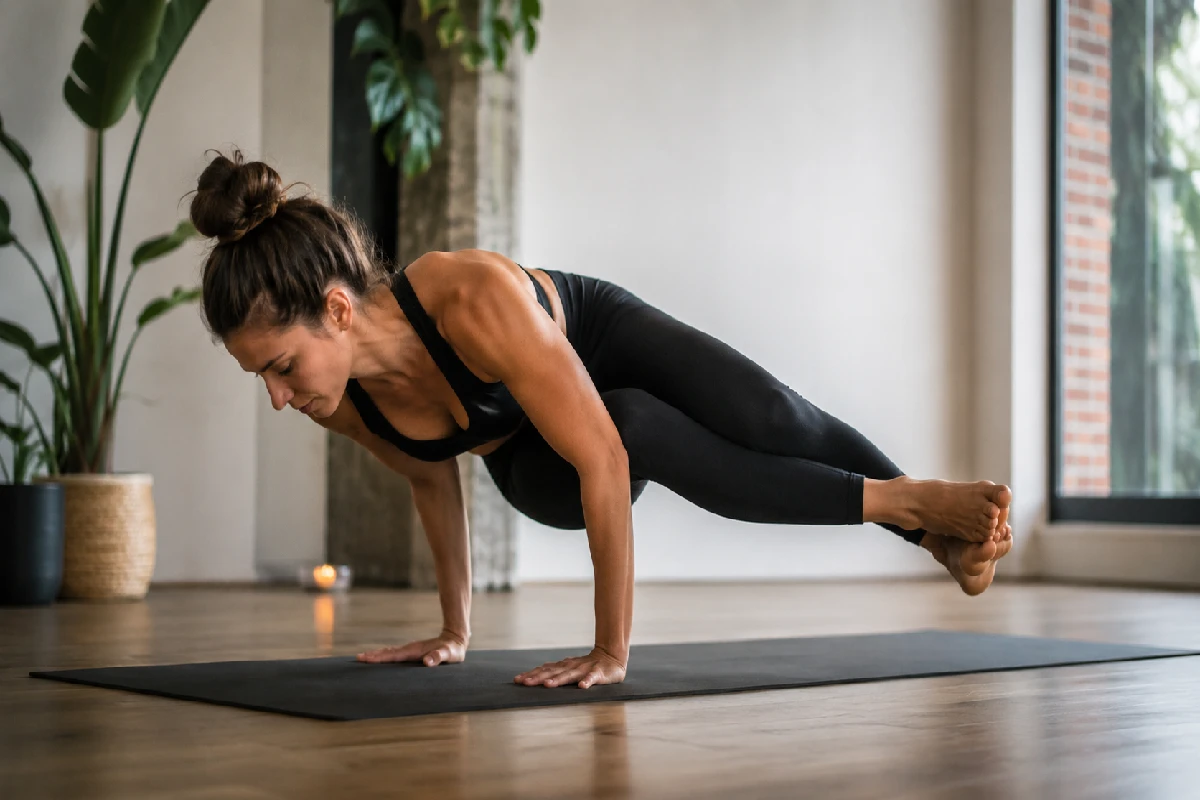
5. Eight-Angle Pose — Astavakrasana
Eight-Angle Pose is an advanced arm balance involving a combination of hip mobility, arm strength and core control.
The legs wrap around one arm while the body is lifted from the floor.
It can be especially difficult because the practitioner must coordinate several movements simultaneously.
Key requirements:
- Strong arms
- Active core
- Flexible hips
- Wrist stability
- Coordination
Learning simpler arm balances first can make the progression more manageable.
6. Firefly Pose — Tittibhasana
Firefly Pose is another demanding arm balance.
The hands support the body while the legs extend forward and outward. The pose requires substantial arm and core strength as well as enough hamstring and hip flexibility to position the legs correctly.
Although it looks primarily like a strength pose, flexibility also plays an important role.
7. Peacock Pose — Mayurasana
In Peacock Pose the body needs to be balanced horizontally on the forearms and hands with legs extended.
It puts a great demand on the wrists, arms, shoulders and the core.
The posture also requires body awareness because the centre of gravity is very different from that of ordinary standing yoga poses.
This is not one of the hardest yoga poses for beginners to attempt immediately. Beginners should first build wrist and upper-body strength through simpler movements.
8. Crow Pose — Bakasana
Crow Pose Some people refer to it as a gateway into arm balances, but it still poses a challenge for some beginner Yogi’s! This difficulty is found when moving your balance from your feet to your hands.
Crow can help develop skills needed for more advanced arm balances.
Common requirements:
- Wrist strength
- Arm stability
- Core engagement
- Balance
- Confidence
A controlled approach is more useful than repeatedly jumping into the posture.
9. Side Crow — Parsva Bakasana
Side Crow adds a rotational component to the traditional crow pose.
The feet point down to the right, while the torso rotates and balances off to the left. Upper body strength, core stability and mindful spine rotation help you balance here.
Practitioners often find the twisting component more difficult than standard crow.
10. Head-to-Foot Pose — Dwi Pada Sirsasana
Dwi Pada Sirsasana is an extremely challenging pose that demands a very significant level of hip flexibility and range of motion of the hamstrings. The feet circle around the head but the body is held in position. This pose is an excellent illustration that one should never, ever force flexibility.
11. Lotus Pose — Padmasana
“This posture can appear more straightforward than headstands, forearm balances and arm balancingposes but full lotus poses are quite challenging for people with less mobilehips.
The knees should not be forced down. Ideally, the movement should come primarily from the hips rather than twisting the knees into position.
For some practitioners, full lotus may not be anatomically comfortable or appropriate.
That is flawlessly normal.
Yoga is not a competition, and not every practitioner needs to achieve every posture.
12. Compass Pose — Parivrtta Surya Yantrasana
Compass Pose syndicates a deep sat stretch with spinal rotation and leg extension.
It requires flexibility through the hamstrings, hips and shoulders.
The pose becomes particularly stimulating when practitioners attempt to straighten the extended leg while maintaining an upright torso.
This is among the advanced yoga poses for flexibility that should be approached progressively.
13. Wheel Pose — Urdhva Dhanurasana
Wheel Pose is a demanding backbend that requires mobility and strength throughout the body.
The shoulders, wrists, spine, hips and legs all contribute to the posture.
A strong Wheel Pose requires more than simply bending the back. The legs and arms should actively support the body while the shoulders remain controlled.
Preparatory poses can include:
- Bridge Pose
- Cobra Pose
- Sphinx Pose
- Locust Pose
- Supported backbends
14. King Cobra Pose
King Cobra is an advanced backbend that goes beyond the range of a traditional cobra posture.
The deeper spinal extension requires considerable flexibility and strength.
Practitioners should avoid treating the lower back as the only source of movement. Proper preparation involves the shoulders, chest, hips and entire posterior chain.
15. Bird of Paradise — Svarga Dvijasana
Bird of Paradise combines standing balance, hip mobility, hamstring flexibility and upper-body control.
The practitioner binds the arms around one leg and then rises into a standing position while maintaining the leg lift.
This makes the pose particularly demanding because several skills must work together.
16. Flying Pigeon Pose
Flying Pigeon combines a pigeon-like leg position with an arm balance.
The posture requires:
- Hip mobility
- Arm strength
- Core stability
- Balance
- Concentration
It can be significantly more challenging than traditional pigeon pose because the hands must support most of the body’s weight.
17. Grasshopper Pose
Grasshopper is an advanced arm balance involving hip rotation and a twisting movement.
The legs extend to one side while the practitioner supports the body with the arms.
It is a good example of a pose where strength alone is not enough. Mobility and coordination are equally important.
18. Tortoise Pose — Kurmasana
- Tortoise pose You’ll need quite some mobility in the hips and hamstrings for this posture. Tortoise pose has the torso going forward, whereas the hands slide into the spaces between the legs. From the image you can think this is a relaxing resting pose, though the real depth this pose enables needs quite some mobility though. Gradually allow your hip openers to open rather than shoving legs or shoulders towards their destination.
19. Yoganidrasana
It’s also often known as sleeping-yogi-asana. This posture requires the highest level of flexibility of the hips to get the legs into such an extreme position without completely flailing out of control, of course. Generally speaking, a student that takes on this pose needs to have established extreme mobility, or has a hip that works to this extent.
20. Full Splits — Hanumanasana
Hanuman asana This pose is arguably the one that immediately jumps to mind when talking about a flexibility-centric pose. Your legs stretch apart in opposite directions so demands a high degree of motion in your hamstrings, hip flexers and all supporting tissue.
21. Standing Split Variation
A standing split takes the flexibility demand of a traditional split and adds balance.
The practitioner stands on one leg while extending the other leg upward.
It requires:
- Hamstring flexibility
- Hip mobility
- Leg strength
- Balance
- Core stability
Using a wall or blocks can provide useful support while learning the movement.
22. King Dancer Pose — Natarajasana
This is a standing balance integrated with a strong backbend. In King Dancer pose the practitioner stands on one leg supporting the pose, then holds the other foot and reaches up with the leg, keeping the opposite leg straight.
This pose demands excellent balance and good range of movement through your shoulders, hips and spine. Balance is key in this pose and proper breathing can have quite an impact.
23. Handstand Scorpion
This, as its name suggests, is a combination between two challenging skills – the handstand, and the backbend. The person supports them self on their hands, whilst simultaneously bringing their legs towards their head.
This is far harder than the ordinary handstand, on account of the shifting centre of gravity.
It should be approached only after developing reliable handstand control and adequate mobility.
24. Lotus in Handstand
A handstand with the legs arranged in lotus combines inversion, balance, hip mobility and body control.
The challenge is not simply getting upside down. The practitioner must maintain stability while changing the position of the legs.
This is a good example of an advanced posture that combines several skills rather than relying on one physical quality.
25. One-Handed Handstand
The one-handed handstand is among the most difficult yoga locations.
Instead of distributing body weight between two hands, the practitioner must balance almost entirely through one arm.
It requires exceptional:
- Shoulder stability
- Wrist and hand control
- Core strength
- Balance
- Coordination
- Concentration
This is not a pose to rush towards. Although you will be the most in Control during Two-Handed Handstands by definition, you will still need many, many hours of practice to reach such high Control. Strong core muscles provide the stability needed for many advanced balancing and arm-supported postures. Explore our Core-Intensive Yoga Poses.
What Makes Advanced Yoga Poses So Difficult?
The hardest yoga poses usually combine several physical and mental demands.
Strength
Arm balances and inversions require considerable strength in the shoulders, arms and core.
Flexibility
Deep backbends, splits and hip-opening positions require an appropriate range of motion.
Balance
Overturns and standing equilibria need constant small changes to have the body steady.
Mobility
Flexibility and mobility are related but different. Mobility involves having usable movement through a joint while maintaining control.
Coordination
Some difficult yoga positions require several body parts to perform different actions at the same time.
Concentration
Advanced postures can be mentally demanding. Losing focus for a moment can affect balance and technique.
Difficult Yoga Poses vs. Advanced Yoga Poses
Generally, the word is interchangeable, though, it can be helpful to consider this difference –
“Difficult” poses the term means a yoga pose that can be a challenge to specific individual. Advanced poses refer to postures which typically need more technical ability/ strength, experience or mobility.
The level of poses doesn’t mean to say the postures automatically become impressive “advanced” when practitioners see them being performed.
A beginner who has bendy hips might consider a basic seated leg stretches really easily while a strength-focused expert might find it more of a challenge.
Your individual starting point matters. Building toward difficult yoga poses requires gradual progression and proper technique development. Discover step-by-step methods in our Yoga Pose Progressions.
Are the Hardest Yoga Poses Suitable for Beginners?
Usually, beginners should not start with the most problematic yoga poses.
There will be basic poses someone in need of yoga fundamentals to further your advanced poses 11 Such as:
- Mountain Pose
- Child’s Pose
- Cat-Cow
- Downward-Facing Dog
- Low Lunge
- Warrior I
- Warrior II
- Bridge Pose
- Plank
- Cobra Pose
This practice allows to promote stability, strengthen your abilities, mobile and be aware of you.
So, the words biggest (hardest)yoga positionsfor a beginner is misleading. You must devote less effort to mastering the most difficult postures and more to building the foundation of yoga positions that can advance safely.
How to Prepare for Difficult Yoga Positions
Before trying challenging yoga poses, consider building a organized foundation.
1. Warm Up Properly
Start with gentle movement before attempting intense stretches, inversions or backbends.
A warm-up can include:
- Cat-Cow
- Shoulder circles
- Hip circles
- Gentle lunges
- Wrist movements
- Sun Salutations
2. Build Core Strength
A strong core helps stabilise the body during arm balances and inversions.
Useful exercises include:
- Planks
- Side planks
- Dead bugs
- Boat Pose
- Hollow-body holds
3. Strengthen Your Wrists and Shoulders
The 7 best yoga handstand posture tips #2 Put most of your weight on your hands. Start out slowly build your strength in the wrists, forearms, and shoulders before you hold a deep pose for a longer amount of time.
4. Improve Flexibility Gradually
If your goal is advanced yoga poses for flexibility, consistency is more useful than aggressive stretching.
Avoid bouncing or forcing your body beyond its comfortable range.
5. Use Props
Yoga blocks, straps, bolsters and walls can help make difficult postures more accessible.
Props are not signs of weakness. They can help practitioners understand alignment and develop strength safely.
Common Mistakes When Attempting Hardest Yoga Poses
Trying advanced postures without preparation can create unnecessary problems.
Forcing flexibility
Pushing aggressively into a stretch does not guarantee faster progress.
Ignoring pain
A difficult pose may feel challenging, but sharp or unusual pain is a reason to stop and reassess.
Skipping the warm-up
Cold muscles and joints may not be ready for extreme ranges of motion.
Comparing yourself with others
People have different anatomy, experience levels and mobility.
Chasing the final shape
The process of developing strength and control is more important than simply reaching the final position.
Holding your breath
Breathing should remain controlled. If you are repeatedly holding your breath to maintain a pose, the posture may currently be beyond your sustainable level.
How Long Does It Take to Master Difficult Yoga Poses?
There is no universal timeline.
One person might develop a handstand relatively quickly, while another may need months or years of practice.
Factors that influence progress include:
- Previous exercise experience
- Current strength
- Mobility
- Body awareness
- Consistency
- Training technique
- Individual anatomy
- Quality of instruction
The ‘Pain’ Poses 3 reasons: Some poses may just not feel ‘right’ for some people for anatomical reasons; not necessarily because your practice is unsuccessful.
A Beginner-to-Advanced Yoga Progression
Instead of immediately attempting the hardest yoga poses, consider progressing through stages.
| Level | Focus | Example poses |
| Beginner | Movement and awareness | Mountain, Child’s Pose, Cat-Cow |
| Foundation | Strength and mobility | Plank, Warrior poses, Bridge |
| Intermediate | Balance and control | Crow, Half Moon, Wheel |
| Advanced | Strength + flexibility | Forearm Stand, Firefly, King Pigeon |
| Highly advanced | Complex combinations | Handstand Scorpion, One-Handed Handstand |
The exact progression will vary depending on your goals and experience.
Benefits of Practising Challenging Yoga Poses
Advanced yoga practice can offer several potential benefits when approached appropriately.
Improved Body Awareness
Complex postures require careful attention to alignment, breathing and movement.
Better Balance
Inversions and standing balances can challenge your ability to control the body’s centre of gravity.
Greater Strength
Arm balances and inversions can develop strength throughout the upper body and core.
Increased Mobility
Reliable mobility-focused practice can help recover usable range of motion.
Mental Focus
Some postures require concentration, tolerance for discomfort, but in order to receive real benefits from this practice you don’t have to master difficult postures, many beginner and intermediate poses are more than enough.
Safety Tips for Difficult Yoga Poses
Safety should come before achieving an impressive-looking posture.
Keep these principles in mind:
- Learn proper technique before increasing difficulty.
- Warm up before intense practice.
- Progress gradually.
- Use props when appropriate.
- Avoid forcing joints into uncomfortable positions.
- Stop if you experience sharp or unusual pain.
- Practise inversions in an appropriate environment.
- Consider learning advanced postures with a qualified yoga teacher.
- Give your body enough recovery time.
- Do not comparison your progress with additional person’s practice.
Pre-existing physical conditions, medical or any other injuries should be reviewed with appropriate health and professional advice before undertaking any strenuous activity.
Frequently Asked Questions
What are the most difficult yoga poses?
A few common advanced positions include the one-handed handstand, forearm stands, King Pigeon pose, scorpions pose, handstand scorpions, peacock pose, advanced arm-balancing, and the full splits poses. The difficulty of doing any of these poses will depends entirely upon which one of us try poses are on their to do or what and it’s not easy or it hard poses to perform.
What is the toughest yoga pose?
While the hardest yoga poses vary from individual to individual, a few common contenders for this title include the one-handed handstand, challengingscorpion pose and intricatearm balances – a few well deserving options when you consider how much strength, control, flexibility and balance is needed.
What is the hardest yoga poses for beginners?
For beginners, advanced poses are typically not the goal – not from the first or second day, anyway. When You Have Gained a basis of Strength, Balance, and Suppleness with basic Yoga Exercises more challenging yoga actions come naturally.
Which yoga poses require the most suppleness?
Back to Basics: Openers for Hips, Spine, and Beyond: Back Bends Split Position divides hip openers Backbends splits positions Need more knee flexibility! King pigeon Behind-The-Knee poses: [asana]s This Asana could improve a knee problem king pigeon A pose where both legs are up Yoganidrasasana Back to Basics.
Can beginners learn advanced yoga poses?
Absolutely, a beginner has every capacity to work towards those more advanced positions but do that slowly! A good base of strength, flexibility, balance, and technique to start.
How can I improve at difficult yoga poses?
Practice consistently. Practice the muscles that help with this shape gradually strengthen over time. Learn the mechanics of the pose and not simply trying to snap into this shape with your body through force. Work and breathe into your stretch and utilize props to help.
Are difficult yoga poses better than basic poses?
No, I do not believe advanced poses are superior. Simpleposes can be enormously useful for teaching strength, mobility,Balance and awareness of breath and movement. Recovery practices help reduce fatigue, improve flexibility, and support long-term yoga progress. Learn more in our Yoga Recovery Guide.
Final Thoughts
However daunting complicated poses can be to advanced practitioners it’s not necessary to simply seek the hardest postures out there. If you’re striving for an advanced level with your yoga practice, be patient. Deep backbends, high handstands, balance moves, or ridiculously complex flexibility challenges aren’t usually masters in one day.
When training for advanced yoga stances take a step back first and concentrate on building your basics: flexibility, balance, core body awareness, breath awareness and strength.
Do build up step-by-step, apply modifications wherever they’re required and heed your physical restrictions. Remember you aren’t competing against anyone else’s strength, mobility or balance. Best improvements usually come through enhanced control, control, and confidence.