
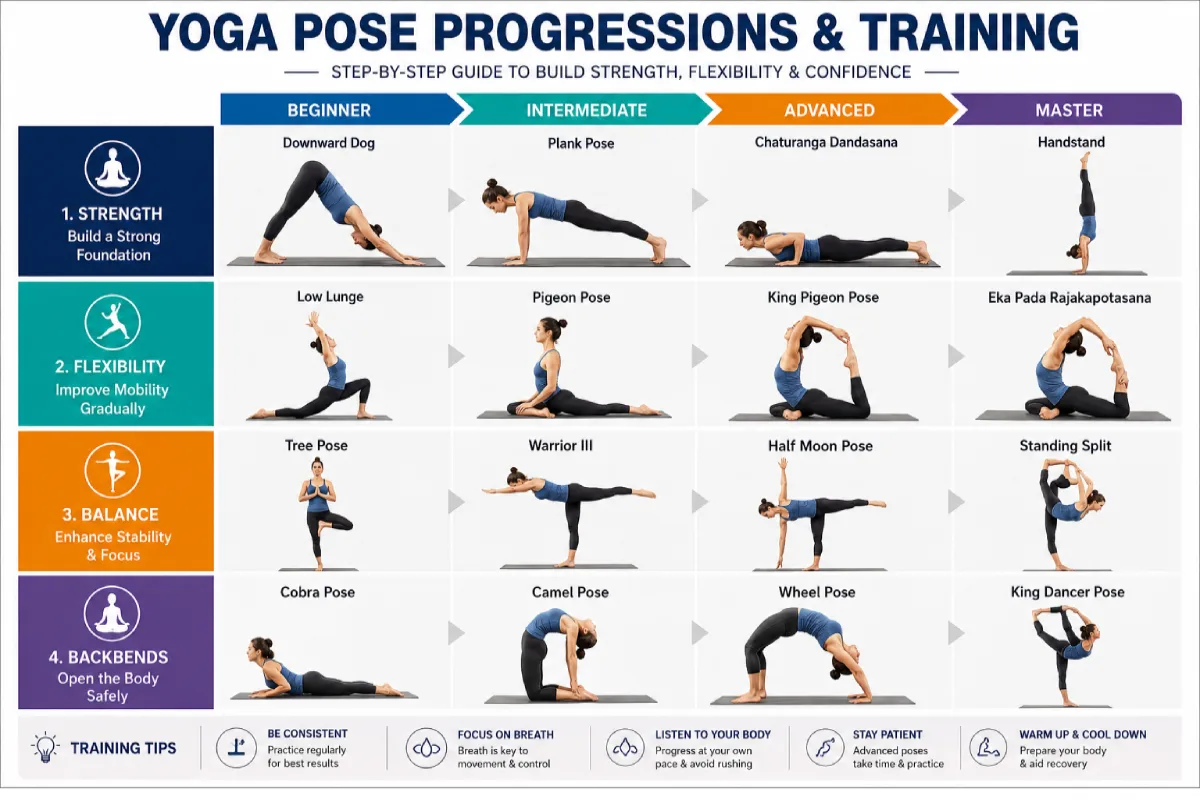
Yoga is often seen as a road, not a quick stop. Many people start with poses. Long‑term improvement however comes from following Yoga Pose Progressions and Training methods. Yoga progression lets you slowly build strength, flexibility, balance and control before you try poses.
If your aspiration is arm balances, deeper backbends, inversions or simply to move with more ease knowing the proper Yoga progression will help you reach your goals with ease and safety. Before attempting advanced movements, it’s helpful to understand the full range of difficult yoga poses and the skills required to perform them safely.
What Is Yoga Pose Progression?
A yoga progression is the process you follow to ease into challenging poses through a series of less challenging ones. You create the proper physical and technique base to eventually be able to perform the fully advanced posture without pushing yourself too hard too soon.
Examples include:
- Moving from Downward Dog to Handstand preparation
- Progressing from Low Lunge to Full Splits
- Building from Bridge Pose toward Wheel Pose
- Advancing from Crow Pose to Side Crow
This approach allows gradual adaptation while improving long-term results.
Why Progressive Yoga Training Matters
Many injuries occur when people attempt advanced postures before developing sufficient mobility or strength.
Benefits of structured progression include:
- Improved flexibility
- Better joint stability
- Enhanced body awareness
- Reduced injury risk
- Sustainable skill development
- Greater confidence during practice
The progressive nature also encourage the practitioner to not only concentrate on his or her flexibility, but on what’s physically necessary to create such movements. The systematic progression could lead the student to slowly strengthen up his or hers balance and flexibility to for advanced yoga poses.
Understanding the Stages of Yoga Development
| Stage | Focus Area | Typical Goals |
| Beginner | Alignment and breathing | Learn foundational poses |
| Early Intermediate | Strength and mobility | Improve transitions |
| Intermediate | Balance and endurance | Hold poses longer |
| Advanced | Skill development | Master challenging postures |
| Expert Practice | Refinement | Improve control and efficiency |
Progress through these stages varies by individual. However some may be making rapid progress in balance poses but a slower progress when it comes to flexibility.
Yoga Flexibility Progression: Building Mobility Safely
Key Areas to Improve
Hamstrings
Important for:
- Forward folds
- Splits
- Standing balances
Helpful poses:
- Standing Forward Fold
- Pyramid Pose
- Half Splits
Hip Mobility
Essential for:
- Lotus variations
- Deep lunges
- Pigeon Pose
Helpful poses:
- Butterfly Pose
- Lizard Pose
- Pigeon Pose
Shoulder Mobility
Supports:
- Backbends
- Arm balances
- Inversions
Helpful poses:
- Puppy Pose
- Thread the Needle
- Dolphin Pose
Spine Mobility
Improves:
- Twists
- Backbends
- Overall movement quality
Helpful poses:
- Cat-Cow
- Cobra
- Sphinx Pose
Advanced Yoga Training: Preparing for Challenging Poses
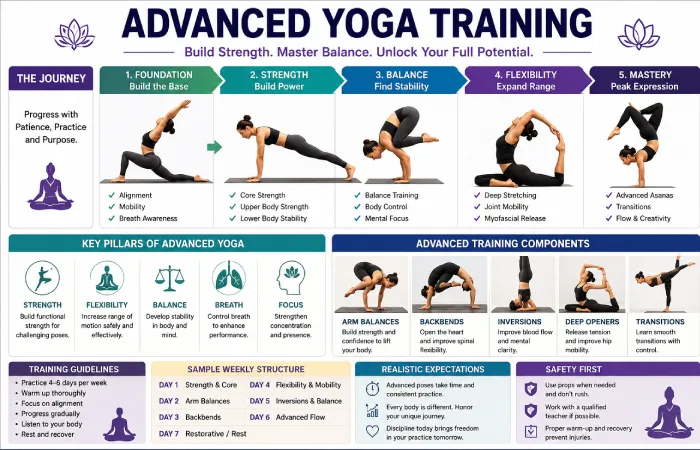
Many practitioners eventually become interested in advanced yoga training. However, advanced poses typically require a combination of:
- Strength
- Flexibility
- Balance
- Coordination
- Breath control
Examples of Advanced Poses
| Pose | Primary Requirement |
| Handstand | Shoulder strength |
| Forearm Stand | Core control |
| Wheel Pose | Spinal mobility |
| King Pigeon | Hip flexibility |
| Flying Pigeon | Balance and strength |
| Eight Angle Pose | Core stability |
How to Learn Difficult Yoga Poses
Many students wonder how to learn difficult yoga poses without becoming frustrated.
A practical approach includes:
- Master Prerequisite Poses
Before attempting a Handstand:
- Plank
- Dolphin
- Downward Dog
- Crow Pose
Before attempting Wheel Pose:
- Bridge Pose
- Cobra
- Camel Pose
- Break Skills Into Components
Complex poses can be divided into smaller skills.
For example, Handstand training involves:
- Shoulder mobility
- Core engagement
- Wrist conditioning
- Wall-supported practice
- Increase Training Volume Gradually
Rather than practising advanced poses daily, increase training gradually.
- Two skill sessions weekly
Week 3–4:
- Three sessions weekly
Week 5–8:
- Three to four sessions weekly
Advanced Yoga Practice: Strength and Stability Development
Flexibility on its own is almost never the most essential thing for a complex yoga session.
Strength building exercises Modern Yoga Training has made its case very widely.
Important Strength Areas
Core Strength
Supports:
- Arm balances
- Inversions
- Stability
Exercises:
- Boat Pose
- Forearm Plank
- Hollow Body Hold
Shoulder Strength
Supports:
- Handstands
- Crow Pose
- Forearm Stand
Exercises:
- Dolphin Push-Ups
- Plank Variations
- Wall Walks
Leg Strength
Supports:
- Warrior series
- Standing balances
- Jump transitions
Exercises:
- Chair Pose
- Warrior III
- High Lunge Holds
Sample Yoga Progression Workflow
Beginner to Intermediate Training Plan
Step 1: Foundation Phase (Weeks 1–4)
Focus on:
- Breathing techniques
- Basic standing poses
- Core engagement
Step 2: Mobility Development (Weeks 5–8)
Focus on:
- Hip opening
- Hamstring flexibility
- Shoulder mobility
Step 3: Strength Building (Weeks 9–12)
Focus on:
- Planks
- Balance training
- Controlled transitions
Step 4: Skill Training (Weeks 13–16)
Focus on:
- Arm balances
- Backbend progression
- Inversion preparation
Step 5: Advanced Integration (Week 17+)
Focus on:
- Combining advanced movements
- Longer holds
- Refined technique
Beginner vs Advanced Yoga Training
| Feature | Beginner Yoga | Advanced Yoga Training |
| Session Focus | Learning basics | Skill mastery |
| Pose Complexity | Low | High |
| Strength Requirement | Moderate | Significant |
| Flexibility Demand | Moderate | High |
| Injury Risk | Lower | Higher if rushed |
| Training Frequency | 2–3 sessions weekly | 4–6 sessions weekly |
| Recovery Needs | Moderate | Higher |
Common Progression Mistakes
Many practitioners experience plateaus because of avoidable errors.
Skipping Foundations
When you find yourself pushing for more difficult positions before mastering basics, it can be an inhibiting practice in the long run.
Training Flexibility Only
Mobility without strength can create instability.
Ignoring Recovery
Recovery allows muscles and connective tissues to adapt.
Comparing Yourself to Others
Yoga progression varies significantly between individuals due to:
- Age
- Training history
- Mobility levels
- Body proportions
Improving flexibility through progressive training can make demanding mobility-based yoga poses more accessible.
Realistic Expectations for Yoga Progress
A balanced perspective is important.
- What You May Notice Within 4–8 Weeks
- Improved mobility
- Better balance
- Increased confidence
- Better posture awareness
2. What May Take Several Months
- Splits progress
- Strong arm balances
- Deep backbends
3. What Often Takes a Year or More
- Stable Handstand
- Advanced inversions
- Complex transitions
Consistent practice generally delivers better results than aggressive training schedules. Developing core stability through gradual progression is essential for mastering many core-intensive yoga poses.
Recovery and Training Frequency
Recovery plays a major role in successful progression.
Recommended weekly structure:
| Day | Activity |
| Monday | Strength-focused yoga |
| Tuesday | Mobility work |
| Wednesday | Recovery flow |
| Thursday | Skill practice |
| Friday | Strength session |
| Saturday | Longer practice |
| Sunday | Rest or gentle stretching |
This balance helps reduce overuse issues while supporting adaptation.
Who Benefits Most from Yoga Pose Progressions?
Structured progression can benefit:
- Beginners seeking long-term improvement
- Intermediate practitioners reaching plateaus
- Athletes improving mobility
- Fitness enthusiasts developing body control
- Older adults maintaining movement quality
The approach can be adapted to nearly any fitness level.
Limitations of Yoga Progression Training
Although progression is effective, it has limitations.
- Results vary between individuals
- Flexibility improvements may be gradual
- Certain advanced poses may not suit everyone
- Recovery requirements increase as training intensity rises
- Some anatomical differences affect pose accessibility
Understanding these limitations helps maintain realistic expectations. Proper yoga recovery techniques can help reduce soreness and support consistent progress when learning advanced postures.
Conclusion
The Yoga Pose Progressions & Training’s focus on the “on going” development provides tools for the building offlexibility, strength, balance and confidence over time. Of trying to get to hard postures too quickly people often get better results by learning the basic movements first moving step, by step and giving the body enough time to rest and recover.
If your aim is to improve how your body moves, to learn how to do inversions or to take your yoga practice to a level, a regular and patient way of practicing is one of the best ways to stay successful over the long term.