
Introduction
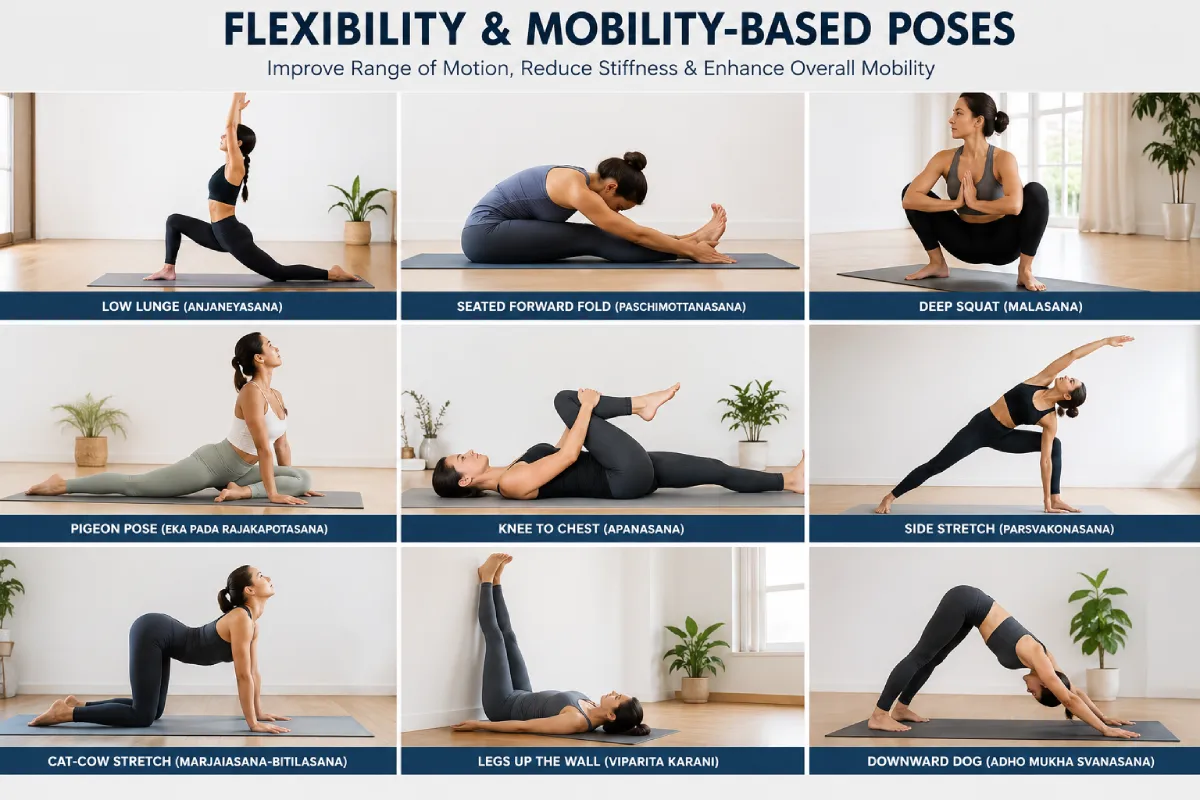
Flexibility and mobility are talked about a lot. They are not the same thing. Flexibility is about how a muscle can stretch. Mobility is about how well a joint can move. When we do flexibility and mobility poses we are working on both of these things. This helps us move better feel less stiff and our bodies work overall.
If you are just starting out and want to touch your toes or if you are really good, at yoga and want to do flexibility poses you need to take a balanced approach. Doing these exercises all the time can help you stand up straight do sports better. Feel comfortable every day. Mobility is a key requirement for many challenging yoga postures that demand flexibility, balance, and body control. Explore our Difficult Yoga Poses to discover advanced movements that benefit from improved mobility.
What Are Flexibility & Mobility-Based Poses?
Yoga postures are great for our bodies. They help our muscles and the tissues that connect them. Yoga postures also help our joints. When we do yoga postures that focus on flexibility and mobility it is really good for us. We can move better. Have a better range of motion. Yoga postures are good, for our muscles and our joints. They usually include exercises that get us moving stretches that we hold still and slow movements from one pose to another. All these things help our body learn how to move in a way. Postures which demand equilibrium, balance and flexibility are also important as they affect our movement and range of movement.
Why Flexibility and Mobility Matter
Improved mobility supports:
- Better posture
- Easier daily movement
- Enhanced athletic performance
- Improved balance and coordination
- Reduced feelings of stiffness
- More efficient movement patterns
Flexibility can contribute to mobility, but strength and control are equally important. A highly flexible body without stability may still experience movement limitations. Many advanced yoga postures require exceptional hip, shoulder, and spinal mobility to achieve proper alignment. Learn more in our Advanced Yoga Poses Guide.
Understanding the Difference Between Flexibility and Mobility
| Flexibility | Mobility |
| Ability of muscles to lengthen | Ability of joints to move freely |
| Focuses on soft tissues | Involves muscles, joints and nervous system |
| Often improved through stretching | Improved through movement and strength |
| Passive ability | Active ability |
Core Flexibility & Mobility-Based Poses for Beginners
Cat-Cow Pose
Cat-Cow improves spinal mobility and increases awareness of spinal movement.
Benefits:
- Mobilises the spine
- Improves posture awareness
- Gently warms up the body
Child’s Pose
A restorative stretch that encourages flexibility through the hips, back and shoulders.
Benefits:
- Promotes relaxation
- Lengthens the lower back
- Supports hip mobility
Downward-Facing Dog
One of yoga’s most recognised poses for full-body flexibility.
Benefits:
- Stretches calves and hamstrings
- Improves shoulder mobility
- Strengthens upper body stability
Low Lunge
Low Lunge targets the hip flexors, which commonly become tight from prolonged sitting.
Benefits:
- Opens the hips
- Improves lower-body mobility
- Encourages better posture
Seated Forward Fold
This posture focuses on the posterior chain.
Benefits:
- Improves hamstring flexibility
- Encourages spinal lengthening
- Develops patience in stretching practice
Mobility and core strength often work together to create stability and control in advanced yoga positions. Read our Core-Intensive Yoga Poses.
Intermediate Mobility Progression
Once the basic movement gets better doctors can start adding intense stretches and slow careful actions. Once the basic movement gets better doctors can start adding intense stretches and slow careful actions.
Pigeon Pose
An effective posture for hip mobility.
Benefits:
- Targets glutes and hips
- Improves external hip rotation
- Supports lower-body flexibility
Lizard Pose
Lizard Pose creates a deeper hip-opening experience.
Benefits:
- Stretches hip flexors
- Improves groin flexibility
- Encourages lower-body mobility
Garland Pose
Garland Pose develops ankle, hip and knee mobility simultaneously.
Benefits:
- Supports deep squatting ability
- Improves lower-body movement quality
- Strengthens postural control
Advanced Flexibility Yoga Poses
Doing yoga poses like flexibility yoga poses needs to be done at the right time. You have to get ready and be strong and able to move. If you try to do flexibility yoga poses soon you might get hurt. Flexibility yoga poses are not easy. You have to be careful when you do them.
Bird of Paradise
Benefits:
- Challenges balance
- Improves hamstring flexibility
- Develops hip mobility
Requirements:
- Strong hamstring flexibility
- Hip mobility
- Good balance control
Standing Split
Benefits:
- Enhances lower-body flexibility
- Improves balance
- Strengthens supporting leg
Compass Pose
Benefits:
- Deep lateral body stretch
- Advanced hamstring flexibility
- Increased hip mobility
Difficult Yoga Poses for Flexibility
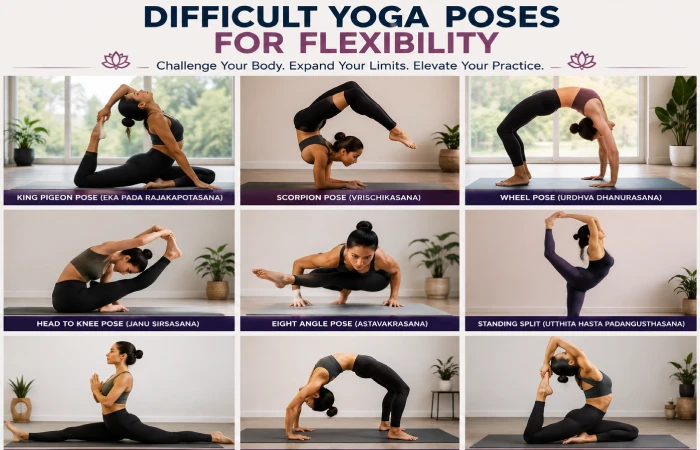
Some difficult yoga poses for flexibility demand years of gradual practice.
King Pigeon Pose
A challenging posture requiring:
- Shoulder mobility
- Spinal flexibility
- Hip opening
Yogi Dancer Pose
This pose combines flexibility, balance and strength.
Benefits:
- Develops spinal extension
- Enhances quadriceps flexibility
- Improves coordination
Extreme Forward Fold Variations
These advanced positions require careful progression and should never be forced.
Advanced Hip Opening Yoga Practices
Hip mobility plays an important role in many yoga traditions.
Dragon Pose
Benefits:
- Deep hip flexor stretch
- Improved lower-body mobility
- Increased movement awareness
Double Pigeon Pose
Benefits:
- Targets external hip rotation
- Improves sitting comfort
- Supports advanced yoga progression
Frog Pose
Benefits:
- Opens inner thighs
- Improves groin flexibility
- Encourages mobility development
Hip Mobility Workflow
- Begin with Cat-Cow
- Move into Low Lunge
- Practise Lizard Pose
- Progress to Pigeon Pose
- Finish with Frog Pose
- Cool down in Child’s Pose
Deep Backbend Yoga Progression
Deep backbend yoga postures require gradual preparation and balanced strength.
Cobra Pose
Ideal starting point for backbend development.
Camel Pose
Builds spinal extension and front-body flexibility.
Wheel Pose
An advanced backbend requiring:
- Shoulder mobility
- Thoracic spine mobility
- Core strength
King Pigeon Backbend Variation
Represents one of the more advanced backbend expressions.
Backbend Progression Table
| Beginner | Intermediate | Advanced |
| Cobra Pose | Camel Pose | Wheel Pose |
| Sphinx Pose | Bow Pose | King Pigeon |
| Bridge Pose | Full Bridge | Advanced Backbend Variations |
Stage 1: Hamstring Preparation
Focus on:
- Seated Forward Fold
- Standing Forward Fold
- Half Split
Stage 2: Hip Flexor Development
Include:
- Low Lunge
- Crescent Lunge
- Lizard Pose
Stage 3: Supported Split Work
Use blocks and props to safely explore deeper ranges.
Stage 4: Full Split Attempts
Attempt only after developing sufficient flexibility and mobility.
Sample Weekly Flexibility & Mobility Routine
1 Day
- Cat-Cow
- Child’s Pose
- Downward Dog
- Low Lunge
2 Day
- Pigeon Pose
- Garland Pose
- Seated Forward Fold
3 Day
Recovery and gentle mobility work
4 Day
- Camel Pose
- Lizard Pose
- Frog Pose
5 Day
Yoga splits progression practice
Day 6
Full-body mobility session
Day 7
Active recovery
What Results Can You Realistically Expect?
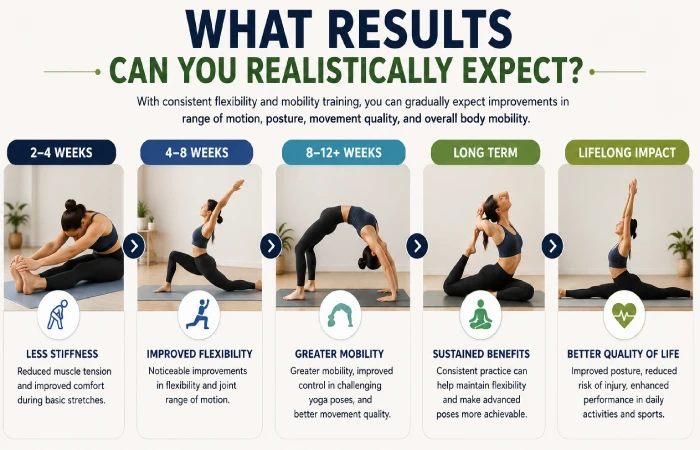
After 2–4 Weeks
Possible improvements:
- Reduced stiffness
- Better movement awareness
- Increased comfort in basic poses
After 2–3 Months
Potential improvements:
- Greater flexibility
- Improved balance
- Better mobility during daily activities
Long-Term Expectations
Consistent practice may support:
- Improved posture
- Enhanced movement quality
- Better overall body awareness
People are different when it comes to getting more flexible. The reason for this is that flexibility gains are not the same for everyone. This is because things like how old you’re your genetics how active you are and how often you train affect your flexibility. Better mobility can improve positioning and control during challenging inversions such as handstands and forearm stands. Explore our Inversion Poses Guide.
Benefits and Limitations
Benefits
- Improved mobility
- Better posture
- Enhanced movement efficiency
- Increased flexibility
- Greater body awareness
Limitations
- Results require consistency
- Progress may be gradual
- Advanced poses require supervision
- Individual mobility potential varies
Safety Considerations
To practise safely:
- Warm up properly
- Avoid bouncing stretches
- Respect pain signals
- Progress gradually
- Focus on controlled breathing
- Use props when needed
Remember that deeper is not always better. Focus is on range of motion with an emphasis on quality of movement, not sheer extent. Restoration methods assist with increasing mobility while preventing issues from developing that lead to mobility loss; they combat the problem of increased tightness. Explore our Yoga Recovery Guide.
Conclusion
Flexibility and mobility-based poses are a way to get our bodies moving better. We can improve how we move and stand up straight. There are stretches for people who are just starting out. There are also yoga poses that can help open up our hips and bend our backs. So everyone can find something that works for them.
The important thing is to keep doing the work. Doing a bit of the work every day is better, than trying really hard to do the work and getting hurt. You should just keep doing the work every day. If we are patient and do not expect much too soon we can get better at flexibility and mobility-based poses. We just need to do them the way. Then we can move around easily and feel better, in our bodies. Flexibility and mobility-based poses can really help us feel good physically.