
Introduction
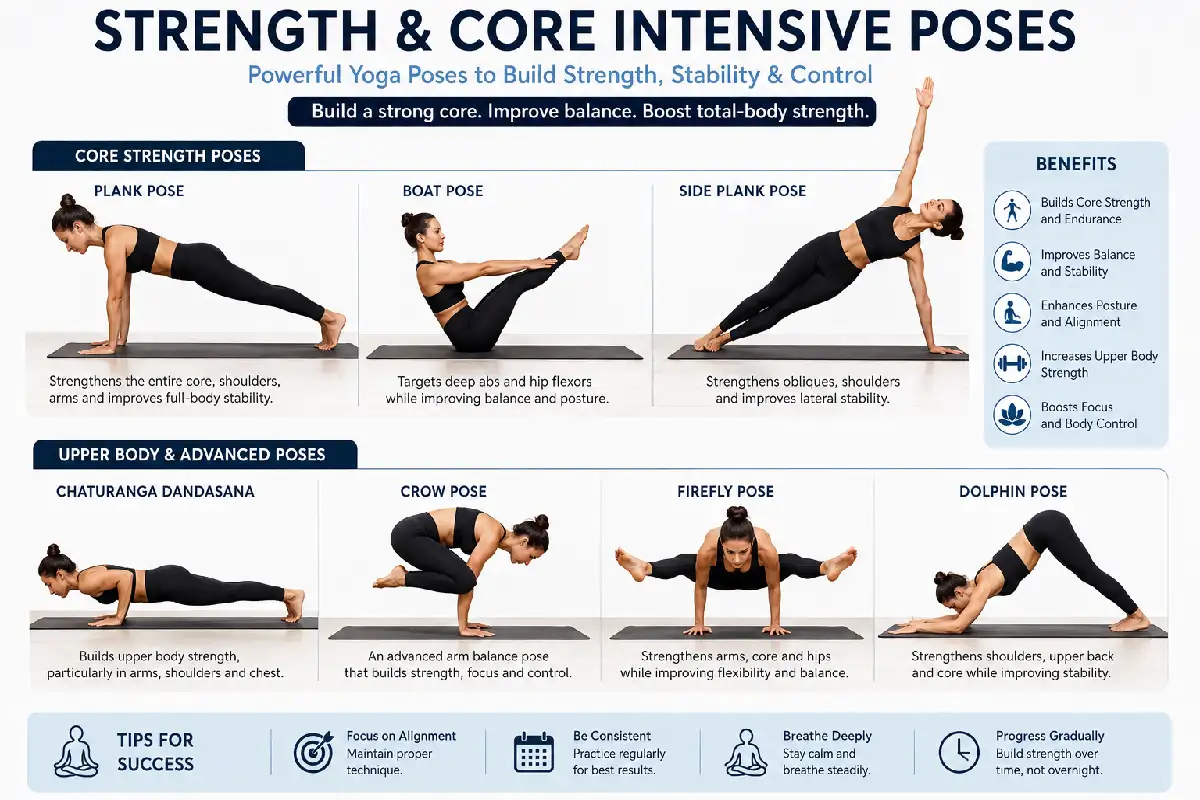
People start doing yoga to become more flexible. They also get some really great benefits from getting stronger and having better core stability. The Strength & Core Intensive Poses are really good at working muscle groups at the same time, which helps people build endurance, balance and a better sense of their body.
These poses are different from the exercises you do at the gym because they use your body instead of just one part. You have to use all of your muscles from your arms to your legs.
They can significantly contribute to practicing yoga in a safe and efficient way. Strength & Core Intensive Poses are really useful for people who want to improve their performance or just feel more comfortable, in their own body. Difficult Yoga Poses Guide to discover advanced movements that rely on strong core engagement.
What Are Strength & Core Intensive Poses?
Strength & Core Intensive Poses are yoga postures that require sustained muscular engagement, particularly through the:
- Abdominal muscles
- Obliques
- Lower back
- Shoulders
- Arms
- Glutes
- Hip stabilisers
These poses often involve supporting body weight, maintaining balance or controlling movement against gravity.
Primary Benefits
- Improved core stability
- Better posture and spinal support
- Increased muscular endurance
- Enhanced balance and coordination
- Stronger shoulders and arms
- Greater body awareness
Yoga Poses for Strength: Why They Matter
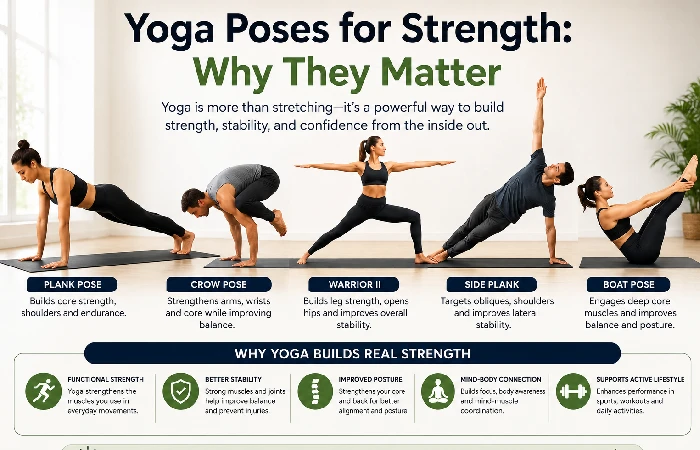
Yoga is different from lifting weights. Yoga uses your body weight and the way you move your body to make your muscles work hard. This helps you get strong in a way that’s useful for the things you do every day and, for playing sports. Yoga helps you build strength that you can actually use when you are doing things like yoga itself. Many advanced yoga postures demand exceptional core strength to maintain alignment and body control throughout the movement. Learn more in our Advanced Yoga Poses.
Key Strength Adaptations
| Benefit | How Yoga Helps |
| Core Strength | Constant stabilisation during poses |
| Shoulder Strength | Weight-bearing positions build endurance |
| Hip Stability | Single-leg balances activate stabilisers |
| Postural Control | Deep core engagement supports alignment |
| Functional Movement | Multiple muscle groups work together |
Foundational Strength & Core Intensive Poses
Plank Pose
Plank is one of the most effective full-body strengthening exercises in yoga.
Muscles Worked:
- Rectus abdominis
- Transverse abdominis
- Shoulders
- Chest
- Quadriceps
Forearm Plank
Forearm plank increases core demand while reducing wrist pressure.
Benefits include:
- Improved abdominal endurance
- Enhanced shoulder stability
- Better spinal support
Boat Pose (Navasana)
Boat Pose directly targets the core while improving balance.
Key focus areas:
- Deep abdominal muscles
- Hip flexors
- Lower back stabilisers
Advanced Core Yoga for Experienced Practitioners
Advanced core yoga poses require body awareness, movement and strength.
These postures should only be tried after building basic stability.
Side Plank (Vasisthasana)
Side Plank challenges:
- Obliques
- Shoulder stabilisers
- Glute medius
- Hip muscles
Benefits include improved lateral stability and stronger shoulder support.
Dolphin Pose
The Dolphin Pose strengthens the entire upper body as well as providing for the inversions.
Primary muscles involved:
- Deltoids
- Triceps
- Upper back
- Core stabilisers
Hollow Body Variations
Building on a gymnastic skill, the hollow body hold develops your ability to create full body tension.
Benefits include:
- Better arm balances
- Improved inversions
- Enhanced core endurance
Yoga for Upper Body Strength
Good upper body strength can be required for arm balancing, inversions and the more advanced sequences in yoga
Chaturanga Dandasana
Often called yoga’s push-up, Chaturanga develops:
- Chest strength
- Triceps endurance
- Shoulder stability
- Core control
Upward Facing Dog
Although often seen as a back bend, in fact it’s a pose that uses so much of the body – especially the upper-body muscles.
Benefits include:
- Stronger shoulders
- Improved spinal extension
- Better posture
Dolphin Push-Ups
The stronger the hold becomes, so does the strength required. The increase in shoulder flexibility is also of benefit. The core strength stabilizes the body through handstands, headstands, and inversions. Explore our Inversion Poses.
Yoga Arm Strength Development
Yoga arm strength improves through gradual exposure to weight-bearing postures.
Recommended Progression
| Level | Pose |
| Beginner | Plank |
| Beginner-Intermediate | Side Plank |
| Intermediate | Dolphin Pose |
| Intermediate | Crow Preparation |
| Advanced | Crow Pose |
| Advanced | Firefly Pose |
These arm and shoulder control exercises, once practiced regularly, you should soon notice the difference!
Difficult Yoga Poses for Strength
Some poses represent advanced strength milestones within yoga practice.
Crow Pose (Bakasana)
Crow Pose develops:
- Arm strength
- Core activation
- Balance
- Focus
Firefly Pose (Tittibhasana)
Firefly Pose requires:
- Strong shoulders
- Active core engagement
- Hamstring flexibility
- Body control
Eight-Angle Pose
This arm balance challenges multiple systems simultaneously.
Muscles involved include:
- Obliques
- Triceps
- Hip flexors
- Adductors
Forearm Stand
Forearm Stand combines inversion training with significant upper-body strength requirements.
Combining mobility with core stability can improve posture control and movement efficiency in advanced yoga practice. Read our Mobility-Based Yoga Poses.
Strength & Core Intensive Poses Comparison Table
| Pose | Core Demand | Upper Body Demand | Balance Requirement | Difficulty |
| Plank | High | Moderate | Low | Beginner |
| Boat Pose | High | Low | Moderate | Beginner |
| Side Plank | High | High | Moderate | Intermediate |
| Dolphin Pose | Moderate | High | Low | Intermediate |
| Crow Pose | High | High | High | Advanced |
| Firefly Pose | Very High | Very High | High | Advanced |
A Practical Weekly Strength-Building Yoga Workflow
Day 1: Core Focus
- Plank
- Forearm Plank
- Boat Pose
- Side Plank
Day 2: Upper Body Focus
- Dolphin Pose
- Chaturanga Practice
- Upward Facing Dog
Day 3: Balance Focus
- Tree Pose
- Side Plank
- Crow Preparation
Day 4: Recovery
- Gentle mobility work
- Hip openers
- Light stretching
Day 5: Advanced Practice
- Crow Pose
- Firefly Preparation
- Hollow Body Holds
Day 6–7: Active Recovery
- Walking
- Gentle yoga flow
- Breathing exercises
What Results Can You Realistically Expect?
Realistic outcomes depend on:
- Training consistency
- Current fitness level
- Recovery quality
- Nutrition habits
Typical Progress Timeline
| Time Period | Potential Improvements |
| 2–4 Weeks | Better body awareness |
| 4–8 Weeks | Improved plank endurance |
| 8–12 Weeks | Stronger shoulders and core |
| 3–6 Months | Progress towards arm balances |
| 6+ Months | Greater overall strength and control |
Individual results will vary. Building core strength gradually through progressive training can help prepare you for more demanding yoga positions. Learn more in our Yoga Pose Progressions
Common Mistakes to Avoid
Relying on Momentum
Controlled movement is more effective than rushing through transitions.
Neglecting Core Engagement
Many practitioners focus only on arms while ignoring abdominal activation.
Advancing Too Quickly
Difficult yoga poses for strength require preparation and patience.
Ignoring Recovery
Muscles adapt during recovery periods, not only during training.
Who Should Practise Strength & Core Intensive Poses?
These poses may be suitable for:
- Yoga practitioners seeking progression
- Athletes wanting better stability
- Individuals improving posture
- People interested in functional fitness
Who Should Use Caution?
Consult a qualified healthcare professional before attempting advanced poses if you have:
- Shoulder injuries
- Wrist conditions
- Back pain
- Balance disorders
- Recent surgery
Conclusion
Yoga is really good for you. It helps you get strong and be more aware of your body. And also you can do poses like Plank and Boat Pose. These poses are great for beginners.
You can also do poses like Crow and Firefly. These are arm balances that’re not easy to do.
The best way to get good at yoga is to start and keep practicing. You should not try to do much too soon.
If you practice yoga regularly and take care of your body you will get stronger. Your core will get stronger. Your upper body will be more resilient. You will also be able to move your body
Strength & Core Intensive Poses are a way to develop functional fitness and stability through yoga. By doing these poses you will be able to build a core and have more control, over your movements. Recovery strategies can help reduce muscle fatigue and support core performance during challenging yoga sessions. Explore our Yoga Recovery.