
Introduction
Many people who do yoga start to wonder about the hard yoga poses once they feel good about the basic ones. The hard yoga poses are usually the ones that show you can balance well are very flexible are strong and can focus.. Getting good at the hard yoga poses is not just about getting into a fancy shape. It is actually, about practicing every day for a time getting better slowly and knowing how your body works.
If you want to try the yoga poses or you just want to know what makes the yoga poses tough this guide will tell you about the hardest yoga poses. You will learn what you need to be able to do to get into the yoga poses. You will also learn what you can really expect to happen as you get better at the yoga poses. The yoga poses are not easy. Explore our Difficult Yoga Poses for a complete overview of advanced yoga training.
What Makes Certain Yoga Poses So Difficult?
Not every advanced-looking pose is equally challenging. Several factors contribute to difficulty levels:
- Strength requirements
- Joint mobility demands
- Balance control
- Core stability
- Breathing regulation
- Body awareness
- Injury risk management
Some people might think arm balances are easier than backbends. Others might do better with poses that require flexibility. Everyones body is different. This means that some hard yoga postures feel harder for some people, than others.
Advanced Yoga Poses That Challenge Strength
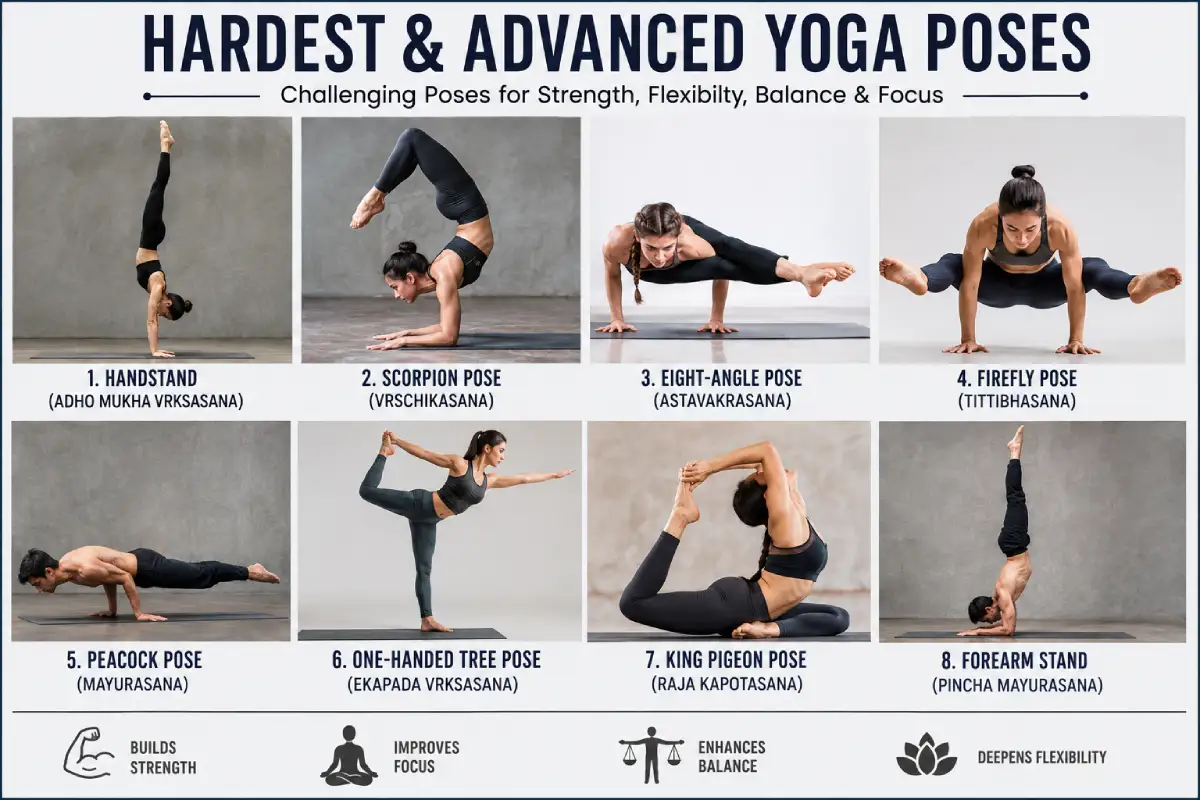
Handstand (Adho Mukha Vrksasana)
Handstand remains one of the most recognised advanced yoga poses. It demands:
- Shoulder stability
- Core engagement
- Balance control
- Body alignment
Many practitioners spend months or years developing a consistent handstand practice.
Peacock Pose (Mayurasana)
Peacock pose you will lift your entire body and balance on your hands, horizontal to the floor.
Benefits include:
- Improved upper-body strength
- Enhanced wrist stability
- Better core activation
Limitations:
- Difficult for beginners
- Can strain wrists if performed incorrectly
Eight-Angle Pose (Astavakrasana)
This arm balance combines twisting, core strength, and coordination.
Key skills required:
- Hip mobility
- Arm strength
- Core stability
- Focused breathing
Challenging Yoga Poses That Test Flexibility
King Pigeon Pose (Kapotasana Variation)
King Pigeon poses are one of the most challenging yoga poses variation for the flexibility of the person.
Primary demands include:
- Hip mobility
- Shoulder flexibility
- Spinal extension
- Quadriceps flexibility
Many yoga students spend years safely progressing toward this posture.
Full Wheel Dropback
This advanced backbend requires:
- Strong spinal mobility
- Shoulder flexibility
- Leg strength
- Confidence during movement
Proper supervision is often recommended when learning dropbacks.
Standing Split Variations
Although they appear simple, advanced standing splits require:
- Hamstring flexibility
- Balance control
- Hip stability
Flexibility alone is not enough to achieve proper alignment.
Many advanced yoga poses involve balancing upside down and developing exceptional body control. Learn more in our Inversion Poses.
Difficult Yoga Positions That Require Exceptional Balance
Forearm Stand (Pincha Mayurasana)
Forearm Stand combines inversion training with shoulder stability.
Benefits include:
- Improved upper-body strength
- Better body awareness
- Enhanced balance skills
Challenges include:
- Fear of falling
- Shoulder mobility limitations
- Core weakness
One-Handed Tree Pose
This variation elevates traditional balance training.
Practitioners must maintain:
- Single-leg stability
- Mental concentration
- Postural alignment
Even experienced yogis may find this pose challenging.
Side Crow Variations
Side Crow transitions demand:
- Rotational strength
- Arm balance control
- Weight distribution awareness
These things take lots of practice, too! It takes deep range of movement and flexibility of the joints to perform most of the other yoga poses that are more physically advanced. Explore our Mobility-Based Yoga Poses.
The Hardest Yoga Position for Many Practitioners: Scorpion Pose
Why Scorpion Pose Is So Challenging
It combines:
- Inversion skills
- Deep spinal flexibility
- Shoulder mobility
- Balance control
- Core strength
Very few yoga postures require mastery across so many physical capacities simultaneously.
Benefits
- Improved body awareness
- Stronger shoulders
- Enhanced balance
- Greater confidence in inversions
Limitations
- Requires extensive preparation
- Increased injury risk if rushed
- Not suitable for beginners
Workflow: How to Progress Towards Advanced Yoga Poses
Step 1: Master Fundamental Postures
Build proficiency in:
- Downward Dog
- Warrior poses
- Plank
- Crow Pose
- Bridge Pose
Step 2: Develop Strength
Focus on:
- Core training
- Shoulder stability
- Wrist conditioning
- Leg strength
Step 3: Improve Mobility
Work consistently on:
- Hip opening
- Hamstring flexibility
- Thoracic spine mobility
- Shoulder range of motion
Step 4: Practise Intermediate Variations
Examples include:
- Crow Pose
- Dolphin Pose
- Half Pigeon
- Supported Headstand
Benefits of Practising Advanced Yoga Poses
Advanced postures may offer:
- Improved strength
- Better flexibility
- Enhanced coordination
- Greater body awareness
- Increased mental focus
- Improved balance control
However, benefits depend heavily on safe technique and consistent practice.
Advanced yoga often demands significant core strength to maintain balance and stability in complex positions. Read our Core-Intensive Yoga Poses.
Expectations Management: What Most People Should Know
Many social media images create unrealistic expectations about advanced yoga.
Realistic Timeline
| Goal | Typical Time Frame |
| Basic flexibility gains | Several weeks |
| Intermediate postures | Several months |
| Consistent arm balances | 6–24 months |
| Advanced inversions | 1–5 years |
| Mastery-level poses | Multiple years |
Important Considerations
- Progress is rarely linear.
- Individual anatomy differs.
- Flexibility develops at different rates.
- Recovery matters as much as training.
Safety Guidelines Before Attempting Challenging Yoga Poses
Before practising advanced postures:
- Warm up thoroughly.
- Progress gradually.
- Use qualified instruction when possible.
- Avoid forcing range of motion.
- Stop if pain occurs.
- Allow adequate recovery.
Common Mistakes When Learning Advanced Yoga Poses
Skipping Foundational Training
Many practitioners rush into advanced poses without adequate preparation.
Chasing Appearance Instead of Technique
A pose that looks correct may still involve poor alignment.
Ignoring Recovery
Muscles and connective tissues require time to adapt.
Comparing Yourself to Others
Social media often highlights final results rather than years of practice.
Before attempting advanced yoga poses, it’s important to build skills gradually through structured progressions. Discover more in our Yoga Pose Progressions.
Conclusion
The tough yoga poses are not about doing something that is really hard on your body. Yoga poses like these are also about being patient, with yourself and working on them every day. When you are doing yoga poses you have to pay attention to your body and take things one step at a time with the yoga poses.
Doing yoga poses like Scorpion Pose and Peacock Pose and Forearm Stand can be something to work towards.
When you try to do the yoga poses you should be realistic about what you can do. You have to get ready and listen to your body so you do not get hurt. If you do this you will have a time doing yoga and it will be safer for you, over time. Recovery practices can help improve flexibility, reduce soreness, and support consistent advancement in yoga. Learn more in our Yoga Recovery.