
Fitness rings have become an alternative to traditional fitness trackers and smartwatches. Of wearing a device with a screen on your wrist a smart ring can gather chosen health and activity data from your finger and show the results on a smartphone app. I find fitness rings are easy to use.
The appeal is simple: a ring is small enough to wear all day and all night while still giving information about movement, sleep and physiological trends. It feels comfortable on my finger.
However adding sensors and more numbers does not automatically mean better health tracking.. I still prefer a watch, for detailed stats.
When comparing fitness ring features and health tracking look past the feature list. Sensor quality, software, fit, battery life, compatibility and the way the data is interpreted can make a difference. I look at the details before buying. To get a complete understanding of wearable health technology, explore our Fitness Tracker Ring guide, which covers everything from tracking capabilities to buying considerations:
What Are Fitness Ring Features & Health Tracking?
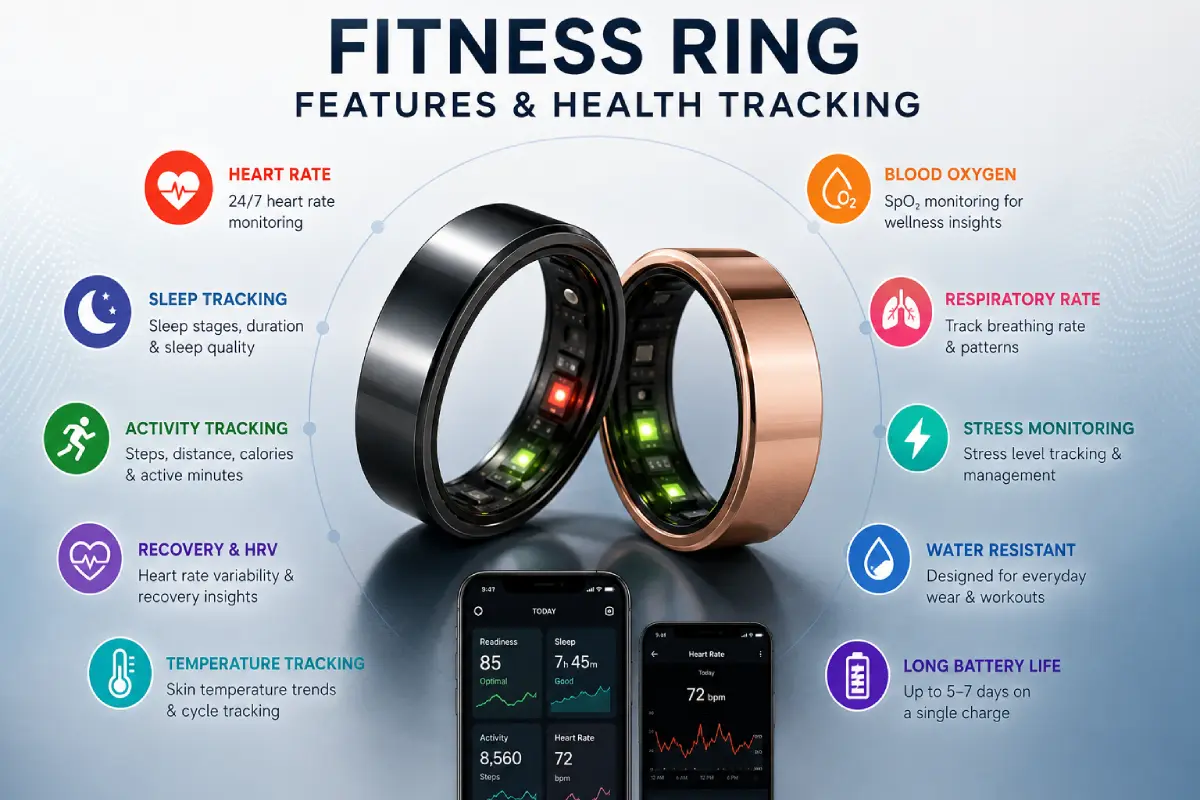
Fitness rings use sensors like heart-rate sensors, accelerometers and temperature sensors to gather data about the body and movement. Some models track heart rate resting heart rate, sleep, steps, physical activity, breathing patterns, skin temperature, blood oxygen levels and other health-related measures.
The ring usually sends this data to an app. Of showing detailed results directly on the ring the app turns the raw information into easy-to-read charts, trends, scores or advice.
This means that when looking at a fitness tracker ring it’s important to evaluate the system. The hardware, the software and how well the app turns data into insights all play a big role, in how helpful the ring really is.
How Fitness Ring Health Tracking Works
A typical tracking workflow looks like this:
- The ring collects data using optical and motion sensors.
- Sensors record measurements at intervals or continuously, depending on the feature and device.
- Algorithms process the raw information to identify patterns such as periods of activity or sleep.
- The smartphone app organises the results into daily and longer-term trends.
- You use the trends to adjust behaviour, such as sleep routines, training volume or daily movement.
This final step is important. A fitness ring is primarily a monitoring and behaviour-support tool, not a replacement for clinical assessment. If you’re looking for device recommendations, check out our list of the best fitness tracker rings that combine advanced features, comfort, and reliable health monitoring:
Fitness Ring Heart Rate Tracking
Heart-rate monitoring is one of the most useful features to look for.
Nearly all fitness rings employ PPG or photoplethysmography, which employs light and a sensor to analyze an approximation of blood volume variations under the skin. Depending on the device, your heart rate might be logged while relaxing, during slumber, or during a workout.
Useful heart-rate features can include:
- Resting heart rate
- Continuous or periodic heart-rate measurements
- Exercise heart rate
- Heart-rate trends
- Heart-rate variability (HRV), where supported
- High or low heart-rate notifications on some platforms
For vigorous workouts, a chest-strap monitor may still be preferable when precise exercise heart-rate measurement is important.
Fitness Ring Sleep Tracking
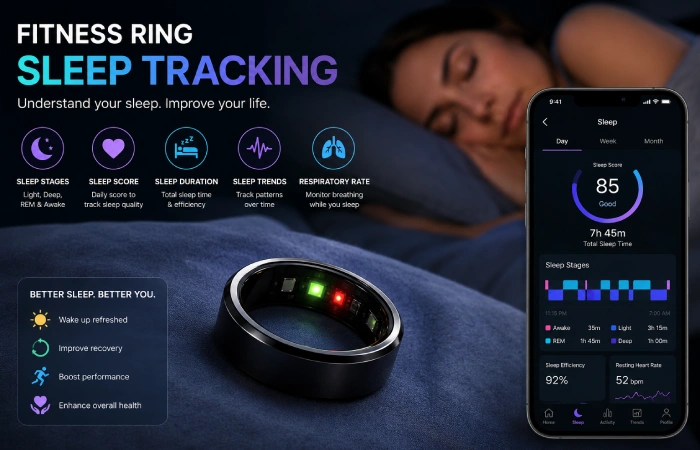
Fitness ring sleep tracking is another major reason people choose rings rather than wrist-based devices.
Because rings are generally small and screen-free, some people find them comfortable to wear overnight. Depending on the model, sleep tracking may estimate:
- Time asleep
- Time awake
- Sleep duration
- Sleep stages
- Resting heart rate
- HRV
- Breathing-related trends
- Sleep consistency
Sleep data should be treated as an estimate rather than a clinical sleep study. Research into consumer wearables has found that sleep measurements can differ from reference methods, with consumer devices often tending to overestimate total sleep time. Many modern smart rings include activity and calorie tracking tools that make them useful fitness rings for weight loss and long-term wellness goals:
For everyday use, the most valuable feature may therefore be trend tracking. If your ring consistently shows that you are sleeping less than usual, that pattern may be more useful than obsessing over whether a particular night contained exactly 72 or 81 minutes of a particular sleep stage.
Fitness Ring Activity Tracking
Fitness ring activity tracking typically focuses on everyday movement rather than replacing a dedicated sports watch.
Common metrics include:
- Steps
- Distance
- Active time
- Calories or energy expenditure estimates
- Workout detection
- Activity intensity
- Sedentary periods
Accuracy varies considerably between devices and activities. A systematic review of consumer wearable technologies found that physical-activity intensity measurements can have substantially higher errors than simpler measurements such as heart rate, while step-count performance can also vary by device and activity.
For this reason, activity data is best used to identify patterns. If your ring shows that you are consistently less active on working days, that information can help you make a practical change.
It should not be treated as an exact measurement of every calorie burned. Before choosing a wearable, compare smart ring vs fitness watch options to determine which device best fits your lifestyle and tracking preferences
Fitness Ring Recovery Tracking
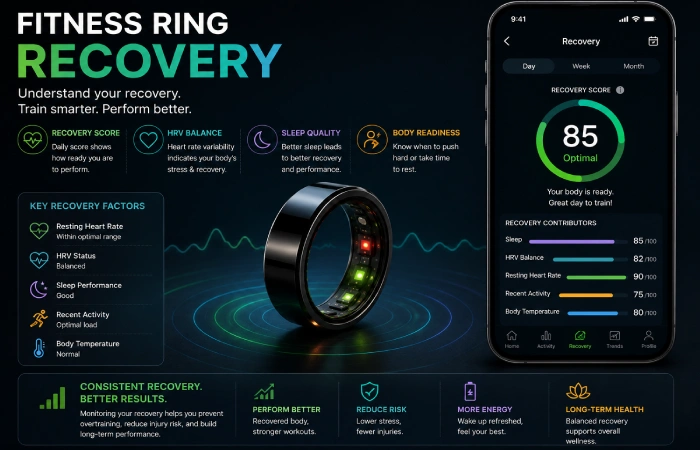
Fitness ring recovery features attempt to help users understand how ready they may feel for another demanding day or workout.
Depending on the platform, recovery insights can combine:
- Resting heart rate
- HRV
- Sleep duration
- Sleep consistency
- Recent activity
- Skin-temperature trends
- Previous training load
The concept is useful, but recovery scores are algorithmic estimates. They should complement how you actually feel rather than override it.
For example, if an app reports poor recovery but you feel fresh, there is no reason to automatically cancel your planned workout. Likewise, consistently poor sleep, unusual fatigue and declining performance deserve attention even if an app reports a favourable score.
Key Fitness Tracker Ring Features to Compare
| Feature | What it can tell you | What to check |
| Heart rate | Resting and exercise heart-rate trends | Measurement frequency and exercise accuracy |
| Sleep tracking | Sleep duration and patterns | Validation, sleep-stage methodology and comfort |
| Activity tracking | Steps, movement and workouts | Supported activities and detection accuracy |
| Recovery | Readiness and physiological trends | Which metrics influence the score |
| HRV | Changes in beat-to-beat variation | When and how HRV is measured |
| Temperature | Changes in skin-temperature trends | Baseline tracking and intended use |
| SpO₂ | Estimated blood oxygen | Whether it is wellness or medically intended |
| Battery | How often the ring needs charging | Real-world battery claims and charging method |
| Water resistance | Suitability for everyday wear | Actual rating and manufacturer limitations |
| App | Where data and trends are viewed | Compatibility, usability and subscription requirements |
What About Blood Oxygen and Other Health Metrics?
Some smart rings include SpO₂ or blood-oxygen estimation. This can sound like a medical feature, but consumers should be careful about interpreting it that way.
I have read that the FDA says that pulse‑oximeter readings can be affected by factors such as circulation, skin colour, skin temperature and other conditions. The FDA also says that it separates devices, from general‑wellness products that are not evaluated for clinical decision‑making.
Therefore, if a ring reports blood oxygen, consider it a wellness metric unless the specific product has an appropriate medical indication. Do not use a consumer ring alone to diagnose or rule out a health condition. Different manufacturers offer unique capabilities, so reviewing fitness ring brands reviews can help you identify the most reliable and feature-rich options
Accuracy Expectations: What Can a Fitness Ring Really Tell You?
The biggest mistake when buying a fitness ring is expecting every number to be exact.
Wearable accuracy depends on the sensor, algorithms, device position, movement, activity type and individual characteristics. A recent validation study comparing several wearables with ECG during sleep found meaningful differences between devices, even for measurements such as resting heart rate and HRV.
A sensible approach is to use a ring for consistent trend monitoring.
For example:
More useful: “My resting heart rate has gradually increased over the last two weeks.”
Less useful: “The ring says I burned exactly 642 calories today.”
The first observation can help you understand a change in your routine. The second creates a level of precision that consumer wearable estimates may not justify.
Fitness Ring vs Smartwatch
A ring and a smartwatch can both monitor health and activity, but they serve different priorities.
| Category | Fitness Ring | Smartwatch |
| Size | Small and discreet | Larger |
| Screen | Usually none | Usually included |
| Sleep comfort | Often a strong advantage | Depends on user |
| Notifications | Usually limited | Extensive |
| GPS | Often relies on phone or may be unavailable | Common on many models |
| Health trends | Strong focus | Strong, but varies by model |
| Workout controls | Usually limited | Generally better |
| Battery | Often several days, depending on model | Varies widely |
| Best for | Passive health and lifestyle tracking | Fitness plus smart-device functions |
If you want detailed workout controls, GPS navigation and notifications, a smartwatch may be more practical. If you prefer unobtrusive, continuous lifestyle tracking, a ring may be a better fit.
Pros and Limitations of Fitness Rings
Pros
- Small and discreet
- Convenient for overnight wear
- Useful long-term health and activity trends
- Often screen-free, reducing distractions
- Can complement a smartphone-based health ecosystem
- May provide useful sleep and recovery information
Limitations
- No large on-device display on most models
- Some features may require subscriptions
- Ring sizing needs careful consideration
- Exercise tracking may be less comprehensive than a sports watch
- Measurements are estimates rather than clinical tests
- Accuracy varies between devices and activities
- A ring may not suit people who prefer wrist-based controls
Who Should Consider a Fitness Ring?
A fitness ring may suit someone who wants passive health tracking without wearing a conventional smartwatch.
It can be particularly useful for people interested in sleep habits, resting heart rate, daily activity and longer-term trends.
It may be less suitable for athletes who need detailed GPS data, advanced training metrics, live workout screens or extensive navigation.
How to Choose the Right Fitness Ring
Before buying, work through this checklist:
- Start with your main goal.
If sleep is your priority, investigate sleep metrics and overnight comfort. For training, examine workout support and heart-rate performance. - Check sensor capabilities.
Do not assume every ring measures the same things. - Investigate accuracy evidence.
Look for independent validation rather than relying solely on manufacturer claims. - Check battery life.
A device that needs frequent charging can create gaps in your health record. - Check compatibility.
Make sure the companion app works properly with your smartphone. - Understand subscriptions.
Some platforms restrict advanced analytics behind a recurring fee. - Get the sizing right.
A poor fit can affect comfort and potentially the quality of sensor contact. - Consider the ecosystem.
The best ring is not necessarily the one with the longest feature list. It is the one whose data you will actually use.
How to Use Fitness Ring Data Responsibly
Think of your ring as a source of context, not a diagnosis.
A useful routine is to check trends rather than reacting to every daily fluctuation. Compare sleep, activity, resting heart rate and recovery indicators with your behaviour.
For example if your sleep duration drops, after late nights and your activity also declines the data can reinforce what you already know about your routine.
For health goals wearable data should sit alongside established habits. The CDC currently recommends that adults get least 150 minutes of moderate-intensity physical activity each week plus muscle-strengthening activity on at least two days.
The ring can help you monitor behaviour. It does not create the health benefit by itself. Before purchasing a device, verify its fitness ring compatibility to ensure it works seamlessly with your smartphone, operating system, and health apps:
Final Thoughts
The best Fitness Ring Features & Health Tracking experience is not about having the sensors. It is about having the mix of useful measurements, comfortable hardware, reliable software and clear insights into trends.
Heart rate, sleep, activity and recovery can give you information for everyday fitness choices.. Keep in mind that consumer wearable data has limits. Look at the numbers as estimates. Focus on patterns over time. Never use wellness metrics as a replacement, for advice.
For people the smartest choice is simple. Pick a ring that tracks the metrics you actually care about. Make sure it fits enough to wear every day.. Choose one that shows the data in a way you can understand and use.