
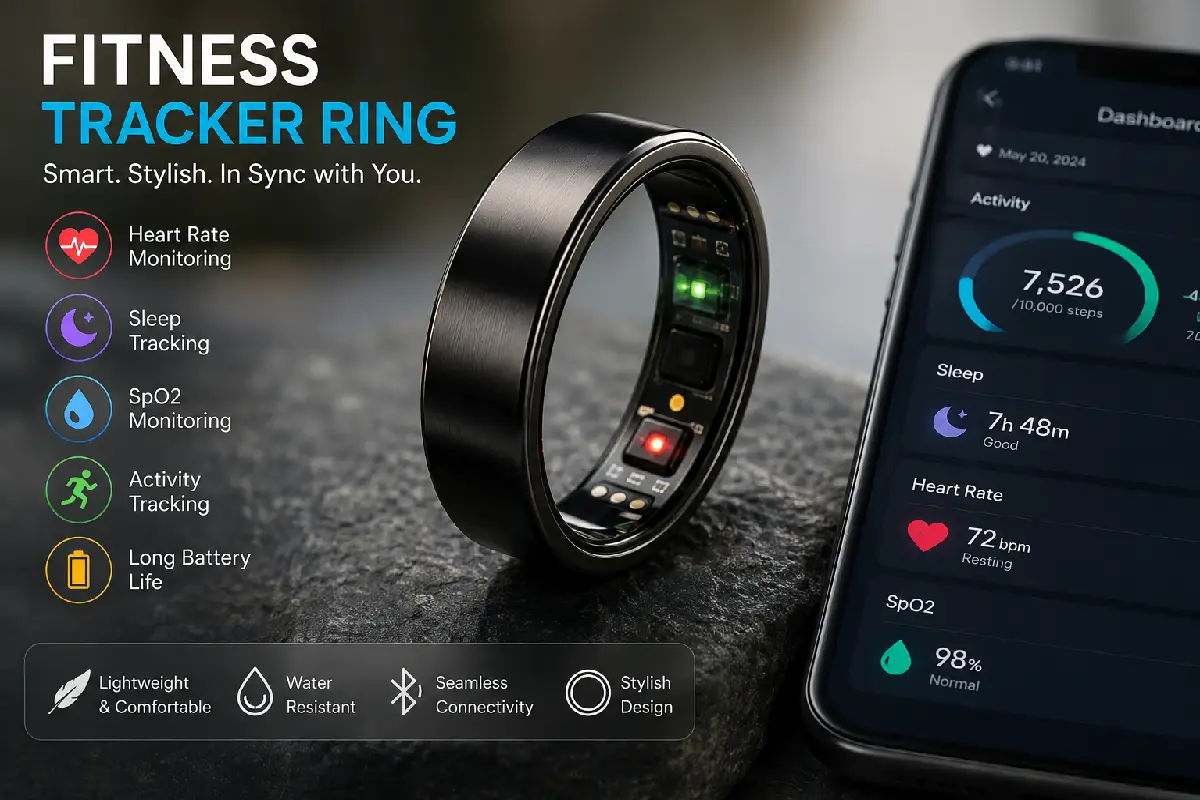
A fitness tracker ring is one of the ways to keep track of daily activity, sleep and certain health-related data. Of wearing a watch on your wrist you wear a ring with sensors, on your finger. The information gathered is then checked using an app. For people who feel uneasy wearing a watch at night or who just want something that doesn’t stand out smart rings offer an discreet option.
The technology has developed considerably. Modern rings can combine optical sensors, temperature sensors and accelerometers to monitor areas such as heart rate, movement, sleep and recovery. Some models also estimate additional metrics through software and algorithms.
However a ring does not automatically beat a fitness watch. The best choice depends on what you want to measure which phone you use, whether you need a screen how seriously you. How much you are willing to spend.
This guide shows how a fitness tracker ring works, what it can truly tell you how it stacks up against watches and bands and what to look for before buying a ring. If you’re looking for the top devices on the market, explore our guide to the best fitness tracker rings to compare features, accuracy, and overall value:
What Is a Fitness Tracker Ring?
A fitness tracker ring is an electronic device created to gather fitness and wellness data while it is worn on a finger.
Smart rings do not have a big display. Instead sensors inside the ring gather information. Send it to a smartphone app that comes with the device. The app then changes that sensor data, into charts, scores, trends and other details.
Depending on the model, a ring may track:
- Heart rate
- Resting heart rate
- Heart rate variability (HRV)
- Steps and movement
- Activity levels
- Sleep duration
- Sleep stages or sleep-related estimates
- Skin temperature changes
- Blood oxygen measurements
- Workout-related information
- Recovery indicators
- Stress-related metrics
- Respiratory information during sleep
The exact feature set varies substantially between manufacturers.
For example Oura Ring 4 uses sensors, temperature sensing and an accelerometer for continuous health and activity tracking. Oura lists 24/7 heart-rate tracking, blood oxygen sensing, temperature monitoring, activity detection. Sleep analysis among its features.
Samsungs Galaxy Ring similarly combines an accelerometer, optical bio- sensor and skin-temperature sensor. Its ecosystem connects the ring with Samsung Health, for activity, sleep, heart-rate and other wellness information.
The important point is that a ring is primarily a data-collection wearable. Its usefulness comes from what it measures how consistently you wear it and how well its software interprets those measurements.
How Does a Smart Ring Fitness Tracker Work?
The basic workflow is straightforward.
1. Sensors collect information
Small sensors positioned around the inside of the ring interact with your finger.
Optical sensors can use light to estimate changes associated with blood flow. Accelerometers detect movement. Temperature sensors can detect changes in skin temperature.
2. The ring processes the data
The device performs some initial processing before transmitting information to the companion application.
The algorithms may look for patterns in movement, heart rate and other measurements.
3. Data is transferred to an app
The ring normally connects to a smartphone using Bluetooth.
The app shows the information in a way that’s easier to understand. Of just displaying raw sensor data it can give daily summaries highlight trends show scores or offer recommendations.
4. You use trends rather than individual readings
This is one of the most important ways to use a fitness ring properly.
I find that a nights sleep score or one unusually high heart-rate reading does not necessarily reveal much. Patterns over days or weeks are generally far more useful, for making lifestyle decisions.
5. You adjust your routine
The final step is turning information into action.
For example:
Wear ring → collect data → review trends → identify pattern → adjust routine → monitor again
That workflow makes a smart ring more useful than simply checking numbers for the sake of checking them. Before choosing a device, it’s important to understand the most valuable fitness ring features, including sleep tracking, heart-rate monitoring, and activity tracking
Fitness Ring Features & Health Tracking
Different products prioritise different features, so shoppers should avoid assuming every ring offers the same measurements.
Heart-rate tracking
Heart rate is one of the most common features found in modern smart rings.
A ring can use optical sensors to monitor heart-rate information throughout the day or during specific periods. Some products also calculate resting heart rate and heart-rate variability.
These metrics can be useful for understanding changes in your normal patterns.
That does not automatically identify the cause. It simply gives the user another piece of information to consider.
Oura states that its Ring 4 uses green and infrared photoplethysmography sensors to measure heart rate continuously, alongside HRV and sleep-related measurements. Many users choose smart rings to support their health journey, and these fitness rings for weight loss can help track activity levels, calories burned, and daily progress
Sleep tracking
Sleep is an area where smart rings can be particularly convenient.
A ring is relatively small and does not have a bright screen, making it less intrusive for overnight wear than some watches.
Depending on the model, sleep tracking can include:
- Time asleep
- Time in bed
- Sleep timing
- Movement during sleep
- Estimated sleep stages
- Resting heart rate
- HRV
- Respiratory information
- Blood oxygen measurements
- Skin temperature
Research into smart rings is developing. A recent systematic review found promising results across several smart-ring applications but also highlighted important limitations, including proprietary algorithms, study bias and adherence challenges. Not sure which wearable is right for you? Our comparison of smart ring vs fitness watch highlights the key differences in comfort, tracking capabilities, and convenience
That distinction matters: good wearable performance does not mean a ring replaces a clinical sleep study.
Activity tracking
A fitness ring can detect movement throughout the day.
Depending on the model, this may include:
- Steps
- Walking
- Running
- General activity
- Calories or energy expenditure estimates
- Periods of inactivity
- Workout-related information
Samsung, for example, states that Galaxy Ring can automatically track walking and running and synchronise the resulting information with Samsung Health.
Activity tracking can help people become more aware of how much they move during the day.
Temperature tracking
Some smart rings monitor changes in skin temperature.
This can contribute to sleep, recovery and cycle-related insights, depending on the software ecosystem.
Temperature data should generally be interpreted as a trend, rather than treated as a standalone diagnostic measurement.
Blood oxygen tracking
Some smart rings use red and infrared light to estimate blood oxygen saturation.
This can be useful as part of general wellness monitoring, particularly when combined with sleep and respiratory trends.
However, consumers should be cautious about treating wearable SpO₂ measurements as equivalent to clinical equipment.
Stress and recovery insights
Many modern smart rings attempt to turn physiological and behavioural information into broader concepts such as recovery, readiness, stress or energy.
These can be convenient summaries, but they are software interpretations rather than direct biological measurements.
When an app says your recovery score is low the useful question to ask is why. Look at the underlying information such, as sleep duration resting heart rate, recent activity and your own experience.
Best Fitness Tracker Rings: What Should You Look For?
There is no single best fitness tracker ring for everybody.
The best choice depends on the mix of features, phone compatibility, what kind of subscription is needed how the battery lasts how comfortable the device is and what kind of training is required.
Three well-known smart-ring ecosystems illustrate the differences.
| Smart ring | Key strengths | Fitness & wellness focus | Battery information | Important consideration |
| Oura Ring 4 | Broad health, sleep and recovery ecosystem | Sleep, activity, heart rate, HRV, temperature and recovery | Typically 5–8 days according to Oura’s current specifications | Many advanced features require an active membership |
| Samsung Galaxy Ring | Strong Samsung Health integration | Sleep, heart rate, activity, energy and temperature | Up to 7 days depending on size and usage | Best suited to users within the Samsung/Android ecosystem |
| Ultrahuman Ring AIR | Lightweight design and no mandatory subscription | Sleep, recovery, movement and metabolic-oriented insights | Around 4–6 days according to Ultrahuman | Feature availability and software experience should be checked before purchase |
Oura currently states that Ring 4 typically lasts five to eight days, although battery life varies according to size, settings, features and usage.
Samsung says Galaxy Ring can provide up to seven days of battery life depending on size and usage, with actual performance varying between users.
Ultrahuman currently lists four to six days of battery life for Ring AIR and highlights that it does not require a mandatory subscription for its core experience.
These figures should be viewed as manufacturer specifications rather than guaranteed everyday results.
Fitness Ring vs Fitness Watch vs Fitness Band
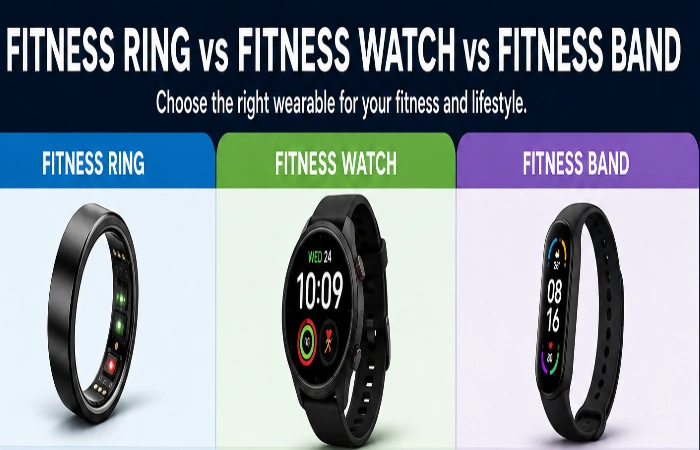
A smart ring is not simply a smaller fitness watch.
The three form factors have different strengths.
| Feature | Fitness tracker ring | Fitness watch | Fitness band |
| Comfort during sleep | Usually excellent | Depends on size and design | Usually good |
| On-device display | Usually no | Yes | Usually yes |
| Notifications | Limited or app-based | Strong | Basic to moderate |
| GPS | Usually relies on phone | Often built in | Depends on model |
| Workout controls | Limited | Usually excellent | Moderate |
| Sleep tracking | Strong focus on many models | Strong | Strong |
| Heart-rate tracking | Common | Common | Common |
| Battery life | Often several days | Usually shorter | Often several days |
| Discreet appearance | Excellent | Moderate | Moderate |
| Detailed workout metrics | Limited to moderate | Usually strongest | Moderate |
| Smartphone dependence | High | Moderate | Moderate to high |
| Best suited to | Passive wellness tracking | Active training and all-round use | Basic activity tracking |
When a fitness ring makes more sense
A ring can be attractive if you:
- Prioritise sleep tracking
- Want a discreet wearable
- Dislike wearing a watch overnight
- Want passive health and activity trends
- Prefer viewing information later in an app
- Already use a compatible smartphone ecosystem
When a fitness watch is better
A watch may be the stronger choice if you:
- Run regularly
- Cycle outdoors
- Need GPS
- Want live workout statistics
- Need pace, distance and heart-rate information while exercising
- Want notifications on your wrist
- Prefer controlling workouts directly from the wearable
For serious training, a watch is often more practical because you can see information while exercising rather than reaching for your phone. To find the right device, check out our fitness ring brands reviews, where we compare popular options based on performance, design, battery life, and user feedback
Fitness Rings for Weight Loss & Workouts
A fitness ring can support a weight-loss or exercise routine, but it does not cause weight loss by itself.
The useful role of a ring is feedback.
For example, someone trying to become more active might use a ring to monitor:
- Daily movement
- Walking consistency
- Sleep duration
- Resting heart rate trends
- Workout frequency
- Recovery patterns
- General activity levels
That information can help create better habits.
- Example weight-loss workflow
- Set a realistic activity goal
- Wear the ring consistently
- Monitor movement and sleep
- Review weekly trends
- Adjust activity, recovery and daily habits
Repeat
The key is consistency.
If the ring encourages you to walk more, sleep regularly and maintain a sustainable exercise routine, it can become useful.
However, calorie-burn estimates should not be treated as precise measurements of energy expenditure. Wearables estimate calories using algorithms based on available sensor data and personal information. Actual energy expenditure can differ.
For weight management, nutrition, activity, sleep and long-term behaviour generally matter far more than any individual wearable score.
Using a Fitness Ring for Running and Walking
A fitness ring can work particularly well as a passive companion to walking.
For example, you might wear it throughout the day to monitor general movement and use your phone or watch for detailed running statistics.
Walking
Walking is a straightforward use case.
A ring can help you monitor:
- Step counts
- Daily movement
- Activity consistency
- Periods of inactivity
- General energy expenditure estimates
The biggest benefit may be behavioural awareness.
Seeing that you have moved less than usual can be a simple reminder to take a short walk.
Running
Running is more complicated.
A ring can provide useful heart-rate and activity information, but runners often need:
- GPS distance
- Pace
- Splits
- Route information
- Live heart rate
- Workout intervals
- Training-zone information
A smartwatch is usually better equipped for these needs.
Therefore, one practical setup is:
Smart ring for sleep + recovery + everyday tracking
Fitness watch or phone for detailed running
The two can complement each other rather than compete.
Popular Fitness Ring Brands & Reviews
The smart-ring market has several manufacturers, but three names are particularly relevant when researching current mainstream options.
Oura
Oura has built its product around sleep, recovery, activity and broader health insights.
AOura Ring 4 uses multiple sensor types, including PPG sensors, red and infrared LEDs, temperature sensing and an accelerometer. Oura says the device is designed for continuous data collection day and night.
One major consideration is its membership model. Buyers should calculate the total cost over several years rather than considering only the hardware price.
Oura is particularly interesting for people who prioritise sleep, recovery and long-term trends.
Samsung Galaxy Ring
Samsung’s Galaxy Ring is designed to work closely with Samsung Health.
Its features include sleep tracking, heart-rate monitoring, activity tracking and energy-related insights. Samsung also states that the ring can automatically track walking and running.
Compatibility is important. Samsung documentation states that Galaxy Ring requires an Android smartphone meeting specified requirements, alongside Samsung’s relevant applications and account.
That makes it especially appealing to people already invested in the Galaxy ecosystem.
Ultrahuman Ring AIR
Ultrahuman positions Ring AIR around sleep, recovery, movement and broader health tracking.
The company lists a lightweight 2.4-gram design, four-to-six-day battery life and no mandatory subscription as key characteristics.
This may make it attractive to buyers who dislike recurring membership fees.
As with every smart ring, prospective buyers should check the current feature list, app compatibility and pricing before purchasing because software offerings can change.
Fitness Ring Buying Guide & Compatibility
Before purchasing a ring, work through the following checklist.
1. Check smartphone compatibility
This is one of the easiest details to overlook.
Some rings support both major mobile operating systems, while others are much more closely tied to a particular ecosystem.
For example, Samsung’s Galaxy Ring requires an Android phone meeting its specified requirements.
If your phone is incompatible, the ring’s hardware features become largely irrelevant.
2. Check subscription costs
A ring may look reasonably priced until you calculate the total ownership cost.
Ask:
- Is a subscription required?
- Which features are locked behind it?
- Is the subscription monthly or annual?
- What happens to my data if I stop paying?
- Are basic measurements still available?
This is particularly important when comparing Oura with subscription-free alternatives.
3. Get the sizing right
Sizing is more important with a smart ring than with a conventional ring.
A loose fit can affect comfort and potentially sensor contact. A ring that is too tight can feel uncomfortable especially when fingers get bigger because of heat working out or while sleeping.
Oura suggests using the sizing kit and making sure the sensors are facing the palm side of the finger for the best fit and accurate readings.
- Consider battery life
Longer battery life makes continuous tracking easier.
But advertised battery life is usually based on defined test conditions.
Features such as frequent workout tracking, blood oxygen sensing, connectivity and battery age can influence real-world performance.
For example, Oura says its Ring 4 typically lasts five to eight days, while noting that settings and usage affect the result.
5. Think about your training style
Ask yourself what you actually want to track.
If you mainly want:
Sleep + recovery + daily movement:
A smart ring may be a strong fit.
If you mainly want:
Running + GPS + live workout metrics:
A fitness watch is probably more practical.
If you want:
Both:
Consider using a ring and watch together if the ecosystems allow useful data integration.
6. Examine water resistance
If you plan to swim, shower or exercise with the ring, check the manufacturer’s water-resistance specifications.
Do not assume every ring has identical protection.
Oura says Ring 4 can handle water up to 100 metres or 328 feet. Ring 4 is good, for water sports and sauna.. Ring 4 is not meant for diving.
Fitness Tracker Ring Specifications That Matter Most
Marketing specifications can be distracting.
For everyday fitness use, prioritise these areas:
| Specification | Why it matters |
| Sensor types | Determines which measurements can be collected |
| Battery life | Affects continuous tracking |
| Charging method | Influences everyday convenience |
| Weight | Important for comfort |
| Ring thickness | Can affect comfort during sleep and exercise |
| Sizes available | Determines fit options |
| Water resistance | Important for swimming and showering |
| Bluetooth connectivity | Required for communication with the phone |
| Smartphone compatibility | Determines whether you can use the device |
| App quality | Determines how useful the collected data becomes |
| Subscription | Changes the long-term ownership cost |
| Data export/integration | Useful for people who use multiple health platforms |
The app deserves as much attention as the physical ring.
A ring that is technically capable is not very useful if the software is confusing unreliable or cannot show the trends that you really care about.
Performance Expectations: How Accurate Is a Fitness Ring?
This is where buyers should have realistic expectations.
Smart rings can give measurements but smart rings are only consumer gadgets, not full replacements for the machines that doctors rely on in clinics. I find that a thorough review in a journal said smart rings can be quite accurate for many types of measurements, such, as heart rate and sleep detection yet that same review also found big problems in the way those studies were done. The review pointed out that many of those studies used algorithms that only the makers could see and it also said that many studies had a moderate or high chance of bias.
That means two things can be true at the same time:
- Smart rings can provide useful physiological trends.
- Their readings should not automatically be treated as medical-grade measurements.
Why readings can vary
Measurements can be affected by:
- Ring position
- Ring size
- Finger movement
- Exercise intensity
- Skin characteristics
- Temperature
- Sensor contact
- Battery level
- Software algorithms
- Individual physiology
A ring may therefore produce better results under some conditions than others.
The most sensible approach is to focus on consistent trends, especially for wellness purposes, rather than reacting to every small numerical change.
Be especially cautious about medical claims
The FDA has specifically warned consumers not to use smartwatches or smart rings that claim to measure blood glucose without piercing the skin. The agency says it has not authorised, cleared or approved such smart rings to independently measure or estimate blood glucose.
The FDA has also warned against unauthorised wearable features that claim to measure blood pressure.
Therefore, treat extraordinary medical claims with caution.
A legitimate fitness wearable should clearly explain what it measures, how the measurements are generated and what they are intended for.
Is a Fitness Tracker Ring Legitimate?
A smart ring can be a legitimate fitness product, but legitimacy should be assessed product by product.
Before buying, check:
- The manufacturer’s official website
- Clear technical specifications
- Smartphone compatibility
- Warranty information
- Privacy policy
- Return policy
- Independent reviews
- App-store reputation
- Whether medical claims are appropriately qualified
- Whether the product has transparent pricing
Be cautious when a cheap device promises to diagnose multiple medical conditions or accurately measure complex biomarkers without explaining its validation.
The more extraordinary the health claim, the more evidence you should expect. Before making a purchase, review our guide to fitness ring compatibility to ensure your device works seamlessly with your smartphone, apps, and operating system
Pros and Cons of a Fitness Ring
Pros
- Small and discreet
- Comfortable for overnight wear
- No large screen demanding attention
- Useful for passive tracking
- Good fit for sleep monitoring
- Several days of battery life on many models
- Can complement a smartwatch
- Useful for observing long-term trends
- Often lighter than a watch
Cons
- Usually lacks a screen
- Less useful for live workout feedback
- Many models depend heavily on a smartphone app
- Some require subscriptions
- Calorie estimates are not exact
- Sleep stages are algorithmic estimates
- Small size can make buttons and controls impractical
- Compatibility varies
- Some advanced health claims should be treated cautiously
- Can be expensive for a device with limited on-device functionality
Who Should Buy a Fitness Ring?
A smart ring may suit you if:
You prioritise sleep
If overnight tracking is one of your main interests, a ring can be more comfortable than a watch for some people.
You dislike wearing watches
A small ring provides an alternative form factor.
You want passive tracking
Smart rings are designed to collect information in the background rather than requiring constant interaction.
You care about recovery
People who combine exercise with sleep and recovery monitoring may appreciate the broader picture provided by a ring.
You already use a compatible health ecosystem
If your smartphone, health app and other devices already work together, integration can make a ring more useful.
Who Should Avoid a Smart Ring?
A fitness ring may not be ideal if your main goal is live training data.
Consider another wearable if you need:
- Built-in GPS
- Detailed maps
- Live pace
- On-screen workout instructions
- Large notifications
- Music controls
- Extensive workout controls
- Detailed cycling information
A watch is generally better suited to these tasks.
You should also reconsider buying a ring if you are unlikely to wear it consistently. A sophisticated tracker cannot compensate for inconsistent use.
Smart Ring vs Fitness Watch: Which Is Better?
There is no universal winner.
Think of the choice in terms of when you need information.
A fitness ring is strongest when you want information collected quietly in the background.
A fitness watch is strongest when you need information while exercising.
For example:
At night:
Ring → sleep, heart rate, recovery trends
During a morning run:
Watch → pace, GPS, distance, live heart rate
During the working day:
Ring → movement and general activity
This is why some people may eventually use both.
The ring does not necessarily need to replace the watch. It can fill the gaps left by a screen-based wearable.
Smart Ring for Everyday Fitness: A Practical Routine
A simple routine can make the data more useful.
Morning
Check:
- Sleep duration
- Resting heart rate
- Recovery/readiness information
- Any noticeable changes from your normal baseline
Do not automatically cancel a workout because of a low score. Use the information alongside how you actually feel.
During the day
Wear the ring consistently and pay attention to:
- Movement
- Steps
- Inactivity
- General activity
If you have been sitting for several hours, a short walk may be more valuable than repeatedly checking the app.
During exercise
Use the ring if it provides the workout information you need.
For serious running or cycling, consider using a watch for live metrics.
Evening
Look at your overall activity rather than obsessing over individual numbers.
Prepare for sleep and keep the ring charged.
Weekly
Review trends.
Ask:
- Am I moving more?
- Is my sleep becoming more consistent?
- Does my resting heart rate change after hard training?
- Am I recovering adequately?
- Are my routines sustainable?
Weekly trends can provide more useful information than constantly checking individual readings.
Battery, Charging and Long-Term Use
Battery life is one of the practical differences between smart rings and traditional watches.
A ring with several days of battery life can collect overnight information without requiring daily charging.
But charging habits still matter.
Oura recommends keeping its Ring 4 sufficiently charged before bedtime because a low battery can result in missing some sleep insights.
A practical strategy is to charge the ring during a predictable period when you are not wearing it.
For example:
Shower → charge ring → put ring back on
or
Desk work → short top-up → continue wearing
Short, regular charging can be easier than waiting for the battery to reach zero.
Comfort and Build Quality
Comfort is not a minor consideration.
The best health wearable is often the one you actually wear consistently.
Before buying, consider:
- Ring weight
- Thickness
- Interior sensor shape
- Material
- Available sizes
- Finger swelling
- Whether you sleep comfortably wearing jewellery
- Whether you exercise with rings
Oura Ring 4, for example, uses a titanium construction and recessed sensors on the inner surface.
Samsung Galaxy Ring is listed at 7 mm wide and 2.6 mm thick, with weight varying by size.
Specifications are useful, but comfort remains personal. If possible, use the manufacturer’s sizing process before committing to a final size.
Privacy and Health Data
Fitness rings collect information that many people consider personal.
Depending on the product, this can include:
- Sleep patterns
- Heart-rate information
- Activity
- Temperature
- Exercise data
- Location-related information through connected services
- Other wellness information
Before buying, read the manufacturer’s privacy policy.
Look for information about:
- Data storage
- Data sharing
- Third-party integrations
- Account deletion
- Data export
- Security practices
- Whether data is used for research
A technically impressive ring is not automatically the best choice if you are uncomfortable with its data practices.
Fitness Ring Alternatives
A smart ring is only one option.
Fitness smartwatch
Best for people who need GPS, live workout metrics, notifications and extensive training features.
Fitness band
Best for users who want basic activity and health tracking at a simpler price point.
Chest-strap heart-rate monitor
Useful for people who prioritise heart-rate accuracy during structured exercise and do not necessarily need sleep tracking.
Smartphone fitness apps
A phone can track some forms of movement and exercise without requiring another wearable, although it cannot provide the same continuous physiological measurements as a sensor-equipped ring.
Traditional watch
For people who do not need continuous tracking, a conventional watch remains simpler and requires no charging or health-data account.
Fitness Ring Buying Tips
Before pressing the purchase button, run through this checklist:
- Check your phone compatibility.
- Check whether a subscription is required.
- Calculate the three-year ownership cost.
- Check battery-life claims and charging requirements.
- Confirm available sizes.
- Read the water-resistance information.
- Identify which metrics actually matter to you.
- Read independent reviews.
- Check the manufacturer’s privacy policy.
- Avoid products making unrealistic medical claims.
- Decide whether you need live workout information.
- Consider whether a watch or band would offer better value.
The goal is not to own the most sophisticated ring. It is to buy the wearable that fits your actual habits.
Expectations Management: What a Fitness Tracker Ring Cannot Do
A fitness tracker ring can provide useful data, but it cannot tell you everything about your health.
It cannot replace:
- A doctor
- A clinical examination
- A diagnostic test
- A laboratory test
- A medically indicated blood-pressure monitor
- An authorised glucose-monitoring system
- A clinical sleep study when one is required
Even when a ring produces a number that looks precise, precision on the screen does not necessarily mean clinical accuracy.
Treat the data as context, not as a diagnosis.
If you have symptoms, a medical condition or a treatment plan that depends on accurate physiological measurements, use the appropriate clinical equipment and speak with a qualified healthcare professional.
How to Choose the Best Fitness Ring for Your Needs
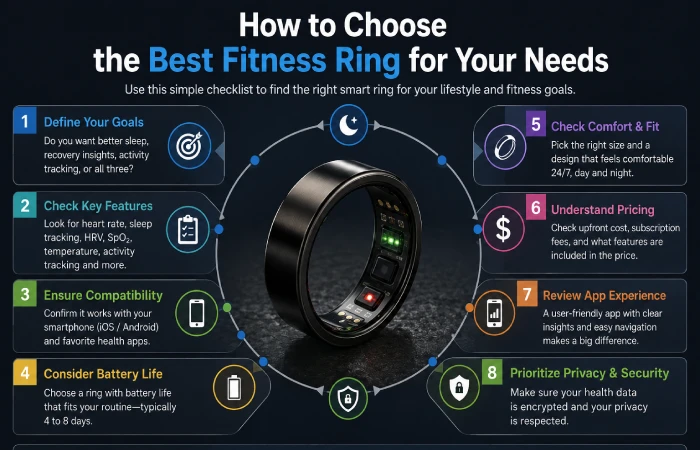
Instead of asking “Which fitness ring is the best?”, ask these five questions.
Do I care most about sleep?
If yes, prioritise sleep analysis, comfort and overnight battery life.
Do I train seriously?
If yes, consider whether you need a smartwatch alongside the ring.
Do I own a Samsung phone?
If yes, Galaxy Ring’s Samsung Health integration may be particularly relevant.
Do I dislike subscriptions?
If yes, pay close attention to the long-term pricing structure and consider products without mandatory recurring fees.
Do I want medical measurements?
If yes, do not choose a ring simply because its marketing lists a medical-sounding metric. Verify whether the device is authorised for the specific purpose you need.
The FDA specifically advises consumers not to rely on unauthorised smart rings claiming to measure blood glucose or blood pressure.
Conclusion
A fitness tracker ring is best viewed as a discreet health and fitness companion rather than a replacement for every other wearable.
Its biggest advantage is simplicity. A small ring can stay on your finger through the day and night, quietly collecting information that can help you understand activity, sleep, heart-rate patterns and recovery.
The most useful approach is to focus on trends rather than isolated numbers. A ring can tell you that your sleep has been shorter, your activity has changed or your resting heart rate differs from your usual pattern. It cannot, by itself, explain every reason behind those changes or diagnose a medical condition.
For sleep-focused users, people who dislike watches and anyone interested in passive wellness tracking, a smart ring can be a compelling option. For runners, cyclists and serious athletes who need live workout information, a fitness watch may still be the better primary device.
Ultimately, the best fitness tracker ring is the one that is comfortable enough to wear consistently, compatible with your phone, transparent about its features and costs, and realistic about what its measurements can and cannot tell you.