
Introduction
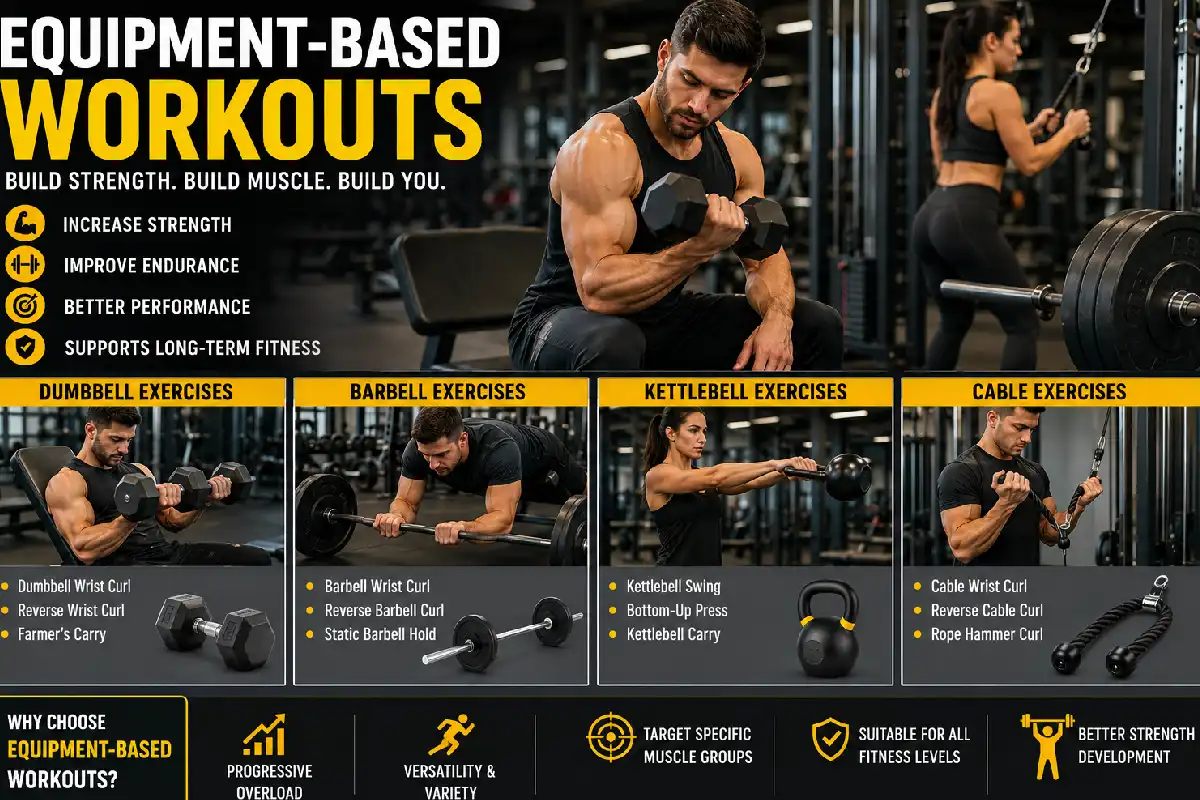
Workout Style Equipment Workouts It could arguably be said that the most successful training methods are any methods which use equipment, for strengthening, muscular endurance, and for achieving any goals you might have in the longer run. These may be executed at a well-stocked home gym or a local commercial gym. However, whatever your chosen setting, you’re utilizing exercise equipment which utilizes resistance. It doesn’t matter if it’s barbells, dumbbells, kettle bells, cables, you can make good training with these tools. Equipment-based training can accelerate your progress, but it works best as part of a complete program. Explore our Forearm Workouts to discover the most effective training methods for building stronger forearms.
This Article is part of the Workout Plans
What Are Equipment-Based Workouts?
Equipment-Based Workout programmes that don’t rely on an individuals own bodyweight but instead use equipment with which to work out are referred to as Equipment-Based Workouts. Examples include barbells and weights, resistance machines, bands, Kettlebells and other fitness aids. The goal is to achieve variable resistance and enable clients to progress at an appropriate rate in their strength.
Why Choose Equipment-Based Workouts?
Equipment provides several advantages that can support fitness progress.
Key Benefits
- Greater resistance options
- Easier progression over time
- More exercise variety
- Improved strength development
- Better muscle isolation when required
- Suitable for beginners and advanced trainees
Bodyweight is great but machines let you control resistance levels more accurately and select a better range of exercise types. Understanding how the forearm muscles function can help you choose the right exercises and improve training efficiency. Learn more in our Forearm Anatomy.
Types of Equipment Used in Workouts
Dumbbells
The dumbbell is an awesome exercise for both newbies and fitness veterans.A
Benefits include:
- Unilateral training
- Improved balance and coordination
- Wide exercise selection
- Suitable for home gyms
Barbells
Barbels are often used for compound movements that simultaneously works several muscles of the body.
Popular exercises include:
- Squats
- Deadlifts
- Bench presses
- Rows
Kettlebells
Kettlebells combine strength and conditioning elements.
Common uses include:
- Swings
- Carries
- Cleans
- Presses
Cable Machines
Cable systems provide constant tension throughout movements and allow numerous exercise variations.
Benefits include:
- Smooth resistance
- Adjustable angles
- Joint-friendly movement patterns
Equipment
| Equipment Type | Best For | Difficulty Level | Space Requirement |
| Dumbbells | General strength training | Beginner to Advanced | Low |
| Barbells | Heavy strength development | Intermediate to Advanced | Medium |
| Kettlebells | Functional fitness | Beginner to Advanced | Low |
| Cable Machines | Muscle isolation and versatility | Beginner to Advanced | High |
| Resistance Machines | Controlled movement patterns | Beginner | High |
Dumbbell Forearm Exercises
Forearm exercises help with strength as it assists in building your grip, as well as your total body’s upper body development.
Recommended Dumbbell Forearm Exercises
Wrist Curls
Targets forearm flexors.
Steps:
- Sit on a bench.
- Rest forearms on thighs.
- Hold dumbbells with palms facing upward.
- Curl wrists upward slowly.
- Lower under control.
Reverse Wrist Curls
Focuses on forearm extensors.
Benefits:
- Improves forearm balance
- Supports wrist stability
- Helps strengthen grip muscles
Farmer’s Carry
When carrying heavy dumbbells ensure that you keep your posture in place.
This exercise develops:
- Grip strength
- Forearm endurance
- Core stability
Barbell Forearm Workout
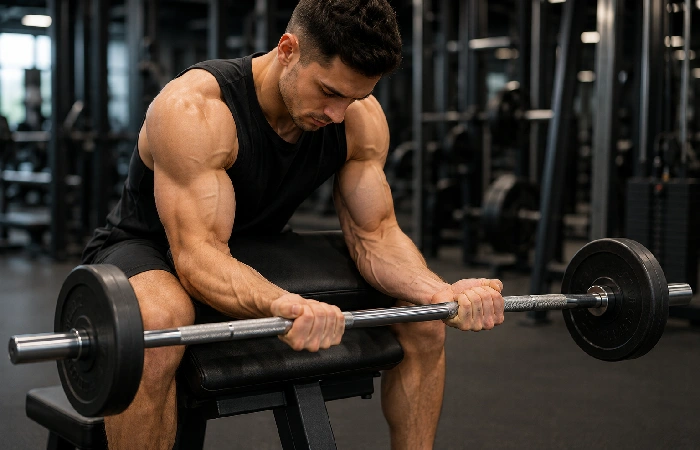
A barbell allows heavier loading and progressive resistance.
Effective Barbell Exercises
Barbell Wrist Curl
A classic forearm-building movement.
Reverse Barbell Curl
Works:
- Brachioradialis
- Forearms
- Upper arms
Static Holds
Holding a loaded barbell for time helps improve grip endurance and forearm strength. Adding variety to your workouts is essential for balanced development. Explore our collection of Forearm Exercises to target every major forearm muscle.
Sample Barbell Forearm Workout
| Exercise | Sets | Reps |
| Barbell Wrist Curl | 3 | 12-15 |
| Reverse Curl | 3 | 10-12 |
| Static Hold | 3 | 30-60 sec |
Kettlebell Forearm Exercises
Grip challenges when Kettlebell training due to the position of its centre of mass
Popular Kettlebell Exercises
Kettlebell Swing
Develops:
- Forearm endurance
- Posterior chain strength
- Cardiovascular fitness
Bottom-Up Press
Requires significant wrist and grip stability.
Kettlebell Carry
An effective exercise for improving:
- Grip strength
- Shoulder stability
- Forearm endurance
Cable Forearm Exercises
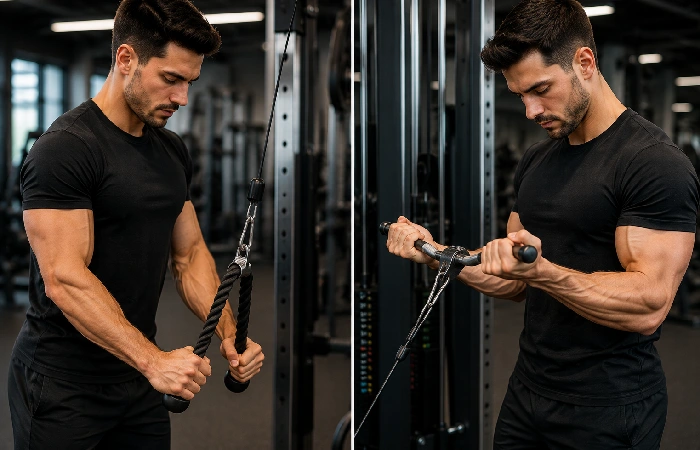
Cable machines provide continuous tension throughout movement.
Effective Cable Exercises
Cable Wrist Curl
Allows smooth resistance and controlled movement.
Reverse Cable Curl
Targets forearm extensors while reducing momentum.
Rope Hammer Curl
Works:
- Forearms
- Biceps
- Grip muscles
Cable exercises can complement free-weight training and provide additional variety. If you don’t always have access to gym equipment, our Home Forearm Training provides effective alternatives that can be performed almost anywhere.
Sample Equipment-Based Workout Workflow
Beginner Full-Body Session
Warm-Up (5–10 Minutes)
- Walking
- Cycling
- Dynamic stretches
Main Strength Exercises
- Dumbbell Squat – 3 sets
- Bench Press – 3 sets
- Cable Row – 3 sets
- Kettlebell Swing – 3 sets
Forearm Training
- Wrist Curl – 3 sets
- Reverse Curl – 3 sets
- Farmer’s Carry – 2 rounds
Cool Down
- Light stretching
- Mobility exercises
Expectations Management: What Results Can You Realistically Expect?
The thing many newcomers expect is some radical transformation within a few weeks. In reality it comes down to a variety of things.
Factors Influencing Results
- Training consistency
- Nutrition quality
- Recovery habits
- Sleep duration
- Exercise technique
Typical Timeline
| Time Period | Possible Changes |
| 2–4 Weeks | Improved exercise confidence |
| 4–8 Weeks | Noticeable strength gains |
| 8–12 Weeks | Improved muscular endurance |
| 3–6 Months | Visible muscle development for many individuals |
Individual results will vary, and consistency remains the most important factor. Many equipment-based exercises are designed to increase hand power and endurance. Improve your performance with our Grip Strength Training Guide.
Advantages and Limitations
Advantages
- Progressive overload is easier
- Wide exercise variety
- Suitable for many fitness goals
- Can target specific muscle groups
Limitations
- Some equipment can be expensive
- Machines require space
- Learning proper technique takes time
- Gym access may not always be convenient
Who Should Use Equipment-Based Workouts?
Equipment-based training may be suitable for:
- Beginners seeking structured progression
- Individuals building strength
- Athletes improving performance
- People aiming for muscle growth
- Fitness enthusiasts seeking exercise variety
Who May Prefer Alternative Training Methods?
Some individuals may prefer:
- Bodyweight workouts
- Outdoor fitness routines
- Minimal-equipment training
- Travel-friendly exercise plans
These strategies can also be useful to try depending on your own preferences and situation. For maximum size and strength gains, combine these exercises with the proven strategies in our Forearm Muscle Building.
Common Mistakes to Avoid
Using Excessive Weight
Poor technique often increases injury risk.
Skipping Warm-Ups
Preparing muscles and joints can improve workout quality.
Neglecting Recovery
Rest is essential for adaptation and progress.
Ignoring Progressive Overload
Gradually increasing challenge supports continued improvements. Athletes often use weighted forearm exercises to improve grip, endurance, and sport-specific performance. Learn more in our Sports and Functional Forearm Training.
FAQs
What is Equipment Based Training?
Equipment Based Workouts are designed as an exercise program that includes use of external resistance tools to enhance fitness and strength, such as dumbbells, barbells, kettle bells, cable machines, and other workout machines.
Are equipment workouts better than body weight exercises?
Both methods have their benefits.
With equipment, you’re able to get greater strength progression compared to bodyweight exercises. Equipment based workouts are often great for this purpose.
How often do beginners do equipment-based training workouts?
The frequency of equipment based training will vary depending on the beginner, but 2-4 times per week seems a good standard range.
Is it possible to get an equipment workout at home?
Absolutely, as long as you’re prepared to invest in dumbbells, kettlebells, resistance bands, compact benches, etc. Intense training places additional stress on the wrists and forearms, making recovery essential. Follow our Forearm Recovery and Injury Prevention to stay healthy and avoid setbacks.
Conclusion
Equipment-Based Workouts Offer Variety, Effective Strength Training for Your Body Equipment-based workouts can take many forms to help you gain muscle, improve your strength, and increase overall fitness. Dumbbells, kettlebells, barbells, cable machines, and other training equipment add an element of variety to your routine and can help you develop well-structured workout plans to build the strength and muscle you desire, if proper lifting, rest, and consistency.