
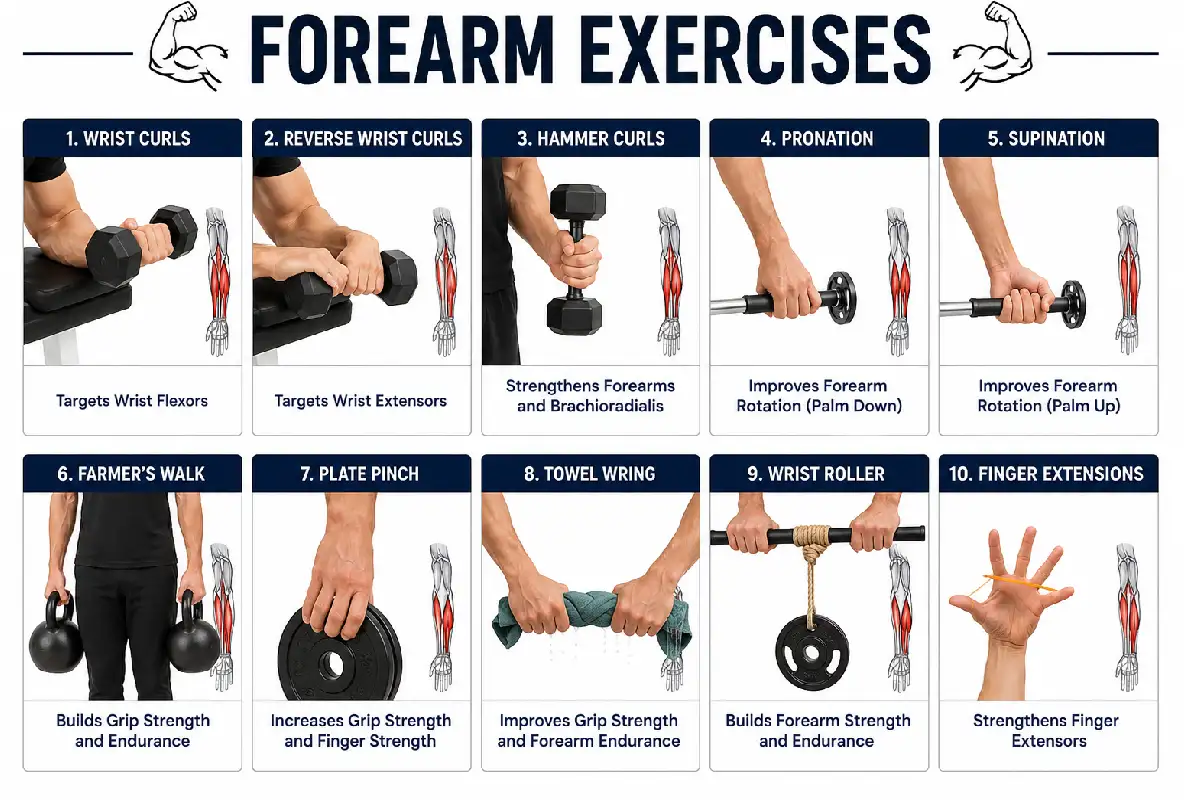
Introduction
Forearm exercises are usually left out of workout plans. They are really important for how strong your grip is, how well you can lift things and how you do everyday things. When you are carrying bags of groceries doing pull-ups or lifting weights at the gym your forearms help a lot with moving and being in control.
You need forearms to do exercises better to keep your wrists steady and to make your whole upper body work well. This guide will tell you about the exercises, for your forearms how to do them the right way and what you can really expect to happen if you keep practicing forearm exercises. If you’re looking for a complete training roadmap, explore our Forearm Workouts Guide covering exercises, grip strength, muscle building, and recovery.
This Article is part of the Workout Plans
What Are Forearm Exercises?
Forearm exercises help make the muscles, between your elbow and wrist stronger.
These muscles help you move your wrist bend and straighten your fingers and grip things tightly.
Forearm exercises are movements that target these muscles.
They are designed to improve wrist movement, finger flexion and finger extension and also boost grip strength.
Why Train Your Forearms?
Forearm exercises complement the action from the majority of complex exercises
Key Benefits
- Improved grip strength
- Better performance in pulling exercises
- Increased wrist stability
- Enhanced muscular endurance
- Greater control during lifting movements
- Balanced upper-body development
Realistic Expectations
Forearm muscles are used every day. It can be hard to grow them fast. Most people see their grip strength get better in a weeks.
To actually see the muscles, in your forearms grow you need to train them regularly for several months focusing on forearm exercises building forearm strength and growing forearm muscles. Understanding the muscles involved in each movement can help you train more effectively. Learn more in our Forearm Anatomy.
Forearm Muscle Groups Explained
Understanding the muscles you are working and select your exercises from there.
| Muscle Group | Primary Function |
| Wrist Flexors | Bend the wrist forward |
| Wrist Extensors | Lift the wrist backward |
| Brachioradialis | Assists elbow flexion |
| Finger Flexors | Improve gripping ability |
| Finger Extensors | Support hand opening and control |
Best Forearm Exercises for Strength and Size
Wrist Curls
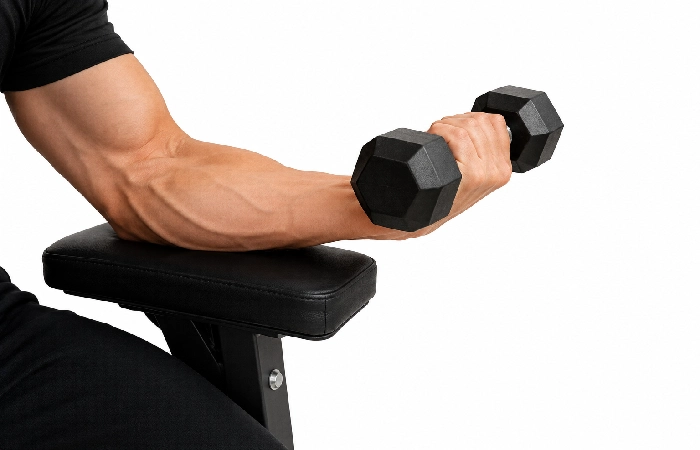
Wrist curls are really good for building up the muscles in your forearms. The muscles, in your forearms are important and wrist curls are one of the ways to make them stronger.
How to Perform Wrist Curls
- Sitting bench dumbbell row: Sit down on the bench with a dumbbell or bar in each hand.
- Allow your forearms to rest on your thighs or the bench itself.
- Allow wrists to extend downward.
- Curl the weight upward using only the wrists.
- Lower slowly and repeat.
Benefits
- Targets forearm flexors directly
- Improves grip strength
- Easy for beginners
Reverse Wrist Curls
Reverse wrist curls target therefore often-neglected extensor muscles.
How to Perform Reverse Wrist Curls
- Hold a barbell with palms facing downward.
- Rest forearms on a bench.
- Raise the wrists upward.
- Lower under control.
Benefits
- Develops forearm balance
- Supports wrist health
- Improves overall forearm appearance
Hammer Curls for Forearms
Therefore hammer curl primarily focuses on the brachioradialis which contributes to forearm size.
How to Perform Hammer Curls
- Hold dumbbells with a neutral grip.
- Keep elbows close to the body.
- Curl the weights upward.
- Lower slowly.
Benefits
- Builds forearm thickness
- Strengthens grip
- Also trains the biceps
Farmer’s Carry Benefits
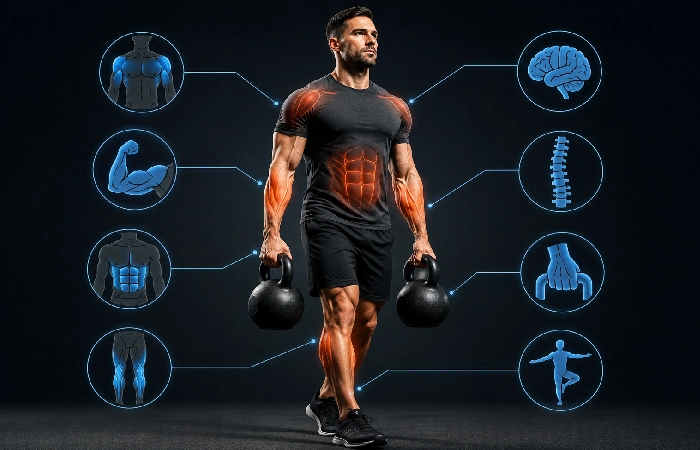
Perhaps the single most useful exercise out there for building the forearms is the farmer’s carry.
How to Perform a Farmer’s Carry
- Pick up heavy dumbbells or kettlebells.
- Stand upright.
- Walk a predetermined distance.
- Maintain a firm grip throughout.
Benefits of Farmer’s Carry
- Improves grip endurance
- Builds full-body stability
- Strengthens forearms naturally
- Enhances functional fitness
Common Mistakes
- Using excessive body sway
- Looking down while walking
- Selecting a weight that is too heavy to control
Don’t have access to a gym? Follow our Home Forearm Training to build strength and endurance using minimal equipment.
Dead Hangs Exercise
Dead hangs are simple but highly effective for grip development.
How to Perform Dead Hangs
- Grab a pull-up bar.
- Hang with arms fully extended.
- Maintain grip as long as possible.
- Rest and repeat.
Benefits
- Improves grip endurance
- Strengthens forearms and hands
- Supports pull-up performance
- Requires minimal equipment
Sample Forearm Training Workflow
Beginner Routine
| Exercise | Sets | Reps |
| Wrist Curls | 3 | 15 |
| Reverse Wrist Curls | 3 | 15 |
| Hammer Curls | 3 | 12 |
| Dead Hangs | 3 | 20–30 seconds |
Comparing Popular Forearm Exercises
| Exercise | Grip Strength | Muscle Growth | Equipment Required | Difficulty |
| Wrist Curls | And Moderate | High | Dumbbell/Barbell | Easy |
| Reverse Wrist Curls | Moderate | Moderate | Dumbbell/Barbell | Easy |
| Hammer Curls | Moderate | High | Dumbbells | Easy |
| Farmer’s Carry | Very High | Moderate | Dumbbells/Kettlebells | Moderate |
| Dead Hangs | Very High | Moderate | Pull-Up Bar | Moderate |
Common Training Mistakes
Training Too Frequently
Whileforearmsexecise may recover quickly, to be too strong is fatigue.
Ignoring Progressive Overload
Gradually increasing resistance helps stimulate continued adaptation.
Neglecting Wrist Extensors
Many trainees focus only on wrist curls and forget reverse wrist curls, creating muscular imbalances.
Using Momentum
Forearm exercises work best with controlled movement and also proper technique. To increase resistance and challenge your muscles further, check out our Equipment-Based Forearm Workouts.
How Often Should You Train Forearms?
Most people can train forearms two to three times per week.
General Recommendations
- Beginners: 2 sessions weekly
- Intermediate lifters: 2–3 sessions weekly
- Advanced athletes: Based on recovery capacity
Allow at least 48 hours between dedicated forearm sessions when possible.
Expectations Management
ThecBuilding stronger forearms requires consistency and also patience.
What You May Notice
Within 2–4 weeks
- Improved grip endurance
- Better exercise control
Within 6–12 weeks
- Increased grip strength
- Enhanced performance in pulling exercises
After Several Months
- Noticeable muscular development
- Improved forearm definition Many of these exercises are excellent for improving hand power and endurance. Read our Grip Strength Training for specialized techniques.
Frequently Asked Questions
What are the best exercises for your forearms if you are just starting out?
You need to get a few sets of wrist curls, reverse wrist curls, hammer curls and of course the classic dead hang all for forearms – for sure a no brainer to do as you get to start your journey.
How times a week should you do forearm exercises?
You should do forearm exercises two or three times a week. This is what works best for people.
Are farmers carries worth doing?
Yes they are. Farmers carries can help your grip endurance and forearm strength and posture and overall fitness.
Do dead hangs work your forearms?
Yes they do. Dead hangs are hard on your forearm muscles. Can really help your grip endurance.
Can exercises, for your forearms make your grip stronger?
Yes they can. If you do forearm exercises all the time they can really improve your grip strength over time. Athletes can use these exercises to enhance performance in climbing, tennis, martial arts, and other activities. Learn more in our Sports and Functional Forearm Training.
Conclusion
Forearm exercises are really good for you. They can make your grip stronger your wrists more stable and your muscles last longer. You can do things like wrist curls and reverse wrist curls to help your forearms. Hammer curls are also good for forearms. If you do farmers carries and dead hangs that is great too.
These movements can help you have a good workout routine that makes you stronger and helps you do things better. It takes a while to see results from forearm exercises.. If you keep at it and make your workouts a little harder over time you can really improve your forearms and how well they work. Forearm exercises can make a difference, in how strong your upper body is. Training hard is important, but recovery matters too. Follow our Forearm Recovery and Injury Prevention to reduce soreness and avoid injuries.