
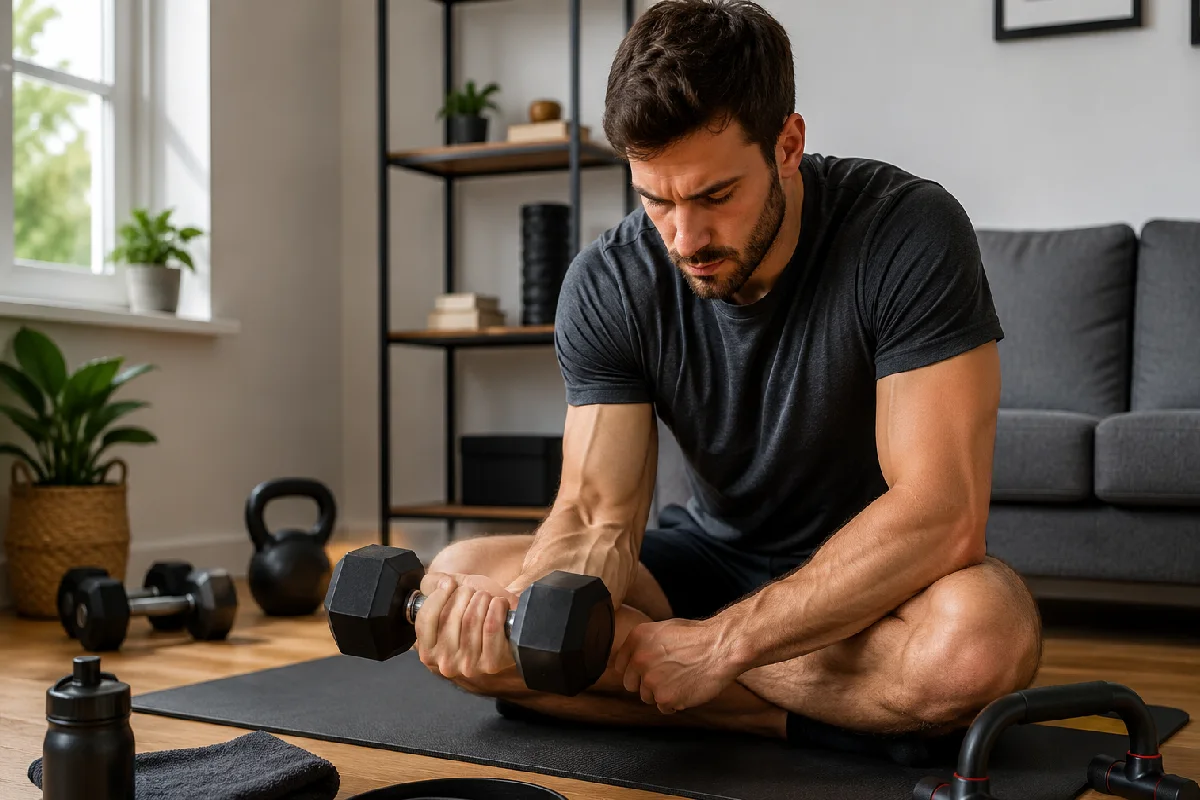
Having forearms is really important for doing everyday things and for playing sports. If you like to lift weights play sports or work with your hands or if you just want to be able to grip things Home Forearm Training is a great way to make your forearms stronger without having to buy a lot of expensive equipment.
Many people spend a lot of time working on their chest, shoulders and arms. They forget about their forearms. Home Forearm Training can help with this. Stronger forearms are good for lifting weights they help you grip things better they are good for your wrists. They help you have more control when you are doing exercises that use your upper body.
This guide will show you how to make your forearms stronger at home. It will tell you which exercises are the best, for your forearms what you can expect to happen when you start doing these exercises and how to avoid making mistakes when you are training your forearms. Home workouts are a great starting point, but a complete program includes strength training, grip work, and recovery. Explore our Forearm Workouts for a comprehensive approach to forearm development.
This Article is part of the Workout Plans
What Is Home Forearm Training?
Home Forearm Training is when you do exercises at home to make your forearm muscles stronger. This helps with moving your wrist and controlling your fingers and grip. You can do these exercises with things you have at home, like your body weight, special bands that give resistance, dumbbells, a heavy backpack or even a water bottle. Home Forearm Training exercises can be done with different things you can find at home. Knowing which muscles you’re targeting can help you get better results from every exercise. Learn more in our Forearm Anatomy.
Unlike isolation routines that only target muscle size, a balanced programme develops:
- Grip strength
- Wrist stability
- Muscular endurance
- Functional strength
- Injury resilience
Benefits of Home Forearm Training
Regular forearm workouts provide several practical benefits.
- Improved grip strength for lifting and carrying
- Better performance during pull-ups and rows
- Increased wrist stability
- Enhanced muscular endurance
- Better control in sports such as tennis, climbing, golf, and basketball
- Reduced fatigue during repetitive hand movements
- Support for everyday activities including carrying shopping bags and lifting objects
Forearm training is good for making the muscles in your forearms look more defined. The form of your forearms will too adapt to changes in the body’s overall form, eating habits as well. Do check our variety of Forearm Exercises for the strength, endurance, muscle building if you desire some variation in your forearm activities.
Forearm Workout at Home: Essential Exercises
A good forearm workout at home should have exercises for the forearm muscles. It should also have exercises for the wrist flexors and the wrist extensors.
Wrist Curls
Targets the wrist flexor muscles.
How to perform:
- Rest your forearm on a bench or chair.
- Hold a light dumbbell or water bottle.
- Slowly curl the wrist upward.
- Lower under control.
Recommended:
- 3 sets
- 12–15 repetitions
Reverse Wrist Curls
This exercise is really good, for the wrist extensors. The wrist extensors are often forgotten about.
Benefits include:
- Improved wrist balance
- Better elbow health
- Greater lifting stability
Farmer’s Carry
Carry heavy objects while maintaining posture.
Household alternatives include:
- Water containers
- Buckets
- Loaded backpacks
This exercise develops:
- Grip strength
- Forearm endurance
- Shoulder stability
- Core engagement
Towel Grip Holds
Roll a towel around a sturdy object or hang from a towel if suitable equipment is available.
Excellent for:
- Grip endurance
- Finger strength
- Functional forearm development
Forearm Exercises Without Equipment
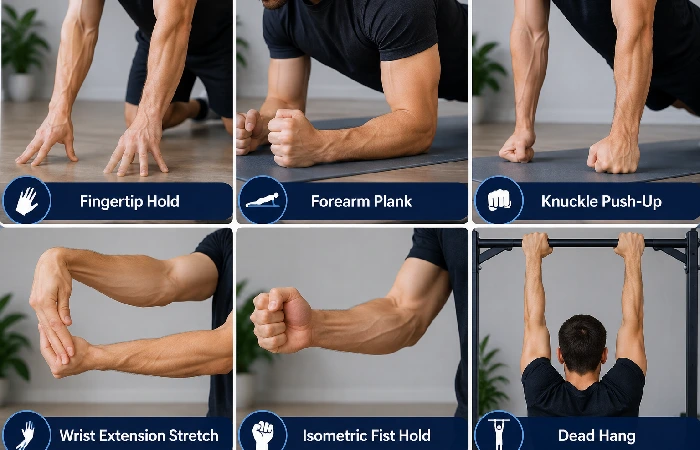
Many people believe equipment is necessary, but several forearm exercises without equipment remain highly effective. Once bodyweight movements become easier, consider progressing to weighted training with our Equipment-Based Forearm Workouts.
Fingertip Push-Ups
Advanced exercise that increases finger and wrist strength.
Beginners should modify against a wall before progressing.
Fist Planks
Holding a plank on closed fists strengthens:
- Wrist stabilisers
- Knuckles
- Forearm muscles
Hand Squeezes
Use:
- Tennis balls
- Stress balls
- Rolled towels
Ideal for daily grip conditioning.
Finger Extensions
Place a rubber band around the fingers and open the hand repeatedly.
This trains the muscles often ignored during gripping exercises.
Resistance Band Forearm Exercises
Resistance bands provide smooth tension while placing relatively low stress on the joints.
Popular resistance band forearm exercises include:
Band Wrist Curl
Attach the band securely and curl the wrist against resistance.
Reverse Band Curl
Strengthens the wrist extensors with controlled resistance.
Wrist Rotation
Rotate the wrist through pronation and supination.
Helps improve:
- Mobility
- Joint control
- Sports performance
Finger Opening
Loop a resistance band around all fingers.
Open the hand repeatedly to strengthen the extensor muscles. Many home exercises are excellent for improving hand and wrist power. For more advanced techniques, read our Grip Strength Training.
Bodyweight Forearm Workout
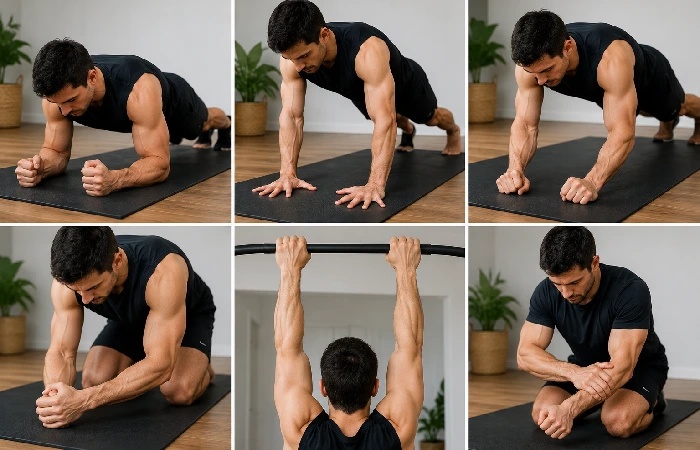
A simple bodyweight forearm workout can be completed in approximately 20 minutes.
| Exercise | Sets | Repetitions |
| Fist Plank | 3 | 30–45 sec |
| Fingertip Push-Up (modified if needed) | 3 | 6–10 |
| Hand Squeezes | 3 | 20 |
| Finger Extensions | 3 | 20 |
| Towel Grip Hold | 3 | 30 sec |
Complete this routine two to three times per week while allowing recovery between sessions. To maximize muscle growth while training at home, follow the proven methods in our Forearm Muscle Building.
Weekly Home Forearm Training Workflow
| Day | Activity |
| Monday | Grip Strength |
| Tuesday | Rest or mobility work |
| Wednesday | Wrist Strength |
| Thursday | Rest |
| Friday | Endurance Circuit |
| Saturday | Light recovery and stretching |
| Sunday | Rest |
Consistency generally produces better long-term results than training every day. Athletes can use home workouts to improve performance in activities such as climbing, tennis, martial arts, and wrestling. Learn more in our Sports and Functional Forearm Training.
Comparison of Home Forearm Training Methods
| Training Method | Equipment Needed | Difficulty | Best For |
| Bodyweight | None | Beginner | General fitness |
| Resistance Bands | Resistance band | Beginner–Intermediate | Joint-friendly strength |
| Household Weights | Water bottles, backpack | Intermediate | Muscle growth |
| Dumbbells | Dumbbells | Intermediate–Advanced | Progressive overload |
Common Training Mistakes
Avoid these frequent errors:
- Using excessive weight
- Training every day without recovery
- Ignoring wrist extensors
- Rushing repetitions
- Poor wrist positioning
- Skipping warm-ups
Quality movement is generally more effective than lifting heavier loads with poor technique.
Expectations: What Results Can You Realistically Expect?
Results vary depending on training consistency, nutrition, sleep, age, genetics, and previous experience.
Typical progression may include:
| Time | Expected Progress |
| 2–4 weeks | Improved grip endurance |
| 4–8 weeks | Better wrist stability |
| 8–12 weeks | Noticeable strength gains |
| 3–6 months | Increased muscular definition (depending on body fat levels) |
Muscle size develops gradually. Progressive overload and adequate protein intake support long-term improvements. Recovery is essential for long-term progress and injury prevention. Follow our Forearm Recovery and Injury Prevention to keep your muscles and joints healthy.
Pros and Limitations
Advantages
- Minimal equipment required
- Suitable for beginners
- Convenient scheduling
- Supports grip strength
- Improves wrist function
- Cost-effective
Limitations
- Limited resistance without equipment
- Progress may plateau
- Requires consistent practice
- Visible muscle growth takes time
Safety Tips
Before beginning Home Forearm Training:
- Warm up wrists for five minutes.
- Use controlled movement.
- Avoid sharp pain.
- Increase resistance gradually.
- Stretch after each workout.
- Allow recovery between sessions.
Individuals with wrist injuries should consult a qualified healthcare professional before starting a new exercise programme.
Conclusion
Home Forearm Training is a way to make your grip stronger make your wrist more stable and do better at things you do every day and at sports. You can do Forearm Training at home do Forearm Training without any equipment use rubber bands to do Forearm Training or follow a plan, for Forearm Training that uses your own body weight. What is important is that you do it regularly not that it is complicated.
Try to get a little each time make sure you are doing the exercises correctly give your body time to rest and do not expect too much too soon. If you keep doing Forearm Training your hands will get stronger you will be able to do things for longer. Your whole upper body will work better. Home Forearm Training is an idea because it helps you make progress and that is what matters. You can do Home Forearm Training. See the difference it makes to your Forearm Training.