
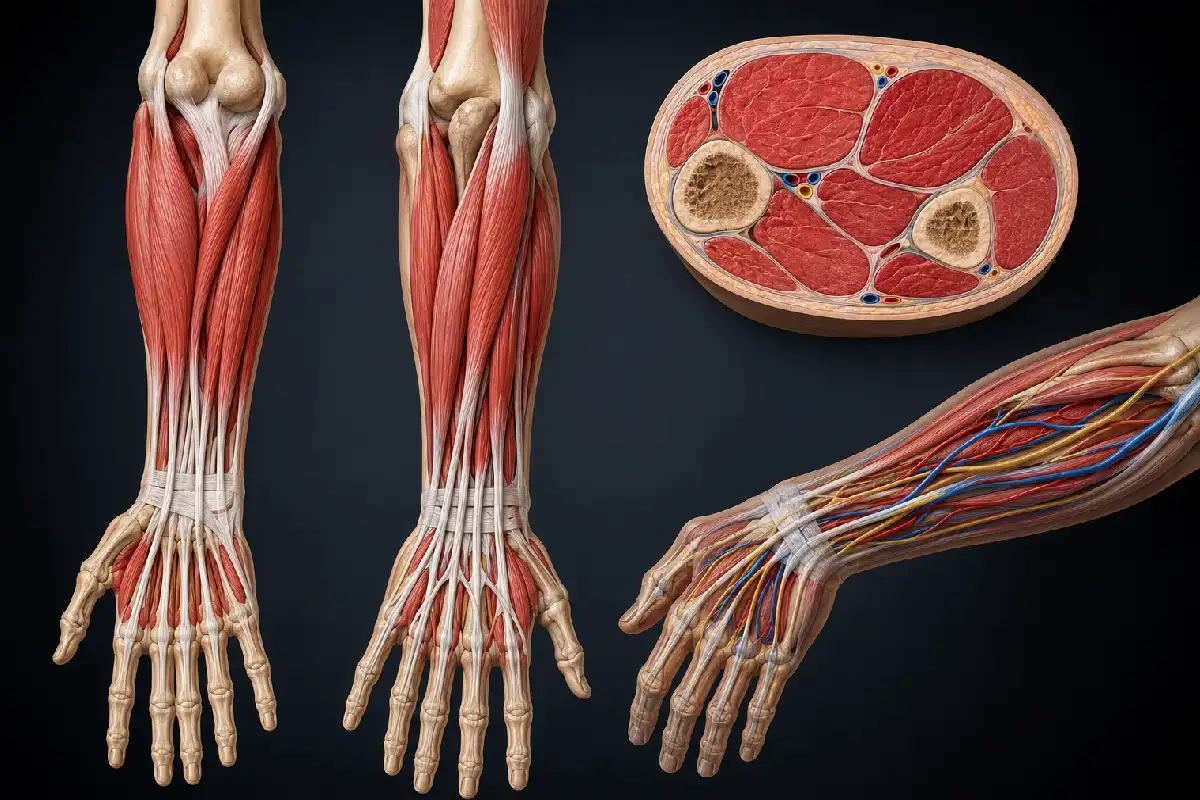
The forearms are really important for lots of things we do with our body. We use our forearms when we lift weights carry groceries type on the computer and play sports.. Even though our forearms are so important many people focus on other muscles and do not think about their forearms.
Understanding how the forearms work and what they do is an idea if you want to train your body effectively. This will help you have a grip do better in sports and get hurt less often. If you are just starting out with working out or if you have been doing it for a time learning about the forearms will help you train smarter and get better results, with your forearm and the rest of your body. To learn how all forearm muscles work together during training, explore our complete Forearm Workouts Guide:
This Article is part of the Workout Plans
Definition: What Are Forearm Anatomy & Fundamentals?
The purpose ofForearm Anatomy & Fundamentalis to identify all the components, structures and how it is functioning that would include muscles, tendons, bones, joints and nerves located within the forearm. All those are essential for gripping, lifting and twisting along with wrist flexion and extension in addition to finger movements.
Learning basic Anatomy of Forearm to Select a workout with proper training volume & how not to commit common training errors that could irritate or over use injury to one of your body parts. Understanding muscle structure makes it easier to choose the right forearm exercises for strength, endurance, and muscle growth:
Understanding Forearm Muscles
The forearm contains numerous muscles that control wrist and also hand, finger movement. These muscles are generally divided into two major groups.
Flexor Muscles
The flexor muscles are located on the inner side of the forearm.
Their primary functions include:
- Wrist flexion
- Finger flexion
- Grip formation
- Object holding
Common flexor muscles include:
- Flexor Carpi Radialis
- Flexor Carpi Ulnaris
- Palmaris Longus
- Flexor Digitorum Superficialis
Muscles involved here are heavily engaged during exercises such as deadlifts, pull-ups, farmer’s carries and wrist curls. Many forearm muscles can be trained effectively at home using bodyweight movements and simple equipment. See our home forearm training guide:
Extensor Muscles
The extensor muscles are located on the outer side of the forearm.
Their responsibilities include:
- Wrist extension
- Finger extension
- Stabilisation during gripping
- Hand opening movements
Major extensor muscles include:
- Extensor Carpi Radialis Longus
- Extensor Carpi Radialis Brevis
- Extensor Digitorum
- Extensor Carpi Ulnaris
Coordinated development of flexor as well as extensor muscles will aid support your joints more as well as help with overall grip strength.
Forearm Structure Overview
However there are some more anatomatical structures working together not including all the musculature to cause movement.
| Structure | Function |
| Radius | Supports wrist rotation |
| Ulna | Provides elbow stability |
| Muscles | Generate movement |
| Tendons | Connect muscles to bones |
| Ligaments | Stabilise joints |
| Nerves | Control muscle activation |
| Blood Vessels | Supply oxygen and nutrients |
Understanding these structures and also can help explain why proper training technique is important for long-term joint health.
Benefits of Strong Forearms
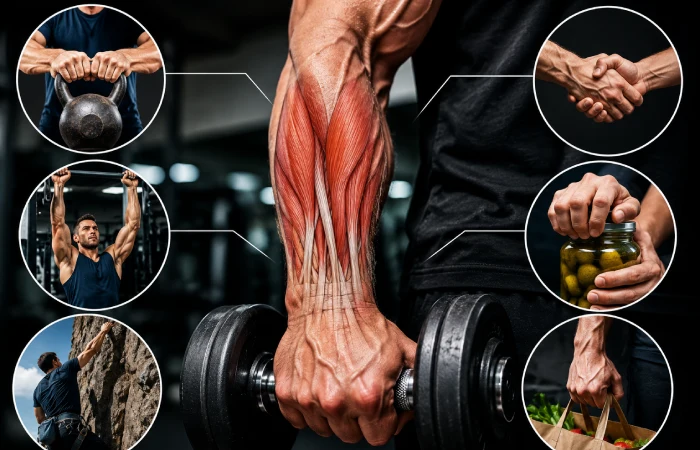
Many fitness fans underestimation the rewards of forearm development. Strong forearms contribute to both performance and daily function.
Improved Grip Strength
Grip strength often limits performance during:
- Deadlifts
- Pull-ups
- Rows
- Carries
Stronger forearms allow individuals to maintain grip for longer periods.
Better Athletic Performance
Sports such as:
- Cricket
- Tennis
- Badminton
- Wrestling
- Rock climbing
require substantial forearm endurance and control.
Enhanced Functional Fitness
Everyday tasks benefit from stronger forearms, including:
- Carrying shopping bags
- Opening jars
- Moving furniture
- Gardening
Reduced Injury Risk
Balanced forearm development may help support wrist stability and reduce stress during repetitive activities.
How Forearm Muscles Work During Movement
Most people think of forearms only during gripping activities. However, these muscles contribute to numerous movement patterns.
Movement Workflow
- Brain sends signal through nerves.
- Forearm muscles contract.
- Tendons pull on bones.
- Wrist or fingers move.
- Grip force is generated.
- Stabilising muscles maintain control.
This coordinated process occurs during both exercise and daily activities.
Forearm Training Frequency
One of the most common questions concerns how often forearms should be trained.
Recommended Training Frequency
| Experience Level | Weekly Frequency |
| Beginner | 1–2 sessions |
| Intermediate | 2–3 sessions |
| Advanced | 3–4 sessions |
| Athletes | Based on sport demands |
Because forearms are involved in many upper-body exercises, excessive direct training may increase recovery demands.
Factors Affecting Frequency
Training frequency should consider:
- Recovery ability
- Overall workout volume
- Grip-intensive exercises
- Previous injuries
- Training goals
For most individuals, moderate volume performed consistently produces better long-term results than excessive daily training.
Effective Exercises for Forearm Development
Several exercises can strengthen forearm muscles effectively.
Beginner-Friendly Exercises
Wrist Curls
Targets wrist flexors and helps build foundational strength.
Reverse Wrist Curls
Focuses on wrist extensors and promotes muscular balance.
Farmer’s Carry
Improves grip endurance and total forearm engagement.
Dead Hangs
Develops grip strength and muscular endurance.
Intermediate and Advanced Exercises
- Plate pinches
- Towel pull-ups
- Heavy carries
- Fat-grip training
- Wrist roller exercises
You need to use variety to develop the whole forearm. Free weights and specialized grip tools can place greater resistance on the forearm muscles. Learn more in our equipment-based forearm workouts guide:
Forearm Workout Mistakes to Avoid
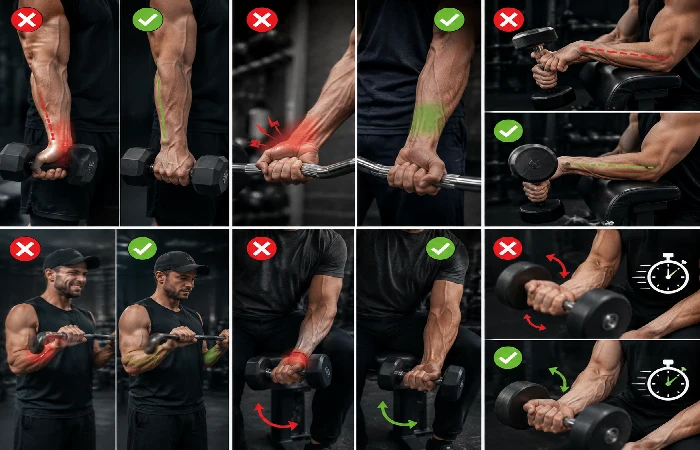
Most of us will stunt our development by practicing these common mistakes.
Mistake 1: Training Only Flexors
Don’t just hammer wrist curls; you may be setting up your own muscular imbalance.
Mistake 2: Ignoring Recovery
Forearms are heavily used throughout daily life. Insufficient recovery can reduce performance.
Mistake 3: Using Excessive Weight
Incorrect technique will likely transfer the load away from your working muscles and add unwanted strain to your joints.
Mistake 4: Neglecting Grip Variety
Each different forearm grip can work your muscles in unique ways.
Mistake 5: Expecting Rapid Growth
Most forearm growth comes about gradually through repeated effort. The forearm muscles are responsible for much of your hand and wrist power, making them essential for developing grip strength:
What Results Can You Realistically Expect?
Managing expectations will be key to long-term progress.
After 4–6 Weeks
You may notice:
- Improved grip endurance
- Better exercise control
- Reduced hand fatigue
After 2–3 Months
Possible improvements include:
- Increased grip strength
- Better lifting performance
- More noticeable muscular definition
Long-Term Development
Visible muscle growth depends on:
- Genetics
- Nutrition
- Recovery
- Training consistency
- Overall body composition
Forearm development is typically a gradual process rather than a rapid transformation. If your goal is larger and more defined forearms, follow our forearm muscle-building guide for proven hypertrophy techniques:
Balanced Training vs Neglected Forearm Training
| Factor | Balanced Forearm Training | Neglected Forearms |
| Grip Strength | Higher | Lower |
| Lifting Performance | Improved | Limited |
| Wrist Stability | Better | Reduced |
| Daily Function | Easier | More Fatigue |
| Injury Resistance | Generally Improved | Potential Weakness |
| Athletic Performance | Enhanced | May Be Limited |
Building a Simple Forearm Training Routine
Sample Weekly Workflow
Day 1
- Wrist Curls – 3 sets
- Reverse Wrist Curls – 3 sets
- Farmer’s Carry – 3 rounds
Day 2
- Dead Hangs – 3 sets
- Plate Pinches – 3 sets
Day 3
- Wrist Roller – 3 sets
- Farmer’s Carry – 3 rounds
Focus on gradual progression rather than excessive volume. Strong forearm muscles are critical for athletic performance in activities such as climbing, tennis, arm wrestling, and martial arts. Discover more in our sports and functional forearm training guide:
Conclusion
To get the results from your workouts you need to know about Forearm Anatomy and the basics. This helps you build a base for working out and doing well in sports over time. The Forearm has a lot of parts like muscles, tendons, bones and nerves that all work together to help you grip things lift things carry things and do everyday tasks.
When you learn how the muscles in your Forearm work. You work out your Forearms the right way and you know why strong Forearms are good for you and you avoid making common mistakes when you work out your Forearms you can get stronger overall. You need to work out be realistic, about what you can do and take care of yourself after you work out. These things are important if you want to make your Forearms stronger and stay healthy.