
Introduction
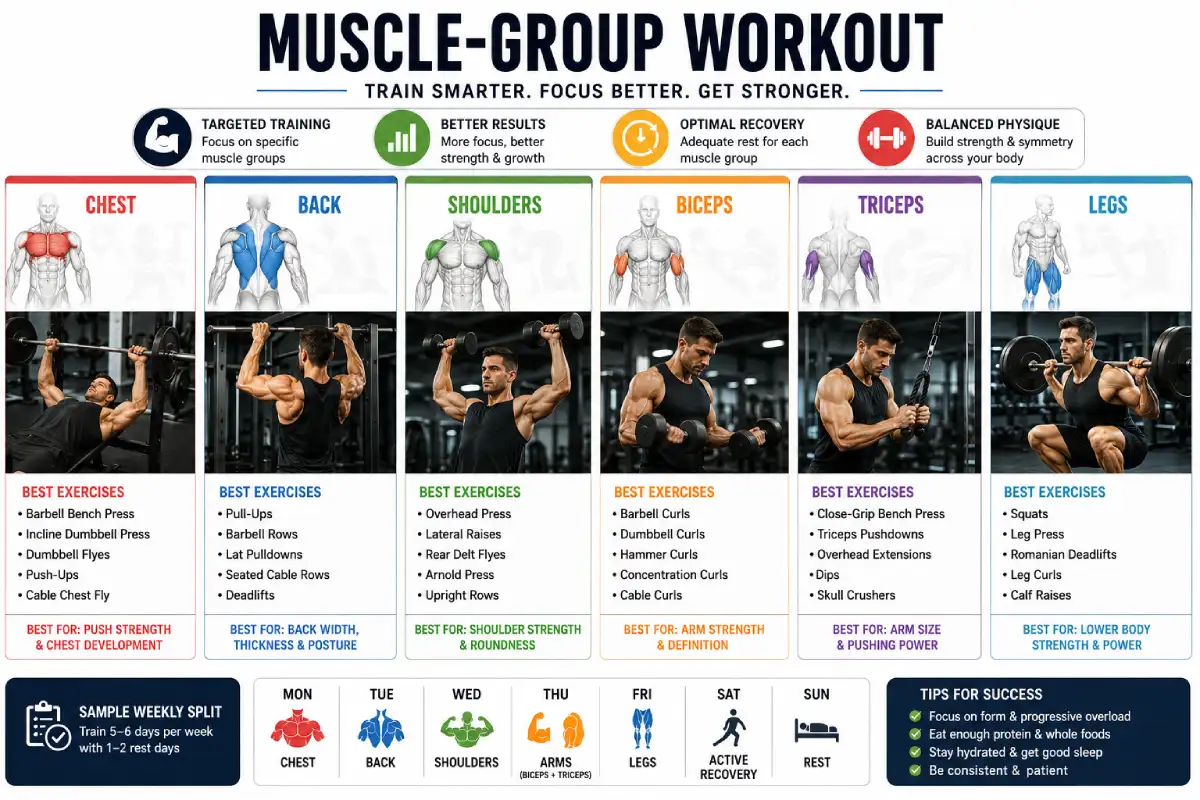
A good Muscle-Group Workout programme is a way to get strong make sure your muscles are balanced and help you reach your fitness goals in the long run. This way of working out does not do the body at once it does different parts, like the chest, back, shoulders, arms and legs on different days.
For a lot of people who go to the gym doing a muscle-group workout routine makes it easier to plan exercises get rest and see how they are doing.. To really get good results you have to do it regularly pick the right exercises rest enough and know what to expect from your Muscle-Group Workout programme. Group training can be an effective way to stay motivated while following a structured workout routine. For a complete overview, explore our 6-Day Gym Workout Schedule.
Why Follow a Muscle-Group Workout Plan?
Training by muscle groups offers several practical benefits:
- Better workout organisation
- Easier recovery management
- Increased training focus
- Improved exercise variety
- Progressive overload opportunities
- Balanced muscle development
Many intermediate and advanced learners use muscle-group splits because they allow greater training volume per muscle group associated to full-body procedures. Successful group workouts require proper exercise sequencing, recovery planning, and workout organization. Learn more in our Training Structure.
Chest Workout: Building Upper-Body Strength
The pectoral muscles are heavily involved in pushing type movements and in upper body strength.
Key Chest Exercises
- Barbell Bench Press
- Incline Dumbbell Press
- Push-Ups
- Chest Flyes
- Cable Crossovers
- Machine Chest Press
Sample Chest Workout
| Exercise | Sets | Reps |
| Bench Press | 4 | 6–10 |
| Incline Dumbbell Press | 3 | 8–12 |
| Chest Flyes | 3 | 10–15 |
| Push-Ups | 3 | To fatigue |
Expectations
Chest strength and growth gained over time Usually, strength and growth for your chest takes some time – it builds slowly for several months of regular training.
Back Workout: Developing Strength and Posture
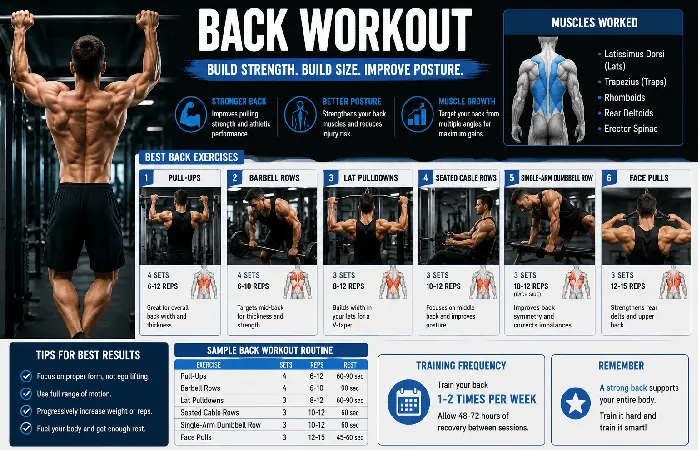
Important Back Muscles
- Latissimus dorsi
- Trapezius
- Rhomboids
- Erector spinae
Key Back Exercises
- Pull-Ups
- Lat Pulldowns
- Barbell Rows
- Seated Cable Rows
- Deadlifts
- Face Pulls
Sample Back Workout
| Exercise | Sets | Reps |
| Pull-Ups | 4 | 6–12 |
| Barbell Rows | 4 | 6–10 |
| Lat Pulldowns | 3 | 10–12 |
| Seated Rows | 3 | 10–12 |
Expectations
Improved posture and pulling strength often appear before visible muscle changes. Training with others can be especially beneficial for newcomers who need guidance and accountability. Read our Beginner 6-Day Workout Guide.
Shoulder Workout: Building Stability and Definition
Strong shoulders contribute to pressing power and upper-body aesthetics.
Shoulder Muscle Areas
- Front Deltoids
- Side Deltoids
- Rear Deltoids
Effective Shoulder Exercises
- Overhead Press
- Lateral Raises
- Rear Delt Flyes
- Arnold Press
- Upright Rows
Sample Shoulder Workout
| Exercise | Sets | Reps |
| Overhead Press | 4 | 6–10 |
| Lateral Raises | 3 | 12–15 |
| Rear Delt Flyes | 3 | 12–15 |
| Arnold Press | 3 | 8–12 |
Expectations
Your shoulders must be trained and conditioned through all3 heads of your deltoid muscles if you expect a mature, developed shoulder, not simply by going through and throwing around and Presses.
Biceps Workout: Improving Pulling Strength
The biceps assist many pulling exercises and contribute to arm development.
Best Biceps Exercises
- Barbell Curls
- Dumbbell Curls
- Hammer Curls
- Concentration Curls
- Cable Curls
Sample Biceps Workout
| Exercise | Sets | Reps |
| Barbell Curl | 4 | 8–12 |
| Hammer Curl | 3 | 10–12 |
| Cable Curl | 3 | 10–15 |
| Concentration Curl | 2 | 12–15 |
Expectations
Total workout intensity and diet really affect arms, not just arm exercises.
Triceps Workout: Supporting Pressing Performance
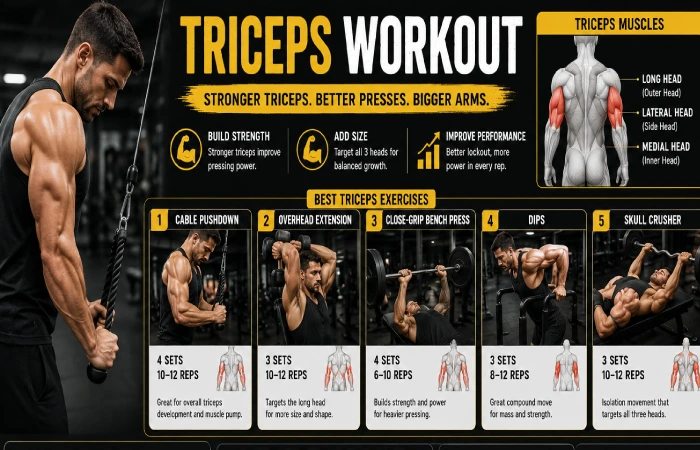
Effective Triceps Exercises
- Close-Grip Bench Press
- Triceps Pushdowns
- Overhead Extensions
- Dips
- Skull Crushers
Sample Triceps Workout
| Exercise | Sets | Reps |
| Close-Grip Bench Press | 4 | 6–10 |
| Pushdowns | 3 | 10–12 |
| Overhead Extensions | 3 | 10–12 |
| Dips | 2 | To fatigue |
Leg Workout: Building Lower-Body Strength
Major Leg Muscles
- Quadriceps
- Hamstrings
- Glutes
- Calves
Best Leg Exercises
- Squats
- Romanian Deadlifts
- Leg Press
- Lunges
- Leg Curls
- Calf Raises
Sample Leg Workout
| Exercise | Sets | Reps |
| Squats | 4 | 6–10 |
| Romanian Deadlift | 4 | 8–10 |
| Leg Press | 3 | 10–12 |
| Walking Lunges | 3 | 12 each leg |
| Calf Raises | 4 | 12–20 |
Muscle-Group Workout Split Comparison
| Training Split | Suitable For | Frequency |
| Full Body | Beginners | 3x weekly |
| Upper-Lower | Beginners to Intermediate | 4x weekly |
| Push Pull Legs | Intermediate | 5–6x weekly |
| Muscle-Group Split | Intermediate to Advanced | 5–6x weekly |
Advantages
- Higher muscle-group focus
- Increased exercise variety
- Better volume distribution
Limitations
- Requires more weekly training days
- Missed sessions may disrupt balance
- Less frequent stimulation for some muscle groups
Weekly Muscle-Group Workout Workflow
Day 1 – Chest Workout
Focus on pressing and chest isolation movements.
Day 2 – Back Workout
Prioritise pulling exercises and posture development.
Day 3 – Shoulder Workout
Train all three deltoid heads.
Day 4 – Biceps and Triceps Workout
Target arm development and accessory strength.
Day 5 – Leg Workout
Focus on compound lower-body movements.
Day 6 – Active Recovery
Walking, mobility work, or light cardio.
Day 7 – Rest
Allow complete recovery before beginning another cycle.
Many lifters use group workouts to increase motivation and consistency while pursuing muscle growth goals. Explore our Muscle Building.
Recovery and Nutrition for Muscle Growth
Recovery Priorities
- Sleep 7–9 hours nightly
- Stay hydrated
- Manage stress
- Schedule rest days
Nutrition Priorities
- Consume sufficient protein
- Include complex carbohydrates
- Eat healthy fats
- Maintain consistent calorie intake
Managing Expectations
Some training schemes are quick fixes. Life happens the reality is progress takes longer than.
Realistic Expectations
- Strength improvements often appear within weeks.
- Visible muscle growth usually requires several months.
- Consistency matters more than perfect workouts.
- Recovery quality affects results significantly.
A better approach is usually long-lasting better long results come from more sustainable routines than do severe short term ones.
Common Muscle-Group Workout Mistakes
Training Too Much
Excessive volume may reduce recovery quality.
Ignoring Progressive Overload
Muscles require gradually increasing challenges.
Poor Exercise Technique
Proper form helps reduce injury risk.
Skipping Leg Workouts
Balanced development requires lower-body training.
Inadequate Recovery
Rest is essential for adaptation and growth.
Proper nutrition remains essential regardless of whether you train alone or with a group. Discover recovery and fueling strategies in our Workout Nutrition Guide.
Frequently Asked Questions
What is a Muscle-Group Workout?
A Muscle-Group Workout is a way of training where you focus on muscles each time you work out. This helps your body recover. Makes your workouts more organised.
Is a muscle-group split good for beginners?
People who are new to working out can use this method. It works for them but a lot of times they do better when they do full-body workouts or upper and lower body workouts.
How often should I train each muscle group?
Most Muscle-Groups do well when you train them one or two times a week. This depends on how experienced you’re how well your body recovers.
Which muscle group should be trained first?
Many people train the big muscle groups like the back or legs at the start of the week. This is when they have the energy.
Can I build muscle with a Muscle-Group Workout?
Yes you can build muscle with a Muscle-Group Workout. If you combine it with making your workouts a little each time eating the right food and getting enough rest a Muscle-Group Workout can really help you get stronger and build more muscle.
Conclusion
A good Muscle-Group Workout programme helps you train your chest, back, shoulders, biceps, triceps and legs in a way throughout the week. You need to be patient and do the workouts all the time to get results.
This way of working out can make you stronger help your muscles grow and make sure you are training all parts of your body equally.
To get the results from your Muscle-Group Workout programme you should do the exercises correctly slowly increase the difficulty, rest when you need to and know what to expect. This will help you do well with your Muscle-Group Workout programme in the run and get good results, from your Muscle-Group Workout programme. Group training can be customized to support different objectives such as fat loss, strength development, or muscle gain. Learn more in our Goal-Based Workout Guide.