
Introduction
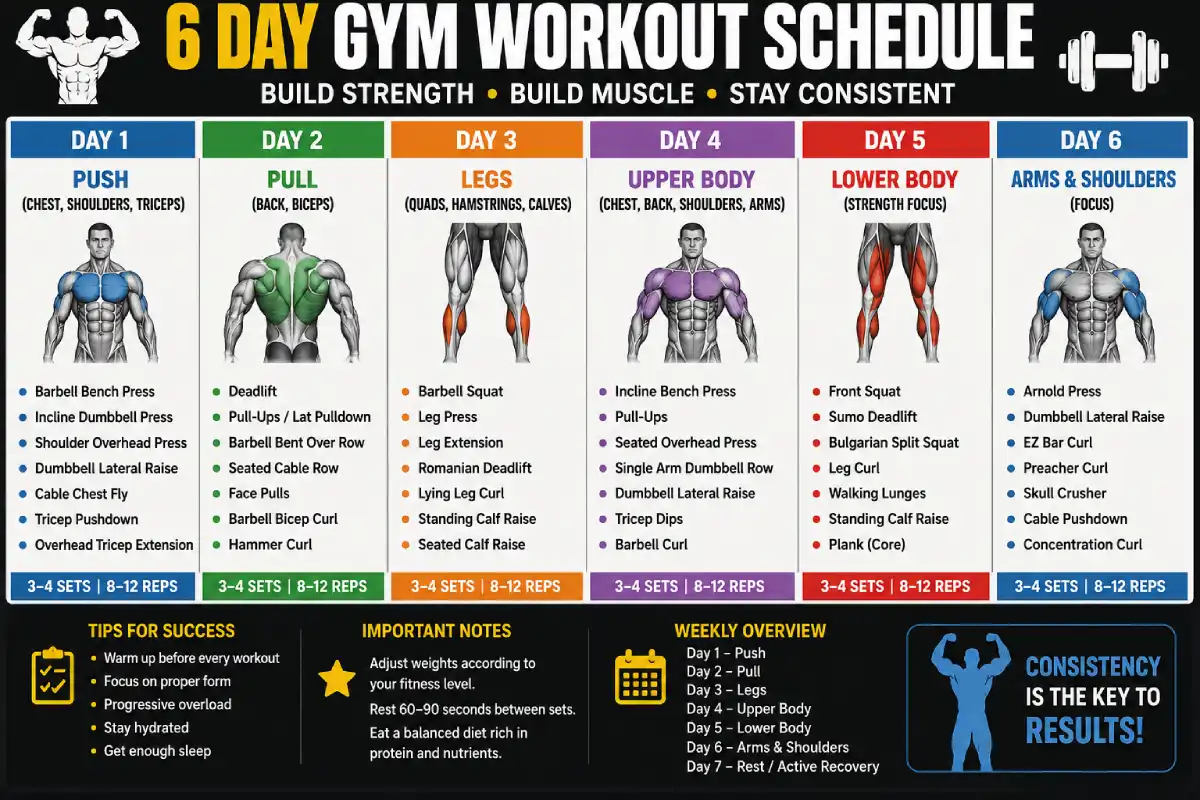
A good gym plan that lasts for six days can really help people build muscle get stronger and make exercise a regular part of their life.
Many people who go to the gym a lot like to work out six days a week because this way they can focus on parts of their body like their arms or legs and still do enough exercise overall.
Just going to the gym for six days is not enough to get the results you want. You also need to choose the exercises work out hard enough get enough rest sleep well and eat the right food.
And with a plan in place that accounts for all these elements, you’ll also make the most of the time you have dedicated to the gym. Avoid getting too tired or hurt.
This guide will tell you about how to make a six-day gym plan work for you, who should try it and how to set up a weekly plan that will help you build muscle and get stronger with a six-day gym workout schedule. A well-designed workout plan starts with proper exercise selection, recovery management, and weekly scheduling. Learn how to organize your routine in our 6-Day Gym Workout Training Structure.
What Is a 6 Day Gym Workout Schedule?
I like to go to the gym for six days and then I take one day off. This is what I call my 6 day gym workout schedule. It is, like a plan that tells me when to do my gym workouts. I do my gym workouts on six days and then I have one day to rest.
The aims is to hit training groups just frequent enough to stimulate growth, without allowing any for recovery between sessions.
Key Characteristics
- Six training days per week
- One recovery day
- Focus on muscle-group splits
- Higher weekly training volume
- Suitable for intermediate and advanced trainees
- Can be adapted for strength, hypertrophy, or general fitness
Benefits
- Greater exercise variety
- More training volume per muscle group
- Improved workout consistency
- Better focus on individual body parts
- Easier progression tracking
Limitations
- Requires commitment and consistency
- Recovery becomes more important
- May not suit beginners
- Poor sleep or nutrition can limit results
6 Day Workout Split: Understanding the Structure
The most popular 6 day workout split is the Push-Pull-Legs approach repeated twice per week.
| Day | Muscle Groups |
| Monday | Push |
| Tuesday | Pull |
| Wednesday | Legs |
| Thursday | Push |
| Friday | Pull |
| Saturday | Legs |
| Sunday | Rest |
Push Days
Train muscles involved in pressing movements:
- Chest
- Shoulders
- Triceps
Pull Days
Train muscles involved in pulling movements:
- Back
- Rear delts
- Biceps
- Forearms
Leg Days
Focus on lower-body development:
- Quadriceps
- Hamstrings
- Glutes
- Calves
This structure provides balanced training frequency and recovery. Training with a partner or group can improve consistency, motivation, and workout enjoyment. Explore our 6-Day Group Workout for effective training approaches.
6 Day Gym Workout Plan Works
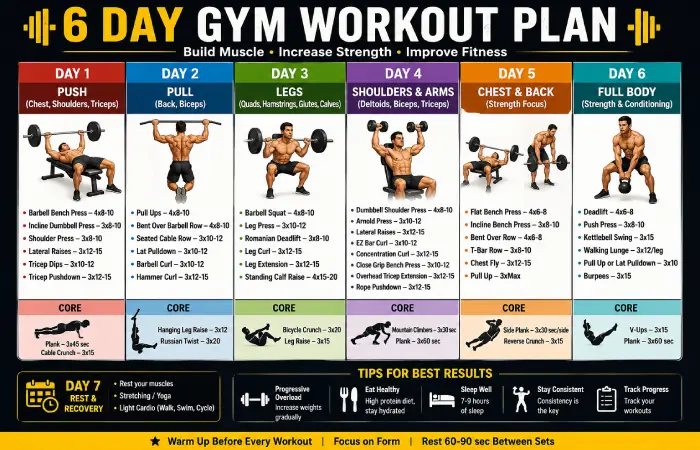
This a a perfectly structured 6 day gym workout plan, which will not result in any muscle fatigue, due to its structure, whilst also creating great frequency in training.
Research consistently shows that muscle growth is stimulated through:
- Progressive overload
- Sufficient weekly volume
- Adequate recovery
- Consistent training
A six-day schedule allows these principles to work together effectively. If you’re new to a six-day training split, understanding progression and recovery is essential. Read our Beginner 6-Day Gym Workout Guide.
Beginner & Experience-Level
A 6-day gym workout schedule is good for people who are just starting out and for people who have been going to the gym for a time.
The main thing is to make sure the workout is not too hard or too easy, for you.
You need to choose exercises that’re right for your body and make sure you get enough rest.
If you follow a plan and do a bit more each time you will get stronger and your muscles will grow.
You will also be able to do things for longer without getting tired. You will be healthier overall.
By doing this then you will be sure you can save from injury when you go at the gym when going for your gym workouts schedule days.
Step 1: Assess Your Fitness Level
Before you start you need to figure out if you’re a learner or someone who has stayed training for a while. If you are a beginner that means you are new to lifting weights or you have not been going to the gym regularly for than six months. On the hand if you are an experienced trainee that means you have a good foundation, in training and you know how to do exercises the right way. A six-day workout schedule is often used to maximize training volume and muscle growth. Discover proven strategies in our Muscle Building Workout.
Step 2: Start With the Right Training Volume
When you are just starting out you should focus on learning how to do the movements and doing them the same way every time. For each exercise do two or three sets with weights that’re not too heavy and try to do the exercise eight to twelve times. If you have been doing this for a while like trainees you can do more sets, like three to five sets, per exercise and try some advanced techniques to really work your muscles.
Step 3: Follow a Structured Weekly Split
A common 6-day split includes:
- Day 1: Chest
- Day 2: Back
- Day 3: Legs
- Day 4: Shoulders
- Day 5: Arms
- Day 6: Full Body or Weak Point Training
- Day 7: Rest
Beginners can stick to simple compound moves, And also with more advanced trainees adding some isolation movements and a couple extra sets.
Weekly Training Workflow
1: Choose Your Split
Select a structure such as:
- Push-Pull-Legs
- Upper-Lower Hybrid
- Bodybuilding Split
2: Select Compound Exercises
Examples:
- Squats
- Bench Press
- Deadlifts
- Overhead Press
- Pull-Ups
3: Add Isolation Exercises
Examples:
- Bicep Curls
- Tricep Extensions
- Leg Curls
- Lateral Raises
4: Apply Progressive Overload
Increase:
- Weight
- Repetitions
- Sets
- Time under tension
Step 5: Prioritise Recovery
- Sleep 7–9 hours
- Consume adequate protein
- Stay hydrated
- Schedule rest days
6 Day Bodybuilding Split vs Push-Pull-Legs
| Feature | Bodybuilding Split | Push Pull Legs |
| Frequency | Once weekly per muscle | Twice weekly |
| Muscle Focus | High | Moderate |
| Recovery | More localised | Balanced |
| Strength Gains | Good | Excellent |
| Hypertrophy Potential | High | High |
| Beginner Friendly | Moderate | Better |
Which Is Better?
For most people:
- PPL provides better muscle frequency.
- Bodybuilding splits allow more exercise variety.
- Advanced lifters may benefit from either approach.
Training six days per week requires proper nutrition to support performance, recovery, and muscle development. Learn more in our 0.
Muscle Building & Progressive Overload
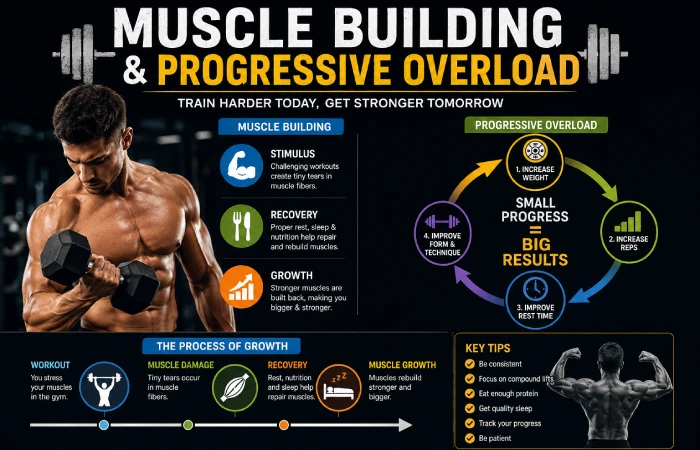
Muscle building is when our muscles get bigger. This happens when we do things that’re hard for our muscles like lifting weights and then our body fixes them when we rest. If we want our muscles to keep getting bigger we need to keep making our workouts a little all the time. This is called overload. If we do not make our workouts harder our body will get used to what we’re doing and our muscles will not get any bigger. Muscle building is also known as hypertrophy. We should always recall that the process of hypertrophy of muscles only takes place when our muscles are stressed and then they have to get recovered.
What Is Progressive Overload?
Progressive overload is when you slowly add stress to your muscles when you work out. As your muscles get stronger they need more of a challenge to keep getting bigger. If you keep making your workouts the body reacts by making your muscles stronger and bigger.
Why Progressive Overload Matters
When you do the exercises with the same weight and do the same number of repetitions for weeks or months your muscles get used to it and you stop getting stronger. Doing overload stops this from happening by making your muscles work harder as time goes on. This helps improve:
- Muscle size and definition
- Strength and power
- Muscular endurance
- Athletic performance
- Overall fitness levels
Effective Ways to Apply Progressive Overload
- Increase Training Weight
One popular option is to slowly increase your resistance in exercises. Let’s say your comfortable bench press weight is 100 pounds and you get 10 reps. Slowly Increase Resistance in exercises. Increase your 100lb bench press number to say 102.5lb in another session.
- Increase Repetitions
If you cannot add weight then do more reps of the current weight. Going from 10 reps to 12 reps can offer a training stimulus.
- Add More Sets
An increased number of sets will increase overall training volume and can lead to muscle growth assuming recovery.
- Improve Exercise Technique
Improving movement, control, and form to enhance the amount of muscle that is trained and stimulated.
- Reduce Rest Time
Taking less rest between sets is another method you can use to intensify your workouts and place a new sort of stress onto your muscles.
Best Exercises for Muscle Growth
Compound exercises work multiple groups of muscles at one time. These exercises are ideal for muscle development:
- Squats
- Deadlifts
- Bench Press
- Pull-Ups
- Barbell Rows
- Overhead Press
Isolation exercises such as bicep curls, tricep extensions, and leg curls can be added to target specific muscles.
Nutrition and Recovery for Muscle Building
Progressive overload really works well when you do it with food and rest. You need to eat protein so your muscles can fix themselves and you have to eat enough calories so your muscles can get bigger. Drinking plenty of water is also important.. You should try to sleep for 7 to 9 hours every night because that is when your body gets to rest. When you let your body rest your muscles can get stronger after you have been training with overload. Progressive overload is what helps your muscles rebuild and get stronger.
Nutrition, Recovery & Rest
Step 1: Focus on Proper Nutrition
Nutrition is the base for building muscle increasing strength and staying fit. Your body needs the mix of nutrients to work well and heal after working out. Add protein sources like chicken, fish, eggs, beans and yogurt to help fix muscles. And also Eat carbs such as brown rice, oats, sweet potatoes and whole grains for energy. The eat Healthy fats after nuts, seeds, avocados and olive oil benefit, with hormone production. Keep on healthy.
Step 2: Stay Hydrated
Water is really important for when you’re working out and getting better afterwards. You should drink water all day long not just when you are exercising. Drinking water helps keep your body at the right temperature gets nutrients to where they need to go and stops you from getting too tired. If you are someone who exercises a lot you should try to drink a lot of water every day especially before you work out while you are working out and after you are done working out with water. Water is something you need to drink all the time to stay healthy and have workout performance, with water.
Step 3: Prioritize Post-Workout Recovery
Your muscles need the food to get better and become stronger. And also You should eat a meal that has protein and carbohydrates in it after you work out. It is best to eat this meal one to three hours after you finish working out. This helps your muscles get the energy they need and helps your muscles build strength. Eating a meal, like this after you work out can really help your muscles. If you do some light stretching and walk around after you work out it can help your muscles feel less sore and get faster. Your muscles will thank you if you eat the food and take care of them after you work out.
Step 4: Get Quality Sleep
Sleep is really important for our body to get better. When we sleep our body fixes the muscles gets energy and sends out special hormones that help us grow. We should try to sleep for 7 to 9 hours every night. Sleep is very important. To sleep well we need to go to bed and wake up at the time every day. This helps our body get into a routine. Sleep helps our body recover. We need to make sure we get sleep each night.
Exercise Selection for a 6 Day Muscle Building Workout
A successful 6 day muscle building workout should include compound and isolation exercises.
Essential Compound Movements
Chest
- Bench Press
- Incline Press
- Dips
Back
- Deadlift
- Rows
- Pull-Ups
Legs
- Squat
- Front Squat
- Romanian Deadlift
Shoulders
- Overhead Press
- Arnold Press
Important Isolation Exercises
Arms
- Bicep Curl
- Hammer Curl
- Tricep Extension
Shoulders
- Lateral Raise
- Rear Delt Fly
Legs
- Leg Extension
- Leg Curl
- Calf Raise
Nutrition for a 6 Day Gym Workout Schedule
Training six days weekly increases energy demands.
Protein Intake
Most active individuals aim for:
- 1.6–2.2 g protein per kilogram of body weight
Sources include:
- Chicken
- Fish
- Eggs
- Greek yoghurt
- Lean beef
- Protein powders
Carbohydrates
Carbohydrates support:
- Workout performance
- Glycogen replenishment
- Recovery
Good sources:
- Rice
- Oats
- Potatoes
- Whole grains
- Fruit
Healthy Fats
Include:
- Avocados
- Nuts
- Olive oil
- Fatty fish
Hydration
Proper hydration supports:
- Strength output
- Muscle recovery
- Overall health
Aim to drink water consistently throughout the day.
Recovery Strategies for Long-Term Progress
Prioritise Sleep
Target:
- 7–9 hours nightly
Sleep supports:
- Hormone regulation
- Muscle repair
- Cognitive performance
Deload Periods
Every 6–10 weeks:
- Reduce volume
- Lower intensity
- Allow recovery
Mobility Training
Benefits include:
- Improved movement quality
- Better exercise technique
- Reduced stiffness
Realistic Expectations from a 6 Day Workout Routine
Many people expect rapid transformations.
A realistic perspective is important.
First Month
Potential improvements:
- Better exercise technique
- Increased confidence
- Slight strength gains
2–3 Months
Possible changes:
- Noticeable muscle growth
- Improved endurance
- Better training capacity
6–12 Months
Consistent training may lead to:
- Significant strength increases
- Visible physique changes
- Improved body composition
Results vary based on:
- Genetics
- Diet
- Sleep
- Consistency
Common Mistakes to Avoid
Training Too Heavy Every Session
Not every workout should be maximal effort.
Ignoring Recovery
Muscles grow during recovery, not only during exercise.
Poor Nutrition
Inadequate calories can slow progress.
Excessive Volume
More exercise doesn’t guarantee a better result.
Skipping Warm-Ups
Warm-ups help prepare muscles and joints.
Who Should Follow a 6 Day Gym Workout Plan?
Suitable For
- Intermediate lifters
- Advanced trainees
- Bodybuilders
- Strength-focused gym-goers
- Individuals with flexible schedules
May Not Be Ideal For
- Complete beginners
- People recovering from injury
- Individuals with limited recovery capacity
- Those unable to maintain consistent training
Sample Weekly Gym Workout Schedule
| Day | Workout |
| Monday | Push |
| Tuesday | Pull |
| Wednesday | Legs |
| Thursday | Push |
| Friday | Pull |
| Saturday | Legs |
| Sunday | Recovery |
Frequently Asked Questions
Is a 6 day gym workout schedule good for muscle growth?
Yes. A well-designed 6 day gym workout plan can aid muscle development as it increases training volume and frequency, in conjunction with rest for your muscles.
How long should each workout last?
Most sessions range from 60–90 minutes depending on exercise selection and rest periods.
Is cardio necessary?
Although optional, Cardio can have benefits in cardiovascular, endurance and fitness health.
What is the best 6 day workout split?
Push-Pull-Legs performed twice weekly is among the most popular and effective options for strength and muscle development.
Should I take supplements?
While supplements could contribute to dietary needs, they are not suitable for replacing a healthy diet and training routine.
Conclusion
A good gym workout plan that lasts for six days can really help you build muscle and get stronger. It can also help you keep working out for a time. You can try a Push-Pull-Legs system. Do it the traditional bodybuilding way. Either way you need to keep making your workouts choose good exercises eat well and rest enough. Your workout schedule should align with your specific fitness objectives, whether they involve strength, muscle gain, or fat loss. Explore our Goal-Based Workout.
The best six day gym workout plan is the one that’s right for you and your level of experience. It should also fit with how you can recover from workouts and what you want to achieve. If you focus on working out and do not expect too much too soon you can make progress that will last. This way you will be less likely to get tired of working out or hurt yourself. A good six day gym workout plan, like this can really help you with your fitness goals. Make sure you keep making progress with your muscle building and strength training over time with a good six day gym workout schedule.