
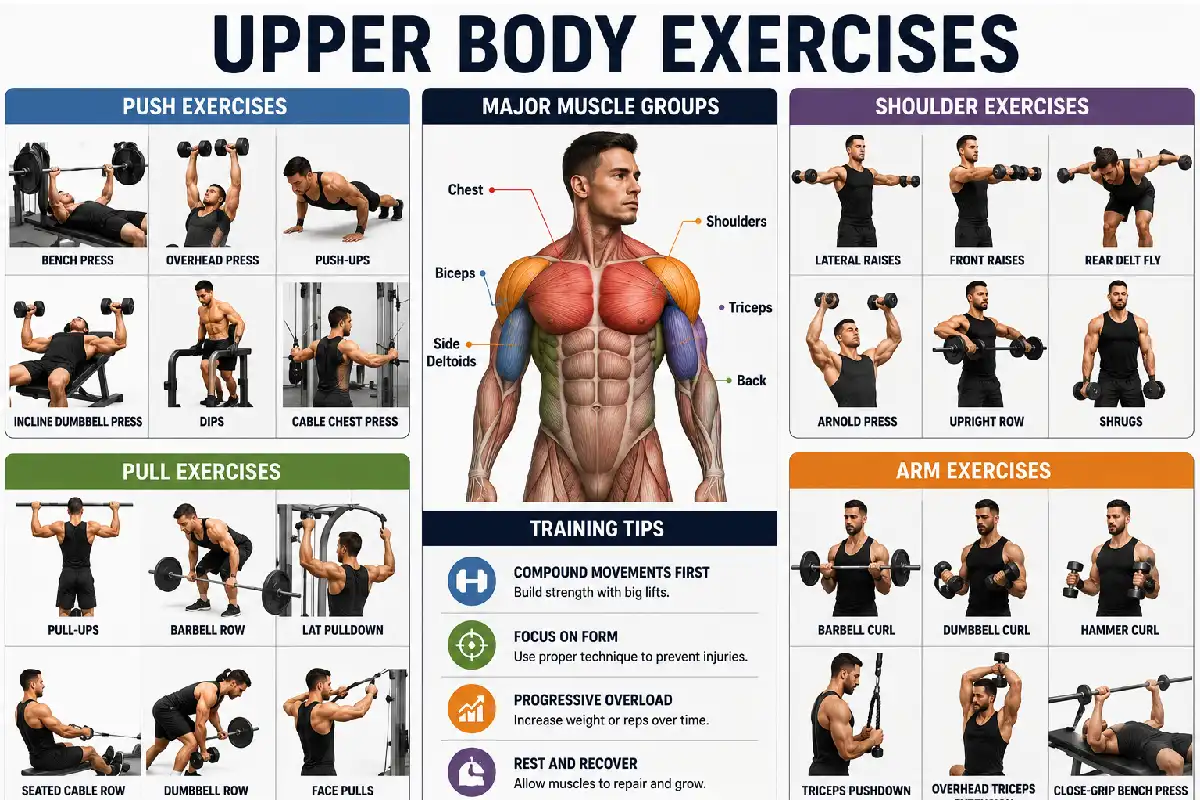
Upper body exercises are really important for building strength. They also help you stand up straight and move around easily. If you want to get muscles run faster or just be fit you should train your upper body. This helps your body develop evenly.
A good workout plan should have exercises, for your chest, shoulders, biceps and triceps. You should do types of movements so that all your major muscles get enough attention. This also helps prevent muscle imbalances. Upper body exercises deliver the best results when they are part of a structured training plan. Explore our Upper Body Workout for complete workout routines, training tips, and progression strategies.
This Article is part of the Home Workout
Definition of Upper Body Exercises
upper body includes the muscles on top of your waist, for example:
- Chest muscles (pectorals)
- Back muscles (latissimus dorsi, rhomboids, traps)
- Shoulder muscles (deltoids)
- Biceps
- Triceps
- Forearms
These exercises can be performed using body weight, dumbbells, and also barbells, resistance bands or machines.
Why Upper Body Training Matters
Consistent upper body training offers several benefits:
- Increased muscular strength
- Improved posture
- Better athletic performance
- Enhanced daily movement capacity
- Greater muscle development
- Improved joint stability
While looks are a motivation for many to work out having strong upper body muscles also helps with everyday tasks.
These tasks include lifting things carrying objects and pushing things. Understanding which muscles are targeted during each movement can help you train more effectively. Learn more in our Upper Body Muscle Groups.
Upper Body Push Exercises
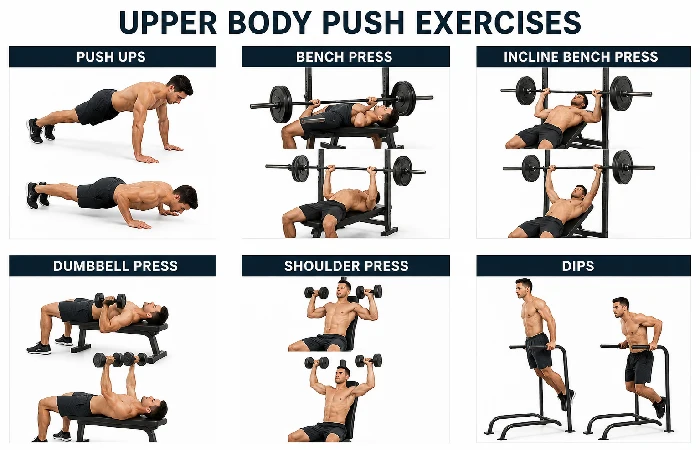
When you do upper body push exercises you are moving weight away, from your body. The upper body push exercises work the chest, the shoulders and the triceps. Many upper body exercises can be performed with minimal equipment, making them ideal for home training. Follow our Home Upper Body Workouts for practical workout ideas.
Popular Push Exercises
Push-Ups
An classic bodyweight exercise for targeting chest, shoulders and triceps.
Bench Press
One of the most recognized strength-training exercises for developed upper-body pushing strength.
Incline Dumbbell Press
Targets the upper chest while also engaging the shoulders.
Overhead Press
Develops shoulder strength and improves overall upper-body stability.
Dips
An effective exercise for the chest and triceps.
Muscles Worked
| Exercise | Primary Muscles |
| Push-Up | Chest, Triceps |
| Bench Press | Chest, Shoulders |
| Overhead Press | Shoulders, Triceps |
| Dips | Chest, Triceps |
Upper Body Pull Exercises
Upper body pull exercises involve pulling resistance towards the body. These movements are mainly target the back and biceps.
Popular Pull Exercises
Pull-Ups
A highly effective bodyweight exercise for back development.
Lat Pulldowns
Suitable for beginners working towards pull-up strength.
Barbell Rows
Build thickness and strength throughout the back.
Seated Cable Rows
Help improve posture and upper-back development.
Dumbbell Rows
Allow each side of the body to work independently.
Muscles Worked
| Exercise | Primary Muscles |
| Pull-Up | Lats, Biceps |
| Lat Pulldown | Lats, Biceps |
| Barbell Row | Back, Rear Delts |
| Cable Row | Mid-Back, Biceps |
If you have access to a gym, adding machines and free weights can increase training intensity and variety. Explore our Gym Upper Body Workouts.
Compound Upper Body Exercises
Compound upper body exercises involve multiple joints and also muscle groups working together.
Many of these have form the backbone of a good weight-training regime.
Benefits of Compound Exercises
- Train several muscles simultaneously
- Improve overall strength
- Save workout time
- Burn more energy
- Allow progressive overload
Best Compound Upper Body Exercises
- Bench Press
- Pull-Ups
- Barbell Rows
- Overhead Press
- Dips
- Push-Ups
When you start working out you usually have a lot of energy. That is why people often do compound exercises at the beginning of their workout. Compound exercises are the ones they do first because they have the energy then. They like to do compound exercises when their energy levelsre the highest. The right combination of exercises is essential for maximizing muscle growth and definition. Discover proven methods in our Upper Body Muscle Building.
Isolation Upper Body Exercises
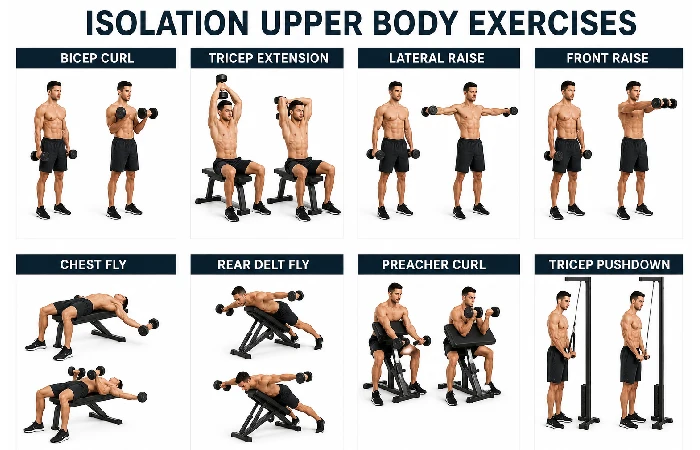
Isolation upper body exercises focus on a single muscle group.
These exercises may reduce the slack and tones muscle definition.
Popular Isolation Exercises
Bicep Curls
Target the biceps directly.
Tricep Pushdowns
Focus on tricep development.
Lateral Raises
Isolate the side deltoids.
Rear Delt Flyes
Improve rear shoulder development.
Chest Flyes
Provide additional chest stimulation.
Compound vs Isolation Comparison
| Feature | Compound Exercises | Isolation Exercises |
| Muscles Worked | Multiple | Single |
| Strength Development | High | Moderate |
| Calorie Expenditure | Higher | Lower |
| Workout Efficiency | High | Moderate |
| Muscle Focus | General | Specific |
Upper Body Training Workflow
Step 1: Warm Up
Prepare muscles and joints using:
- Arm circles
- Band pull-aparts
- Light rowing movements
Step 2: And Perform Compound Exercises
Focus on:
- Bench Press
- Pull-Ups
- Rows
- Overhead Press
Step 3: Add Isolation Work
Include:
- Bicep curls
- Tricep extensions
- Lateral raises
Step 4: Cool Down
Finish with:
- Stretching
- Light mobility exercises
- Controlled breathing
Step 5: Track Progress
Record:
- Weights used
- Sets completed
- Repetitions performed
Sample Upper Body Workout
Beginner Routine
| Exercise | Sets | Reps |
| Push-Ups | 3 | 8-12 |
| Dumbbell Rows | 3 | 10-12 |
| Shoulder Press | 3 | 8-10 |
| Bicep Curls | 2 | 12-15 |
| Tricep Pushdowns | 2 | 12-15 |
Intermediate Routine
| Exercise | Sets | Reps |
| Bench Press | 4 | 6-10 |
| Pull-Ups | 4 | 6-10 |
| Barbell Rows | 4 | 8-10 |
| Overhead Press | 3 | 8-10 |
| Lateral Raises | 3 | 12-15 |
| Bicep Curls | 3 | 10-12 |
Expectations Management: Realistic Progress
Many people expect rapid upper-body transformations.
Factors influencing results include:
- Training frequency
- Exercise technique
- Recovery quality
- Nutrition
- Genetics
- Sleep habits
What to Expect
First Month:
- Improved exercise technique
- Better muscular endurance
- Increased confidence
Two to Three Months:
- Noticeable strength gains
- Improved workout performance
Long-Term:
- Increased muscle mass
- Better posture
- Enhanced upper-body definition
Consistency generally produces better outcomes than extreme training approaches. Many upper body exercises are highly effective for building power and improving overall performance. Learn more in our Upper Body Strength Training.
Advantages and Limitations of Upper Body Training
Advantages
- Increased strength
- Improved athletic performance
- Better posture
- Enhanced muscle development
- Functional fitness benefits
Limitations
- Requires consistent effort
- Results vary between individuals
- Recovery needs increase with training intensity
- Overtraining can reduce performance
Frequently Asked Questions
What are the best upper body exercises for me to do?
The best upper body exercises are things like bench presses and pull-ups and rows and overhead presses and push-ups.
How often should I train my body to get good results?
I think most people do well when they train their body two to three times, per week and they make sure to rest and recover properly.
Are upper body push exercises enough for me to do?
No I do not think that is enough. You should do upper body push exercises and upper body pull exercises. This is because upper body push exercises and upper body pull exercises will keep your upper body muscles balanced and healthy.
Should beginners use upper body exercises when they start?
Yes I think that is an idea. Compound upper body exercises help you build a foundation and they help you get better faster.
Are isolation upper body exercises necessary for me to do?
Isolation upper body exercises can help you improve muscles but I think they work best when you do them with compound upper body exercises. Compound movements can increase calorie expenditure and support body-fat reduction goals. Explore effective strategies in our Upper Body Fat Burning Guide.
Conclusion
Upper body exercises are a way to get stronger stand up straighter and help your muscles grow. When you do upper body exercises that push and pull and you do exercises that work lots of muscles and small exercises that work just a few you can make a workout plan that is fair and helps you get better over time. To really see results that you have to keep doing your workouts do the exercises the right way and know from your upper body exercises. Organizing your exercises into the right schedule can improve recovery and long-term progress. Check out our Upper Body Workout Splits to find the best training structure.