
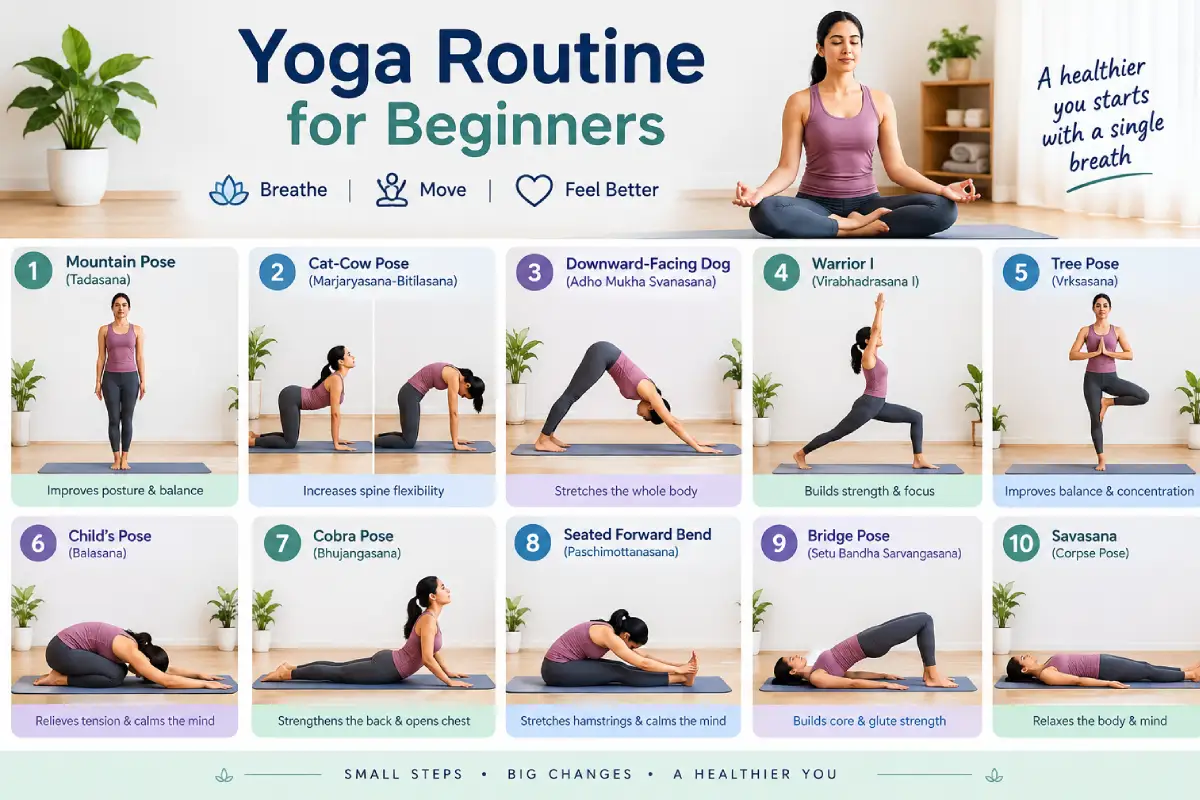
A Yoga Routine for Beginners should be simple and easy to follow so that you do not feel stressed. A 10 to 20 minute session with movements is a good way to start especially if you focus on breathing and how you move, rather than on difficult postures. You can also combine a Yoga Routine for Beginners with walking or other activities to create a plan, for movement each week.
What Should a Beginner Yoga Routine Include?
Beginner routine does not need dozens of poses.
Beginner routine should start with movements that gently take your body through positions and give you time to become familiar, with basic yoga techniques.
A simple routine can include:
- A standing posture to establish balance
- Gentle spinal movements
- A comfortable hip-opening position
- A beginner-friendly forward fold
- A modified Downward-Facing Dog
- A short relaxation period
Move slowly between poses. If you are completely new to exercise, start with fewer repetitions or shorter holds and build gradually.
7 Beginner Yoga Poses to Try
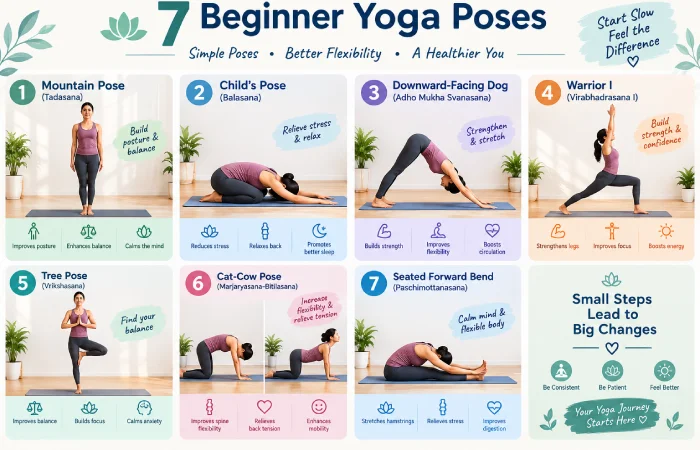
| Pose | How long | Beginner tip |
| Mountain Pose | 30 seconds | Keep your feet comfortable and shoulders relaxed |
| Cat-Cow | 6–8 repetitions | Move slowly with your breathing |
| Child’s Pose | 30–60 seconds | Use a cushion if needed |
| Low Lunge | 20–30 seconds each side | Keep the front knee comfortable |
| Downward-Facing Dog | 20–30 seconds | Bend your knees if necessary |
| Seated Forward Fold | 20–30 seconds | Do not force your hands towards your feet |
| Easy Seated Pose | 1–2 minutes | Finish with relaxed breathing |
Mountain Pose
Stand straight. Have your feet a little apart. Let your arms be loose, by your sides and make sure your shoulders are not tight. Breathe in deeply and slowly. Think about how your body feels in this position. Look at how your body’s lined up. Keep thinking about the way you are standing.
Cat-Cow
Come onto your hands and knees. Slowly round your back then gently shift into a stretched position. Keep the motion smooth and controlled. Don’t force a movement—just go with a natural flow. Focus, on feeling the stretch without pushing hard. Let your body guide the movement.
Child’s Pose
From a position where you’re on your knees slowly move your hips backward toward your heels as much as feels good. Stretch your arms forward in front of you. Let them lie gently by your sides. You can put a pillow under your knees or, between your hips and heels to make this position feel more comfortable and calm.
Low Lunge
Step one foot forwards and place the other knee on the floor. Keep your front foot stable and avoid forcing your hips forwards. Repeat on both sides.
Downward-Facing Dog
From hands and knees lift your hips upward. Beginners can keep their knees bent. Heels lifted. The goal is to find a position not to bring your heels all the way to the floor.
Seated Forward Fold
Sit with your legs extended or slightly bent. Hinge forwards gently while keeping your movement controlled. Stop before you feel strain.
Easy Seated Pose
Finish in a seated position. Place your hands on your thighs relax your shoulders and take slow breaths before Finish the session.
How to Build Your Beginner Routine
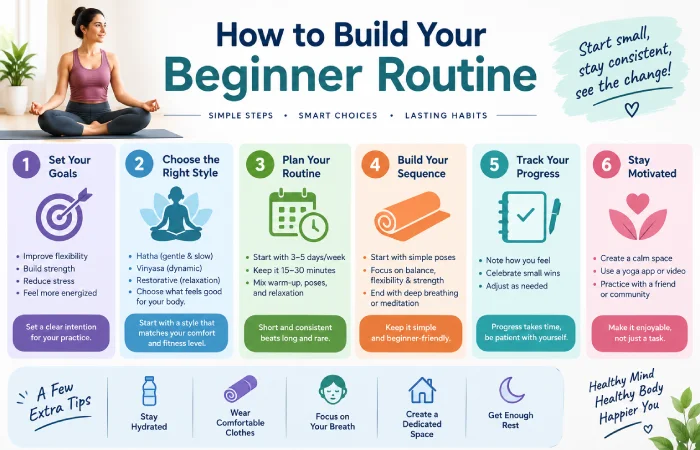
Follow these steps when starting:
- Choose a realistic time. Ten minutes may be enough when you are establishing the habit.
- Warm up gently. Begin with Mountain Pose and Cat-Cow rather than immediately attempting demanding positions.
- Use comfortable ranges. You should not need to force a pose to make it effective.
- Breathe normally. Avoid holding your breath while stretching or changing positions.
- Finish gradually. Include a quiet seated position before returning to normal activity.
- Progress slowly. Once the routine feels comfortable, add a few minutes or another pose rather than dramatically increasing the workload.
I think people who already walk regularly can add this routine to their walking. For example someone who takes a 20–30 minute walk mornings could do ten minutes of yoga before or after the walk. Someone who is new to activity could start with ten minutes of yoga and a short comfortable walk, on selected days. This helps keep walking and adds yoga benefits.
How to Set a Realistic Daily Step Goal
You do not have to set a target of 10,000 steps. First find your baseline. Look at the step count on your phone, smartwatch or fitness tracker over normal days. Compute an average so that one active day does not set the bar. I know that many people think 10,000 steps is a number but it is not the only goal.
Now choose a target. If you normally walk three thousand five hundred steps, a target of four thousand steps or four thousand five hundred steps could be a start. If you already walk eight thousand steps there may be reason to chase ten thousand steps just for the sake of the number.
Then look at how you feel. If your target feels comfortable, over a period you can think about a modest bump. If it brings tiredness, ongoing soreness or pain lower the target and give yourself more recovery time. Remember, 10,000 steps is one way to think about walking.
US physical activity guidance specifically says that 10,000 steps is not a rule. Step counting can help track activity. The main recommendations focus on how much and how hard you move. The steps you take matter. The intensity matters even more.
Common Beginner Mistake: Going Too Deep
Instead shorten the range of motion bend your knees when appropriate and use cushions or yoga blocks for support. Your version of a pose may look different, from someone And that is perfectly normal.
When Should You Stop?
Stop your session or walk if you develop pain feel faint become unusually short of breath or experience other concerning symptoms. Don’t ignore increasing pain Get medical help for serious symptoms, such as chest pain, fainting or severe difficulty breathing. Talk to a doctor about an exercise programme if you experience pain on more than one or two occasions when engaging in activity or have a medical condition. The CDC advises people with conditions to seek professional guidance about the types and amounts of physical activity that are suitable, for them.
FAQs
How long should a beginner yoga routine be?
There is no required duration. Start the routine with about ten to twenty minutes. The routine will fit more easily into your day. As you become comfortable, with the movements extend the duration of the session little by little.
Can I do yoga every day as a beginner?
Some people may choose to practise yoga regularly yet the right amount of gentle yoga practice depends on how intense each gentle yoga session is and, on your personal situation. Give yourself time to recover when your body feels especially tired or sore.
Should I do yoga before or after walking?
Both choices can work. A short gentle yoga session can be used before a walk as part of a movement routine while yoga after walking can provide a transition into recovery.
Conclusion
A beginner yoga practice should be easy, relaxing, and easy to repeat. A beginner yoga practice begins with simple moves and breathing and gradually increases the time or challengingness. If you also want to become more active through walking use your current step average, as your starting point of treating 10,000 steps as a requirement. The goal is to build a routine that fits your current abilities and can change as those abilities grow.