
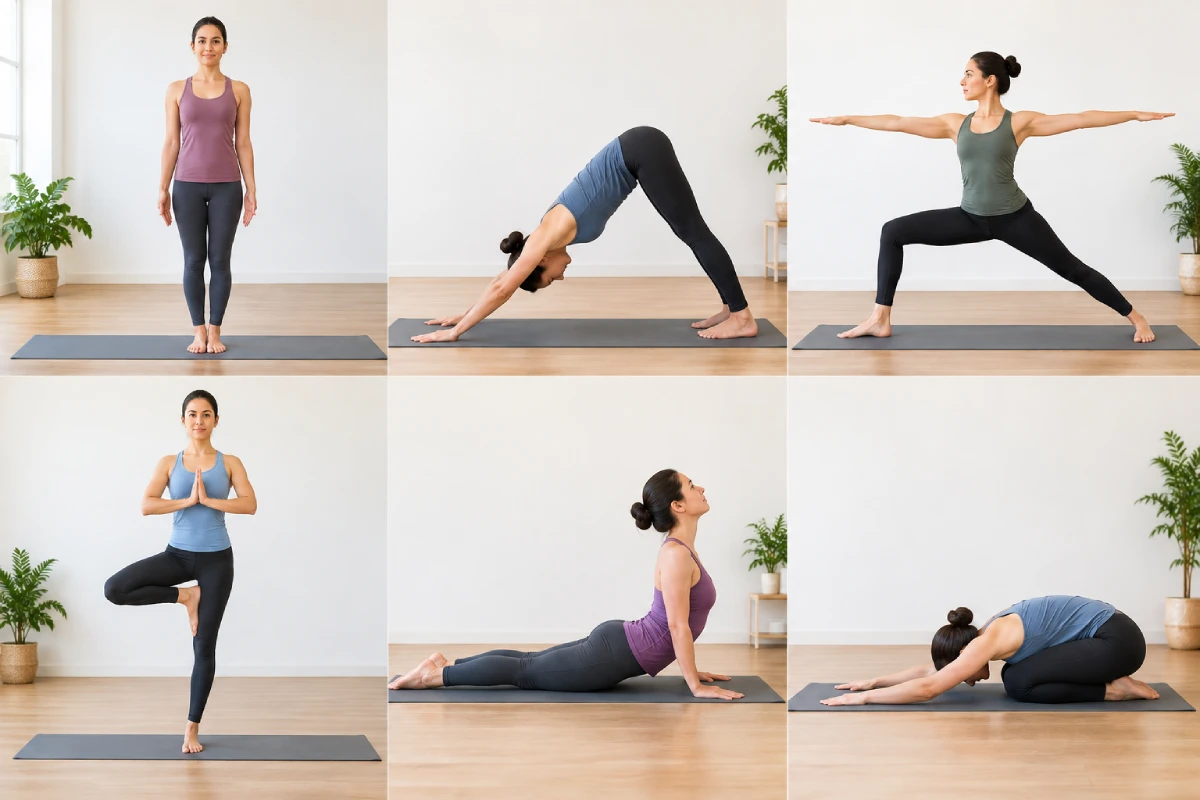
Starting yoga does not need flexibility or complicated movements. Basic yoga poses give a start to breathing, balance, mobility and mindful movement.
For beginners the best plan is to learn a simple yoga positions and practise them every day. You do not need to force your body into a shape. Good yoga technique, comfortable breathing and slow progress matter more, than how you can stretch.
What Are Basic Yoga Poses?
Basic yoga poses are beginner- positions that are part of many starting yoga classes. They can be done with little or no equipment. They can also be changed to fit your movement and level of experience.
A beginner yoga session may combine:
- Standing poses
- Seated poses
- Gentle forward folds
- Balance exercises
- Hip and shoulder mobility movements
- Resting positions
- Gentle stretches
Yoga is broader than stretching alone. Many practices also incorporate breathing, concentration and relaxation.
Basic Yoga Poses for Beginners
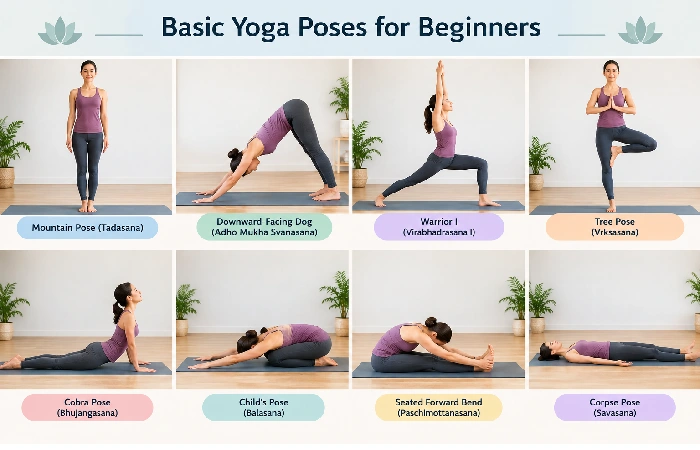
Here are several simple yoga poses that are commonly suitable for people starting out.
Mountain Pose
Mountain Pose, or Tadasana, is a straightforward standing position that encourages awareness of posture and alignment.
How to practise:
- Stand with your feet comfortably positioned.
- Keep your knees relaxed rather than locked.
- Let your arms rest by your sides.
- Lengthen through the top of your head.
- Breathe slowly and comfortably.
Child’s Pose
Child’s Pose is commonly used as a resting or recovery position.
Start on your hands and knees then slowly move your hips toward your heels. Stretch your arms forward. Let them lie next to your body. If your hips don’t easily reach your heels put a cushion or a folded blanket, under you for help.
Avoid forcing the position if your knees, hips or back feel uncomfortable.
Cat-Cow Pose
Cat Cow is a movement series that allows the spine to bend and stretch in a gentle and controlled manner. Begin on your hands and knees. As you inhale gently lift your chest. Let your spine stretch into a comfortable arch. When you breathe out gently curve your back upward. Move slowly. Focus on comfort rather, than trying to push into a big range of motion.
Cobra Pose
It’s a great pose for beginners to explore gentle back extension. Start on your tummy with your hands under your shoulders. Lightly press into your hands and lift through your chest just to the extent you can feel supported.
Do not rely on your arms to push your torso high. A smaller movement can be more appropriate for beginners.
Seated Forward Fold
This seated position offers a way to start stretching the hamstrings and the back of the legs.
Sit with legs slightly bent. Sit with a forward lean from hips ensuring motion stays smooth and, under control.
You do not need to touch your feet. A comfortable partial movement is perfectly acceptable.
Tree Pose
Tree Pose for stability and focus. From a standing position, bring one foot up to rest against the calf or thigh (not on the knee joint) of the standing leg. Use a wall or chair to support if needed. Balancing becomes easier with time, so this pose will give you some wobbly moments at the beginning.
Beginner Yoga Positions: A Simple Practice Workflow
Learning poses one at a time can be useful. Learning poses together in a short routine can make practice easier.
A 10-Minute Beginner Yoga Workflow
1 — Prepare:
Choose a clear, comfortable surface and wear clothing that allows unrestricted movement.
2 — Breathe:
Spend about one minute taking slow, comfortable breaths.
3 — Warm up:
Perform gentle Cat-Cow movements for several repetitions.
4 — Stand:
Practise Mountain Pose, followed by a gentle standing movement.
5 — Move:
Try Downward-Facing Dog or another comfortable full-body position.
6 — Balance:
Practise Tree Pose near a wall for support.
7 — Cool down:
Finish with Child’s Pose or another comfortable resting position.
The routine can be shortened or extended depending on your experience and comfort.
How Long Should Beginners Hold Yoga Poses?
Holding time isn’t one size fits all. An avid beginner might hold a few deep, slow breaths in more accessible static yoga poses. Some motions, for example Cat-Cow are usually performed in a series and, for a handful of breaths rather than being held statically in a typical yoga pose; Cat-Cow is often done this way.
When learning a pose, you may want to try holding it for longer and longer if it feels good.
Remember, you don’t want to endure pain! If a move causes sharp, sudden, or increasing pain, you should stop and troubleshoot the move.
Easy Yoga Positions and Safety Tips
Yoga is generally adaptable, but beginners should still practise sensibly.
- Start with gentle movements.
- Avoid bouncing during stretches.
- Keep breathing naturally.
- Use a wall or chair for balance when needed.
- Do not compare your flexibility with another person’s.
- Stop if you experience sharp or unusual pain.
- Increase range of motion gradually.
Expectations: What Can Beginners Realistically Expect?
Some ability to do yoga postures can get better with frequent practice leading to more movement, stretch, balance and knowing your body.. People can be very different when it comes to how fast they get better. For example, more active individuals may find some positions easier to perform, while those with less mobility may need more modifications. Improvements in flexibility are also likely to be slow, and be noticed only after a number of sessions, rather than having occurred after one.
It’s more sensible to measure changes over time in ease of movement, control and consistency, than by how many inches you can stretch.
Yoga should not be assumed to be a substitute for other kinds of physical activity and should instead be used to complement other activities such as walking, cardiovascular exercise and resistance exercises, which can all play their part in a balanced exercise routine.
Common Yoga Poses: Pros and Limitations
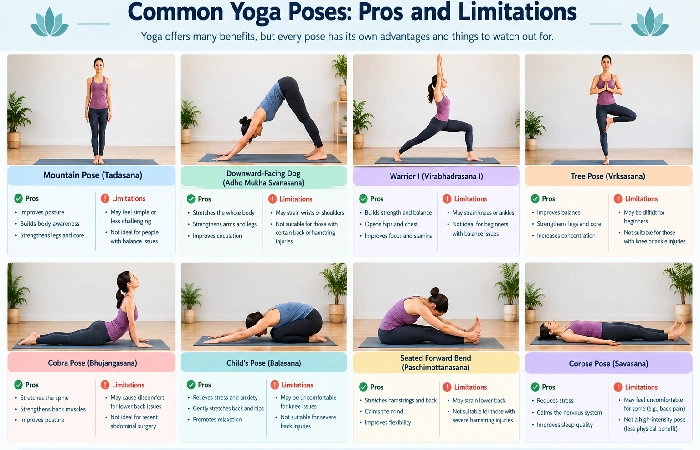
| Benefits | Limitations |
| Can be adapted for beginners | Some poses may be unsuitable with certain injuries |
| Requires relatively little equipment | Flexibility improvements take time |
| Can develop balance and body awareness | Incorrect technique can cause discomfort |
| Can be practised at home | Some poses require modification |
| Offers a range of movement styles | Yoga alone may not cover every fitness goal |
How to Progress Beyond Basic Yoga Poses
Once basic positions become familiar, progress gradually rather than immediately choosing advanced poses.
You might:
- Improve breathing control.
- Increase the duration of comfortable positions.
- Develop better balance.
- Explore gentle yoga flows.
- Add mobility-focused movements.
- Learn more detailed alignment principles.
- Try different styles of yoga with qualified instruction.
Progress should remain controlled and appropriate for your current ability.
Who Should Modify Beginner Yoga Exercises?
Individual modifications may be necessary for people recovering from injury or having a movement condition, or for those restarting exercise after a break from activity. People who are pregnant require different modifications than a generic beginner workout. If you’re unsure about a particular movement or exercise, a professional health or movement expert can guide you on potential modifications.
Final Thoughts
Basic yoga poses give a way to start learning how to move with control stay balanced be flexible and know your body. Start with positions pay attention to breathing in a comfortable way and slowly get better at what you’re doing.
Sticking with it is more important, than trying to do poses fast. If you go at a pace and make changes when needed the basic yoga poses can be part of a bigger lasting way to stay active.