
Last Updated: September 14, 2026
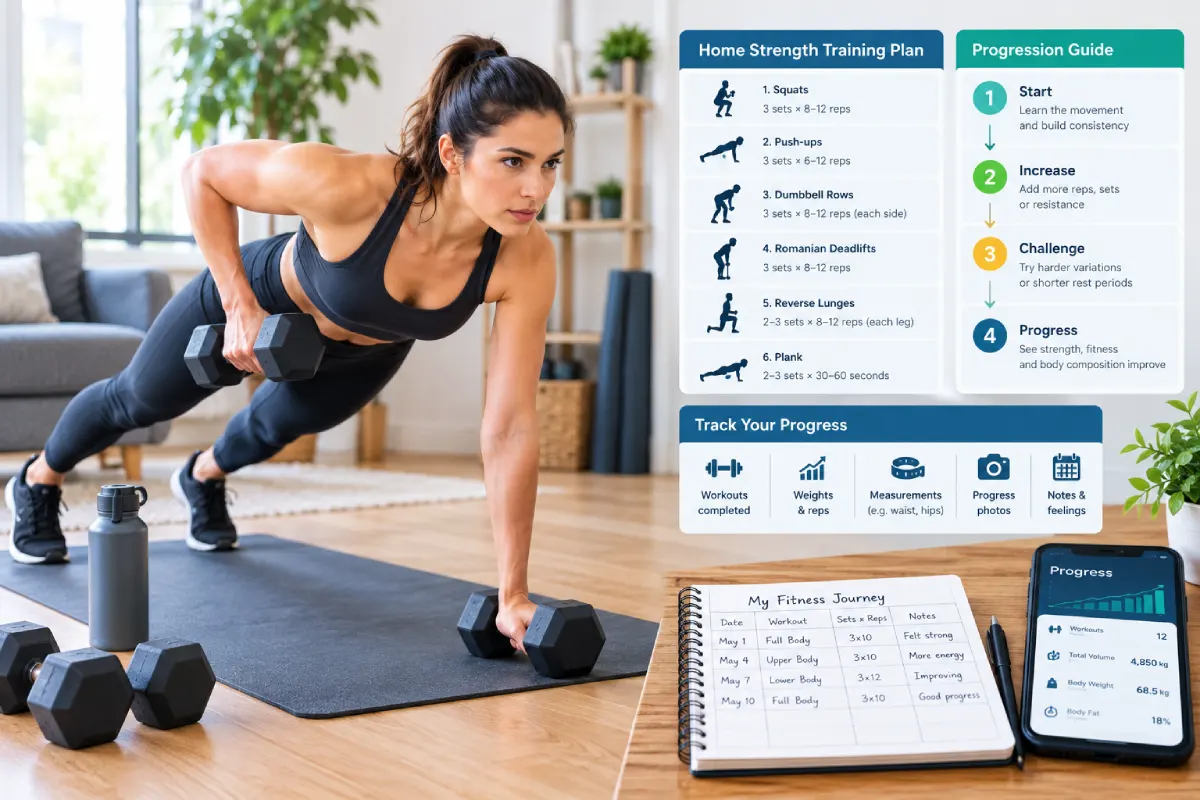
How to Build Strength At Home It’s not about doing random workouts day in and day out to build strength at home. When it comes to long-term progress with strength, it takes organisation, loading progression, and consistent tracking to achieve results.
Effective, well-planned Home Strength Training Plans, Progression & Tracking can help exercisers and beginners stay committed to their training and monitor their results, reduce mistakes, and enjoy the journey to building strength at home. Bodyweight exercises, bands, and free weights all take organisation, effort and planning, but the results are worth it.
Why Planning Matters for Strength Training
Many people start exercising with enthusiasm.. Many people struggle to keep exercising consistently. The reason is that many people do not have a programme.
A training plan can help:
- Create clear goals
- Improve workout consistency
- Monitor progress objectively
- Reduce unnecessary training volume
- Support gradual strength improvements
- Improve motivation over time
Rather than constantly changing workouts, a structured plan allows performance improvements to become measurable.
Strength Training at Home Workout Plan Fundamentals
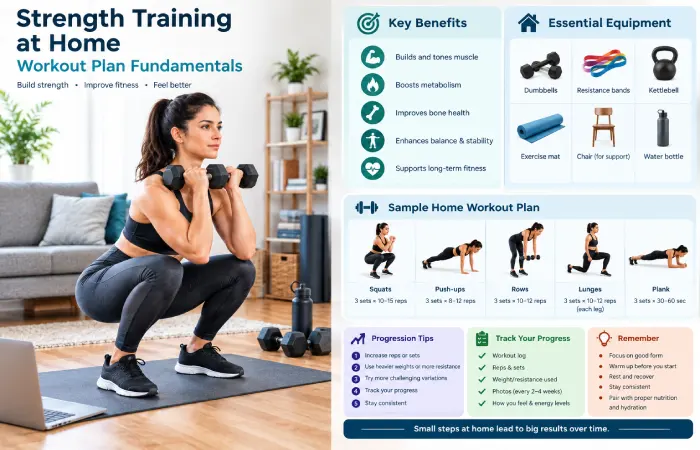
A successful strength programme usually includes several key elements.
Core Components of a Strength Plan
Exercise Selection
Choose movements that target major muscle groups.
Examples include:
- Squats
- Push-ups
- Lunges
- Rows
- Glute bridges
- Planks
Training Frequency
Most people benefit from training:
- 2–3 days weekly as beginners
- 3–4 days weekly as intermediates
Recovery
Rest days support muscle recovery and adaptation.
Progression
Gradually increasing difficulty helps stimulate ongoing improvement.
3 Day Strength Training at Home Plan
A three-day programme works well for many beginners and busy individuals.
Example Weekly Schedule
| Day | Focus |
| Monday | Full Body Strength |
| Wednesday | Full Body Strength |
| Friday | Full Body Strength |
Sample Workout Structure
| Exercise | Sets | Repetitions |
| Squats | 3 | 10–15 |
| Push-Ups | 3 | 8–12 |
| Glute Bridges | 3 | 12–15 |
| Rows | 3 | 10–12 |
| Lunges | 3 | 10 per leg |
| Plank | 3 | 30 seconds |
This structure allows sufficient recovery while maintaining training frequency.
4 Day Strength Training at Home Plan
Individuals with more training experience may prefer a four-day schedule.
Example Split
| Day | Focus |
| Monday | Upper Body |
| Tuesday | Lower Body |
| Thursday | Upper Body |
| Friday | Lower Body |
Benefits of a 4-Day Plan
- Greater exercise variety
- Additional training volume
- More focused sessions
- Increased progression opportunities
However, additional training days also require proper recovery management.
Progressive Overload at Home
What Is Progressive Overload?
Progressive overload means making training over time to help the body adapt. It is a way to challenge the body so it can get stronger.
Without progression, strength improvements may eventually slow.
Ways to Apply Progressive Overload at Home
Increase Repetitions
Example:
- Week 1: 10 push-ups
- Week 2: 12 push-ups
- Week 3: 15 push-ups
Increase Sets
Move from:
- 2 sets
- to 3 sets
- to 4 sets
Slow Exercise Tempo
Slow down movements to keep tension high. Movements that are slow help build muscles.
Reduce Rest Periods
Shorter rest intervals can increase workout difficulty.
Progress Exercise Variations
Examples:
| Easier Exercise | Harder Exercise |
| Wall Push-Up | Standard Push-Up |
| Squat | Split Squat |
| Plank | Side Plank |
| Glute Bridge | Single-Leg Bridge |
Strength Training Progression: Measuring Improvement
Progress is not always reflected by appearance alone.
Key Tracking Metrics
Repetitions
Monitor how many repetitions you can complete with proper form.
Sets Completed
Track total training volume.
Exercise Difficulty
Record progression to more advanced variations.
Recovery Quality
Assess soreness, energy levels, and readiness to train.
Consistency
Track how many planned workouts were completed each month.
Example Progress Log
| Week | Push-Ups | Squats | Plank |
| Week 1 | 8 | 12 | 20 sec |
| Week 4 | 12 | 18 | 35 sec |
| Week 8 | 18 | 25 | 60 sec |
These improvements often indicate meaningful strength development.
Home Strength Training Schedule Options
Different schedules suit different lifestyles.
Schedule Comparison
| Schedule | Best For | Weekly Sessions |
| 2 Days | Beginners | 2 |
| 3 Days | Most Individuals | 3 |
| 4 Days | Intermediate Trainees | 4 |
| 5 Days | Advanced Programmes | 5 |
A schedule should fit realistically into daily life.
The effective programme is usually the one that can be followed consistently.
30 Day Strength Training Challenge
Short-term challenges can help establish routine and accountability.
Example Structure
Week 1
Focus on technique and movement quality.
Week 2
Increase repetitions slightly.
Week 3
Add additional sets.
Week 4
Progress exercise difficulty where appropriate.
Potential Benefits
- Improved consistency
- Better exercise confidence
- Enhanced movement quality
- Increased training awareness
Important Limitation
Momentum is created by a 30 day challenge Momentum created is not enough for long term success. Long term success is a product of habits that are built after the 30 day challenge. Strength Training Workflow for Long-Term Success
Step 1: Set Clear Goals
Examples:
- Improve push-up performance
- Increase strength
- Enhance fitness levels
Step 2: Choose a Schedule
Select a realistic training frequency.
Step 3: Follow the Plan Consistently
Focus on execution before optimisation.
Step 4: Track Every Workout
Record:
- Exercises
- Sets
- Repetitions
- Notes
Step 5: Apply Progressive Overload
Increase training difficulty gradually.
Step 6: Review Progress Monthly
Assess improvements and make adjustments.
Expectations Management: What Results Are Realistic?
Strength development takes time.
Early Progress (Weeks 1–4)
Many people experience:
- Improved coordination
- Better technique
- Increased confidence
Intermediate Progress (Months 2–6)
Consistent training may contribute to:
- Increased muscular strength
- Improved endurance
- Better movement quality
- Enhanced fitness levels
Factors Influencing Progress
- Training consistency
- Recovery quality
- Nutrition habits
- Sleep patterns
- Starting fitness level
Progress rarely follows a perfectly linear pattern.
Temporary plateaus are a normal part of training.
Common Mistakes in Home Strength Training
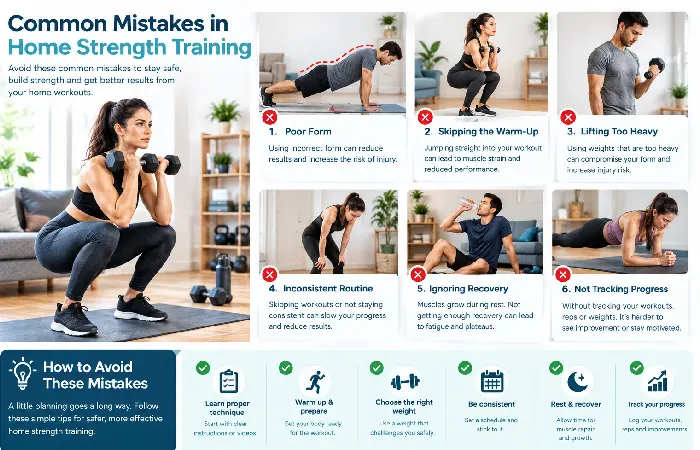
Training Without a Plan
Random workouts often make progress difficult to measure.
Changing Programmes Too Frequently
Consistency allows progression to occur.
Ignoring Recovery
Rest is an important part of adaptation.
Tracking Only Body Weight
Strength improvements can occur even when body weight remains stable.
Progressing Too Quickly
Gradual progression typically supports better long-term results.
Who Should Use Structured Home Strength Training Plans?
Structured programmes may benefit:
- Beginners
- Intermediate trainees
- Home exercisers
- Busy professionals
- Students
- Individuals seeking measurable progress
Most people can benefit from having a clear training roadmap.
Conclusion
Home Strength Training Plans, Progression & Tracking provide the structure needed to support long-term strength development. Incorporate a realistic strength training at home workout plan, progressive overload at home, home strength training schedule, and measure quantifiable performance markers and you will develop sustainable habits and realistic gains. The key to success is consistency, patience and slow gains.