
Last Updated: September 14, 2026
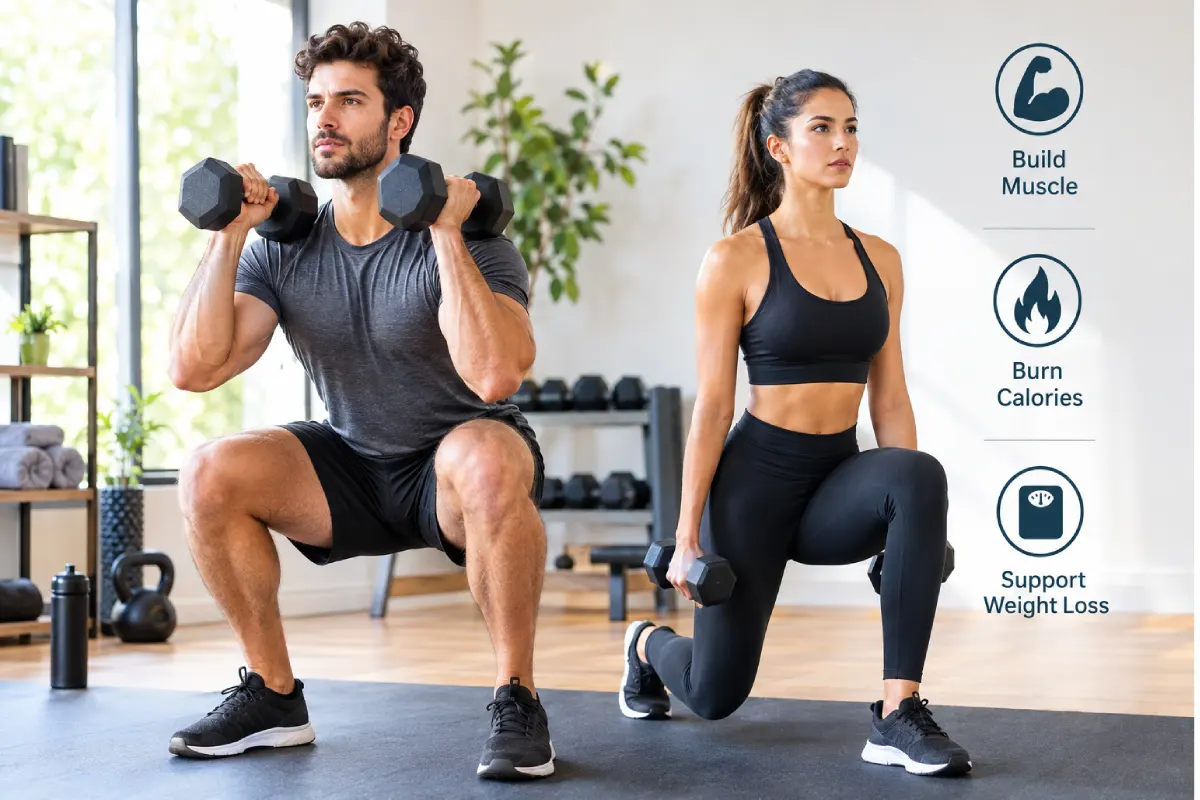
Strength Training to Build Muscle & Burn Fat can be used to help those wishing to get stronger, change their body composition, and keep a high level of overall functional strength. Resistance training isn’t just about weight loss alone, but it’s a fantastic way to give your body a reason to keep and build muscle while you burn excess body fat.
The best part about strength training is that you do not need a gym to do strength training. In fact many beginners and intermediates can use kettlebells, resistance bands, dumbbells or bodyweight exercises to provide the resistance, for strength training.
What Is Strength Training?
Strength training is a kind of exercise that tests muscles by pushing them against resistance. I find that the resistance, in Strength training can come from weights, machines, resistance bands, cables or even bodyweight.
Common movements include:
- Squats and split squats
- Push-ups and presses
- Rows and pull-downs
- Deadlift variations
- Lunges
- Shoulder presses
- Hip thrusts
- Loaded carries
The foundation is progressive overload: that is, making it more difficult as you become stronger.
How Strength Training Supports Muscle Building and Weight Loss
Muscle growth generally involves resistance training and then nutrition and recovery. Resistance training creates a stress on muscles. When the body receives recovery and nutrition the body will adapt to that stress on muscles and become stronger, at dealing with it.
Nutrition is especially important for weight loss. A fairly consistent calorie deficit is usually needed for body weight to decrease, and strength training can assist in maintaining muscle mass during that process.
Resistance exercise works well for strength training that targets weight loss and targets loss. However resistance exercise is not a method for loss, by itself.
Strength Training for Muscle Building & Weight Loss: How to Structure It
A simple weekly routine might involve two to four strength sessions.
| Training element | Beginner approach | Main purpose |
| Squat movement | 2–3 sets | Legs and glutes |
| Push movement | 2–3 sets | Chest, shoulders and triceps |
| Pull movement | 2–3 sets | Back and biceps |
| Hip-hinge movement | 2–3 sets | Glutes and hamstrings |
| Core exercise | 2–3 sets | Trunk strength |
| Walking/cardio | As appropriate | General activity and fitness |
There’s no need to train every exercise until failure. Use controlled technique, then increase the intensity of the exercise.
A Practical Strength Training Workflow
Step 1: Choose your training frequency.
Begin with two or three days a week if you are new, to resistance training. Resistance training should start slowly to build confidence and avoid injury.
Step 2: Select full-body movements.
Use exercises that train movement patterns and do not concentrate on only one muscle group; instead focus on major movement patterns, for balanced strength.
Step 3: Establish manageable resistance.
I suggest picking a weight or resistance. That weight or resistance should let you finish the planned repetitions while keeping a form.
Step 4: Track your sessions.
Record exercises, sets, repetitions and resistance.
Step 5: Progress gradually.
When an exercise starts to feel easy and you can do it without struggling you should make it a little harder. You can add times you do it use heavier weights do more groups of the exercise or make the exercise more challenging.
Step 6: Recover.
Allow muscles time to recover and prioritise adequate sleep and nutrition.
Strength Training at Home for Muscle Gain
You can perform effective strength training at home for muscle gain with relatively little equipment.
A home session could include:
- Goblet squats
- Dumbbell Romanian deadlifts
- Push-ups
- One-arm dumbbell rows
- Reverse lunges
- Dumbbell shoulder presses
- Planks
I find that if equipment is limited bodyweight exercises can still be a starting point. However, muscle-building progress eventually depends on making the training stimulus sufficiently challenging.
Home Strength Workout for Muscle Building
A simple example is:
- Squats — 3 × 8–12
- Push-ups — 3 × 6–12
- Dumbbell rows — 3 × 8–12 per side
- Romanian deadlifts — 3 × 8–12
- Reverse lunges — 2 × 8–12 per leg
- Plank — 2–3 controlled sets
These numbers are just starting points, not rules. You should change the exercise choices. How much you do based on your experience what you can handle and how quickly you recover.
Home Workout to Build Muscle: What Matters Most?
The equipment itself is less important than the training stimulus.
For a home workout to build muscle, pay attention to:
- Progressive resistance
- Sufficient training volume
- Consistent sessions
- Good exercise technique
- Adequate protein and overall nutrition
- Recovery between sessions
If the only equipment you have are a couple of light dumbbells you can make the dumbbells harder, with more repetitions, slower repetitions, single‑arm movements or other more difficult options. Managing Expectations
Managing Expectations
At some point though, more challenging/Heavier resistance may be necessary. Setting Realistic Goals gains in strength and muscle can take several days, or weeks, to become noticeable – body-coat changes and coordination can occur more rapidly than changes in muscle mass and body fat.
Weight loss can vary because body weight is impacted by food, water and glycogen; so its best to track progress using multiple measures like:
- Strength improvements
- Waist measurements
- Progress photographs
- Clothing fit
- Workout consistency
- Body weight trends over several weeks
A short-term increase on the scales does not automatically mean that a programme has failed.
Nutrition for Muscle Gain and Fat Loss
Training and nutrition work together.
For loss the total calorie intake matters a great deal. For muscle development having protein and enough energy is essential. A person who wants to lose fat but keep muscle will usually do better with a calorie deficit instead of a very restrictive diet.
Build meals around foods such as:
- Lean meat, fish and eggs
- Dairy or suitable alternatives
- Beans and lentils
- Whole grains
- Fruit and vegetables
- Nuts and seeds
Hydration and adequate sleep also support training performance and recovery.
Pros and Limitations
Pros
- Can improve muscular strength
- Supports muscle retention during weight loss
- Can be performed at home
- Helps develop functional movement capacity
- Can complement cardiovascular exercise
- Progress can be measured objectively
Limitations
- Results require consistency
- Technique matters
- Poor programming can lead to stalled progress
- Resistance training alone does not guarantee fat loss
- Recovery becomes increasingly important as training volume rises
Who Is This Approach Suitable For?
Strength training can work for people who are just starting out those who exercise for fun and those who are really, into it. Newcomers should begin with weights that’re not too hard and focus on learning the right way to move before trying to lift heavier things.
People, with injuries that already exist people who have medical conditions or people who worry about exercising should get proper professional help before starting a new program.
Conclusion
The Most Effective Program to Build Muscle and Lose Weight Since the programme must become part of your way of life, as opposed to a 12-week fix, a resistance instructional course to keep you to a great extent with time and constant terms will enable you to assemble quality, secure muscle, and get in shape. Watch your exercises, eat reasonably, and get physical exercise. Step by step instructions to start with, grasp your exercises, monitor your progress, and progress gradually.