
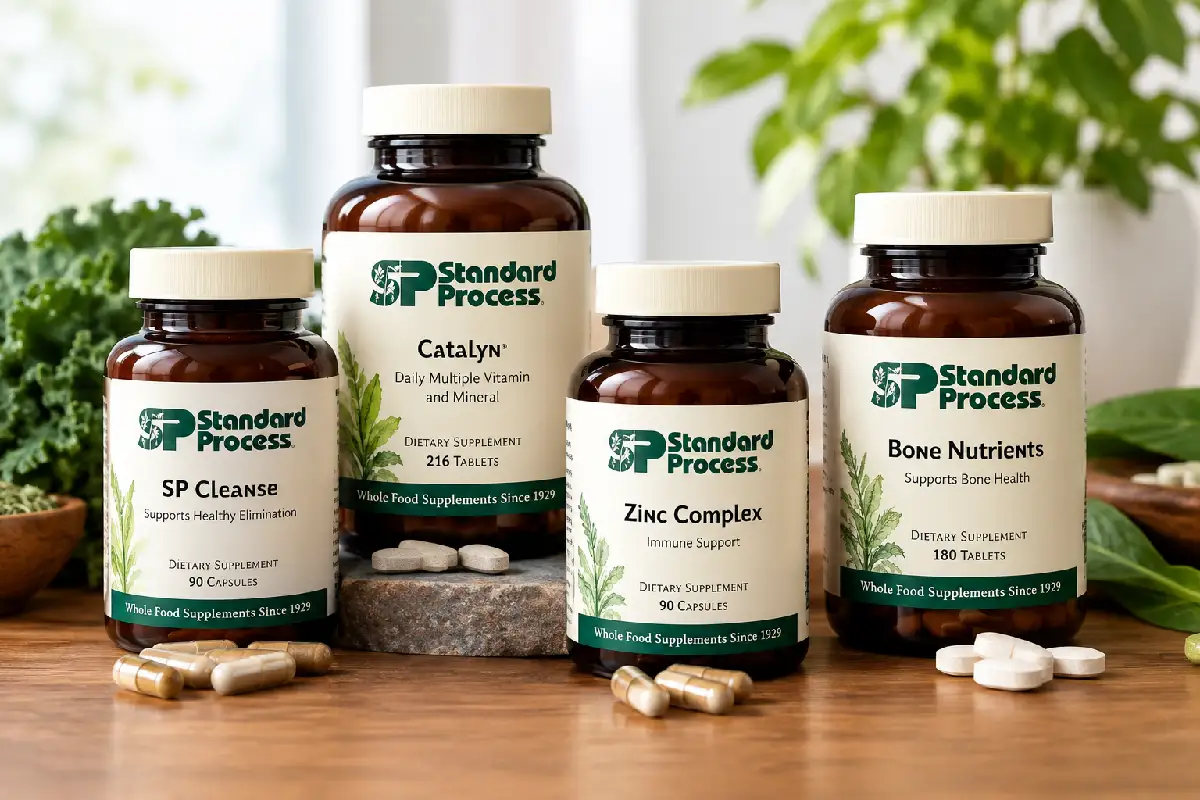
If you have ever left a chiropractor, a naturopath or a functional medicine clinic with a brown bottle of tablets you had never seen before there is a good chance that bottle was Standard Process.
This brand is common among practitioners. Rarely found in regular stores. That is why many people type its name into Google soon as they arrive home.
What is Standard Process?
Why does it cost more than the multivitamin at the pharmacy? Is the whole food claim true or just marketing?
I will review the company history, how its products are made what the popular items do how much they cost and very important what critics say. This debate is worth knowing before you decide to spend your money.
Who Is Standard Process Really?
Standard Process is not a wellness startup. It began in 1929, when a Wisconsin dentist named Dr. Royal Lee founded the company. He believed that food processing removed nutrients from the diet and that supplements made from whole foods not isolated synthetic vitamins would work better for the body. A hundred years later Standard Process remains headquartered in Wisconsin remains family owned and is now run by four generations of the same family.
- The reason the brand stays relevant is not nostalgia.
- Standard Process created an identity based on a “soil to supplement” approach.
- This means the company does not simply buy ingredients and mix them into a capsule.
- Standard Process. Farms a certified organic farm.
- They grow many of the plants that go into their formulas.
- They also built a Nutrition Innovation Center to research and test their products in‑house.
- This vertical control is a part of the claim.
- Many supplement companies are mainly formulation and marketing firms that outsource production.
- Standard Process by contrast manages everything from the field to the bottle.
- Standard Process farms the ingredients harvests them extracts the nutrients formulates the capsules tests the products and packages them all under one company.
The “Whole Food” Philosophy, Explained
Now the discussion becomes a bit more interesting and contested. Most ordinary multivitamins use synthetic nutrients. For example ascorbic acid replaces vitamin C and folic acid replaces folate. Standard Process argues that nutrients in isolation do not act the same as they do inside plant or animal tissues. Therefore Standard Process makes its products from whole foods such as beets, carrots, alfalfa organ meats and other vegetables. The idea is that enzymes, cofactors and phytochemicals that come with food help the body use the nutrient instead of just passing an isolated compound through the system. This is a philosophy, not a marketing slogan. It comes directly from Dr. Lees idea. Whether science fully supports it is another question that will be discussed later. It is useful to understand this logic before you judge the products.
Standard Process Vitamins & Minerals
| Feature | Standard Process Vitamins & Minerals Overview |
| Brand Background | Standard Process is a nutritional supplement company that has been producing whole-food-based supplements for decades. The company focuses on providing vitamins, minerals, and nutritional support products made from carefully selected ingredients. |
| Product Category | Vitamins and minerals supplements designed to help support general health, wellness, and nutritional balance. |
| Main Nutrients | Products may contain essential vitamins such as Vitamin A, Vitamin C, Vitamin D, Vitamin E, and B-complex vitamins, along with minerals like calcium, magnesium, zinc, iron, and selenium. |
| Source of Ingredients | Many Standard Process supplements emphasize whole-food ingredients, plant-based components, and nutrient-rich concentrates to complement traditional vitamin and mineral formulations. |
| Potential Benefits | May help support immune function, energy production, bone health, muscle function, healthy metabolism, and overall wellness when used as part of a balanced lifestyle. |
| Target Users | Adults seeking nutritional support, individuals with dietary gaps, active people, and those looking to maintain overall health and wellness. |
| Available Forms | Capsules, tablets, powders, and specialized nutrient formulas depending on the specific product line. |
| Quality Approach | The company is known for ingredient testing, quality control processes, and manufacturing standards designed to maintain product consistency and purity. |
| Usage Guidelines | Follow the serving instructions provided on the product label or recommendations from a qualified healthcare professional. Dosage may vary by product and individual needs. |
| Dietary Considerations | Some products may be suitable for specific dietary preferences, but ingredient lists should always be reviewed for allergens, sensitivities, or dietary restrictions. |
| Advantages | Offers a wide range of nutrient-focused formulas, emphasizes whole-food ingredients, and provides products tailored to different health goals. |
| Considerations | Nutritional supplements should not replace a balanced diet. Individual results may vary, and some people may require personalized nutritional advice before starting supplementation. |
| Best For | People looking to supplement their daily nutrient intake and support long-term wellness through vitamins and minerals. |
Standard Process Supplement Products: What’s Actually in the Lineup
- Standard Process offers products.
- The catalog is large with hundreds of items.
- However a few names appear repeatedly among practitioners and long‑time users.
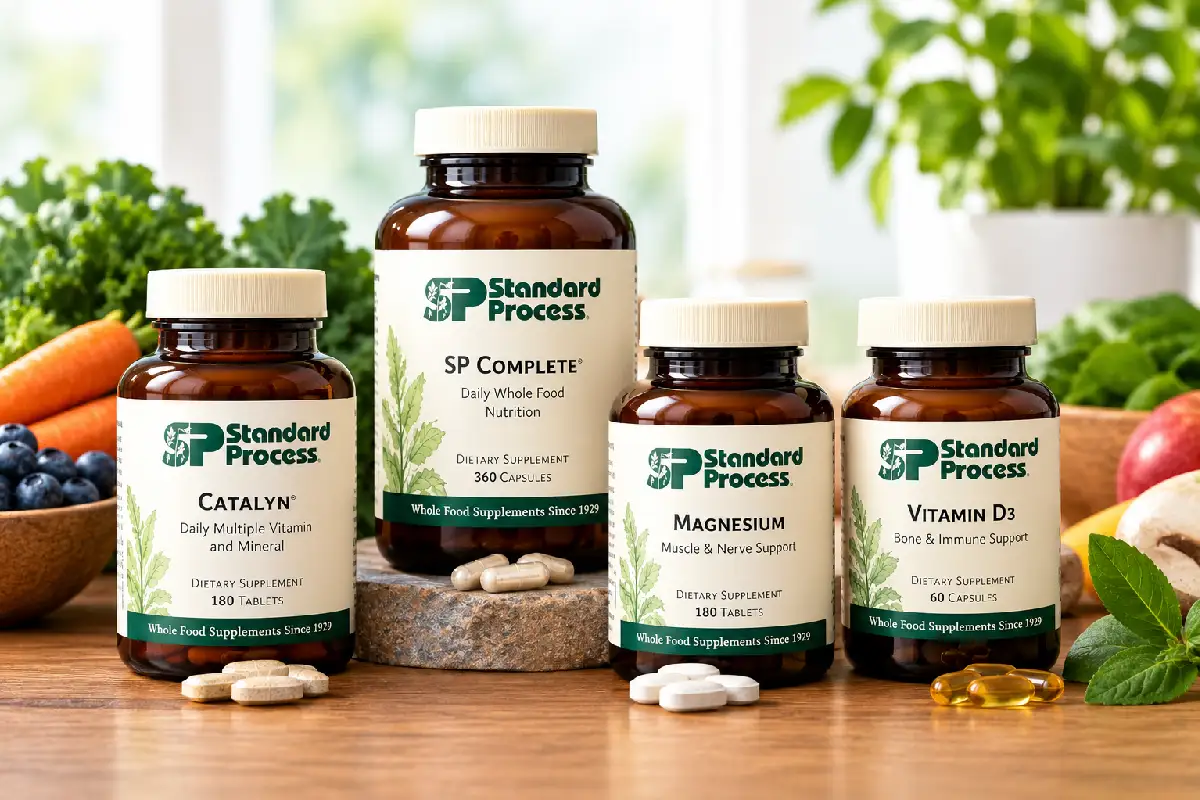
- Catalyn is probably the thing to a flagship product from Standard Process.
- It is presented as a whole food multivitamin that fills general dietary gaps.
- Many practitioners recommend Catalyn first before adding specific supplements.
- SP Cleanse is likely the brands best‑known specialty item.
- It mixes twenty whole food and botanical ingredients.
- It is marketed to support the bodys detoxification processes, such as kidney, liver and gallbladder function, as well, as healthy digestion.
- This product also receives the scrutiny from independent reviewers and I will discuss that later.
Cardio-Plus is designed to support the heart and cardiovascular system. It contains vitamin C, B‑vitamins and an extract from heart called PMG. Cardio‑Plus is often paired with a companion product named Myo‑Plus, which helps muscle and connective tissue.
Symplex F and Symplex M’re glandular‑based formulas. Symplex F is used for women while Symplex M is used for men. These products are common in practitioner plans that address reproductive issues.
Renafood focuses on kidney health. Gastrex focuses on support. Ligaplex II is commonly recommended for tissue and joint concerns. There is also Zypan, an enzyme formula and Antronex, a product that some practitioners still use for detox and histamine support.
Standard Process Vitamins and Supplements: How the Categories Break Down
When you look at the site the catalog is organized by body system or life stage rather than by vitamin type. This makes it easier to navigate than supplement stores. You will usually find sections built around:
- Digestive health
- Cardiovascular support
- Hormonal and adrenal balance
- Immune function
- Bone and joint health
- Childrens supplements, formulated specifically for kids than just smaller adult doses
- Detox and cleansing programs
- General foundational multivitamins
The last category the foundational multis such as Catalyn is usually where new customers begin. Practitioners add targeted formulas after they understand a person’s specific needs. It is important to know that Standard Process follows a build‑a‑protocol model, not a bottle solution. A practitioner may combine three, four or even six Standard Process products to work together instead of recommending one all‑in‑one product.
Standard Process Whole Food Supplements: The Purification Program
The Standard Process 21‑Day Purification Program is a cleanse that uses Standard Process products instead of just one bottle. The program usually pairs SP Complete shakes, which come in a flavors with foundational supplements such as Catalyn, an omega‑3 product and a trace mineral formula. The program guides participants through phases: an elimination period, then a structured reintroduction of food groups one at a time.
Reviews of this program are mixed. Some participants report results: weight loss, better energy and digestive improvements that last beyond the 21 days. Other participants follow the protocol exactly. Get almost nothing apart from a lighter wallet. This split appears in independent reviews so it is not a fluke. Individual response to elimination programs varies a lot whether or not you use Standard Process.
How Much Do Standard Process Supplements Cost?
This is one of the common questions. It is fair because Standard Process products are not as cheap as those found at a drugstore.
Prices vary by product. Based on retail listings a bottle of Catalyn usually costs between high teens and high twenties depending on tablet count. SP Cleanse typically costs between $40 and $50. Cardio‑Plus costs around $65. Gastrex is $30. Renafood is $44. Symplex F can be close to $70 for a bottle. Adding these together in a multi‑product protocol shows that a practitioner‑recommended regimen can exceed $100 a month.
Multiplying these amounts across a multi‑product protocol shows that a practitioner‑recommended regimen can easily exceed $100 a month.
Why does Standard Process charge a premium? Part of it is the integrated farming and manufacturing model. Owning a farm and running an in‑house testing lab costs money. Another part is that Standard Process is a practitioner‑distribution brand. That channel usually has margins than mass‑market retail. It is worth knowing this before you buy.
Part of it is also simply that Standard Process is a practitioner‑distribution brand. That channel usually has margins, than mass‑market retail. It is worth knowing this before you buy.
Where to Actually Buy Standard Process
This can confuse people. Standard Process has historically been a brand. That means the usual way to buy Standard Process products is through a health professional such as a chiropractor, naturopath, nutritionist or similar. The professional will set up an account for you. Then you can buy directly from the office or through an online portal such as Fullscript. Standard Process products can also appear on marketplaces, specialty supplement sites and sometimes on Amazon or eBay from third‑party sellers.. If you buy outside the practitioner channel you miss the personalized protocol that Standard Process is built around. Also buying from sources increases the risk of counterfeit or poorly stored product.
The Criticism: What Skeptics Say About Standard Process
I do not think an useful guide on Standard Process can skip this part so let us talk about it directly. Standard Process has a history of criticism from the science‑based medicine community. Writers at sites such as SkepVet have argued that Standard Process’s core ” food” philosophy— the idea that plant and animal extracts carry near‑magical combined benefits beyond their individual nutrients— extends well past what the actual evidence supports and that a lot of the marketing language blends legitimate nutritional science with unsupported claims dressed up to sound scientific.
Independent ingredient reviewers have also raised specific practical concerns. One detailed breakdown of SP Cleanse pointed out that Standard Process’s proprietary blend of over twenty ingredients only works out to roughly 128 milligrams per ingredient on average— a genuinely small amount, comparable to a fraction of a single stalk of broccoli—which raises real questions about whether individual ingredients are present in high enough amounts to do much of anything.
There is also the fact that like virtually the entire supplement industry Standard Process products are not FDA‑approved and have not gone through the kind of large‑scale randomized clinical trials that pharmaceutical products require. Every product page carries the disclaimer that its statements have not been evaluated by the FDA and that the product is not intended to diagnose, treat, cure or prevent disease— boilerplate language, sure but a real reminder that these are dietary supplements, not medicine.
So Who Actually Benefits From These Supplements?
Honestly I think the fair answer is: it depends a lot on who recommends it and why. If you are already working with a chiropractor, naturopath or functional medicine practitioner who uses Standard Process as part of a personalized protocol— factoring in your labs your symptoms, your diet— that is a very different situation than randomly grabbing a bottle of SP Cleanse off Amazon because you saw it mentioned somewhere. Standard Process’s entire model is built around practitioner guidance and a lot of the value people report seems to come from that structured monitored approach, than any single product working in isolation.
If you are someone who prioritizes nutrition philosophically likes that the company farms a lot of its own ingredients organically and is comfortable paying a premium for that vertical integration Standard Process will appeal to you in a way that a mass‑market synthetic multivitamin never will.
If you are mainly looking for the most clinically‑proven way to fill a specific nutrient gap— say, you just need more vitamin D or an iron supplement— there are more affordable more research‑backed single‑nutrient options out there and it is worth being honest that Standard Process is not really positioned to compete on that front.
A Few Practical Tips If You Decide to Try Standard Process
A couple of things worth knowing before you order anything:
- Talk to a practitioner if you can even a brief consultation, rather than self‑diagnosing which product you need. The brand’s own model assumes this step and skipping it means you are essentially guessing at dosing and combinations that were designed to be used together.
- Buy through a channel. Given the practitioner‑distribution model third‑party marketplace listings carry risk of expired stock, improper storage or in rare cases counterfeit product.
- Read the ingredient panel, not just the marketing copy, especially for anything with a “proprietary blend” label. As the SP Cleanse example shows, blend labeling can obscure how much of any single ingredient you are actually getting.
- Give it time. Whole food‑based low‑dose botanical formulas are not designed to work like a fast‑acting drug. Most practitioners recommend committing to a product for least a few months before judging whether it is doing anything.
- . Set expectations honestly. If you are hoping for a guaranteed transformation the mixed reviews on things like the purification program are a good reminder that results vary a lot from person to person.
Final Take
Standard Process occupies a middle ground in the supplement world. Standard Process is a century old genuinely vertically integrated in a way most supplement brands are not and clearly trusted enough by a large base of health practitioners to remain a staple in clinics across the country. At the time a fair amount of Standard Process’s core “whole food” philosophy sits ahead of where the hard clinical evidence actually is and independent reviewers have raised legitimate questions about ingredient dosing, quality control and whether the premium price is really buying you meaningfully better outcomes than a well‑formulated evidence‑based alternative would.