

Here’s what you need to know about Orange theory Fitness If you’ve searched for Orangetheory Fitness, or have seen those bright orange-hued studios in your neighborhood, and have been curious about what actually happens in them, you’re in luck. They crafted their workouts based on a system that combines structured cardio, strength, and rowing with live heart rate data and a live coach.
Whether you are trying to lose weight or build muscle through your workout, you can think about whether Orangetheory will be a good fit for you. If you are thinking about jumping into an Orangetheory class, here’s a breakdown of the class structure, what to expect knowledge wise, the prosand cons and the first timer take.
What Is Orange theory Fitness?
Orange theory Fitness is the #1 workout for you, your mind and your body. This class at Orange theory Fitness is coach-led group workouts based on heart-rate monitored interval training. Orangetheory is the most effective workout for your body and mind with a unique format which integrates cardio and rowing together and some resistance training on top.
The idea isn’t to work out as hard as you possibly can for the whole session. Instead you work in different intensity levels and the heart-rate will let you know how hard you’re working.
Orangetheory currently offers several class formats. Its India workout information lists Orange 60, Tread 50 and Strength 50, with each format designed around a different emphasis.
The programme also uses an OTconnect performance monitor to display workout information and help members track their effort. The monitor can provide real-time heart-rate information and store workout data in the mobile app.
In modest terms, Orangetheory is best understood as a organized group workout where cardio, forte training, coaching & performance tracking are joint. If you’re new to the program, our guide on how OrangeTheory Fitness works explains the science, structure, and heart-rate-based training approach behind every session.
How Does an Orangetheory Workout Work?
A typical Orangetheory session uses several exercise stations.
Depending on the class, you may work with:
- Treadmills
- Rowing machines
- Dumbbells
- TRX straps
- Benches
- Bodyweight exercises
- Other functional strength equipment
Workouts Vary It won’t be the exact same session over and over, though, as the details of the workout may change.
An ordinary Orange 60class consists of a blend of aerobic and strength training exercises. The ‘Official program notes’ states that Orange 60 is its signature 60min class, tread 50 on the other hand concentrates mostly on cardio endurance and running performance, whilst strength 50 canters mainly on resistance training and strength development.
A coach explains what to do and when to change exercises or intensity. This is one of the biggest differences between Orangetheory and simply walking into a conventional gym.
Instead of arriving with your own programme, selecting exercises and deciding how to structure the session, you follow a prepared workout under coaching.
What Happens During an Orangetheory Class?
The precise template can vary, but the general experience involves moving between different types of exercise and different intensity levels.
A session may include periods of:
- Warm-up
- Cardio
- Rowing
- Resistance exercises
- Higher-intensity intervals
- Recovery periods
- Cool-down or finishing work
The purpose of the intervals is to vary the demand placed on your body rather than maintaining exactly the same effort throughout the session.
For someone who dislikes repetitive gym routines, this can make the workout feel more engaging.
It also removes much of the planning involved in creating a session yourself. To understand the exercises, class formats, and coaching methods used in each session, explore our OrangeTheory workouts and training guide.
Do You Have to Run?
No.
The Origen theory workouts can be individualized for any fitness level; official training tells you to perform as well as possible for the current moment and your current ability (for the training session itself). What might involve yourunning, jog,orpower walk can differ depending on the workout structure and your own level.
Why do these adjustments allow flexibility for people doing same class? Because each one could possibly be exercising very slowly with minimum resistance while another with maximal resistance simultaneously.
The objective is not to match the person alongside you.
It is to complete the set workout at an suitable level for you.
Orangetheory Heart-Rate Zones Explained
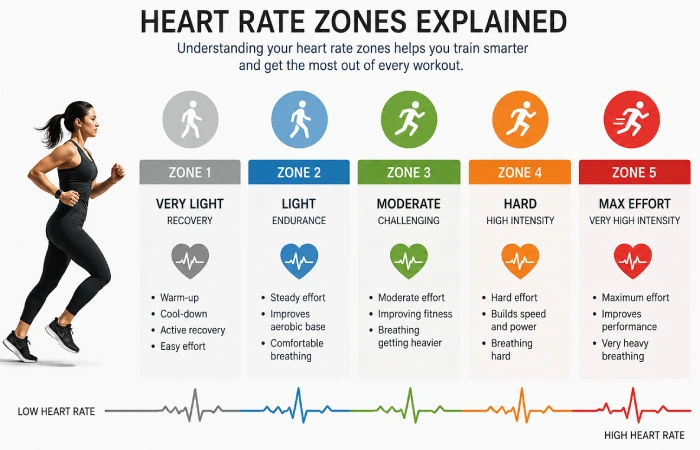
Heart-rate zones are one of the defining features of the Orangetheory system.
The current Orangetheory India workout information describes five zones based on a personalised maximum heart rate:
| Zone | Approximate % of personalised maximum heart rate | General purpose |
| Grey | 50–60% | Very light effort/recovery |
| Blue | 61–70% | Easy-to-moderate effort |
| Green | 71–83% | Base or challenging sustainable effort |
| Orange | 84–91% | Hard effort |
| Red | 92–100% | Very hard effort |
These percentages are based on the individual’s personalised maximum heart rate rather than being a universal target for everybody.
What Does Each Zone Feel Like?
Grey:
You are working lightly and should be able to recover comfortably.
Blue:
Your breathing has increased, but the effort remains relatively easy.
Green:
You are working at a meaningful pace that you can generally sustain.
Orange:
The effort becomes difficult and uncomfortable. You are working hard but still following the workout.
Red:
You are approaching your highest level of effort.
The important point is that red does not automatically mean better.
A good workout contains different intensities, including recovery. Trying to remain at maximum intensity throughout the entire class would defeat the purpose of interval training and may make recovery more difficult. Many members join to improve body composition and overall fitness. Learn more in our OrangeTheory weight loss and fitness goals guide.
What Are Splat Points?
You may hear Orangetheory members talk about Splat Points.
Splat Points represent the minutes spent in the Orange Zone according to the Orangetheory system. The company’s current FAQ explains that Splat Points are tied to the total minutes spent in the Orange Zone, while your maximum heart rate determines your individual zones.
Although, a number of such wearable fitness trackers can be used as an estimation forworkout Intensity, but should not be used as a universal indicator ofFitness a.k.a. Overall Health Status of a Person.
For instance, an ill person returning to exercise, or an ill person working on a less intense session, might intentionally not spend as much time in the orange or red zones.
That does not mean the test was ineffective.
Your training should be judged against your goals, fitness level and recovery—not simply by how many points appear on a screen.
Orangetheory Class Types
The right class depends on what you want from your training.
Orange 60
Orange 60: this is the standard 60-minute Orangetheory class.
It’s a mixture of weights and cardio; heart rate-based interval training is used to control the intensity; it seems the clearest way for someone looking for a balanced full-body session to start.
Best suited to:
- General fitness
- Cardio and strength
- People who enjoy varied workouts
- Those who want a coached full-body session
Tread 50
A class called Tread 50 this class duration of 50minutes and centers heavily around cardiovascular conditioning & running.
its main benefits are stated by the program to cardiovascular endurance, stamina and lower-body power.
Best suited to:
- Runners
- People building cardiovascular endurance
- Improving treadmill performance
- Those who prefer a cardio-focused session
Strength 50
Strength 50 50-minute class based around all thing strength and resistance. It will build strength, muscular endurance and power.
Best suited to:
- People prioritising resistance training
- Building strength
- Improving muscular endurance
- Members who want more dedicated strength work
The availability of precise class formats may be studio-dependent, please raise to the agenda at your resident studio when creation plans for your week.
What Are the Profits of an Orangetheory Workout?
As the health benefits are largely due to the sort of exercise being undertaken, rather than to the brand itself.
1. Cardiovascular Fitness
Rowing, treadmill intervals and other types of aerobic training can deliver a good dose of cardio workout.
We already know regular aerobic activity has incredible benefits. According to current guidelines from CDC: You should aim for 150 minutes per week of moderate aerobic activity, 75 minutes of vigorous activity, plus muscle-strengthening on two days.
A session may help with that activity in general, but it depends on what that activity is and the intensity and your intensity of a class.
2. Strength Training
It also adds resistance exercises using weights and TRX straps. That means Orangetheory is more than a pure cardio session.
When used in proper progressions and implemented with consistency, resistance exercise can lead to increases in muscle strength and muscular endurance.
That being said, a person focused on developing maximal strength or size may soon outgrow solely relying on a group conditioning class, necessitating a more specialized resistance training program.
3. Workout Variety
A major practical advantage is variety.
Instead of a full hour just spent on the treadmill, an class can include a mixture of cardio, row and strength components.
It may take the sting out of training; it may even serve those of you who hate gym class as much as I do.
4. Coaching and Structure
Some people do not need more motivation—they need fewer decisions.
A coach-led format tells you:
- What exercise to perform
- When to change
- How intensely to work
- When to recover
- What equipment to use
That structure can be particularly useful for beginners or people who find independent gym programming confusing.
5. Progress Tracking
Track work out details using performance monitoring and the Orangetheory mobile app.
Members can also see a progression of performance over time, instead of judging the success of a session entirely by how it felt.
Tracking can work because, so long as you think of the numbers as information, not as evidence that you’re unfit.
Can Orangetheory Help with Weight Loss?
It can be used as part of an attempt to lose weight, but an Orangetheory membership does not ensure the loss of any weight.
Weight change boils down to an energy-in versus energy-out equation. The CDC also explains that when a person adds physical activity, it also ups the number of calories being burnt off – something they say is integral in achieving weight loss.
This means Orangetheory may help by:
- Snowballing corporeal activity
- Educating circulatory fitness
- Supporting muscle maintenance and development
- Making exercise more consistent
- Providing structured workouts
But your results will also depend on nutrition, sleep, recovery, starting fitness, training frequency and other lifestyle factors.
Don’t Judge Results by Calories Alone
Fitness trackers and workout monitors can provide useful estimates, but they should not be treated as exact measurements of fat loss.
A better long-term approach is to look at several indicators:
- Fitness improvements
- Strength improvements
- Exercise consistency
- Waist or body measurements
- Body composition when appropriately measured
- How you feel during everyday activity
- Performance in workouts
Body heaviness can also fluctuate for reasons unconnected to body-fat vicissitudes.
Can Orangetheory Shape the Muscle?
Yes, Orangetheory includes resistance training, and Strength 50 provides a more dedicated strength-focused option.
However, the phrase “build muscle” needs context.
Muscle growth depends on factors including sufficient training stimulus, progression, nutrition and recovery.
If your main goal is general strength and improved muscular fitness, Orangetheory may provide a useful combination of resistance work and conditioning.
If your primary goal is bodybuilding-style hypertrophy or maximum strength, a dedicated resistance programme may offer more control over exercise selection, volume, loading and progression.
In other words, Orangetheory can be a strong general fitness programme without necessarily being the ideal programme for every specialised fitness goal.
Is Orangetheory Good for Beginners?
For many beginners, yes.
Orangetheory is accessible to all levels of fitness and each participant works out at their own pace according to the description on the official website.
That does not mean your first class will necessarily feel easy.
A beginner may find the combination of cardio, rowing and resistance training challenging.
The best approach is to think of the first few classes as an introduction to the system.
You do not need to keep up with experienced members.
Beginner Tips
Start conservatively.
Your first goal should be learning the exercises and understanding the class structure.
Tell the coach you are new.
A coach can explain equipment and help you understand modifications.
Do not chase the Red Zone.
High intensity is only one part of the workout.
Use power walking if appropriate.
You do not have to run simply because someone else is running.
Focus on technique.
A lighter weight performed correctly is generally more useful than a heavier weight that compromises your movement.
Allow recovery.
A hard workout is still a training stimulus that your body needs time to adapt to.
What to Expect Through Your First Orangetheory Class

The room can seem a little disorienting in the early few minutes if you’ve never been before.
The wonderful thing though is that you’re not meant to know what you are supposed to be doing.
A sensible first-class checklist is:
Before class
- Arrive early.
- Complete any required registration or intake information.
- Tell the staff or coach that it is your first session.
- Wear comfortable exercise clothing.
- Bring water.
- Ask about the heart-rate monitor and how it works.
Some Orangetheory studio pages currently advise first-time visitors to arrive around 30 minutes early for the introduction and check-in process.
During class
Concentrate on the coach instead of trying to imitate the fastest person in the class.
When you are uncertain of an exercise then question.
If an exercise causes pain rather than normal muscular effort, stop and tell the coach.
After class
Your first session may feel harder than expected, particularly if you have not exercised recently.
That is not a reason to immediately schedule another intense workout the next day.
Give your body time to recover and judge how you feel over the following 24–48 hours.
How Regularly You Do Orangetheory?
There is no single precise number of Orangetheory classes for everybody.
The suitable incidence depends on:
- Training history
- Current fitness
- Other exercise
- Sleep
- Work and lifestyle demand
- Recovery
- Your specific goals
Consider getting a less frequently updated routine to start so that someone won’t attempt to attend many times a day, 7 days a week.
A total of two organized classes a week could work for someone who was otherwise not really into vigorous exercise, and someone more experienced could manage something else, for instance.
The key principle is consistency without sacrificing recovery.
If you frequently find yourself hitting thegymhard every single day thenyou’re going to have a significantly tougher time over time. Vary the focus of the day if you’re one of the people that visits many days a week and you probably don’t want every single workout to be about being able to achieve ultimate output for that session. Before signing up, review our OrangeTheory membership cost guide to compare plans, pricing, and membership options.
Orangetheory Pros and Cons
| Potential advantages | Potential disadvantages | |
| Coach-led workouts | Can feel intense | |
| Combines cardio and strength | Membership may cost more than basic gym access | |
| Structured sessions | Less control over programme design | |
| Heart-rate tracking | Data can become distracting | |
| Workout variety | Group environment is not for everyone | |
| Suitable for different fitness levels | Recovery needs to be managed | |
| App-based workout tracking | Specialised goals may require additional training |
Who Is Likely to Enjoy Orangetheory?
Orangetheory may suit you if you:
- Like structured workouts
- Enjoy exercising with other people
- Want coaching
- Get bored training alone
- Want a mixture of cardio and strength
- Like tracking performance
- Need accountability to exercise consistently
Who Might Prefer a Traditional Gym?
A conventional gym may be a better choice if you:
- Prefer training alone
- Want complete control over your programme
- Primarily train for bodybuilding
- Need highly specialised strength programming
- Prefer flexible workout durations
- Do not enjoy group classes
Neither option is universally better.
The best selection is the one you will actually wear and fits your interests.
Orangetheory vs a Traditional Gym
| Factor | Orangetheory | Traditional Gym |
| Programming | Pre-structured | Self-directed |
| Coaching | Included in class | Usually separate or limited |
| Cardio | Strong emphasis | Depends on programme |
| Strength | Included | Highly customisable |
| Social environment | Group-based | Usually more independent |
| Exercise selection | Determined by class | User chooses |
| Progress tracking | Integrated technology | Depends on equipment/app |
| Flexibility | Based on class schedule | Generally higher |
| Best for | Structured general fitness | Customised training |
The important distinction is structure versus control.
Orangetheory takes much of the programming work away from you.
A conventional gym gives you much more freedom.
How to Get Better Results from Orangetheory
- Prioritise consistency
One exceptional workout followed by two weeks away is less useful than a realistic routine you can maintain.
- Learn the movements
Do not sacrifice technique to increase a number on the screen.
- Use recovery days
Your body adapts between workouts, not simply during them.
- Include other movement
Walking, mobility work, recreational sport and easier cardio can complement intense training.
- Eat appropriately
Exercise does not remove the importance of general nutrition.
- Track meaningful progress
Look beyond calories and Splat Points.
Ask:
- Is my running improving?
- Can I row more efficiently?
- Are my weights increasing?
- Is my recovery improving?
- Am I exercising consistently?
- Do everyday activities feel easier?
Those measures provide a more useful picture of progress.
How Orangetheory Fits into General Fitness Guidelines
Based on current CDC recommendations, adults need at least 150 minutes of moderate strength aerobic workout or 75 minutes of vigorous strength aerophilous exercise & muscle-strengthening exercise at least two days per week.
That does not nasty you need to attend a particular suitability studio to be strong.
It simply provides a useful framework for thinking about your overall activity.
A balanced week might include:
- Orangetheory sessions
- Walking or other lower-intensity movement
- Strength-focused work where appropriate
- Mobility or flexibility work
- Rest and recovery
For someone doing several demanding classes, adding more high-intensity workouts is not automatically better.
Is Orangetheory Worth It?
Is the price of Orangetheory right for you? Well that really depends on what is most important to you.
If you value guidance from a coach, scheduled workouts, a team environment to help motivate you, and performance metrics that help you stay on track, then the price may indeed be justified.
But if you don’t need these things and plan to create your own workouts and just use equipment (weight and cardio machines), then a more standard gym may be a more economical way to go.
Membership costs also vary by studio. Orangetheory India’s membership information lists different membership structures, while individual studio pages note that pricing can vary by location.
Therefore, it is better to check your local studio rather than relying on a generic internet price. Heart-rate monitoring is a core part of the program. Discover how performance is measured in our OrangeTheory fitness tracking.
Orangetheory class comparison
| Class | Duration | Main focus | Best for |
| Orange 60 | 60 min | Cardio + strength | General fitness |
| Tread 50 | 50 min | Cardiovascular training | Endurance/running |
| Strength 50 | 50 min | Resistance training | Strength and muscular endurance |
These are the current class descriptions listed by Orangetheory India.
Quick beginner checklist
Before the first class:
- Arrive early.
- Tell the coach you are new.
- Bring water.
- Wear comfortable training clothes.
- Learn how the heart-rate monitor works.
- Start at an appropriate intensity.
- Don’t compare your numbers with experienced members.
- Prioritise technique.
- Give yourself adequate recovery afterwards.
FAQs
- What is Orangetheory Fitness?
Orangetheory Fitness is a coach-led group fitness programme combining cardiovascular exercise, rowing and resistance training with personalised heart-rate monitoring.
- Is Orangetheory good for beginners?
Yes, Orangetheory promotes itself to fit every fitness level and individuals can participate at their own pace. Beginners should exercise with caution in the beginning. Do not compete with those who have more experience.
- Is Orangetheory a HIIT workout?
“We’reintervalbased. It doesn’t involve doingmaximum– intensity stuff the entire time. The workouts are a blend of various heart rates with cardio, rowing, and strength.
- Can Orangetheory help you lose weight?
The use of exercise can enhance a weight loss programme as it increases physical expenditure. However weight loss relies on the energy consumed, by exercise alone cannot ensure weight loss will occurs without consider your diet and your energy balance.
- Do you have to run at Orangetheory?
No. Workouts on the treadmill can be altered for people of different Fitness Levels and power walking would be perfectly okay for people wanting no to run.
- What are Splat Points?
The Orange Zone is the central part of the OTbeat system and is associated with Splats points. Splats can serve as indicator of performance in training, however are not the definitive key to a great workout.
- Which Orangetheory class is best for beginners?
Orange 60 is usually the easiest to jump in with if you’re looking to get cardio and strength in one class. Ultimately, the class will all depend on your ultimate goals, and what classes your studio has available.
- How regularly would you do Orangetheory?
There is no universal schedule. Beginners should choose a manageable frequency and allow sufficient recovery between demanding sessions. Your overall exercise routine should also include appropriate lower-intensity movement and strength work.
Final Verdict
Orange theory Fitness should be approached as a well-ordered, coached workout system, not just another HIIT class The mix of cardio, rowing, strength and heart monitoring workouts works well for anyone looking for a more comprehensive and less time-consuming workout not to mention, without the hassle of creating workouts themselves.
– The primary appeal of an activity, whether you’re a beginner or experienced, is that for new exercisers, it’s structured (e.g., with a coach), and for the more experienced, it can be measured, has variation, and benefits from team camaraderie.
Yet, Orangetheory does not provide some get-quick-for-weight-loss, strength or fitness solution. The results depend on hard training, suitable diet, recover and reasonable expectations.
However, if you’d prefer the comfort of coached group fitness training and an workout which merges several fitness areas all at the same time, you may need check out Orangetheory. If you plan to fully manage your current training plan or have extremely certain muscle and strength objectives, you should likely stick with a gym.
Ultimately, the best workout is the one you can do without injury and recovery and that you can maintain long term. Want to know what members think? Read our detailed OrangeTheory Fitness reviews for real-world experiences, pros, and cons.