
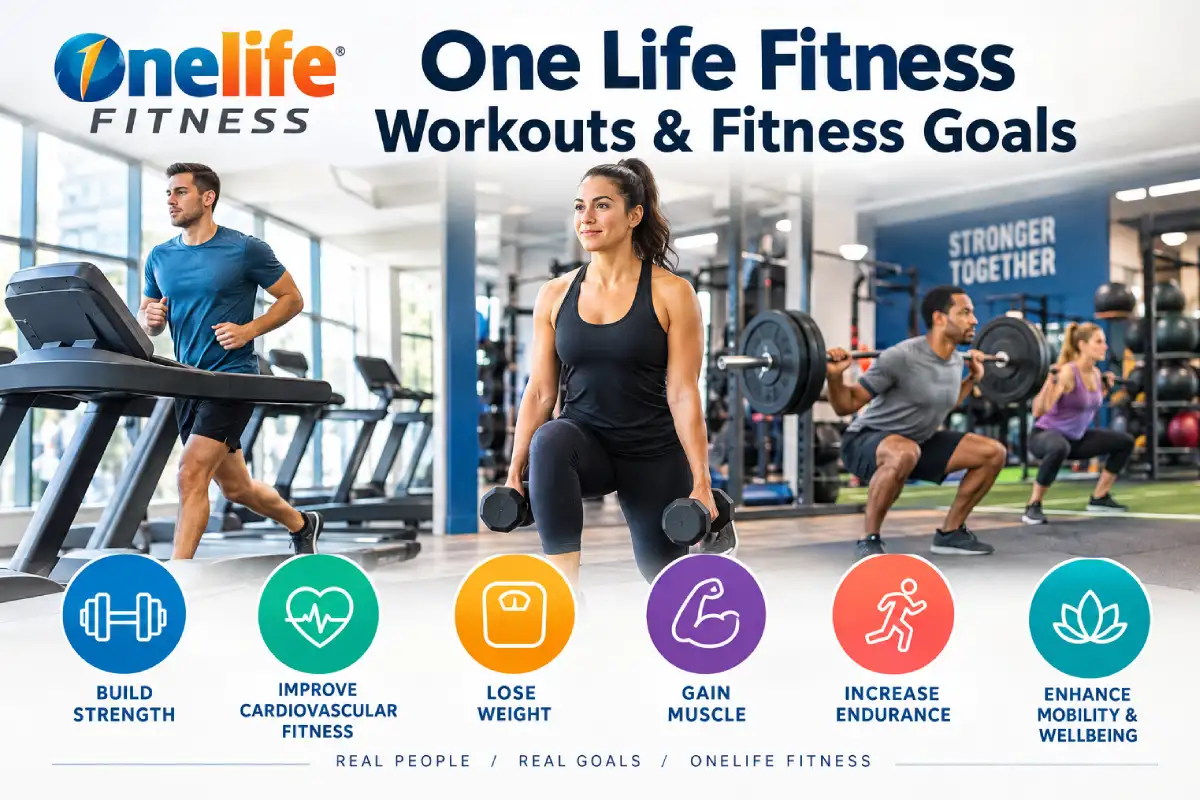
Starting at a gym can feel scary especially when you do not know which machines to use, how many minutes of cardio to perform, or if you should prioritize strength training. Understanding how the One Life Fitness workouts fit into your fitness program can make it much less intimidating.
Onelife Fitness official website describes a range of facilities and services, including studio classes, personal training, small-group training, swimming, recovery options and other gym amenities. Its official FAQ also explains that personal training is designed around an individual’s goals and needs, while members can access on-demand workouts through the Onelife Fitness app.
What Are One Life Fitness Workouts?
Onelife Fitness workouts can take several forms depending on the club and the services available at that location. Options can include independent gym training, group studio classes, personal training, small-group training and cardio-based exercise.
The official Onelife Fitness website shows that their clubs offer studio classes, swimming, small-group training, mind-and-body activities, basketball, recovery services and STRIKE boxing. Remember, not every place offers the same facilities; thus, it is a good idea to call your local club to verify that you can perform that one activity at that facility before deciding upon your workout routine.
For a beginner, these options can broadly be organised into four training categories:
- Strength training: weights, machines and resistance exercises.
- Cardio: walking, cycling, rowing, running and similar activities.
- Group fitness: instructor-led classes and specialised sessions.
- Mobility and recovery: stretching, mobility work and recovery-focused services.
The best combination depends on your objective rather than the gym’s equipment list alone.
Choosing the right membership can support your long-term success, so review the One Life Fitness Membership Pricing Guide to find the best option for your needs.
One Life Fitness Workouts for Different Fitness Goals
To build a routine that works, start by deciding the outcome you want. The outcome guides every choice. A person who trains for muscle gain will not need the routine as a person whose main aim is to improve cardiovascular fitness. The difference, in matters because muscle gain and cardiovascular fitness require different workouts.
| Fitness goal | Main training focus | Beginner approach |
| General fitness | Strength + cardio | 2–3 strength sessions plus regular walking/cardio |
| Weight loss | Activity + strength + nutrition | Full-body resistance training with regular cardio |
| Muscle gain | Resistance training | Progressive strength training 3–4 days weekly |
| Strength | Compound resistance exercises | Focus on technique before heavier loads |
| Cardiovascular fitness | Aerobic exercise | Gradually increase duration and intensity |
| Mobility | Mobility + controlled strength | Regular stretching and movement practice |
Gym Workouts for Beginners
The biggest mistake new gym members make is often doing too much too soon.
A beginner does not need a complicated five- or six-day split. A straightforward programme covering the major movement patterns can provide a solid foundation.
A typical beginner session might include:
- Warm-up: 5–10 minutes of easy cardio and dynamic movement.
- Leg exercise: squat variation or leg press.
- Push exercise: chest press or machine press.
- Pull exercise: seated row or lat pulldown.
- Hip-dominant exercise: Romanian deadlift or another suitable variation.
- Core exercise: plank or controlled abdominal exercise.
- Optional cardio: 10–20 minutes at a comfortable-to-moderate intensity.
Start with manageable resistance and prioritise controlled movement. You should not need to train to complete exhaustion to make progress.
For beginners who are uncertain about exercise selection or technique, personal training may provide useful structure. Onelife Fitness says its trainers create and guide programmes around individual goals and needs.
Access to quality equipment and amenities can make a difference in achieving results, which is why the One Life Fitness Locations and Gym Facilities Guide is worth exploring.
Full Body Gym Workout for a Simple Weekly Routine
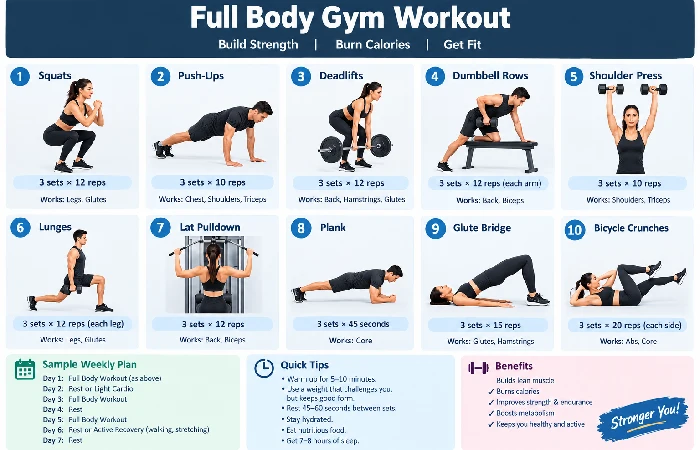
The full body gym workout will also be especially beneficial for people that haven’t done resistance training before, and that aren’t very time rich!
Rather than hitting one or two body parts per day you perform one big workout and target several large muscles groups.
For example:
Beginner Full-Body Session
Lower body
- Leg press — 2–3 sets
- Bodyweight squat or goblet squat — 2 sets
Upper body
- Chest press — 2–3 sets
- Lat pulldown — 2–3 sets
- Seated cable row — 2 sets
Core
- Plank — 2–3 controlled sets
Cardio
- 10–20 minutes of brisk walking, cycling or another preferred activity
Gym Workout for Weight Loss
A gym workout for weight loss should not be viewed as a way to simply burn as many calories as possible during one session.
A practical approach can combine:
- 2–3 resistance-training sessions each week
- Regular brisk walking or other moderate cardio
- Additional activity that you enjoy
- Adequate recovery
- A sustainable eating pattern
For example, it’s possible to have Monday and Friday as days when you do a full-body strength training, have a shorter strength session on Wednesday and walk frequently throughout the week.
This approach is generally more sustainable than trying to compensate with extremely long cardio sessions.
Combining structured workouts with One Life Fitness Classes and Group Workouts can help improve motivation and consistency.
Gym Workout for Muscle Gain
A gym workout for muscle gain needs consistent resistance training and adequate recovery.
It is also progressive overload, where over time you might slowly increase your resistance, your reps, your sets, or the exercises (making them harder, without losing good technique).
A beginner muscle-building programme might use exercises such as:
- Leg press or squat
- Romanian deadlift
- Chest press or bench press
- Lat pulldown
- Seated row
- Shoulder press
- Biceps and triceps exercises
The frequency of your training can differ, however for beginners sufficient rest time should be allowed between targeting the same muscles.
Nutrition also needs some care. While machinery helps in the gym-that does not all of muscle building-a sufficient amount of protein, caloric and sleep/recovery need some taking into consideration as well.
Cardio Gym Workout Options
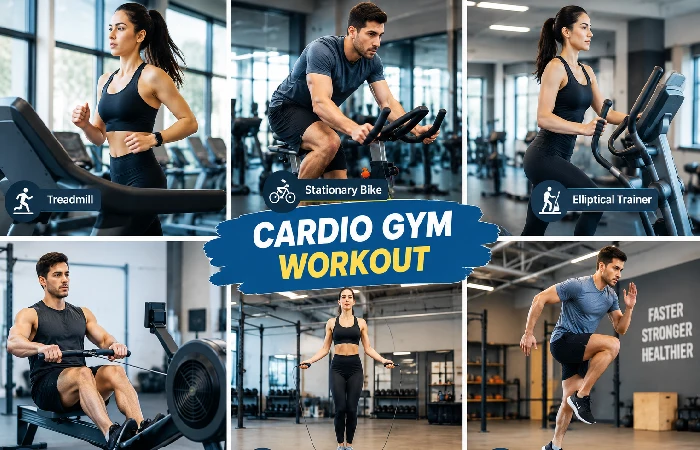
Beginners should not assume that harder is always better.
A sensible progression could look like:
Week 1–2:
15–20 minutes of comfortable cardio.
Week 3–4:
20–30 minutes, depending on recovery.
Later:
Gradually increase duration or introduce short periods of higher intensity.
CDC advises adults to exercise 150 minutes each week at a moderate-to-intensive cardio workout or 75 minutes if the workout is vigorous and include muscle strengthening on two days minimum.
You don’t need to hit all of the target immediately. One of the other key messages the CDC states is that “some activity is better than no activity” and that activity should be spread throughout the week.
For personalized support and customized exercise plans, consider One Life Fitness Personal Training and Workout Programs alongside your fitness goals.
One Life Fitness Workouts & Fitness Goals: A Simple Workflow
A useful beginner workflow is:
Goal → Assessment → Programme → Technique → Progression → Review
- Choose the goal
Know what you want-Are you after general fitness, fat loss, muscle mass increase, strength, stamina, or just moving more.
- Assess your starting point
Consider your current activity level, training experience, available time and any movement limitations.
- Choose a manageable programme
Start with a routine you can realistically repeat each week.
- Learn technique
Use lighter resistance while learning new exercises. If necessary, ask a qualified trainer for instruction.
- Progress gradually
It is at this point, when a particular load feels easy to you and under your control, that you up the weight/complexity.
- Review after several weeks
Look beyond the scales. Improvements in strength, stamina, exercise technique, consistency and daily energy can also indicate progress.
What to Expect From Your Fitness Progress
One of the most important expectations to set is that results are rarely linear.
You may notice improved coordination and exercise confidence relatively early. Strength can also improve as you become more familiar with movements. Visible changes in body composition can take longer to see and relies on: training, diet, sleep, genes, as well as commitment.
There is no reliable universal timetable for losing a particular amount of weight or gaining a specific amount of muscle.
A better way to measure progress is to track several indicators:
- Exercise performance
- Repetitions and resistance
- Cardio duration
- Waist or clothing changes
- Body weight trends, if relevant
- Energy and general fitness
- Training consistency
These are health guidelines rather than a promise of a particular physique or rate of progress.
Onelife Fitness Classes, Personal Training and Independent Workouts
Different training formats suit different people.
| Training option | Best suited to | Main advantage | Possible limitation |
| Independent gym training | Self-directed members | Flexible | Requires planning |
| Personal training | Beginners needing guidance | Individualised support | Additional cost |
| Group classes | Social and structured exercisers | Scheduled workout | Less individualisation |
| Small-group training | People wanting coaching with others | Balance of support and group setting | Availability varies |
| On-demand workouts | Members wanting home flexibility | Convenient | Less direct coaching |
Onelife Fitness states that personal training is delivered at its clubs, while members can access a library of on-demand workouts through its app for virtual exercise.
Who Should Consider This Approach?
Onelife Fitness’s broad selection of training formats may suit people who want access to different ways of exercising rather than following one specialised programme.
It can be particularly useful for:
- Beginners who want to learn gym basics
- People combining strength and cardio
- Members who enjoy instructor-led classes
- People who prefer structured personal training
- Experienced gym users who want access to varied equipment and facilities
Ultimately, it all depends on the club itself, membership benefits, the price tag and your individual needs.
Someone who only needs a basic weights area may not benefit from paying for facilities they rarely use. Conversely, a person who enjoys classes, swimming or recovery services may value having those options available. Before deciding on a training approach, read One Life Fitness Reviews, Pros, Cons, and Comparisons to learn from member experiences.
Limitations and Things to Check Before Joining
A large fitness centre is not automatically the right gym for everyone.
Before committing, check:
- Whether your preferred equipment is available
- Opening hours at your chosen club
- Class schedules
- Personal-training availability
- Membership pricing and terms
- Additional fees
- Parking and location
- Busy periods
- Whether the facilities match your routine
The Onelife Fitness website allows visitors to search for clubs by city, state or ZIP code, which is useful because services and amenities can differ between locations.
Safety and Beginner Training Advice
New exercisers should avoid the urge to copy lifters or greatly increase how much they train.
Start with weights and routines that’re easy to handle. Focus on learning the way to move. Give your body time to recover between workouts.
Talk to qualified fitness professional in you are unwell with the condition you have with a significant injury or condition which can alter you performance in the exercise protocol. The CDC says people, with long-term health problems or disabilities should check with a health professional or a physical activity specialist to find activities.
Stop working out and get help right away if you feel severe chest pain pass out or have strange shortness of breath.
Final Thoughts
One Life Fitness Workouts and Fitness Goals are best thought of as a framework instead of one single workout plan. Beginners can start with full-body strength sessions include manageable cardio and slowly make the training more challenging as fitness gets better.
The best program is usually the one that you can do regularly recover from and change as your abilities grow. Whether the goal is losing weight, building muscle improving heart health or just being more active steady progress is more important, than doing the workout possible.
For people who are just starting out begin with steps learn the basics and track progress over weeks and months instead of hoping for quick results.