
Introduction
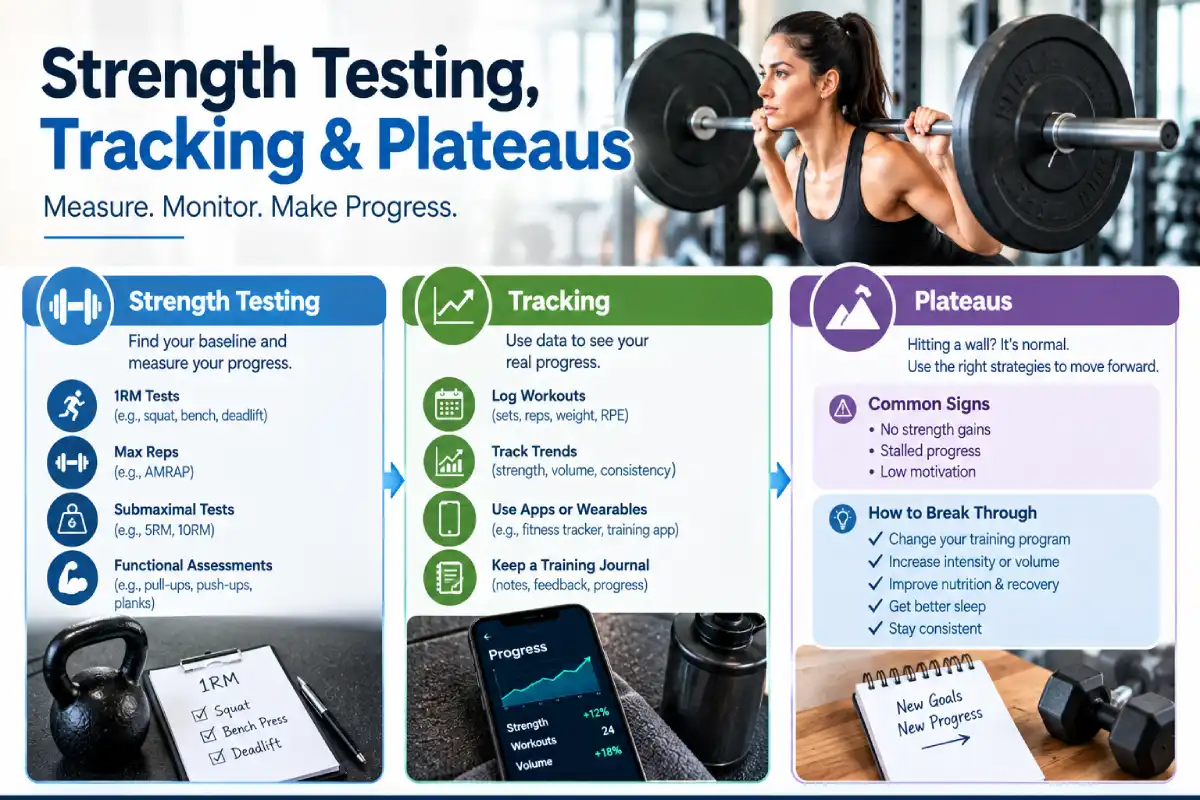
Strength training is much easier to improve if you have an accurate record of just where you are starting from. Therefore Strength Testing, Tracking & Plateaus are essential components in any good training programme. While many tend to think in terms of the sole workout, using performance measurements and feedback can give you the information you need to know if what you are doing is effective or not. Muscle strength testing is used for a variety of reasons, whether you want to build muscle, enhance your athletic performance or gain more strength in general, learning how to go about testing your muscle strength and tracking your results will allow you to make better training choices
Why Strength Testing Matters
Some lifters‘ only indicator of progress is changes in how they look. Gains in appearance are often a great source of motivation, but they don‘t necessarily mean it‘s stronger.
Strength testing helps:
- Establish a starting point
- Measure training effectiveness
- Set realistic goals
- Identify weaknesses
- Monitor long-term progress
Regular testing. You can develop confidence by showing progress through initial testing.
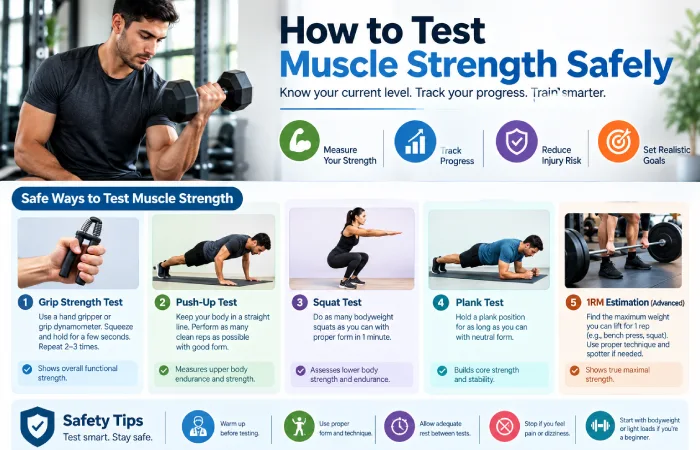
How to Test Muscle Strength Safely
Common Strength Testing Methods
| Method | Description | Best For |
| One Rep Max (1RM) | Maximum weight lifted once | Experienced lifters |
| Estimated 1RM | Calculated from multiple reps | Most gym users |
| 3RM Test | Maximum weight for 3 reps | Intermediate lifters |
| 5RM Test | Maximum weight for 5 reps | Beginners |
| Bodyweight Tests | Push-ups, pull-ups, squats | General fitness |
For many people, estimated maximums provide a safer alternative to true one-rep maximum testing.
One Rep Max Calculator Guide
A one rep max calculator guide can help estimate maximum strength without attempting an all-out lift.
Common Formula
Estimated 1RM:
Weight Lifted × (1 + Reps ÷ 30)
Example
| Weight Lifted | Repetitions | Estimated 1RM |
| 80 kg | 5 reps | Approximately 93 kg |
| 100 kg | 3 reps | Approximately 110 kg |
| 60 kg | 8 reps | Approximately 76 kg |
While calculators provide useful estimates, they are not perfectly accurate for everyone.
Limitations
- Individual differences affect accuracy
- Exercise technique matters
- Fatigue can influence results
- Estimates become less reliable with higher repetitions
Strength Standards for Beginners
Many newcomers wonder how their performance compares with others. Understanding strength standards for beginners can provide context without creating unrealistic expectations.
Beginner Strength Benchmarks
| Exercise | Beginner Target (Men) | Beginner Target (Women) |
| Squat | Bodyweight × 0.8 | Bodyweight × 0.5 |
| Bench Press | Bodyweight × 0.7 | Bodyweight × 0.4 |
| Deadlift | Bodyweight × 1.0 | Bodyweight × 0.7 |
These figures are general guidelines rather than strict requirements.
Factors affecting strength include:
- Age
- Body size
- Training experience
- Exercise technique
- Recovery quality
Progress should be measured against your own previous performance rather than someone else’s numbers.
Track Strength Progress Effectively
Tracking is useful as it can be used to find out information about trends that may occur over the course of 2-3 weeks.
What Should You Track?
Workout Performance
Record:
- Weight used
- Repetitions completed
- Sets performed
- Rest periods
Recovery Metrics
Track:
- Sleep duration
- Energy levels
- Muscle soreness
- Stress levels
Body Metrics
Useful measurements include:
- Body weight
- Waist measurements
- Progress photos
- Lean mass estimates
Strength Tracking Methods Comparison
| Method | Advantages | Limitations |
| Notebook | Simple and inexpensive | Manual entry required |
| Spreadsheet | Easy analysis | Requires organisation |
| Fitness Apps | Automated tracking | May require subscription |
| Smart Wearables | Additional health data | Limited strength-specific data |
| Coaching Software | Detailed analysis | Higher cost |
The best system is usually the one you will consistently use.
Strength Training Plateau: Why Progress Slows

Experiencing a strength training plateau is normal. Most lifters encounter periods where improvements become slower or temporarily stop.
Common Causes of Plateaus
Inadequate Recovery
Poor sleep and insufficient recovery can affect performance.
Lack of Progressive Overload
Using the same weights repeatedly may reduce adaptation.
Poor Nutrition
Insufficient calories or protein can limit recovery.
Excessive Training Volume
More exercise is not always better.
Stress
Work, school and life stress can affect recovery and performance.
How to Break a Strength Plateau
Many lifters search for ways to learn how to break a strength plateau when progress stalls.
Practical Strategies
- Review Recovery Habits
Focus on:
- Sleep quality
- Hydration
- Protein intake
- Stress management
- Adjust Training Volume
Some people benefit from:
- Fewer weekly sets
- Additional recovery days
- Reduced intensity temporarily
- Improve Exercise Technique
Small improvements in form can sometimes unlock further progress.
- Use Periodisation
Structured changes in intensity and volume may help prevent stagnation.
- Focus on Weak Points
Accessory exercises can address limiting muscle groups.
Plateau-Breaking Workflow
Step 1: Assess Recent Progress
Review training logs from the previous four to six weeks.
Step 2: Identify Potential Causes
Look for:
- Poor sleep
- Reduced calorie intake
- Increased stress
- Missed workouts
Step 3: Make One Change
Avoid changing everything at once.
Step 4: Monitor Results
Track performance for several weeks.
Step 5: Reassess
Keep making modifications only when it is unavoidable.
This step eliminates any wandering down blind alleys and helps us decide what works.
Expectations Management: How Fast Should Strength Improve?
The first is the misconception that we will be progressing on a week to week basis
Realistic Expectations
Beginners
Often experience faster initial gains because of skill development and neural adaptations.
Intermediate Lifters
Progress usually becomes slower and less predictable.
Advanced Lifters
Strength increases often occur gradually over months rather than weeks.
Important Reminder
Temporary plateaus do not necessarily mean failure.
Progress may still occur through:
- Improved technique
- Better movement quality
- Increased training volume
- Enhanced recovery
Common Strength Tracking Mistakes
Testing Too Frequently
Constant maximum testing can interfere with training.
Comparing Yourself to Others
Individual differences make direct comparisons difficult.
Ignoring Recovery Data
Performance alone does not tell the complete story.
Chasing Numbers Only
Strength is important, but movement quality matters too.
Inconsistent Record Keeping
Missing data makes long-term analysis difficult.
Conclusion
Strength Testing, Tracking & Plateaus are useful tools for the gym-goer who wants to improve strength. Focus on understanding how to test strength in the gym using a one rep max calculator, strength standards for a beginner, and systematically monitoring strength progress to give feedback for life-long improvement. As well as a rational underpinning to recovery from strength training plateaus in performance, programming and analysis of results. For progress that is available in to a novice, focus on a goal of improving over time with patience and consistency.