

Progressive Overload & Strength Progression is one of the fundamental concepts behind a sensible approach to resistance training. Instead of maxing out every session, the aim is to move the load up in a controlled fashion without sacrificing form or neglecting the necessary rest periods:
You can make progress by applying a bit more weight, doing a higher number of repetitions with the same weight, increasing volume or advancing to a harder variation of the exercise. The best method for you will depend on your experience, goals and programme.
What Is Progressive Overload for Strength?
Progressive overload for strength is continually increasing the training demand placed on your musculoskeletal and nervous system. For instance, say you can complete 3 sets of 5 repetitions of a barbell squat at 60 kg with good technique. Over the course of a few training sessions you may:
- Increase the load to 62.5 kg
- Perform an extra repetition at 60 kg
- Add another set
- Improve your range of motion or technique
- Progress to a more demanding variation
The change doesn‘t have to be dramatic – even small, manageable successes will add up over weeks or months. The 2026 ACSM resistance-training guidelines similarly stresses the importance of individualizing the training variables to the individual‘s goal, and progression of training over time, rather than using overly complex systems.
How to Get Stronger in Gym
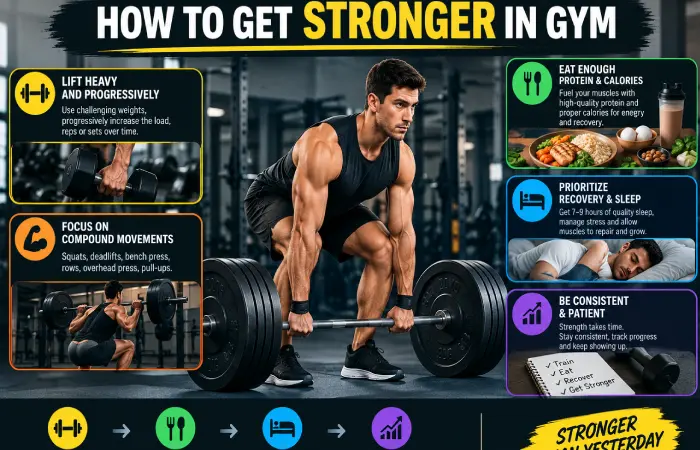
If what you‘re trying to learn is how to get stronger in the gym, begin with consistency and basic movement repitition than changing variations all the time.
- Establish a Baseline
Choose several key exercises and record:
- Weight used
- Sets completed
- Repetitions
- Exercise variation
- Technique notes
- Rest between sets
This creates a reference point for future workouts.
- Repeat Important Movements
Repeating key exercises gives you an opportunity to improve technique and performance. Constantly replacing exercises makes progression harder to measure.
- Increase the Challenge Gradually
When your current workload becomes manageable, make a small adjustment. Depending on the exercise, this might mean adding a little resistance or performing another repetition.
- Keep Technique Consistent
A heavier weight is not necessarily evidence of progress if the range of motion becomes shorter or technique deteriorates substantially.
Quality repetitions should remain a priority.
Ways to Increase Lifting Strength
There is more than one way to increase lifting strength.
| Progression method | Example | When it can help |
| Add load | 60 kg → 62.5 kg | When current weight is manageable |
| Add repetitions | 6 → 8 reps | Useful within a defined rep range |
| Add sets | 3 → 4 sets | When more training volume is appropriate |
| Improve technique | Better control and range | When form limits performance |
| Exercise progression | Push-up → weighted push-up | When a movement becomes too easy |
| Reduce unnecessary fatigue | Better exercise order | When fatigue affects performance |
Progression does not mean increasing all variables simultaneously. Choose one change and monitor how you respond.
Building a Strength Progression Plan
A simple strength progression plan can use a repetition range.
For example, you could prescribe 3 sets of 6–8 repetitions for an exercise.
Start with a weight that allows approximately six good repetitions per set. Over subsequent sessions, work towards eight repetitions without compromising technique.
Once you can consistently complete the upper end of the range, a small increase in resistance can be considered. You may then return towards the lower end of the range and build back up.
This is often called double progression.
Example
| Week | Load | Reps per set | Sets |
| 1 | 50 kg | 6, 6, 6 | 3 |
| 2 | 50 kg | 7, 6, 6 | 3 |
| 3 | 50 kg | 7, 7, 6 | 3 |
| 4 | 50 kg | 8, 8, 8 | 3 |
| 5 | 52.5 kg | 6, 6, 6 | 3 |
This is only an example. The appropriate load and progression rate vary between exercises and individuals.
Reps and Sets for Strength
Selection of reps and sets for a strength training will be influenced by the element of exercise, personal experience and training objective. The other major component of resistance training, maximal or near-maximal strength training, uses heavier loads and lower repetitions. ACSM 2026 recommends heavy loads (~80%1RM) and 2–3 sets/exercise as one approach to strength for healthy people. But it doesn‘t mean that every exercise has to be executed at precisely 80% 1RM. You can train with various loads and repetitions.
For general strength training, a practical session might include:
- Compound exercises: around 3–8 repetitions
- Accessory exercises: around 6–15 repetitions
- Multiple working sets
- Gradual progression over time
These ranges are useful starting points rather than strict rules.
Rest Time for Strength Training
Rest time (strength training) is important because reduced recovery time between high demands can lead to poor performance.
Heavy compound exercises may warrant longer rest periods if you want to preserve performance across sets. Light accessory exercises may require less rest.
Instead of slavishly adhering to the stopwatch, ask yourself if you are adequate recovered to do the next set doing the right things.
A practical starting point could be:
| Exercise type | Example rest |
| Heavy compound movement | 2–4 minutes |
| Moderate compound movement | 1.5–3 minutes |
| Accessory exercise | 1–2 minutes |
| Core or lighter movement | 45–90 seconds |
These are practical ranges, not universal prescriptions.
Progressive Overload Workflow
A straightforward progression workflow looks like this:
Choose an exercise
↓
Select a manageable load and repetition range
↓
Record your performance
↓
Repeat the exercise consistently
↓
Check whether the current workload is becoming easier
↓
Increase one training variable gradually
↓
Monitor technique and recovery
↓
Repeat
This process is more useful than trying to increase the weight every single workout.
How Often Should You Progress?
You do not necessarily need to make a measurable increase every session.
Beginners may see relatively frequent improvements because they are learning the movements and adapting to resistance training. More experienced lifters generally face slower progress, particularly on demanding compound exercises.
Progress can also temporarily stall because of:
- Poor sleep
- Insufficient recovery
- Changes in body weight
- Stress
- Inconsistent training
- Excessive training volume
- Technique limitations
- Previous fatigue
A short period without an increase does not automatically mean that the programme has failed.
Expectations: How Fast Can Strength Increase?
Strength progression is individual.
Someone new to resistance training may improve quickly during the early stages, partly because technique and coordination improve alongside physical adaptation. A more experienced lifter may need considerably longer to make a noticeable increase in a major lift.
Avoid comparing your weekly numbers with someone else’s. Training history, body size, exercise technique and programme design all affect performance.
ACSM’s 2026 review also stresses that consistency is more important than unnecessarily complicated programming for the average healthy adult.
The US Physical Activity Guidelines recommend muscle-strengthening activities involving all major muscle groups on at least two days each week for adults.
Common Progressive Overload Mistakes
Adding Weight Too Quickly
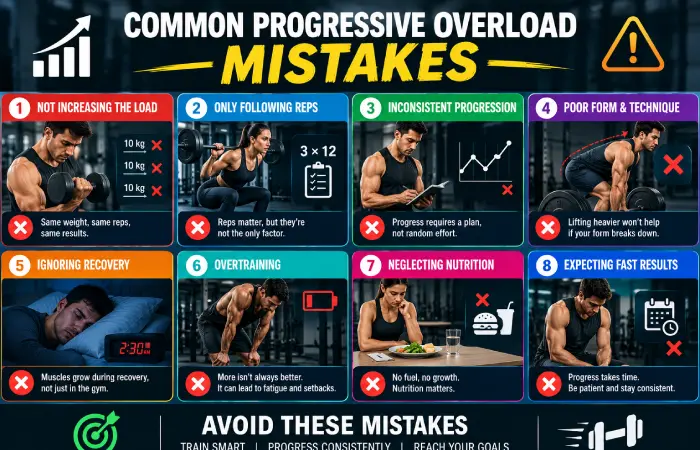
Increasing the load before you have control of the current workload can compromise technique and recovery.
Changing Exercises Too Often
Exercise variety has a place, but changing your main movement every week makes performance difficult to track.
Training to Failure Constantly
Every set does not need to reach absolute failure. ACSM’s 2026 evidence review found that advanced techniques such as consistently training to momentary failure are not necessary for the average healthy adult to make progress.
Ignoring Recovery
More work is not automatically better. Your programme should account for rest, sleep and your overall training load.
Chasing Numbers at the Expense of Form
If you have to significantly change your technique to complete a heavier repetition, the number on the bar may not represent genuine strength progression.
Can Progressive Overload Be Done at Home?
Yes. Progressive overload does not require a commercial gym.
You can increase difficulty with:
- Dumbbells
- Resistance bands
- Bodyweight exercises
- Adjustable weights
- Tempo changes
- Increased range of motion
- More repetitions
- More challenging exercise variations
The current advice from ACSM states ‘When used appropriately and on a regular basis, resistance bands, body weight training (e.g. pushups) and home programs from a book can provide sufficiently significant improvements in health and conditioning as to make serious savings on expensive equipment unnecessary’
Conclusion
Progressive Overload & Strength Progression is more simply a matter of gradually making your training harder with good technique and decent recovery (increasing load, volume, quality or difficulty). You can add strength using more weight, reps, sets, better movement quality and/or harder variation. A straightforward strength progression plan you are able to follow on a regular basis is usually more effective than an overly complex programme that is hard to maintain. Record your lifts, make small incremental changes and allow the body time to adapt.