
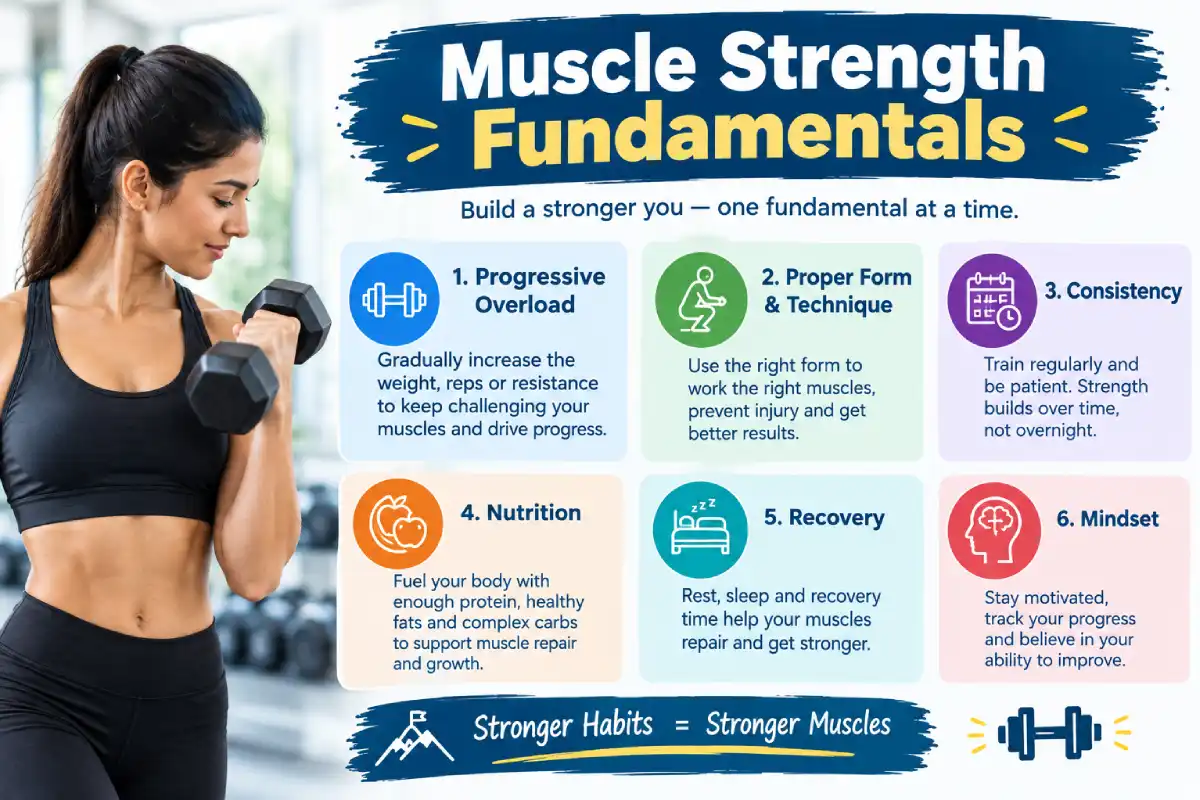
Muscles Strength Basics describe what muscle strength is, how muscles become stronger and why resistance training is effective. If you are a seasoned athlete or just starting an exercise program, your strength improvements will come from consistent overloading of your body, with ample time and nutrients given for rest and recovery.
What Is Muscle Strength?
Muscle strength is the ability of a muscle or group of muscles to produce force against resistance.
That resistance can come from:
- Free weights
- Resistance machines
- Resistance bands
- Bodyweight exercises
- Cables
- Kettlebells
- Other external loads
Apart from what have already been mentioned muscular strength is also the ability to press or lift a greater amount of weight such as a heavier squat, push-up variation or dumbbell press. Strength is also specific. Improving in strength at one movement does not imply any proportionate increase in strength to all other movements.
Strength Training Basics
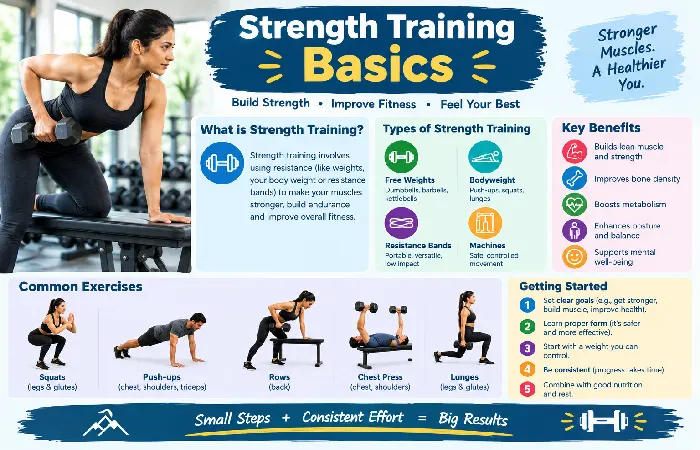
Effective strength training has several simple foundations.
- Resistance
Your muscles need an appropriate challenge. The resistance should be difficult enough to stimulate adaptation while still allowing you to perform the movement with reasonable control.
- Technique
Proper technique allows you to perform an exercise uniformly and evaluate progress more effectively. Beginners should become accustomed to the movement itself prior to upgrading to heavier weights.
- Consistency
One hard workout is not enough to develop permanent strength. They need to be repeated during the course of weeks and months. The CDC suggests that adults engage in physical activities that strengthen muscles, such as lifting or carrying, on a minimum of 2 days of every week. All the main muscles should be involved in the workout.
- Recovery
Training is a stimulus; recovery gives the system time to respond. Sleep, eating well and resting between tiring sessions are among those factors.
How Muscles Get Stronger
In other words, the increase in the size of a muscle is not only a result of increasing the weight lifted. When you do a resistance exercise frequently, it reacts to the pressure from the exercise. Initial progress could also be due to higher coordination, adaptation of the nervous system, and with easy movements.
With long-term training muscle tissue can also change.
A useful way to think about the process is:
Training stimulus → recovery → adaptation → gradual progression
If the training challenge is never altered, one risk is that progress might plateau. If the challenge is increased “too rapidly” then it may be more difficult to recover from the resulting fatigue.
The goal is to find a manageable middle ground.
Strength vs Muscle Size
Strength vs muscle size is an important distinction.
Muscle Strength: How much force you can generate. Muscle Hypertrophy: Increase in a muscle size.
They are related, but they are not identical.
| Muscle strength | Muscle size |
| Focuses on force production | Focuses on increasing muscle mass |
| Specific lifts and movements matter | Overall training volume is important |
| Heavier loading can be useful | Moderate and heavier loads can both contribute |
| Skill and coordination can affect performance | Muscle growth depends on training and other factors |
| Performance is often measured by load or repetitions | Changes in muscle size can be monitored over time |
The 2026 ACSM position stand considers hypertrophy, strength, and physical performance as related but separate resistance training outcomes. Its guidelines imply that more heavy loading can be helpful when strength is the focus and higher weekly training volume can be helpful when muscle hypertrophy is the focus.
So you can still do both, the same time but your focus of the programme may vary.
How to Increase Muscle Strength

If you want to know how to increase muscle strength, start with a few fundamental movement patterns rather than trying dozens of exercises.
Useful choices include:
- Squats
- Hip hinges and deadlift variations
- Push-ups or presses
- Rows
- Pull-ups or pulldowns
- Overhead presses
- Split squats
A beginner might perform a full-body routine two or three times per week, adjusting the exercises and workload to their ability.
Practical progression example
Imagine you can perform a goblet squat with:
Progress does not have to happen every workout.
Some weeks may involve maintaining the same weight while improving technique and consistency.
Muscular Strength Benefits
There are several practical muscular strength benefits.
Everyday physical function
Strength can make tasks such as carrying objects, climbing stairs and getting up from a chair easier to manage.
Exercise performance
Greater strength can provide a useful foundation for recreational activities and other forms of physical training.
Maintaining physical capability
Resistance training can help support muscle function across adulthood. For general health, the CDC recommends combining muscle-strengthening activity with regular aerobic activity.
Confidence with movement
Learning to control resistance and gradually improve performance can make physical activity feel more manageable.
These benefits should be viewed realistically. Strength training is one component of overall health rather than a solution to every health or fitness concern.
A Simple Muscle Strength Training Workflow
A straightforward workflow can make strength training easier to maintain.
Step 1: Choose your exercises
Select movements that cover the major muscle groups and fit your experience level.
Step 2: Start with manageable resistance
Use a load that allows you to maintain controlled technique.
Step 3: Record your workout
Write down the exercise, resistance, repetitions and sets.
Step 4: Repeat consistently
Use the same core movements for long enough to identify whether your performance is improving.
Step 5: Progress gradually
When a workload becomes easily manageable, increase the weight, repetitions, sets ordifficulty of exercise.
Step 6: Allow recovery
Avoid assuming that more training automatically produces better results. Your programme should leave enough room for recovery.
What Beginners Should Expect
Strength improvements do not happen at exactly the same rate for everyone.
Progress will be comparatively rapid as the beginner is adapting to new movements and the resistance training.
Later, progress may become slower.
Your results can be influenced by:
- Training experience
- Exercise selection
- Consistency
- Sleep
- Nutrition
- Stress
- Age
- Individual differences
- Previous physical activity
Avoid comparing your strength numbers directly with another person’s. A better measure is whether your own technique, repetitions or resistance are improving over time.
The 2026 ACSM guidance also highlights that consistency matters more than making a programme unnecessarily complicated.
Common Muscle Strength Mistakes
Training too heavily too soon
A heavier weight is not automatically a better workout. Beginners should first become comfortable with the movement.
Changing exercises constantly
Frequent changes can make it difficult to identify whether you are actually progressing.
Ignoring recovery
Training the same muscles hard without enough recovery can make performance decline.
Focusing only on one body part
A balanced routine should include major muscle groups rather than concentrating exclusively on visible muscles.
Expecting linear progress
Strength rarely increases in a perfectly straight line. Temporary plateaus and easier sessions are normal parts of training.
Muscle Strength Fundamentals at Home
You do not necessarily need a gym to practise the basics.
A simple home routine might include:
| Movement | Beginner option |
| Squat | Bodyweight squat |
| Push | Incline push-up |
| Pull | Resistance-band row |
| Hinge | Bodyweight hip hinge |
| Legs | Split squat |
| Shoulders | Light dumbbell or band press |
ACSM’s 2026 guidance notes that bodyweight exercises, elastic bands and home-based resistance training can be effective options, meaning access to a traditional gym is not essential for everyone.
Conclusion
Muscle strength Knowledge makes resistance training much less daunting. Muscle strength is acquired through frequent training using sufficient effort, appropriate resistance, quality technique, incremental overload and sufficient recovery. My preferred statement of principle is make continuous progress rather than blowing energy trying to get strong as quickly as I can. Good, consistent training will build your strength and capabilities over time and prepare you for higher-level regimes.