
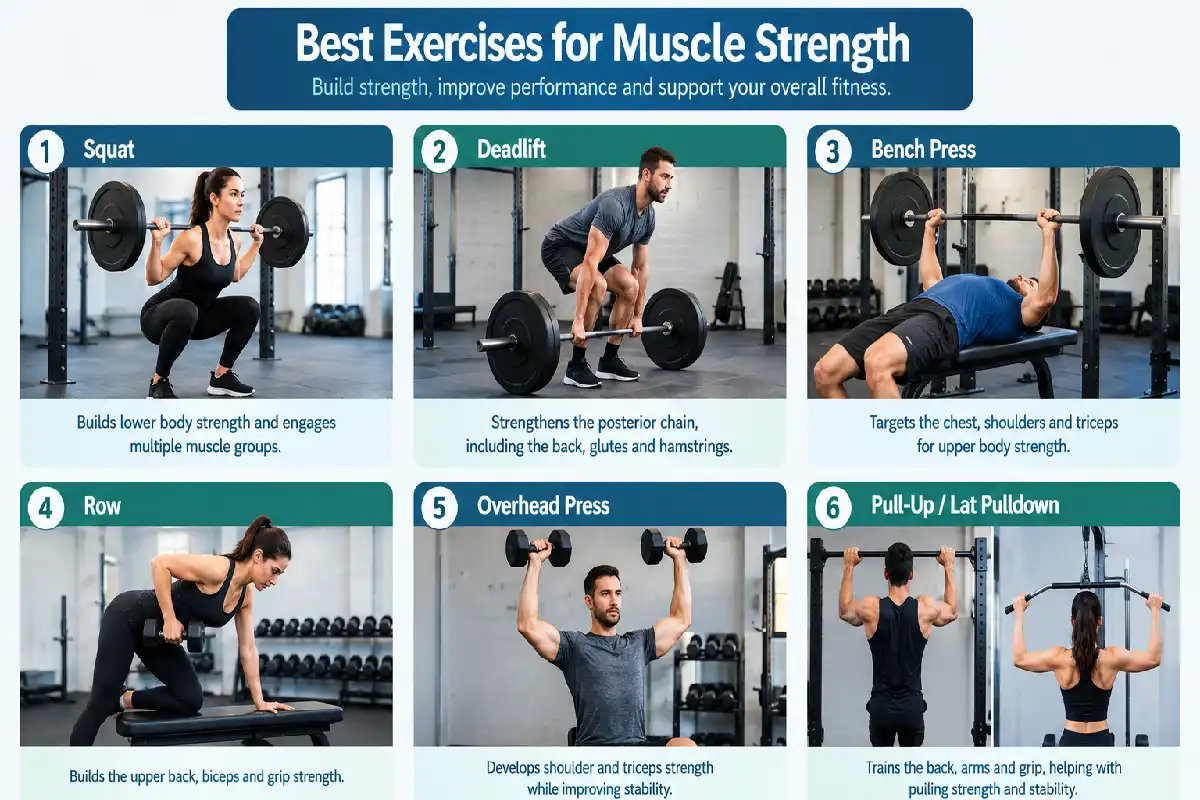
There is no single best exercise to develop muscle strength. The most successful strength programme will generally involve a variety of exercises to develop the muscles of the Legs, Hips, Back, Chest, shoulders and arms while also enabling practice of good technique and a smoothly progressive increase in resistance. The 2026 American College of Sports medicine (ACSM) guidance on resistance programmes also stresses the importance of frequency and tailoring to a specific goal rather than unnecessarily complex programmes.
What Makes an Exercise Good for Strength?
A useful strength exercise should allow you to:
- Train an important movement pattern or muscle group
- Use an appropriate level of resistance
- Maintain controlled technique
- Track repetitions and load
- Progress gradually over time
- Perform the exercise consistently
However Compound movements are essential for involving many joints and many muscles in a movement and isolations can be used in an overall programme.
Best Exercises for Strength
The following movements provide a practical foundation for many strength programmes.
- Squat for Strength
The squat for strength is a fundamental lower-body movement that primarily trains the quadriceps and glutes while also requiring trunk stability.
Common variations include:
- Bodyweight squat
- Goblet squat
- Front squat
- Back squat
- Box squat
Beginners can start with bodyweight or goblet squats before progressing to more demanding variations.
A useful progression is to first improve movement control, then gradually increase resistance.
- Deadlift for Strength
The deadlift for strength trains the posterior chain, including the glutes, hamstrings and back muscles.
Variations include:
- Conventional deadlift
- Romanian deadlift
- Trap-bar deadlift
- Dumbbell deadlift
- Kettlebell deadlift
Deadlifts technique is critical when the resistance is heavy. It is advisable for beginners to have their learners performing the hip-hinge pattern, prior to practicing with heavy loads.
- Bench Press for Strength
The bench press for strength is a horizontal pushing movement that primarily trains the chest, shoulders and triceps.
Options include:
- Barbell bench press
- Dumbbell bench press
- Machine chest press
- Push-ups
A novice need not replace the barbell at the outset push-ups, and machine and dumbell versions can also offer a valuable alternative.
- Row
Rows train the upper back and contribute to pulling strength.
Examples include:
- Dumbbell row
- Cable row
- Seated machine row
- Chest-supported row
- Inverted row
Using controlled movement is generally more useful than trying to move the heaviest possible weight.
- Overhead Press
An overhead press trains the shoulders and triceps while also requiring stability through the torso.
You can perform it with:
- Dumbbells
- A barbell
- Resistance bands
- A machine
- Pull-Up or Lat Pulldown
Vertical pulling exercises train the upper back and arms.
If bodyweight pull-up is very hard, you can use a lat pulldown or assisted pull-up to get started.
Compound Exercises for Strength
Compound exercises for strength involve multiple joints and muscle groups in one movement.
| Exercise | Main focus | Beginner variation |
| Squat | Legs and hips | Goblet squat |
| Deadlift | Posterior chain | Kettlebell deadlift |
| Bench press | Chest, shoulders, triceps | Dumbbell press |
| Row | Upper back and arms | Supported dumbbell row |
| Overhead press | Shoulders and triceps | Seated dumbbell press |
| Pull-up | Back and arms | Lat pulldown |
Body part specific exercises may be more time efficient as multiple muscle groups are being trained within the same movement. However, this does not necessarily mean they are more effective for an individual. Other types of exercises, like machines, bands and isolated movement, can be beneficial as part of a programme.
In 2026, ACSM pointed out, resistance training can be performed with many different types of equipment (free weights, machines, elastic bands, body weight).
Full Body Strength Exercises
All body strength exercises can be grouped together to a basic programme of encompassing the five movement patterns.
For example:
Lower body: Squat
Hip movement: Romanian deadlift
Horizontal push: Bench press or push-up
Horizontal pull: Row
Vertical push: Overhead press
Vertical pull: Lat pulldown or pull-up
In doing so, one can- addressed this problem quite effectively. Active adults should participate in muscle strengthening activity at least two days per week and engage all the major muscle groups the legs, hips, back, abdomen, chest, shoulders and arms.
How to Choose the Right Strength Exercises
Not every person needs the same exercise selection.
Beginners
Choose simpler variations that allow you to learn the movement.
For example:
- Goblet squat
- Dumbbell press
- Cable or supported row
- Kettlebell deadlift
- Lat pulldown
Intermediate lifters
You may gradually introduce more technically demanding movements or heavier resistance.
Home trainees
Bodyweight exercises, resistance bands, dumbbells and kettlebells can provide plenty of options. ACSM’s current guidance specifically recognises home-based and non-traditional resistance training as viable approaches.
A practical workout does not need to be complicated.
Step 1: Warm up
Use several minutes of general movement followed by lighter sets of your first exercise.
Step 2: Start with major movements
Perform technically demanding exercises while you are relatively fresh.
Step 3: Use manageable resistance
Choose a load that challenges you without causing your technique to break down.
Step 4: Record your performance
Track:
- Exercise
- Sets
- Repetitions
- Resistance
- Date
Step 5: Progress gradually
When a workload becomes consistently manageable, make a small increase in resistance, repetitions or exercise difficulty.
Step 6: Recover
Allow enough time between demanding sessions for your body to recover.
Realistic Strength Expectations
You should not expect to become dramatically stronger after just a few workouts.
Beginners can sometimes experience relatively quick improvements because they are learning new movement patterns and adapting to resistance training. Progress commonly becomes less predictable as training experience increases.
Your rate of progress can depend on:
- Training history
- Exercise technique
- Sleep
- Nutrition
- Programme structure
- Recovery
- Age
- Individual differences
A useful measure is your own performance over time rather than comparing your numbers with another person’s.
Common Mistakes to Avoid
Using too much weight
A heavier load is not automatically better. If you cannot control the movement, reduce the resistance.
Changing exercises too often
Keeping core movements consistent makes progression easier to track.
Ignoring pulling exercises
A balanced routine should include both pushing and pulling movements.
Training only visible muscles
Include lower-body, back and trunk movements rather than concentrating solely on chest and arms.
Chasing maximum lifts
You do not need to test your maximum strength frequently to make progress.
Skipping recovery
More training is not necessarily better if your performance and recovery are suffering.
Conclusion
The best exercises for muscle strength are not necessarily the most complex exercises. Starts with the basic moves such as squats, deadlifts, presses, rows, pull ups and the other compound exercises. Master them by practicing regularly, and increase the intensity gradually. Begin with controllable variations. Track your sessions and gradually improve the workload. You may rely on free weights, body weight, bands, machines, etc. The important thing is to find a training system you will keep to. To promote general health, try to train all major muscle groups a minimum of twice weekly, while adapting your programme to your level and recovery capacity.