
If you’ve spent any time browsing yoga apps or scrolling through Instagram wellness content, you’ve likely come across Habuild yoga. It has become one of the most popular online yoga resources in India and, increasingly, around the world. But what is Habuild, how does it work, is it worth spending any money on, and does it truly deliver on its promise to help users develop a sustainable yoga habit?
This guide will give an overview of the platform, explaining what it is, how to use it, what benefits it promises, how much it costs, what the Habuild yoga challenge is all about, and what users are saying about the service in online reviews.
What Is Habuild?
Habuild is an online app that helps users develop a sustainable yoga habit. It offers daily yoga, strength building, breathing, and mindfulness classes. It is important to note that Habuild is not a traditional online yoga studio that just moved some of its classes into an online space. The focus of the service is on developing a habit rather than offering a wider variety of yoga styles or more challenging workouts. The idea is that it is less risky to develop a daily yoga habit than to attempt a rigorous fitness program and fail.
Habuild was founded by Saurabh Bothra, an IIT graduate who left a conventional engineering career path to pursue yoga, and what began during lockdown with just three students has since grown into a global movement spanning millions of learners across many countries. The company itself was founded in March 2020 by Saurabh Bothra along with Trishala Bothra, Anshul Agrawal, and Sheetal Pungliya, starting organically during India’s Janata Curfew when Saurabh began offering free yoga lessons over Zoom and YouTube to help people cope with the lockdown.
Saurabh’s own path into yoga started during his time at IIT, where he began practicing it for himself before teaching it to fellow students as a way to build his own consistency, and his family influences — a businessman father and a grandfather who worked as a doctor serving a remote village — shaped his desire to build something with both a social mission and sustainable business. The founding team’s backgrounds span IIT, IIM, and the London Business School, and Habuild today operates on a subscription-based, business-to-consumer model, with classes that were initially free before a fee was introduced specifically to encourage people to actually show up consistently rather than skip sessions.
How Habuild Yoga Works
Unlike a typical pre-recorded video course you complete on your own schedule, Habuild is built around live-style daily sessions and habit tracking. Here’s the general structure:
- Daily sessions, not on-demand libraries — every day a new themed class is released, whether it’s a flexibility-focused yoga flow, a strength and toning session, a breathing (pranayama) practice, or a dance/Zumba-style cardio session.
- A defined access window — classes are typically active for 24 hours, so if you can’t attend at a specific scheduled time, you can still complete that day’s session before it expires.
- Delivery across multiple channels — sessions run primarily through Zoom and YouTube, while WhatsApp handles user communication, attendance tracking, and personalized content.
- The ‘No-Zero Days’ philosophy — a key concept encouraging members to do some form of movement every single day, however small, to build consistency over time.
- Gamified motivation — levels, streaks, rewards, and reminders (including hydration and breathing nudges) to keep users engaged beyond the workout itself.
- Community accountability — attendance tracking and a large peer community create social accountability around a shared daily class.
This combination of daily live-style classes, a 24-hour completion window, and habit-tracking gamification is what differentiates Habuild from a typical static yoga app library.
Habuild Yoga Classes: What’s Actually Included
Habuild’s program lineup has expanded well beyond basic yoga. According to the platform’s own site structure, the core programs and content categories include:
- Yoga Everyday — the flagship daily yoga program covering flexibility, strength, and mindfulness-based flows.
- Strong Everyday — strength and fitness-oriented sessions for people who want to combine yoga with functional strength work.
- Free 14-Day Programs — short free trial challenges (a yoga version and a strength-training version) to let new users experience the format before committing to a paid plan.
- Habitology — an educational content hub covering asanas and mudras, strength and fitness tips, and general lifestyle and wellness guidance.
- Face Yoga — facial exercise routines targeted at jawline definition, anti-aging, and reducing dark circles.
- Yoga for Specific Conditions — targeted sequences for knee pain, lower back pain, and PCOD (polycystic ovarian disease).
- Yoga Types Explained — guidance on styles such as Ashtanga, Hatha, and Power yoga.
The site also features practical, benefit-focused content — for example, guidance on specific poses like ardha matsyendrasana and its benefits for spinal health, digestion, and flexibility — reflecting Habuild’s broader strategy of pairing the live class product with a large library of educational, SEO-friendly yoga content.
Trainers on the platform include founder Saurabh Bothra, along with co-founder and fellow instructor Trishala Bothra, and additional trainers such as Kashish Makhijani, who lead specific class formats.
Habuild Yoga Online: The App and TV Experience
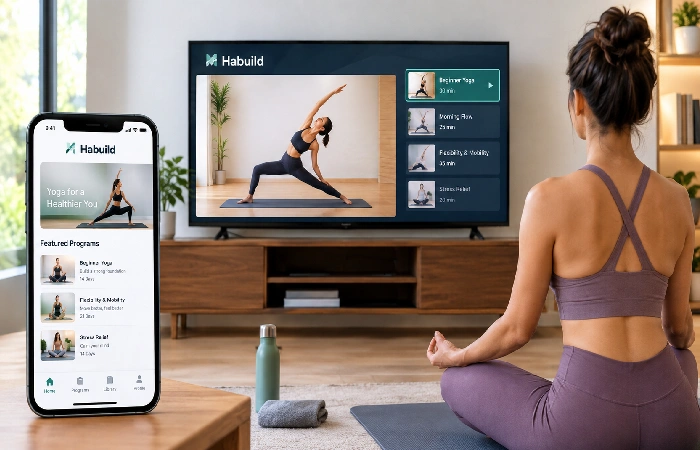
Habuild’s presence spans multiple platforms, which is part of why it’s been able to scale so quickly.
The Mobile App
Habuild’s mobile app is marketed as ‘Online Yoga Everyday,’ letting users join live yoga, dance, and strength sessions designed to support both physical and mental wellbeing, while smart reminders — including water intake notifications — help build consistency, alongside a system of levels, rewards, and access to workshops and nutrition tips.
A separate but related app, ‘Habuild: Daily Yoga and Habits,’ is centered around building habits with founder Saurabh Bothra through daily yoga, breathing, and movement practices, complete with water reminders, gentle breathing reminder prompts, and a system of levels, streaks, and rewards to keep the journey motivating. This app has been installed over 500,000 times and holds a 4.8-star rating from more than 4,600 reviews on the Play Store.
The Smart TV App
For users who prefer practicing on a bigger screen, Habuild also offers a dedicated TV experience that helps users build lasting healthy habits through daily yoga, fitness, and mindfulness programs designed for all levels, letting them join sessions, stay consistent with guided routines, and track attendance to see their progress. Recent updates have focused on speed and reliability — sessions now start instantly, the app runs lighter on older TVs, and sessions appear correctly even if the TV starts up without an internet connection, using previously synced data.
Social and Community Presence
Beyond the apps themselves, Habuild maintains an active presence across social platforms to sustain community engagement between sessions. Its Instagram account, ‘Yoga Everyday,’ has amassed nearly 300,000 followers built around the tagline ‘We build Habits, Habits Build You.’ The brand also runs an active YouTube channel and Facebook page, both used to distribute free content, testimonials, and updates on challenges and programs.
Habuild Yoga Benefits
So what do people actually get out of committing to Habuild’s daily format? Based on the platform’s programming and recurring themes in user feedback, the benefits generally fall into a few categories:
Physical flexibility and mobility. The core daily yoga sessions emphasize stretching, joint mobility, and flexibility work, which many long-term users report improves noticeably over consistent months-long use.
Strength and toning. With dedicated ‘Strong Everyday’ programming and regular strength-focused sessions mixed into the yoga calendar, users get functional strength benefits beyond pure flexibility work.
Stress relief and mental calm. Breathing (pranayama) practices and mindfulness content are woven throughout the platform, and this is one of the most frequently cited benefits in reviews.
Consistency and habit formation. This is arguably Habuild’s core value proposition. The 24-hour access window, streak tracking, and reminder system are specifically engineered to solve the single biggest problem most people have with yoga: not sticking with it.
Condition-specific relief. Because the platform curates specific sequences for issues like knee pain, back pain, and PCOD, many users come to Habuild to manage a specific physical concern, and report meaningful relief when they stick with the targeted routines.
Accessibility regardless of location. Since classes are streamed and remain accessible for 24 hours, users across different countries and time zones can participate without needing to match a live class time exactly.
Face and cosmetic yoga benefits. The dedicated Face Yoga content taps into a growing interest in non-invasive facial toning, targeting jawline definition and skin appearance through targeted facial exercises.
Habuild Yoga Fees: What It Costs
Habuild operates on a subscription (membership) model rather than a pay-per-class system. While the platform’s earliest sessions during the 2020 lockdown were completely free, Habuild later introduced a paid structure specifically because charging a fee was found to meaningfully improve how consistently members actually attended their sessions — aligning directly with the platform’s ‘No-Zero Days’ habit-building philosophy.
A few important points about Habuild’s pricing structure:
- Free trial first — new users are generally funneled through a free 14-day challenge (Yoga Everyday or Strength Training) before being asked to commit to a paid membership.
- Membership tiers — beyond the free trial, Habuild offers structured membership plans that unlock ongoing access to daily live-style sessions, the full Habitology content library, and community features.
- Pricing varies by plan length and region — because Habuild has expanded internationally and periodically runs promotions, exact membership fees change over time and can differ by country and plan duration.
- Renewal transparency — Habuild sends renewal reminders ahead of charging members again, rather than surprising them with an automatic charge, a detail some long-term subscribers specifically appreciate.
Because pricing pages are frequently updated and vary by region and current promotions, the most reliable way to confirm current Habuild yoga fees is to check the official membership plan page directly or open the app, rather than relying on a fixed number that may already be outdated.
The Habuild Yoga Challenge
One of Habuild’s most effective growth and onboarding tools is its free yoga challenge — typically framed as a 14-day (and sometimes 21-day) commitment. This challenge works as both a marketing funnel and a genuine low-risk way for newcomers to experience the platform’s format before paying anything.
The structure generally follows this pattern:
- A fixed number of consecutive daily sessions (often 14 or 21 days), each addressing a different area — flexibility, strength, breathing, or a themed focus like weight management or back pain relief.
- Free and open access, requiring only a phone number or app sign-up rather than payment details up front.
- A built-in accountability structure, using WhatsApp reminders and community messaging to nudge participants to complete each day’s session.
- A natural transition point into paid membership at the end of the challenge, once users have experienced the format and (ideally) started forming the habit.
User testimonials frequently reference this challenge format directly. One widely echoed sentiment across reviews is captured in comments like ‘I Tried Yoga for 21 Days: My Pain Vanished!’ — a phrase that appears directly in Habuild’s own site content, reflecting the kind of transformation story the platform actively promotes around its free challenge format. Whether or not every user experiences results that dramatic, the challenge format itself is clearly central to how Habuild converts curious newcomers into long-term, paying community members.
Habuild Yoga Reviews: What Users Are Actually Saying
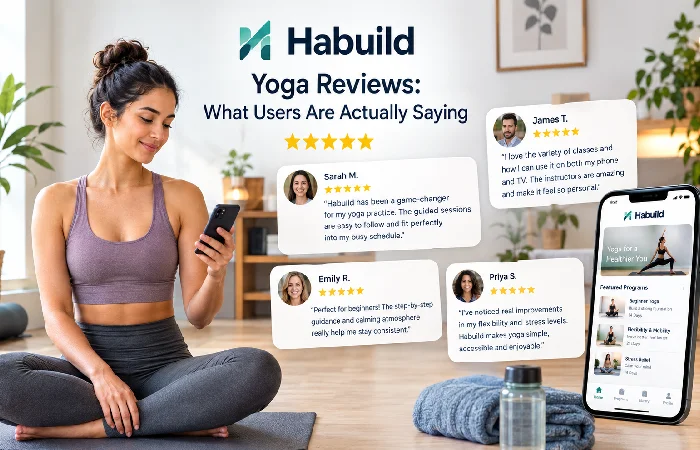
Across app stores and social platforms, Habuild has built up a substantial base of user feedback, and a few consistent themes emerge.
The Positives
Instructor connection. By far the most repeated theme in reviews is how much users connect with the trainers personally, particularly founder Saurabh Bothra. One reviewer described yoga through the app as ‘a self SPA,’ praising how relaxing it is and how much flexibility it’s brought over the years, describing Saurabh Sir and Trishala Mam as their ‘guru’ and noting they switch between different class types to maintain both flexibility and strength.
Ease of use and flexibility around scheduling. Multiple reviewers call out how user-friendly the app is, noting that daily classes remain active for 24 hours — which matters for users in different countries who can’t match India-based class timings — and that the app even supports pausing a recorded video mid-session to repeat a movement before resuming.
Variety. Reviewers note appreciation for how each day brings a different session, with easy and normal variations built in.
Genuine habit change. One reviewer shared that Habuild has helped them stay focused, consistent, and motivated in daily life, crediting the supportive team and Saurabh’s guidance for helping them overcome procrastination and build positive habits.
Customer service and billing transparency. A longer-term subscriber specifically praised the proactive renewal reminders sent well ahead of the next charge, calling it one of the more thoughtful wellness apps they’d used. Another reviewer described joining Habuild as one of the best decisions they’ve made, praising how simple the app is to follow daily and how supportive and prompt the team is in resolving queries.
Overall Sentiment
Habuild’s daily yoga and habits app currently holds a strong 4.8-star rating out of more than 4,600 reviews on the Google Play Store, with over 500,000 downloads — a solid signal of consistent user satisfaction at scale. The recurring pattern across testimonials is that users value the platform less for any single class and more for the cumulative effect of daily consistency, community support, and the personal connection many feel toward the instructors.
As with any subscription wellness product, individual experiences vary based on how consistently someone actually uses the daily sessions, and results (physical or otherwise) depend heavily on personal commitment, existing fitness level, and how the practice is combined with other lifestyle factors like diet and sleep.
Institutional Recognition
Habuild’s growth hasn’t gone unnoticed at an institutional level either. The Morarji Desai National Institute of Yoga, operating under India’s Ministry of Ayush, has signed a Memorandum of Understanding with Habuild to launch a nationwide digital yoga initiative ahead of International Day of Yoga 2026 — a meaningful signal of credibility for a platform that started as a grassroots pandemic project just a few years earlier.
Is Habuild Yoga Worth It?
Pulling this all together, Habuild’s core appeal comes down to a few distinct advantages over generic yoga content you might find scattered across YouTube:
- Structure over randomness — a defined daily program instead of endlessly searching for ‘what yoga video should I do today.’
- Accountability — habit tracking, streaks, and community pressure that static video libraries don’t offer.
- Instructor relationship — many users form a genuine connection with Saurabh Bothra and the other trainers, which keeps them coming back.
- Breadth of content — beyond pure yoga, the platform covers strength training, face yoga, condition-specific sequences, and a substantial educational library.
- Low-risk entry point — the free 14-day challenge lets you test the format before paying anything.
The trade-offs worth knowing before committing: it’s a paid subscription after the free trial, the format leans toward India-based scheduling and cultural context (even though the 24-hour window helps offset that), and — like any habit-based program — the actual benefit depends heavily on how consistently you show up, not just on signing up.
For someone who has struggled to stick with yoga on their own and responds well to structure, community, and a recognizable instructor guiding them daily, Habuild’s model directly addresses the consistency problem that derails most solo yoga attempts. For someone who already has a disciplined self-directed practice, or who prefers total flexibility over a scheduled daily format, a more open-ended app or studio might be a better fit.
Final Thoughts
Habuild has grown from a free lockdown Zoom class into one of the more recognizable names in online yoga, built on a simple but effective premise: consistency, community, and accountability matter more than any single perfect session.
Whether you’re drawn in by the free yoga challenge, curious about the app experience, or weighing whether the membership fee is worth it, the platform’s core value proposition remains the same across every entry point helping you actually show up for your practice, day after day, until it becomes a habit rather than a resolution.
If you’re considering trying it, starting with the free 14-day program is the lowest-risk way to see whether Habuild’s daily format, instructor style, and community accountability actually fit how you like to practice before deciding whether the paid membership is worth adding to your routine.