
Last Updated: September 16, 2026
Introduction
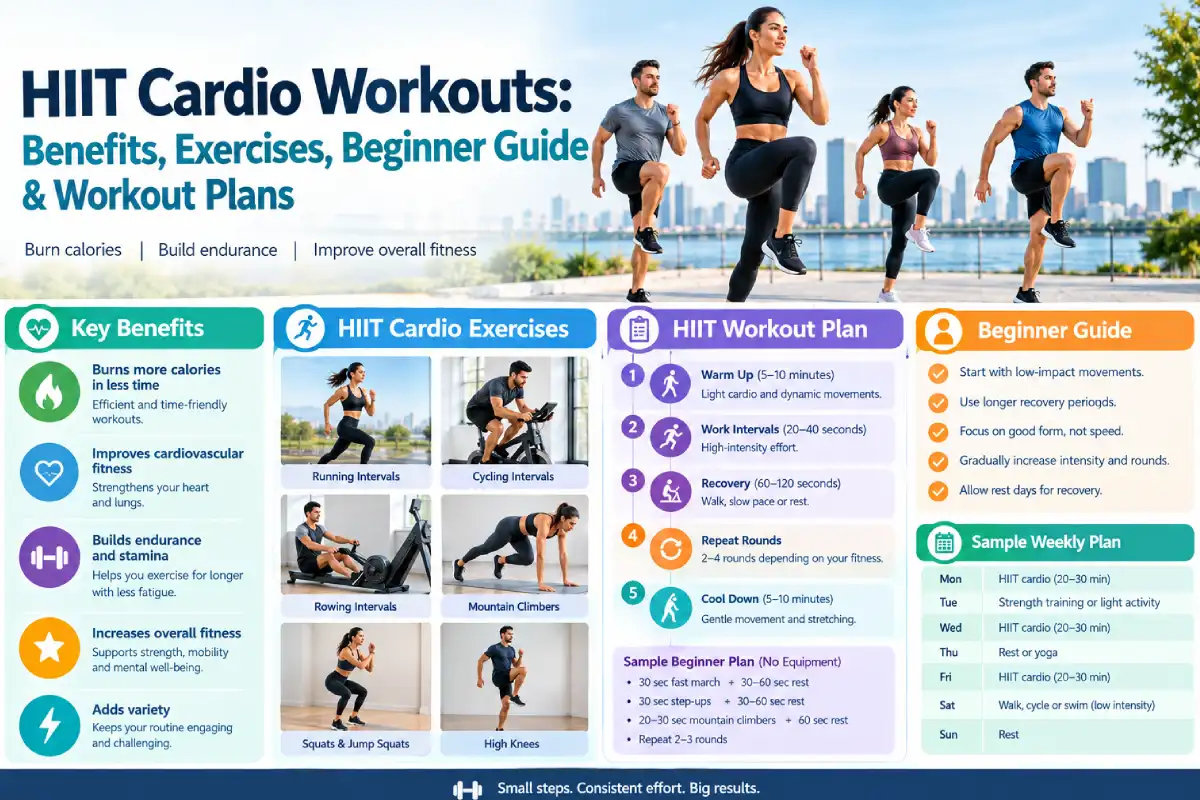
HIIT cardio workouts involve exposing yourself to these sorts of intense training episodes, each of which is separated by managed recovery periods. These workouts can be a valuable time-efficient method of training your heart and lungs while still including movements like running, cycling, jumping, bodyweight and other types of cardiovascular exercises, including rowing. But “hard” doesn’t necessarily mean maximum every time – many factor influence the intensity you require for a given workout, including your fitness level, experience and ability to recover from those episodes of hard effort.
What Are HIIT Cardio Workouts?
High-intensity interval training (HIIT): Usually a workout in which you alternate between easy and hard work. For example, cycle hard for 30 seconds then easy for 60-90 seconds, and repeat.
A HIIT session commonly includes:
- A warm-up
- Several work intervals
- Recovery periods
- A cool-down
The work intervals can be any duration from a matter of seconds up to a matter of minutes. There is not one specific type of HIIT that will suit everyone.
HIIT Cardio Exercises to Try
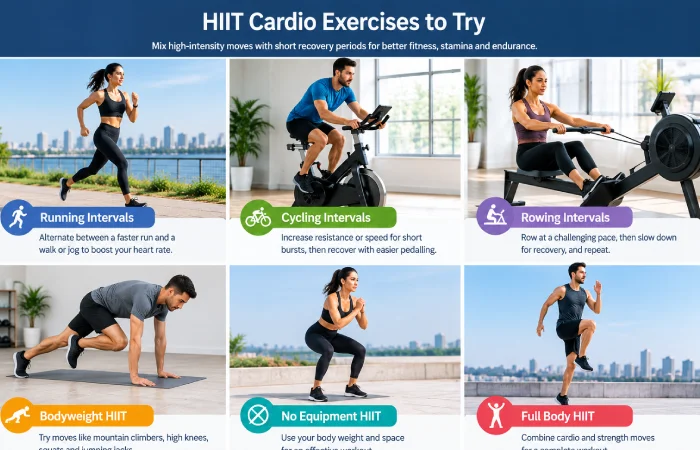
The best HIIT exercises are movements that you can perform safely with appropriate technique.
Running Intervals
Running is a straightforward way to introduce intervals. After warming up, alternate between a faster run and an easy walk or jog.
Example:
- 5–10 minutes easy warm-up
- 30 seconds faster running
- 90 seconds walking
- Repeat 6–8 times
- 5 minutes easy cool-down
The faster periods should be challenging but controlled rather than an uncontrolled sprint.
Cycling Intervals
10 Easily controlled with indoor or outdoor cycling. Cycling also offers a lower impact alternative to running.
Try 30 seconds of harder cycling followed by 90 seconds of easy pedalling for several rounds.
Rowing Intervals
The rowing machine targets the cardiovascular system as well as using many muscles. If you use the rowing machine, instead of rushing you should concentrate on your technique.
Bodyweight HIIT Exercises
Bodyweight movements can be incorporated into interval circuits.
Examples include:
- Fast marching
- Step-ups
- Squat-to-reach movements
- Mountain climbers
- High knees
- Low-impact jumping-jack variations
HIIT Cardio Workout: A Simple Structure
A well-organised session is easier to control than randomly performing exercises until you are exhausted.
1: Warm up for 5–10 minutes
Make use of gentle walking, bicycle riding, or “dynamic” type movements to help build up your activity gradually.
2: Select one or two exercises
Choose movements you can perform confidently.
3: Start with short work intervals
For example, perform 20–30 seconds of harder effort.
4: Recover
60 – 120 second easy pace movement or rest, based on your level of fitness.
5: Repeat several rounds
Beginners may only need a small number of intervals.
6: Cool down
Finish with several minutes of easy movement.
A shorter, controlled workout is generally more useful than extending the session until your technique deteriorates.
High Intensity Cardio Workout vs Steady-State Cardio
HIIT and traditional continuous cardio can both have a place in a fitness programme.
| Feature | HIIT | Steady-state cardio |
| Intensity | Alternates between hard and easy periods | Generally consistent |
| Session structure | Intervals | Continuous effort |
| Examples | Sprint/walk, bike intervals | Brisk walking, jogging, cycling |
| Time efficiency | Can provide a demanding workout in a relatively short session | Often requires longer sessions |
| Recovery needs | Usually higher after hard intervals | Often easier to recover from |
| Beginner suitability | Requires appropriate scaling | Often easier to start with |
| Variety | Usually high | Can be simple and repetitive |
HIIT Workout at Home
You do not need a gym or specialised equipment to perform a basic HIIT session.
No Equipment HIIT Cardio
Try this beginner-friendly circuit:
- March briskly — 30 seconds
- Rest or walk slowly — 30–60 seconds
- Step-ups — 30 seconds
- Rest — 30–60 seconds
- Mountain climbers or a slower modification — 20–30 seconds
- Rest — 60 seconds
HIIT Cardio for Beginners
A simple starting approach is:
- Keep the session short.
- Use longer recovery periods.
- Choose low-impact exercises when necessary.
- Prioritise movement quality.
- Avoid consecutive hard HIIT sessions.
- Increase workload gradually.
Full Body HIIT Cardio
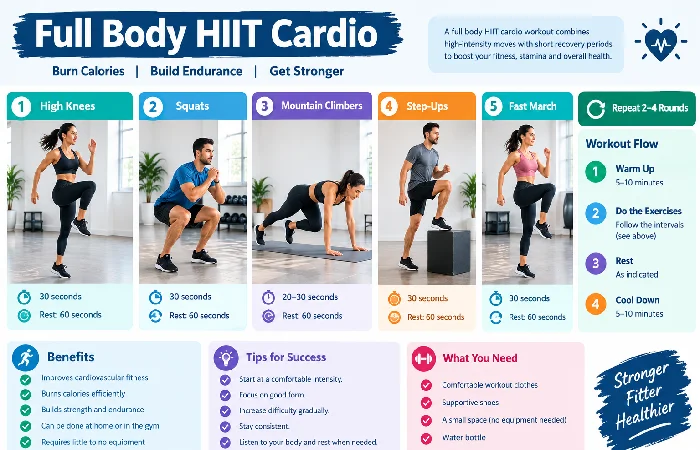
For example:
| Exercise | Work | Recovery |
| High knees or fast march | 30 sec | 60 sec |
| Bodyweight squats | 30 sec | 60 sec |
| Mountain climbers | 20–30 sec | 60 sec |
| Step-ups | 30 sec | 60 sec |
| Fast march | 30 sec | 60 sec |
Complete two to four rounds depending on your fitness and recovery.
The goal is not to perform every movement at maximum speed. Maintaining good technique and controlling the intensity is more important.
How Often Should You Do HIIT?
Each individual has a different number of advisable HIIT sessions. Training frequency should be considered in relation to your entire programme of exercise, workout density and recovery. If you already lead an active lifestyle then one to two hard interval workouts per week may be more manageable than having to perform high-intensity workouts several times a week.
On other days, consider activities such as:
- Walking
- Easy cycling
- Swimming
- Light jogging
- Strength training
- Mobility or recovery work
This approach can provide variety without making every training day highly demanding.
Expectations: How Quickly Can HIIT Improve Fitness?
HIIT can easily make your workouts ‘hard’ fast, but this doesn‘t mean your cardiovascular fitness has changed.
Progression is dependent on present levels of fitness, committing to training, sessions being of high quality, rest, nutrition and recovery.
Instead of focusing only on calories burned or weight, monitor practical changes such as:
- Completing more intervals with good form.
- Recovering more comfortably between intervals.
- Maintaining a faster pace at a similar perceived effort.
- Exercising for longer before becoming fatigued.
- Feeling more comfortable with previously challenging movements.
Then there is also the use of fitness trackers for trend monitoring; however these are not precise measurements of personal exercise performance or energy use, as they are based on heart-rate and calorie estimation.
Benefits and Limitations of HIIT
Potential Benefits
- Efficient use of training time.
- Provides a strong cardiovascular challenge.
- Offers considerable variety.
- Can be adapted to running, cycling, rowing or bodyweight exercises.
- Can complement longer, easier aerobic sessions.
- Can be performed with little or no equipment.
Limitations
- Hard intervals can create substantial fatigue.
- Poor technique becomes more likely when intensity is excessive.
- Beginners may need longer recovery periods.
- High-impact exercises can place additional stress on joints.
- HIIT is not necessary for everyone to improve cardiovascular fitness.
- More intense training requires appropriate recovery.
Choose a routine that you can do regularly and safely and still recover properly.
Common HIIT Mistakes to Avoid
Skipping the Warm-Up
Going directly into hard intervals can make the workout unnecessarily difficult. Start gradually.
Making Every Interval a Sprint
HIIT means alternating intensity, not necessarily sprinting at maximum effort. Controlled hard efforts are often more practical.
Taking Too Little Recovery
Recovery intervals allow you to perform subsequent efforts with better control. Beginners often benefit from longer recovery periods.
Doing HIIT Every Day
More intensity is not automatically better. Frequent hard sessions can make recovery difficult and interfere with other training.
Ignoring Technique
If the performance of the movement begins to deteriorate, decrease the incidence or cease doing the interval. Proper movement must be emphasized over repetition range.
Who Should Consider HIIT?
HIIT may suit people who:
- Already have some exercise experience.
- Enjoy short, varied workouts.
- Want to include interval training in their routine.
- Have limited training time.
- Can recover adequately between challenging sessions.
Is able to recover from tough sessions. It is probably not an ideal program to start if the person exercising is a beginner, especially if they start straight away with high impact.
Conclusion
HIIT Cardio Workouts may be an easy way to incorporate difficult interval sessions into a varied programme. Running, cycling, rowing and bodyweight exercises without equipment can all be scaled up or down.
Beginners should always start with the lightest level, warm-up, rest for sufficient time, and then increase intensity slowly. HIIT should be used as part of a diverse programme, rather than replacing every other form of exercise.