

Last Updated: September 16, 2026
Introduction
The Cardio Workouts for Endurance allow you to exercise for a longer period of time, recover well between bouts and improve your cardiovascular capacity in general. Whether you’re new to exercise, training for a sport or just want more endurance for daily life, the most effective way to train is to do some regular aerobic workouts and time or level enhancements.
Remember that not every single workout should be maximum intensity! A well-rounded cardo schedule will consist of some steady state work, some intervals, some lower impact work and rest days for your body to recover.
What Are Cardio Workouts for Endurance?
Cardio Endurance These are cardio exercises that are designed to work out your heart, lungs and muscles for endurance, or being able to put in effort over a longer period of time. Brisk walking, jogging, cycling, rowing, swimming, eliptical trainer and Stairmaster are all examples of aerobic endurance cardio workouts.
How long before endurance cardio improves will depend on your current state of fitness, how often you exercise, your sleep, recovery and diet. You will see it improve incrementally the more efficiently your body delivers and uses oxygen.
Best Cardio Exercises for Endurance
Various types of cardio are somewhat more challenging for your body. it is often better to do whatever you can do regularly than to do a few of the most rigorous.
1. Brisk Walking
Start with brisk walking, a very easy way to begin exercising again, or for the newcomer. Make your pace brisk enough to cause a little more work of breathing and increase your heart rate but still short enough to allow conversation. As fitness levels increase, so can walking duration, speed or hill capacity.
2. Running and Jogging
Running and jogging can provide a stronger cardiovascular stimulus than walking. Beginners can use a walk-jog format rather than attempting continuous running immediately.
For example:
- Walk for 5 minutes to warm up.
- Jog for 1–2 minutes.
- Walk for 2–3 minutes.
- Repeat for 20–30 minutes.
- Finish with an easy 5-minute walk.
3. Cycling
Cycling gives you a cardio workout, and you can also choose a resistance level and speed. Using an indoor cycling workout helps if the weather or traffic is not good for riding outdoors. For endurance training, start out with a resistance that’s easy and doesn’t have you sprinting for the entire workout.
4. Swimming
Swimming: Works the whole body and is likely to be aerobic with low joint stress. Good for those who prefer exercising in water. Technique of swimming strokes affects energy use so beginners may need to break the length into shorter active periods separated by rest.
Cardio for Stamina: How to Structure a Workout
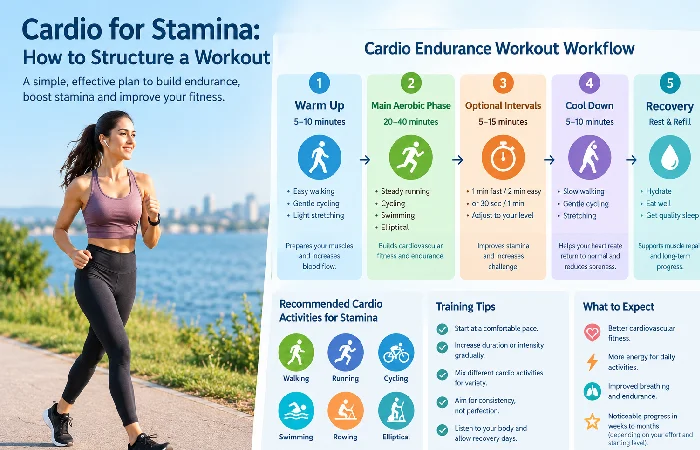
A simple endurance session does not need to be complicated.
Cardio Endurance Workout Workflow
Step 1: Warm up — 5–10 minutes
Start with easy walking, cycling or another gentle movement.
Step 2: Main aerobic phase — 20–40 minutes
Choose a pace that feels sustainable. For many sessions, moderate intensity is appropriate.
3: Optional intervals
Once you have established a fitness base, add short periods of faster effort followed by easier recovery.
Step 4: Cool down — 5–10 minutes
Gradually reduce your pace rather than stopping suddenly after vigorous exercise.
Step 5: Recovery
Rest , sleep, hydrate wellBetween each hard session allow time to rest and recover.
Exercises to Improve Endurance: Steady-State vs Intervals
Both sub-maximum continuous cardio and interval training have a place in an endurance programme, but they produce different results.
| Training type | Example | Main purpose | Typical difficulty |
| Easy aerobic | Comfortable walking | Build activity tolerance | Low |
| Steady-state | 30-minute cycling session | Develop aerobic endurance | Moderate |
| Tempo | Sustained faster running | Improve ability to maintain harder efforts | Moderate–high |
| Intervals | 1 minute fast, 2 minutes easy | Challenge cardiovascular capacity | High |
| Low-impact cardio | Swimming or elliptical | Aerobic training with reduced impact | Low–moderate |
Common error is doing every single workout as an interval. Yes – you need to do hard training, but doing a low-easy session helps you get the aerobic work in as well as managing fatigue. Exercises to Increase Stamina Safely
It should be noted though that progressive overload is just as effective in aerobic training. Rather than making the biggest change possible, alter one variable, for example, time, always.
You could:
- Add 5 minutes to an existing session.
- Increase walking or cycling speed slightly.
- Add a gentle incline.
- Reduce recovery periods gradually.
- Introduce one interval workout per week.
- Increase weekly frequency when recovery is good.
In the example, a person who has come to a halt at a 20 minute continued walk, three times a week, may take that up to 25–30 min kept walk, prior to progressing to more strenuous segments.
Aerobic Endurance Exercises for Beginners
For those of you at the beginning stages of getting fit, it is important to start off with activities that will not discourage you. For example a normal week could be:
| Day | Workout |
| Monday | 25-minute brisk walk |
| Tuesday | Rest or gentle mobility |
| Wednesday | 20–25-minute cycling session |
| Thursday | Rest |
| Friday | 25-minute walk-jog session |
| Saturday | Easy swimming or walking |
| Sunday | Rest |
The right program is based on your present fitness, life commitments and recovery. You do not have to work out hard each day in order to build endurance.
Expectations: How Long Does It Take to Build Endurance?
Endurance does not enhance at the same time for everyone. A novice might feel that everyday activities have become easier after regular training for some weeks; however, better improvements usually demand more extended training.
Rather than judging progress only by speed or distance, track practical measures such as:
- How long you can exercise continuously.
- Whether the same workout feels easier.
- How quickly you recover after exercise.
- Whether you can maintain a consistent pace.
- How your perceived effort changes over time.
Common Mistakes When Training for Endurance
Going Too Hard Too Soon
Beginning the program with too much exercise has the potential to wear you out and hinder consistency.
Increasing Volume Too Quickly
Adding in high volume of additional running, cycling etc suddenly can cause/ provoke too much physical stress. Step by step progression is more sustainable.
Ignoring Recovery
Rest is part of endurance training. Your body adapts between workouts, so recovery should not be treated as wasted training time.
Doing Only One Type of Cardio
Variety can reduce boredom and distribute training stress across different movements.
Measuring Only Calories Burned
Fitness trackers can provide useful estimates, but calorie figures are not precise measurements of individual energy expenditure. Performance, consistency and perceived effort are also useful indicators.
Pros and Limitations of Endurance Cardio
Benefits
- Improves cardiovascular fitness.
- Can increase exercise tolerance.
- Supports stamina for everyday activities.
- Offers many low-impact options.
- Can complement strength training.
- Allows flexible indoor and outdoor workouts.
Limitations
- Progress takes consistent effort.
- High-impact activities may increase injury risk if progressed too quickly.
- Some people may need modified training because of existing health conditions.
- Cardio alone does not provide all aspects of physical fitness.
A well-rounded fitness programme can therefore combine aerobic exercise with strength training, mobility work and adequate recovery.
Conclusion
Cardio Workouts for Endurance – Endurance training requires being consistent, training gradually, and training at the right level for where you are now. All aerobic-based exercise like walking, running, cycling, swimming and others will all help you develop stamina if they are introduced as part of an appropriate training program.
Begin with a tolerable volume of work, increase it slowly and consider recovery from the work. Changes in the length of workouts, perceived exertion and the amount of time spent between workouts are more reliable indicators of progress than doing something that feels more difficult.