
Introduction
Resistance Band Glute Isolation Exercises are a practical way to increase glute engagement without relying on heavy gym equipment. By adding elastic resistance throughout a movement, resistance bands can make common glute exercises more challenging while helping improve muscle awareness and control.
Whether you are new to training, exercising at home, or looking to enhance your lower-body routine, resistance band exercises for glutes can be an effective addition to your programme. While bands are not a replacement for progressive strength training with heavier resistance, they can help improve activation, endurance, and movement quality.
What Are Resistance Band Glute Isolation Exercises?
Glute isolation exercises focus primarily on the gluteal muscles rather than distributing effort across multiple muscle groups.
The glutes consist of:
- Gluteus maximus
- Gluteus medius
- Gluteus minimus
Resistance bands add tension throughout the entire range of motion, making muscles work harder during both the lifting and lowering phases of an exercise.
Common goals include:
- Improving glute activation
- Increasing muscular endurance
- Supporting hip stability
- Enhancing athletic movement
- Supplementing lower-body workouts
- Building foundational strength
Benefits of Resistance Band Exercises for Glutes
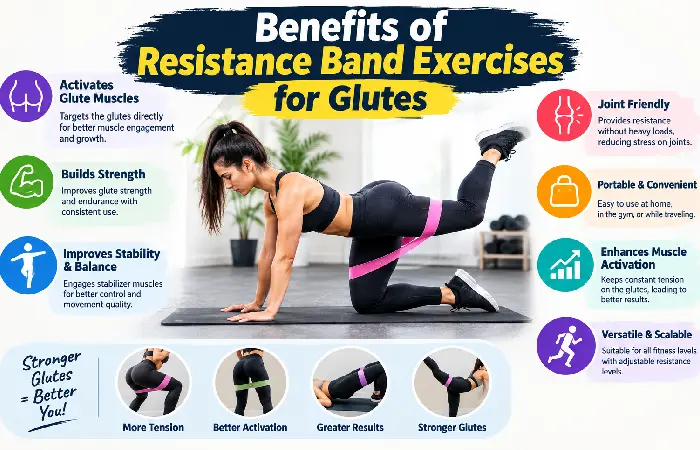
Resistance bands offer several advantages for glute-focused training.
| Benefit | Why It Matters |
| Constant tension | Muscles remain engaged throughout the movement |
| Portable equipment | Easy to use at home or while travelling |
| Joint-friendly | Lower impact than many weighted exercises |
| Suitable for most fitness levels | Resistance can be adjusted |
| Improved muscle awareness | Helps strengthen mind-muscle connection |
While resistance bands can contribute to strength gains, significant muscle growth generally requires progressive overload over time.
Resistance Band Glute Exercises for Every Fitness Level
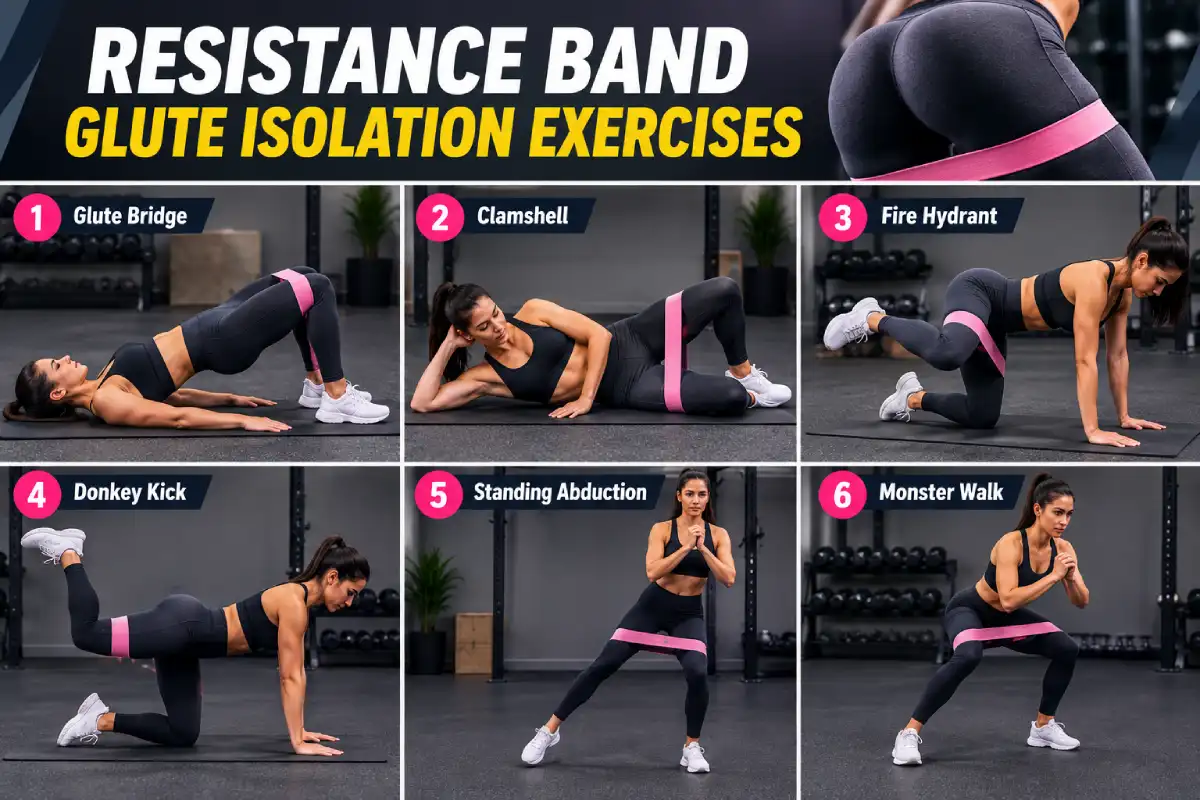
Banded Glute Bridge
The banded glute bridge is one of the most effective beginner-friendly glute exercises.
How to Perform It
- Place a mini band above the knees.
- Lie on your back with knees bent.
- Push knees slightly outward against the band.
- Drive through the heels.
- Lift hips until the body forms a straight line.
- Squeeze the glutes at the top.
- Lower slowly.
Benefits
- Increased glute activation
- Easy to learn
- Suitable for warm-ups and workouts
Banded Glute Kickbacks
Banded glute kickbacks are excellent for targeting the gluteus maximus.
How to Perform Them
- Place a resistance band around the ankles.
- Stand upright or use support if needed.
- Extend one leg behind the body.
- Pause briefly.
- Return slowly.
Benefits
- Direct glute isolation
- Improved hip extension strength
- Minimal equipment required
Recommended Sets
- 2–4 sets
- 12–20 repetitions per leg
Banded Hip Abduction
Banded hip abduction primarily targets the gluteus medius.
How to Perform It
- Place a mini band around the ankles or knees.
- Stand with feet hip-width apart.
- Move one leg outward against resistance.
- Pause briefly.
- Return under control.
Benefits
- Supports hip stability
- Improves balance
- Strengthens smaller glute muscles
Mini Band Glute Exercises for Home Workouts
Mini bands are compact and versatile, making them ideal for home training.
Lateral Band Walks
This exercise challenges hip stabilisers while improving lower-body control.
Clamshells
Clamshells are often used to strengthen the gluteus medius and support hip function.
Seated Band Abductions
A simple movement that maintains constant tension on the glutes.
Monster Walks
Monster walks combine forward and lateral movement to challenge multiple glute muscles.
Complete Glute Band Workout
The following glute band workout can be performed at home with a single resistance band.
| Exercise | Sets | Reps |
| Banded Glute Bridge | 3 | 15 |
| Banded Glute Kickbacks | 3 | 15 per leg |
| Banded Hip Abduction | 3 | 15 per side |
| Lateral Band Walks | 3 | 12 steps each direction |
| Clamshells | 2 | 20 per side |
Rest 45–60 seconds between exercises.
Workout Workflow for Better Glute Activation
Step 1: Warm-Up
Perform:
- Bodyweight squats
- Hip circles
- Leg swings
Duration: 3–5 minutes
Step 2: Activation
Complete:
- Banded glute bridges
- Clamshells
Duration: 5 minutes
Step 3: Main Workout
Perform:
- Banded glute kickbacks
- Banded hip abductions
- Lateral band walks
Focus on controlled movement and full range of motion.
Step 4: Recovery
Finish with:
- Hip flexor stretches
- Figure-four stretch
- Light walking
Resistance Bands vs Bodyweight Glute Training
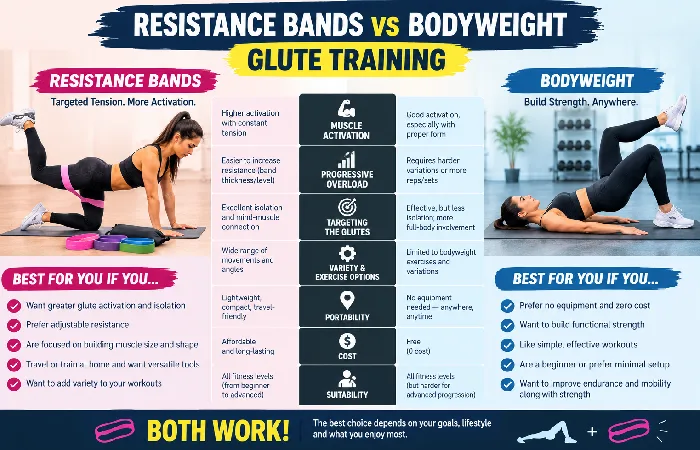
| Feature | Resistance Bands | Bodyweight Only |
| External resistance | Yes | No |
| Progressive challenge | Moderate | Limited |
| Portability | Excellent | Excellent |
| Equipment required | Minimal | None |
| Muscle activation potential | Higher | Moderate |
| Cost | Low | None |
Both approaches can be effective. Resistance bands simply provide an additional training stimulus.
Common Mistakes to Avoid
Using Excessive Resistance
Bands that are too strong can compromise exercise form.
Moving Too Quickly
Slower repetitions often improve muscle engagement.
Neglecting Full Range of Motion
Controlled movement is generally more effective than partial repetitions.
Allowing Knees to Collapse Inward
Maintain proper alignment during all banded movements.
What Results Can You Realistically Expect?
Resistance bands can help improve:
- Glute activation
- Muscular endurance
- Exercise technique
- Hip stability
- Lower-body control
However, expectations should remain realistic.
After 2–4 Weeks
Many people notice:
- Better muscle awareness
- Improved exercise confidence
- Increased stability
After 6–12 Weeks
Consistent training may contribute to:
- Improved strength
- Enhanced muscular endurance
- Better lower-body performance
For substantial hypertrophy goals, additional resistance may eventually be required.
Advantages and Limitations of Glute Band Training
| Advantages | Limitations |
| Affordable equipment | Limited maximum resistance |
| Portable and convenient | Less effective for advanced strength goals |
| Suitable for beginners | Progression eventually plateaus |
| Supports activation work | Not ideal as the sole long-term training method |
| Useful for warm-ups and rehabilitation | Requires consistency for noticeable results |
Frequently Asked Questions
Are Resistance Band Glute Isolation Exercises effective?
Yes. Resistance Band Glute Isolation Exercises can improve glute activation, stability, and muscular endurance when performed consistently with proper technique.
Are banded glute kickbacks good for beginners?
Yes. Banded glute kickbacks are simple to learn and can help strengthen the glute muscles with minimal equipment.
How often should I do resistance band exercises for glutes?
Most people can train glutes with bands 2–4 times per week, depending on overall training volume and recovery.
Are mini band glute exercises enough to build muscle?
Mini band glute exercises can support muscle development, especially for beginners. Advanced trainees may require heavier resistance over time.
What is the best glute band workout for home training?
A balanced routine often includes banded glute bridges, banded glute kickbacks, hip abductions, lateral walks, and clamshells.
Conclusion
Resistance Band Glute Isolation Exercises provide an accessible way to challenge the glute muscles while requiring very little equipment. Exercises such as banded glute kickbacks, banded hip abductions, glute bridges, and mini band glute exercises can help improve activation, stability, and lower-body strength.
Although resistance bands have limitations compared with heavier strength-training methods, they remain a valuable tool for beginners, home exercisers, and individuals looking to improve movement quality. With consistent practice and progressive challenge, resistance band glute isolation exercises can become an effective part of a well-rounded fitness programme.