
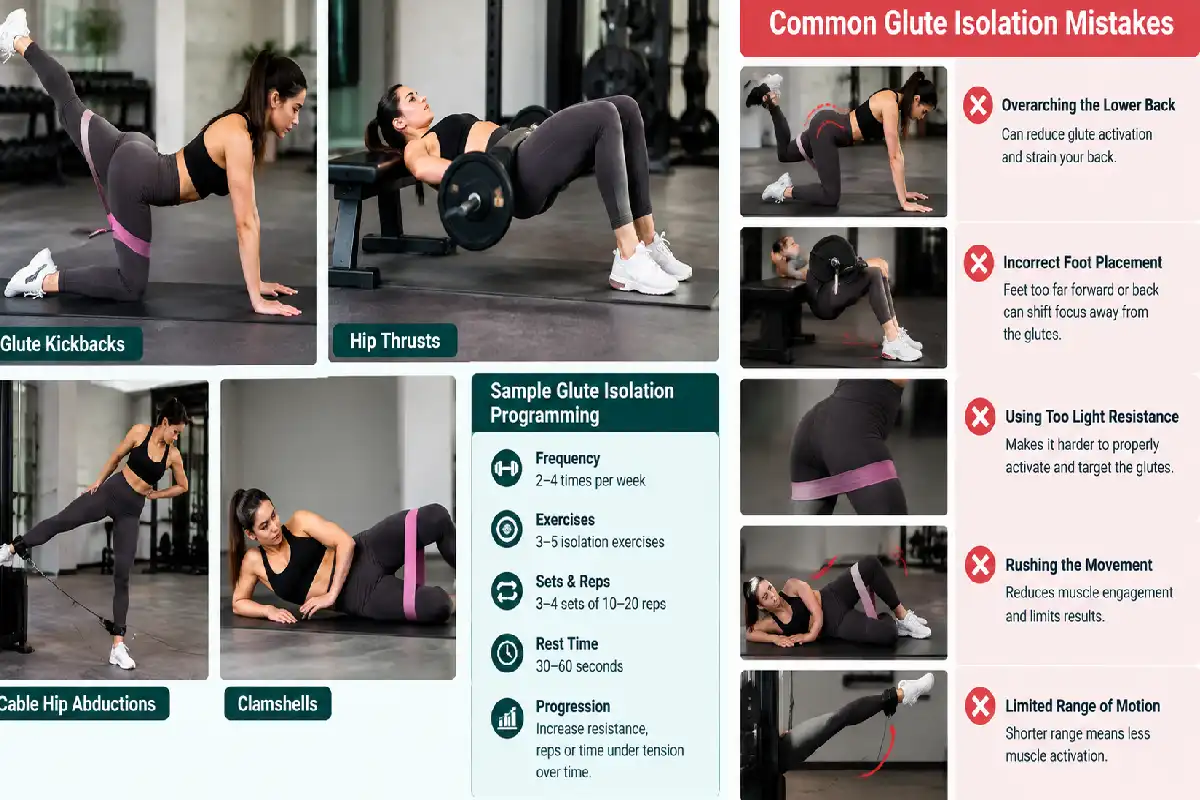
Building stronger, more developed glutes requires more than simply adding extra exercises to a workout routine. Many people perform numerous glute movements each week yet struggle to see progress because of poor exercise selection, ineffective programming, or common training errors. Here is information about Glutes Isolation Programming & Mistakes, such as how frequently to train the glutes, at which point in your workout do you incorporate the isolations exercises, number of sets to perform, and the top few mistakes why your glutes are not growing.
What Is Glute Isolation Programming?
Glutes isolation programming is an isolating programmer of the glutes that is focusing on isolating just the glute muscles and training to some extent around that specific programmer around the specific movement, volume, frequency and rest associated with that actual exercise. This is through ways of working simply on that exercise and the action and contraction of just that specific thing and nothing else through muscle groups as a whole. A programme is established within a set of guidelines that specifies the correct overload required to stimulate adaptation but prevents the development of dangerous fatigue or impair management of recovery.
Understanding the Glute Muscles
The glutes consist of three primary muscles:
| Muscle | Primary Function |
| Gluteus Maximus | Hip extension and power production |
| Gluteus Medius | Hip stability and leg control |
| Gluteus Minimus | Pelvic stability and movement support |
An effective glutes workout needs to include exercises that hit all three glute muscles with movement patterns.
Glute Isolation Workout Plan Basics
A successful glute isolation workout plan should balance exercise selection, training frequency, and recovery.
Common Isolation Exercises
- Cable kickbacks
- Glute bridges
- Frog pumps
- Banded hip abductions
- Clamshells
- Fire hydrants
- Standing cable abductions
- Reverse hypers
These exercises mainly work the glutes, and they are not activated due to the involvement of larger muscles like the Q/T of the legs or the back.
Example Weekly Structure
| Day | Focus |
| Monday | Glute Isolation Session |
| Wednesday | Compound Lower Body Session |
| Friday | Glute Isolation Session |
| Saturday | Optional Glute Activation Work |
This schedule provides adequate recovery while maintaining regular stimulation.
How Often to Train Glutes
One of the most common questions is how often to train glutes for optimal development.
For most individuals:
Experience Level |
Weekly Frequency |
| Beginner | 2 sessions |
| Intermediate | 2–3 sessions |
| Advanced | 3–4 sessions |
Training glutes every day is rarely necessary and may reduce recovery quality.
Signs Frequency May Be Too High
- Constant soreness
- Declining performance
- Fatigue during workouts
- Reduced exercise quality
Signs Frequency May Be Too Low
- Limited training volume
- Slow progress
- Poor exercise consistency
The goal is to find a balance that allows progressive overload while maintaining recovery.
Glute Isolation Before or After Compounds?
A common programming question is whether to perform glute isolation before or after compounds.
The answer depends on the training goal.
Isolation Before Compounds
Benefits:
- Improves mind-muscle connection
- Helps activate glutes before heavy lifts
- Useful when glutes are difficult to feel during exercises
Example:
- Banded abductions
- Cable kickbacks
- Squats
Isolation After Compounds
Benefits:
- Allows maximum strength during heavy lifts
- Easier to manage fatigue
- Often preferred for overall lower-body development
Example:
- Squats
- Romanian deadlifts
- Glute bridges
- Cable kickbacks
Comparison Table
| Approach | Advantages | Limitations |
| Isolation Before Compounds | Better activation | May reduce strength output |
| Isolation After Compounds | Greater lifting performance | Less activation focus |
Both approaches can be effective depending on individual goals.
Reps and Sets for Glutes
Determining suitable reps and sets for glutes is essential for long-term progress.
General Recommendations
| Goal | Sets | Reps |
| Strength | 3–5 | 5–8 |
| Hypertrophy | 3–4 | 8–15 |
| Endurance | 2–4 | 15–25 |
Most isolation exercises work well in the 10–20 repetition range because they create less joint stress and allow greater muscular focus.
Weekly Volume Guidelines
| Experience Level | Weekly Sets |
| Beginner | 8–12 |
| Intermediate | 12–18 |
| Advanced | 18–24 |
More volume is not always better. Recovery quality remains a critical factor.
Common Glute Exercise Mistakes
Many lifters unknowingly make several glute exercise mistakes that limit progress.
- Using Excessive Weight
Heavy loads can shift tension away from the glutes and onto other muscles.
Focus on controlled movement rather than simply increasing resistance.
- Poor Range of Motion
Partial repetitions often reduce glute engagement.
Aim for a full, controlled range whenever mobility allows.
- Ignoring Progressive Overload
Repeating the same workout for months rarely produces significant changes.
Progress can come from:
- Additional repetitions
- Extra sets
- Increased resistance
- Improved technique
- Relying Only on Isolation Work
Isolation exercises are valuable, but compounds such as squats, lunges, and hip thrusts still provide substantial stimulus.
- Inconsistent Training
Missing sessions frequently can prevent accumulation of sufficient training volume.
Consistency remains one of the most important variables.
- Neglecting Recovery
Muscle growth occurs during recovery periods, not during the workout itself.
Adequate sleep, nutrition, and rest days support adaptation.
Why Glutes Are Not Growing
Many people ask why glutes are not growing despite regular training.
Several factors may contribute:
Insufficient Training Volume
Not enough hard sets per week.
Lack of Progressive Overload
Typically, growth (post-natal “growth”) is achieved through incremental escalation in the training.
Poor Exercise Technique
Low value for Glut Activation can be caused by inefficient movement patterns.
Inadequate Nutrition
Muscle growth happens when a person eats calories and protein.
Recovery Issues
Dysfunction of sleep and stress may have adverse effect on adaptation.
Unrealistic Expectations
Visible muscle growth often takes months of effort.
Progress is usually gradual, than dramatic.
Workflow: Building an Effective Glute Isolation Programme
Step 1: Establish Weekly Frequency
Train glutes 2–3 times weekly.
Step 2: Select Core Exercises
Choose 3–5 isolation exercises.
Step 3: Determine Volume
Start with 10–15 total weekly sets.
Step 4: Track Performance
Record:
- Weight used
- Repetitions completed
- Perceived effort
Step 5: Progress Gradually
Increase resistance or repetitions when performance improves.
Step 6: Monitor Recovery
Adjust volume if soreness or fatigue becomes excessive.
What Results Can Realistically Be Expected?
Glute training can improve:
- Muscle strength
- Exercise performance
- Lower-body stability
- Overall athletic function
However, visible physique changes depend on:
- Genetics
- Nutrition
- Training consistency
- Recovery quality
- Overall body composition
Most individuals require several months of structured training before noticing significant muscular development.
Conclusion
If you understand what Glute Isolation Programming & Mistakes are then it is much easier to develop a good, effective, and sustainable training program. Learning how to write a good, specific plan for the glutes, it doing the right amount of reps and sets for the glutes, and having the right expectations for it being much more beneficial than just doing additional exercises. Avoiding the common glute exercise mistakes, recovery, and progressive overload can help to increase most people‘s glute training over time.