
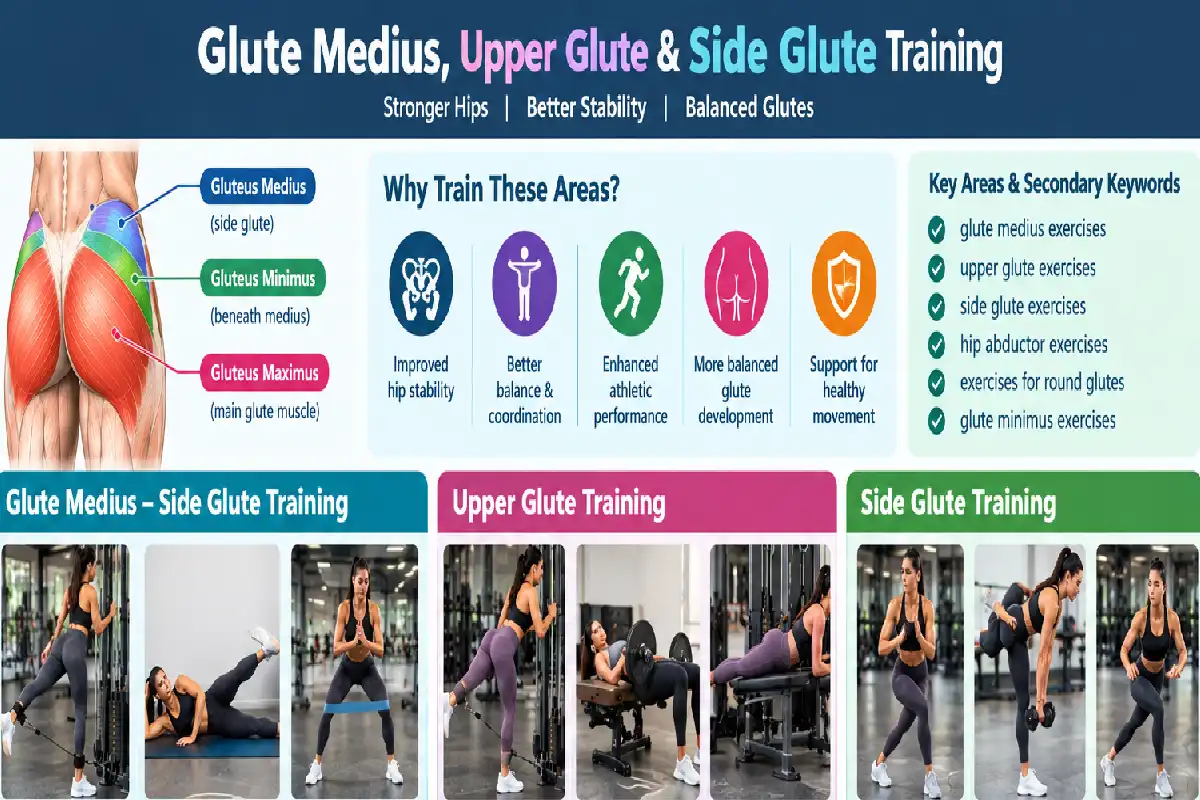
Many people put all of their glute training into squats, lunges and hip thrusts. They still have trouble growing the upper and side parts of their glutes. That is why Glute Medius, Upper Glute & Side Glute Training becomes important. These muscles are important to stabilise the hip joint and shape of the glutes, as the gluteus medius and minimus are vital in movements control. So if you want to achieve hips, glute more balance and definitely athletic performances targeted exercises can be repair the missed part of compound movements.
Understanding the Glute Muscles
The glutes consist of three primary muscles:
| Muscle | Primary Function |
| Gluteus Maximus | Hip extension and power production |
| Gluteus Medius | Hip stability and leg abduction |
| Gluteus Minimus | Pelvic support and hip control |
The upper and side glute areas are largely influenced by the gluteus medius and gluteus minimus.
Why Train the Glute Medius and Side Glutes?
Many lower-body exercises target the gluteus maximus effectively. However, the side glutes often require more direct stimulation.
Benefits may include:
- Improved hip stability
- Better balance and coordination
- Enhanced athletic performance
- Support for healthy movement patterns
- More balanced glute development
- Potential reduction in muscular imbalances
While aesthetics are a common goal, function should remain the primary focus.
Best Glute Medius Exercises for Stronger Hips
Side-Lying Hip Abduction
One of the most effective beginner-friendly glute medius exercises.
How to Perform
- Lie on your side.
- Keep the top leg straight.
- Lift the leg upward.
- Pause briefly.
- Lower under control.
Benefits
- Simple to learn
- Minimal equipment required
- Direct glute medius activation
Standing Cable Hip Abduction
This exercise allows progressive resistance while targeting the side glutes.
Benefits
- Adjustable resistance
- Good range of motion
- Effective for glute medius strengthening
Banded Lateral Walks
A staple exercise for activation and warm-ups.
Benefits
- Improves glute engagement
- Suitable for home workouts
- Useful before heavy lower-body training
Upper Glute Exercises for Balanced Development
The upper glutes contribute significantly to the appearance of glute shape and fullness.
Cable Kickbacks
Cable additional activates the top end of the gluteus maximus along with the core stabilisers.
Hip Thrusts
Improving upper-glute development is also possible in a hip thrust, which is mainly a compound movement. However, hip thrusts are sufficient if executed through a complete amplitude:
Reverse Hyperextensions
These help strengthen the posterior chain while increasing glute involvement.
Step-Ups
A functional movement that challenges glute strength and stability.
Side Glute Exercises for Better Stability
Curtsy Lunges
Curtsy lunges challenge the glute medius while also training balance.
Single-Leg Romanian Deadlifts
These develop hip stability and improve muscular control.
Skater Squats
A more advanced movement requiring strength, balance, and coordination.
Lateral Step-Ups
Useful for strengthening the side glutes while improving lower-body function.
Hip Abductor Exercises for Complete Glute Development
The hip abductors move the leg away from the body’s midline.
Popular hip abductor exercises include:
| Exercise | Difficulty |
| Side-Lying Leg Raises | Beginner |
| Banded Lateral Walks | Beginner |
| Standing Cable Abduction | Intermediate |
| Hip Abduction Machine | Intermediate |
| Single-Leg Balance Drills | Intermediate |
| Lateral Bounds | Advanced |
Training hip abductors regularly can contribute to stronger and more resilient hips.
Glute Minimus Exercises Often Overlooked
The gluteus minimus sits beneath the gluteus medius but plays an important role in pelvic stability.
Effective Glute Minimus Exercises
- Cable hip abduction
- Side-lying leg raises
- Banded monster walks
- Clamshells
- Lateral step-ups
Because the gluteus minimus works alongside the gluteus medius, many exercises train both muscles simultaneously.
Glute Medius vs Glute Maximus Training
| Feature | Glute Medius | Glute Maximus |
| Main Function | Hip stability | Hip extension |
| Location | Side of hip | Back of hip |
| Best Exercises | Abductions, lateral walks | Hip thrusts, squats |
| Athletic Importance | High | High |
| Visible Impact | Side and upper glutes | Overall glute size |
Both muscles should be trained for balanced development.
Exercises for Round Glutes: Building a Complete Programme
Many people search for exercises for round glutes, but no single movement can create a specific shape.
Instead, focus on:
Glute Maximus Training
- Hip thrusts
- Squats
- Romanian deadlifts
Glute Medius Training
- Cable abductions
- Lateral walks
- Clamshells
Glute Minimus Training
- Side-lying leg raises
- Hip abduction machine
- Single-leg stability drills
Training all glute regions creates a more balanced result.
Sample Upper and Side Glute Workout
| Exercise | Sets | Reps |
| Banded Lateral Walks | 2 | 20 |
| Cable Hip Abduction | 3 | 15 |
| Hip Thrust | 4 | 10 |
| Curtsy Lunge | 3 | 12 |
| Side-Lying Leg Raise | 3 | 15 |
| Step-Up | 3 | 10 |
Glute Training Workflow
Step 1: Warm-Up
Perform mobility work and light activation exercises.
Step 2: Glute Activation
Use bands or bodyweight movements.
Step 3: Compound Lifts
Focus on squats, hip thrusts, or deadlifts.
Step 4: Isolation Exercises
Add glute medius and side-glute work.
Step 5: Recovery
Stretch and allow sufficient recovery before the next session.
What Results Can You Realistically Expect?
Many social media transformations create unrealistic expectations.
Realistic Timeline
| Experience Level | Potential Progress Timeline |
| Beginner | 4–8 weeks of noticeable strength gains |
| Intermediate | 8–16 weeks of visible improvements |
| Advanced | Gradual improvements over several months |
Factors influencing results include:
- Consistency
- Nutrition
- Recovery quality
- Training intensity
- Genetics
Glute development takes time, and no exercise guarantees a specific body shape.
Pros and Limitations of Targeted Side Glute Training
Advantages
- Improved hip stability
- Better muscular balance
- Enhanced movement control
- Additional glute development opportunities
- Useful injury-prevention support
Limitations
- Requires consistency
- Results develop gradually
- Cannot override genetics
- Isolation work alone is insufficient
Conclusion
Glute Medius, Upper Glute & Side Glute Training is an integral part of developing stronger more balanced glutes. Through the incorporation of Glute Medius exercises, Upper Glute exercises, Side Glute exercises Hip Abductor exercises & Glute Minimus exercises you will enhance hip stability & movement quality and develop the entire lower-body, work towards any set goals in a balanced way.