
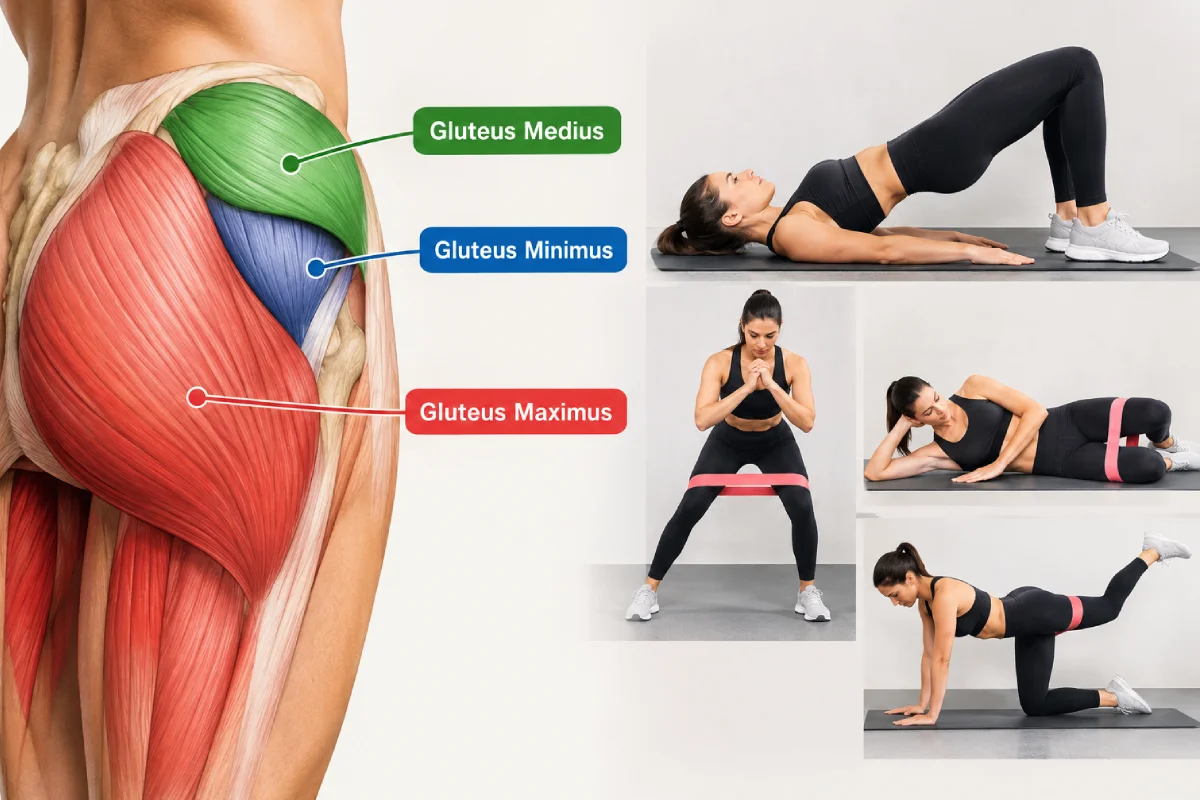
Glutes Anatomy & Activation is considered one of the most crucial concepts for individuals looking to improve lower-body strength, exercise performance and movement efficiency. If there is one thing that individuals do correctly, they will spend hours doing squats, lunges and deadlifts; if there is one thing that individuals do incorrectly, it is not actually activating the glute muscles.
Understanding Glute Muscles Anatomy
The glutes are 3 muscles situated on the back and side of the hips. Each of the muscles will have a different function;
| Muscle | Location | Primary Function |
| Gluteus Maximus | Largest muscle of the buttocks | Hip extension, power production |
| Gluteus Medius | Outer hip region | Hip stability, balance |
| Gluteus Minimus | Beneath the medius | Pelvic control and hip movement |
Together, these muscles support walking, running, jumping, climbing stairs, and maintaining posture.
Why Glute Anatomy Matters
The anatomy of the glute muscles is important to explain why certain exercises seem to be more effective than others. Various exercises put demand on different areas of the glutes.
For example:
- Hip thrusts heavily target the gluteus maximus.
- Single-leg movements challenge the gluteus medius.
- Side-lying exercises often engage both the medius and minimus.
Knowing which muscle is being trained can help improve exercise selection.
What Is Glute Activation?
Glute activation refers to the process of preparing and engaging the glute muscles before training.
How come that most people have glutes that are turned off, sleepy or not firing? Sitting too much, too long and not moving enough variety during your daily habits, a bad exercise technique and lack of glute activation drills in between large movements.
Benefits of Proper Activation
- Improved exercise technique
- Better lower-body coordination
- Enhanced mind-muscle connection
- Increased muscle recruitment during workouts
- Better hip and pelvic stability
While activation is not a magic solution, it can help some individuals feel their glutes working more effectively during training.
How to Activate Glutes Effectively
If you are wondering how to activate glutes before a workout, the goal is not exhaustion. Instead, activation should create awareness and engagement.
Simple Activation Workflow
| Step | Action |
| 1 | Perform 3–5 minutes of light movement |
| 2 | Complete targeted glute activation drills |
| 3 | Progress to bodyweight compound exercises |
| 4 | Begin your main workout |
| 5 | Focus on controlled repetitions |
This sequence prepares both the muscles and nervous system for training.
Best Glute Activation Exercises
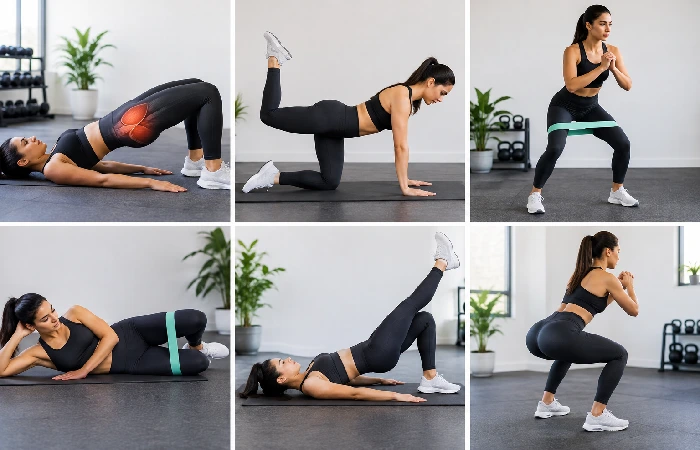
The following glute activation exercises are commonly used as part of a warm-up routine.
1. Glute Bridges
How to perform:
- Lie on your back.
- Bend your knees.
- Drive through your heels.
- Lift your hips upward.
- Pause briefly at the top.
Primary target: Gluteus maximus
2. Banded Lateral Walks
This exercise helps activate the outer glutes.
Primary target: Glute medius activation
Benefits include:
- Improved hip stability
- Better balance
- Increased side-to-side control
3. Clamshells
Clamshells are a simple movement often used to improve hip control.
How to perform:
- Lie on your side.
- Keep feet together.
- Open the top knee while maintaining hip position.
This movement primarily challenges the gluteus medius and minimus.
4. Quadruped Kickbacks
Kickbacks encourage hip extension while keeping movement controlled.
Primary target: Gluteus maximus
Focus on slow, deliberate repetitions rather than speed.
5. Single-Leg Glute Bridge
This progression increases the stability demands placed on each side independently.
Benefits include:
- Improved balance
- Increased glute recruitment
- Better left-to-right strength awareness
Glute Medius Activation and Why It Matters
Although often overshadowed by the maximus, the medius plays a major part in the quality of movement.
Key Functions
- Pelvic stability
- Single-leg balance
- Walking mechanics
- Running efficiency
Weak activation of glute medius can result in dysfunctional movement patterns during squats, lunges.
Effective Glute Medius Exercises
| Exercise | Difficulty |
| Clamshells | Beginner |
| Side-Lying Leg Raises | Beginner |
| Banded Lateral Walks | Intermediate |
| Single-Leg Squats | Intermediate |
| Lateral Step-Ups | Advanced |
Glute Maximus Exercises for Strength Development
The gluteus maximus is the largest muscle in the human body and plays a major role in generating force.
Popular Glute Maximus Exercises
| Exercise | Main Benefit |
| Hip Thrust | High glute loading |
| Romanian Deadlift | Hip hinge strength |
| Squat | Lower-body development |
| Step-Up | Single-leg control |
| Bulgarian Split Squat | Stability and strength |
These exercises can be progressively overloaded through increased resistance or training volume.
Building a Strong Mind-Muscle Connection for Glutes
The mind muscle connection glutes concept refers to consciously focusing on the target muscle during movement.
External performance cues, while still significant, are not always sufficient in the development of the gluteal muscles, although many lifters report that internal cues allow them a sense of feeling the gluteals work properly.
Practical Tips
- Move through a full range of motion.
- Use controlled repetitions.
- Pause briefly at peak contraction.
- Avoid rushing through sets.
- Start with lighter loads when learning technique.
Over time, improved awareness may help create more consistent muscle engagement.
Sample Glute Activation Routine
This routine can be completed in approximately 8–10 minutes.
| Exercise | Sets | Reps |
| Glute Bridges | 2 | 15 |
| Clamshells | 2 | 12 per side |
| Banded Lateral Walks | 2 | 15 steps each direction |
| Quadruped Kickbacks | 2 | 12 per side |
| Bodyweight Squats | 2 | 15 |
The goal is preparation rather than fatigue.
Expectations: What Activation Can and Cannot Do
What Activation May Help With
- Better awareness of glute engagement
- Improved warm-up quality
- Enhanced movement preparation
- Greater exercise confidence
What Activation Cannot Guarantee
- Instant muscle growth
- Immediate strength increases
- Injury prevention in every situation
- Perfect exercise technique
Results vary based on training experience, consistency, recovery, and overall programme design.
Common Mistakes During Glute Training
Skipping the Warm-Up
Jumping directly into heavy lifts may reduce movement quality for some individuals.
Using Excessive Weight
Too much resistance can shift effort away from the target muscles.
Rushing Repetitions
Controlled movement often improves muscle awareness.
Ignoring Recovery
Muscles require adequate rest, nutrition, and sleep to adapt to training.
Glute Activation vs Traditional Warm-Up
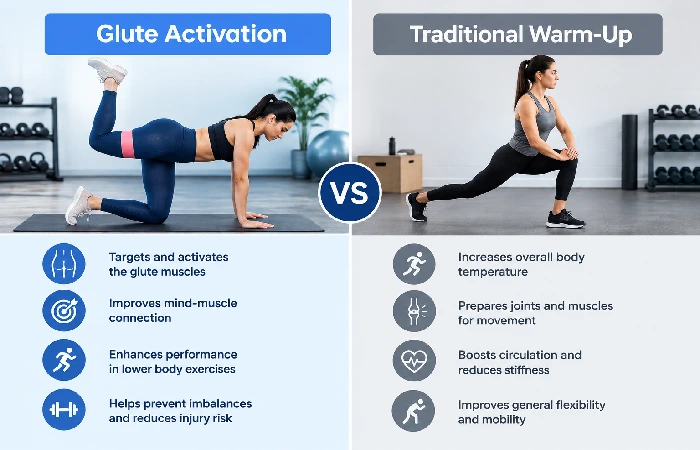
| Feature | Glute Activation | General Warm-Up |
| Targeted Muscle Focus | High | Low |
| Heart Rate Increase | Moderate | Moderate to High |
| Movement Preparation | High | Moderate |
| Specific Muscle Awareness | High | Low |
| Workout Readiness | High | Moderate to High |
Both approaches can be valuable and often work best when combined.
Frequently Asked Questions
What is Glute Anatomy & Activation?
Glute Anatomy & Activation is about the anatomy of the glute muscles, and developing the use of specific exercises to engage the glutes prior to or through the training session.
How long should glute activation take?
Most activation routines take between 5 and 10 minutes and are performed before the main workout.
Are glute activation exercises necessary?
Activation drills aren‘t necessary for everyone, but they are useful for some people to enhance muscle association and prepare for an exercise.
What is the best exercise for glute medius activation?
Banded lateral walks and clamshells are commonly used to target the gluteus medius.
Can glute activation improve the mind muscle connection glutes athletes experience?
Yes. Consistent practice may help some individuals become more aware of glute engagement during training movements.
Conclusion
Glute Anatomy & Activation gives a basic understanding of the function of glutes, aiding in the understanding of how the glutes influence movement, stability and exercise. Learning the anatomy of glute muscles, using key glute activation movements and enhancing the mind muscle connection are all methods which can help us to better understand and become more aware of how our lower body works. Activation is not an easy way to strength and muscle gain but in conjunction with progressive overload, recovery and long term consistency; it can be a beneficial addition.