
Last Updated: September 4, 2026
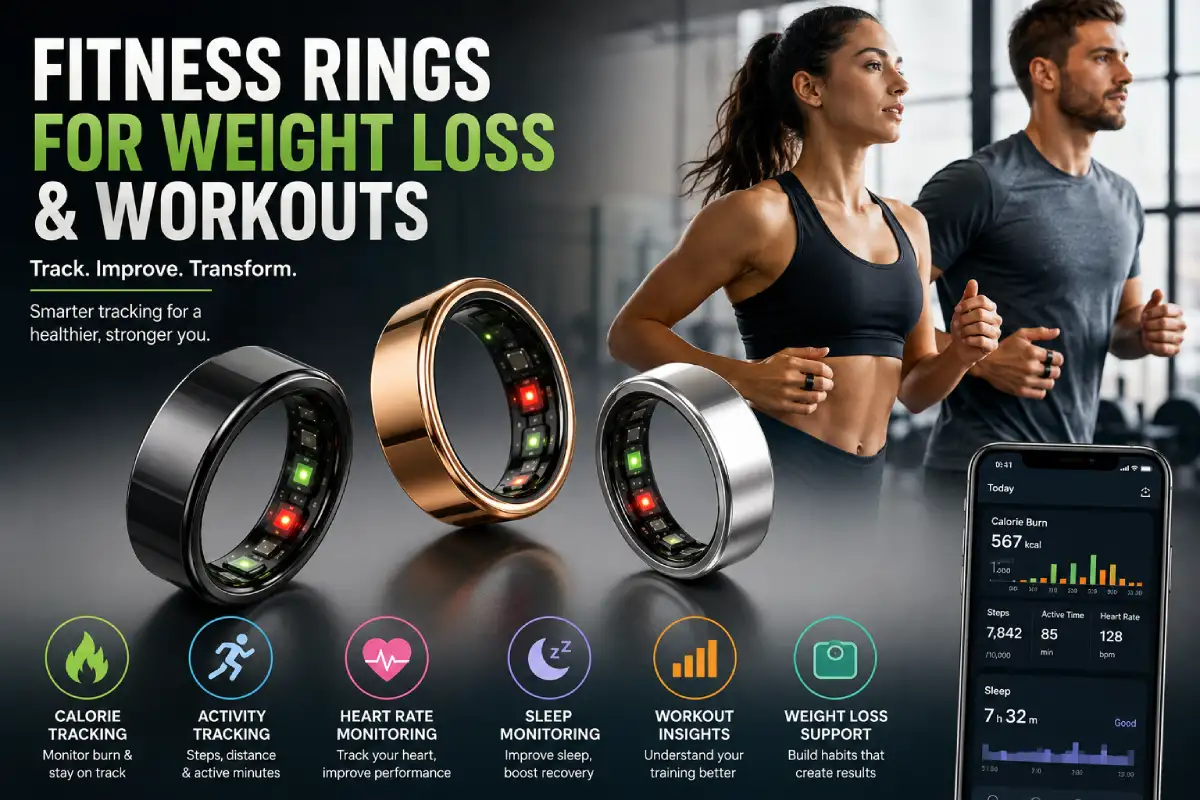
Fitness Rings for Weight Loss & Workouts offer an alternative, to a big fitness watch. These tiny wearables can count steps measure heart rate, record sleep and depending on the model track workout activity and estimate calorie burn.. A fitness ring should be seen mainly as a tracking device and a behaviour‑support aid not as a magic weight‑loss tool. Real lasting weight loss depends mainly on nutrition, regular exercise, proper sleep adequate recovery and a balanced energy budget.
What Are Fitness Rings for Weight Loss & Workouts?
A fitness ring is a device you wear on your finger. It gathers health and activity data from you. Unlike a smartwatch most fitness rings do not have a screen. So you usually look at the information, on a phone app that works with the ring.
Depending on the model, a ring may monitor:
- Daily steps and movement
- Heart rate
- Resting heart rate
- Sleep duration and sleep stages
- Blood oxygen estimates
- Workout activity
- Calories burned or energy expenditure estimates
- Recovery indicators
- Stress-related metrics
- Temperature trends
The exact features vary significantly between brands and models, so specifications should always be checked before buying.
How a Fitness Ring Can Support Weight Loss
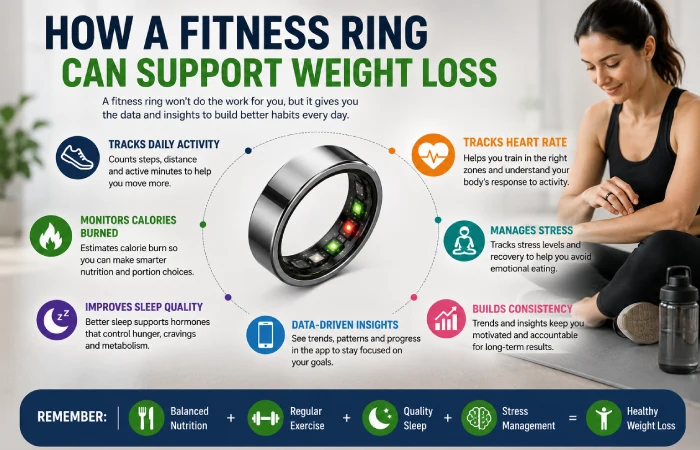
A fitness ring for weight loss does not directly burn fat. The benefit comes from helping you see your habits and make choices.
For example a person who sits all day at work might find out that their daily movement is not much as they thought. Setting a walking goal can then be a way to get more active.
In the way tracking sleep might show that someone has irregular sleep times. Good sleep does not ensure weight loss. Getting enough rest can help with better habits and recovery, from workouts.
Fitness Ring Calorie Tracking
Many fitness rings give an estimate of how calories you burn. This can help you see patterns over time but it should not be taken as a perfect number.
The calorie estimates come from data like your movement, heart rate, body type and the math the device uses. Because of this the numbers might not match what your body actually burns.
When trying to manage weight it’s better to think of the calorie data as one part of the picture. Don’t assume the number, on your ring tells you how many calories you’ve used.
Key Features to Look For
When comparing fitness rings, focus on features that match your actual routine rather than choosing the device with the longest specification list.
- Activity Tracking
Reliable step and movement tracking can be useful if your main goal is to become more active throughout the day.
- Heart Rate Monitoring
Heart-rate tracking can provide useful workout and recovery information. Look for continuous or frequent measurements if monitoring heart rate is important to you.
- Sleep Tracking
For people who exercise regularly, sleep information can help identify patterns in bedtime, sleep duration and recovery.
- Workout Tracking
A good fitness tracker ring for workouts should make it reasonably easy to record or review exercise sessions. Some models support automatic workout detection, while others rely more heavily on the phone app.
- Water Resistance
Water resistance can be helpful for everyday wearers, people who rarely remove their ring, during sweat workouts and general everyday activities, such as handwashing.
- Battery Life
A longer battery life means fewer times the ring needs to be removed from finger to charge. Refer to what the manufacturer claims and remember that usage will affect the reality of the stated battery life.
- App Quality
While the ring may be small, it is the companion app that is the epicenter of the experience. Prioritize data that presents obvious trends, simple graphs, and beneficial summaries rather than a sea of raw information.
Fitness Ring vs Fitness Watch
Both devices can track activity and health information, but they suit different preferences.
| Feature | Fitness Ring | Fitness Watch |
| Wearability | Small and discreet | Larger and more visible |
| Screen | Usually none | Usually has a display |
| Step tracking | Common | Common |
| Heart-rate tracking | Common | Common |
| Sleep tracking | Often a major focus | Available on many models |
| Workout controls | Usually app-based | Often available directly on watch |
| GPS | Limited or phone-dependent on many models | Built-in GPS on many models |
| Notifications | Limited | Usually extensive |
| Battery | Often several days | Varies considerably |
| Phone dependence | Relatively high | Varies by model |
| Best for | Passive health tracking | Active workout and smart features |
Fitness Ring for Running and Walking
Fitness Ring for Running
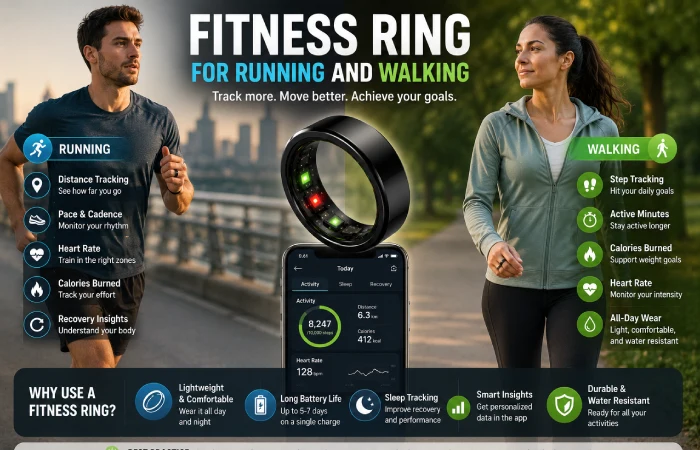
A fitness ring for running can be useful for tracking selected physiological and activity metrics, particularly when paired with a smartphone.
Runners need to also verify that the ring will present to them, the kind of information that they will really use. Typically, dedicated running watches tend to supply more “real-time” data (pace, distance, GPS, work out controls, etc).
If you mainly want post-run information and prefer not to wear a watch, a ring may be sufficient.
Fitness Ring for Walking
A fitness ring for walking can be particularly practical. Walking does not normally require constant access to a screen, making a discreet wearable suitable for tracking daily steps and movement.
For someone beginning an exercise routine, monitoring gradual increases in daily activity can be more useful than chasing aggressive targets.
Fitness Ring Workout Workflow
A simple workflow can make fitness-ring data more useful:
- Wear the ring consistently → 2. Establish your normal activity → 3. Set one realistic goal → 4. Complete workouts → 5. Review trends → 6. Adjust your routine → 7. Repeat
If your usual daily exercise rate is about 5,000 steps, perhaps forcing 15,000 will not be possible and a gradual increase would be easier.
It’s similar when considering exercise programs. The aim isn’t to have one incredibly workout. But rather consist over a period of several weeks.
Performance Expectations: What Can You Realistically Expect?
Fitness rings can be helpful, but their measurements should not be interpreted as medical-grade results.
Expect useful trends, not perfect numbers
Heart rate, steps and sleep estimates can help you recognise patterns. However, sensor placement, movement, skin contact, exercise intensity and device algorithms can affect readings.
Do not expect automatic weight loss
Buying a ring does not create a calorie deficit or replace exercise. It may improve awareness and accountability, but the behaviour still has to come from the user.
Use trends instead of obsessing over individual readings
A single unusual sleep score or calorie estimate is rarely meaningful by itself. Looking at patterns over time is generally more useful.
Weight is only one outcome
Improvements in fitness may entail longer endurance times, higher muscle force, walking ability and better exercise adherence even with slow rate of body weight decrease.
Pros and Cons of Fitness Tracker Rings
Pros
- Compact and discreet
- Comfortable for many users during sleep
- Useful for passive health and activity tracking
- Can monitor multiple metrics in one device
- Usually less distracting than a smartwatch
- Can encourage awareness of daily movement
- Often suitable for continuous wear
Cons
- Usually has no built-in display
- Smartphone app is often required
- Calorie estimates are not perfectly precise
- Sizing and fit are important
- Some advanced features may require subscriptions
- Workout functionality can be less comprehensive than a sports watch
- GPS functionality may be limited or phone-dependent
- Rings can be easier to scratch or damage than expected
Battery, Build and Materials
Fitness rings commonly use lightweight metals, protective coatings and internal optical sensors. Materials differ between products, so durability should be checked rather than assumed.
Battery life can range from several days to longer periods depending on the model, sensor usage and software settings.
A ring designed for continuous wear should ideally have sufficient water resistance for your routine. Being water resistant does not mean it’s not destructible! Be sure to read the manufacturer instructions regarding swimming, hot water, cleaning and exposure to chemicals
Who Should Buy a Fitness Ring?
A fitness ring may suit you if you:
- Prefer a discreet wearable
- Want sleep and activity tracking
- Do not need a screen on your wrist
- Want to monitor daily movement
- Exercise regularly but do not require advanced sports-watch features
- Like reviewing health trends through a phone app
- Want a wearable that can be worn day and night
Who Should Avoid One?
A ring may not be the best choice if you:
- Need live workout information on your wrist
- Require built-in GPS for running or cycling
- Want extensive smartwatch functionality
- Prefer not to wear jewellery
- Need highly specialised sports metrics
- Do not want to use a companion smartphone app
People with medical concerns should also avoid treating consumer wearable readings as a substitute for professional medical assessment.
Buying Tips for Fitness Rings
Before purchasing, consider these factors:
- Check compatibility. Make sure the ring’s app works with your smartphone.
- Get the sizing right. A secure but comfortable fit is important for both comfort and sensor contact.
- Review subscription requirements. Some products reserve advanced insights for paid plans.
- Check battery claims. Consider how often you are comfortable charging the ring.
- Look at workout support. Runners may need more features than casual walkers.
- Check water resistance. Match the rating to your daily activities.
- Read the privacy policy. Health and activity information can be sensitive, so understand how data is stored and used.
- Compare the app, not just the hardware. The software experience can determine how useful the collected data becomes.
Final Verdict
Fitness Rings for Weight Loss & Workouts can be helpful for people who want to track their health and without the bulk of a smartwatch. These rings offer a way to monitor everyday movement sleep quality and workout habits. They help users see their patterns over time and gently push them toward routines.
For walking, exercise and regular daily activities a ring often works well. It’s small and easy to wear all the time. If you are into running you might need GPS tracking or want detailed feedback on your training sessions. In that case a fitness watch could be a fit.