
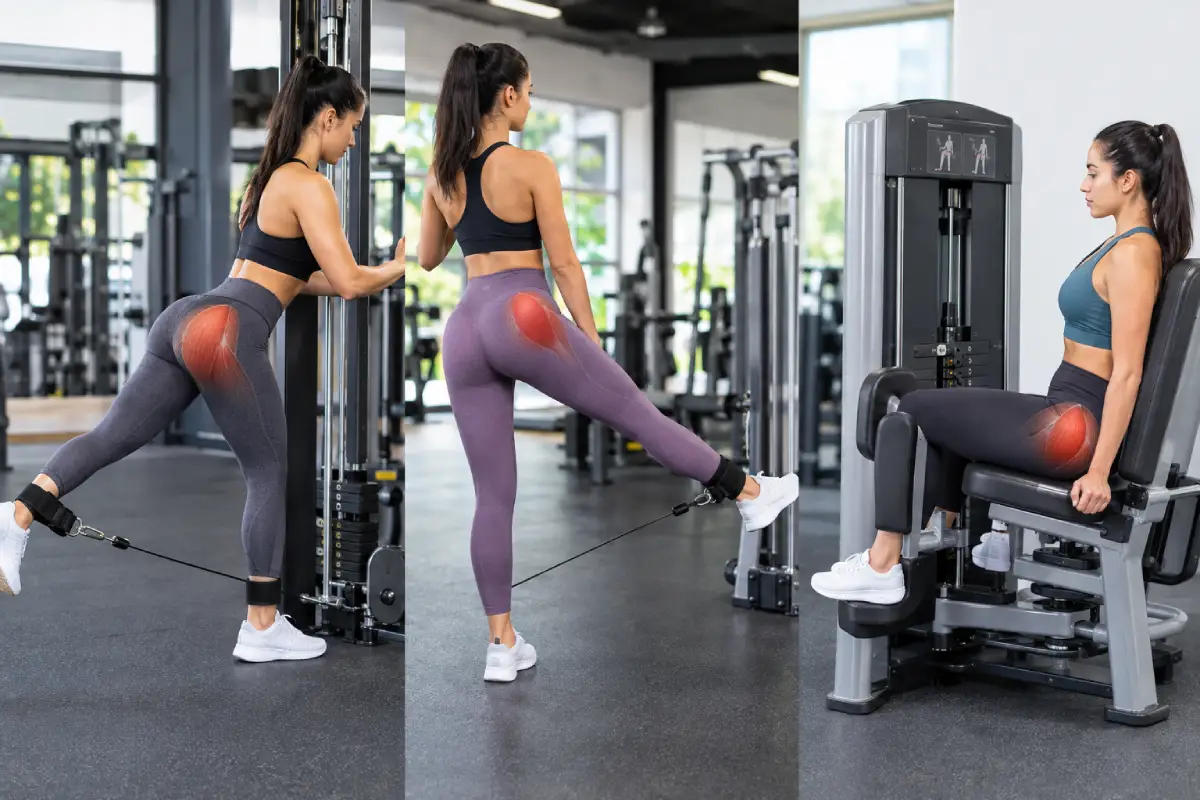
In today’s fitness world, glute training is arguably the most sought-after goal. It is, of course, a fantastic addition to any programme, but unfortunately many compound lifts – those excellent weight training basics of the deadlift and squat – often fail to activate the glutes sufficiently. That’s where Cable & Gym Glute Isolation Exercises come in.
Cable or machine-based glute exercises allow for single-muscle isolation to ensure that you can focus entirely on activating the glutes correcting any muscle imbalances and develop your entire lower body. Whether you‘re training for strength, hypertrophy, sport, or to address broken movement mechanics, cable and machine-based glute training can be an effective component of your program.
Understanding the Glute Muscles
The glutes consist of three primary muscles:
| Muscle | Primary Function |
| Gluteus Maximus | Hip extension and power production |
| Gluteus Medius | Hip stability and lateral movement |
| Gluteus Minimus | Pelvic stability and hip support |
A comprehensive glute training programme should involve all three muscles and movements that hit them from various planes.
Why Include Cable & Gym Glute Isolation Exercises?
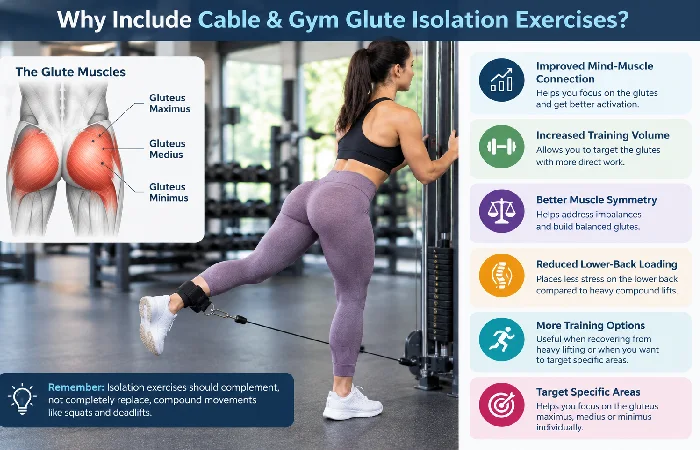
Most trainees stick with squat and lunges for glutes. Although these are good exercises. It uses many muscles.
Isolation exercises offer several advantages:
- Improved mind-muscle connection
- Increased glute training volume
- Better muscle symmetry
- Reduced lower-back loading
- Additional training options when recovering from heavy lifting
- Ability to target specific areas of the glutes
Best Cable Glute Exercises for Targeted Development
Cable Kickbacks for Glutes
Cable kickbacks are among the most popular cable glute exercises because they directly target the gluteus maximus.
How to Perform
- Attach an ankle strap to a low cable pulley.
- Secure the strap around one ankle.
- Stand upright while holding the machine for balance.
- Extend your leg backwards in a controlled motion.
- Squeeze the glute at the top.
- Return slowly to the starting position.
Benefits
- High glute activation
- Adjustable resistance
- Minimal spinal loading
- Suitable for most fitness levels
Common Mistakes
- Excessive lower-back arching
- Swinging the leg
- Using momentum instead of muscle control
Cable Hip Abduction for Glute Medius Development
The gluteus medius is essential for hip stability and athletic movement.
How to Perform Cable Hip Abduction
- Attach an ankle strap to the low pulley.
- Stand side-on to the machine.
- Move the working leg away from the body.
- Pause briefly.
- Return under control.
Benefits
- Targets side glutes effectively
- Supports hip stability
- May improve movement efficiency during running and sports
Recommended Sets
| Goal | Sets | Reps |
| Strength | 3–4 | 8–12 |
| Hypertrophy | 3–5 | 12–15 |
| Endurance | 2–4 | 15–20 |
Glute Exercises with Ankle Strap Attachments
An ankle strap dramatically increases exercise variety on cable machines.
Popular options include:
Standing Cable Kickbacks
Focuses on gluteus maximus development.
Cable Lateral Raises
Targets gluteus medius and minimus.
Cable Diagonal Kickbacks
Challenges glutes through multiple movement planes.
Cable Reverse Leg Drives
Useful for controlled hip extension training.
If you desire very specific resistance positions, ankle straps are your best bet. They are great for glute isolation exercises.
Hip Abduction Machine Glutes Training
The hip abduction machine glutes exercise remains a gym staple.
How It Works
The machine requires users to push their legs outward against resistance while seated.
Benefits
- Easy to learn
- Stable positioning
- Suitable for beginners
- Excellent for glute medius development
Limitations
- Less functional than standing movements
- Limited range of motion compared to cables
- Machine availability may vary between gyms
Cable vs Machine Glute Exercises
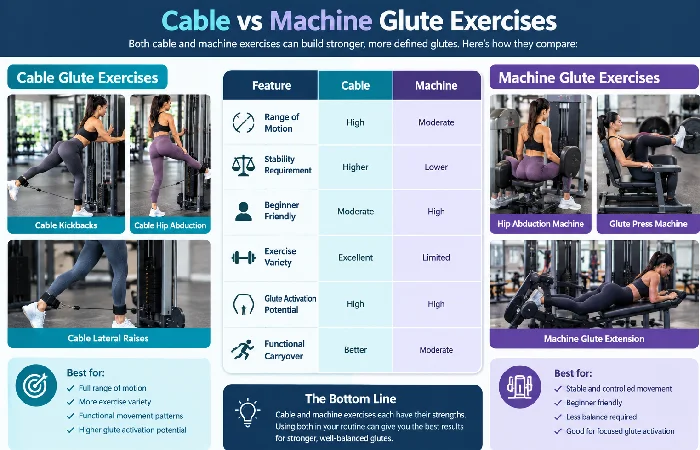
| Feature | Cable Exercises | Machine Exercises |
| Range of Motion | High | Moderate |
| Stability Requirement | Higher | Lower |
| Beginner Friendly | Moderate | High |
| Exercise Variety | Excellent | Limited |
| Glute Activation Potential | High | High |
| Functional Carryover | Better | Moderate |
Both methods can be effective when programmed appropriately.
Sample Gym Glute Isolation Exercises Workout
Beginner Workout
| Exercise | Sets | Reps |
| Cable Kickbacks | 3 | 12 |
| Cable Hip Abduction | 3 | 15 |
| Hip Abduction Machine | 3 | 15 |
| Glute Bridge | 3 | 12 |
Intermediate Workout
| Exercise | Sets | Reps |
| Cable Kickbacks | 4 | 12 |
| Cable Hip Abduction | 4 | 15 |
| Hip Abduction Machine | 4 | 15 |
| Single-Leg Glute Bridge | 3 | 12 |
| Reverse Hyperextension | 3 | 10 |
Glute Training Workflow
Step 1: Warm-Up
Perform 5–10 minutes of light cardio and mobility work.
Step 2: Activation
Use light resistance bands or low-weight cable exercises.
Step 3: Main Glute Training
Complete your primary compound lifts.
Step 4: Isolation Work
Add cable and machine glute exercises.
Step 5: Recovery
Stretch hips and glutes after training.
This sequence helps maximise training quality while managing fatigue.
What Results Can You Realistically Expect?
Typical Expectations
| Training Experience | Potential Timeline |
| Beginner | Noticeable strength gains in 4–8 weeks |
| Intermediate | Visible improvements in 8–16 weeks |
| Advanced | Gradual progress over several months |
Results depend on:
- Training consistency
- Progressive overload
- Nutrition
- Recovery quality
- Genetics
Isolation exercises can help you grow, but only if you use them within a full programme.
Pros and Limitations of Gym Glute Isolation Exercises
Advantages
- Direct glute targeting
- Reduced lower-back stress
- Improved muscle awareness
- Easy progression
- Helpful for correcting imbalances
Limitations
- Less overall strength development than compound lifts
- Limited calorie expenditure
- Require gym equipment
- Not a complete lower-body solution
Alternatives to Cable-Based Glute Training
If cable machines are unavailable, consider:
- Resistance band kickbacks
- Resistance band hip abductions
- Glute bridges
- Hip thrusts
- Bulgarian split squats
- Step-ups
These alternatives can still effectively challenge the glute muscles.
Conclusion
Cable & Gym Glute Isolation Exercises are a way to effectively isolate the glutes and can be used together with large compound movements. Cable kickbacks, for glutes, cable hip abduction, hip abduction machine glutes training, etc. can help increase activation and training volume and work toward developments. I find that Cable & Gym Glute Isolation Exercises help keep the glutes strong. As all exercises progress these are tools, realizable progress still requires appropriate diet, training and recovery.