
Introduction
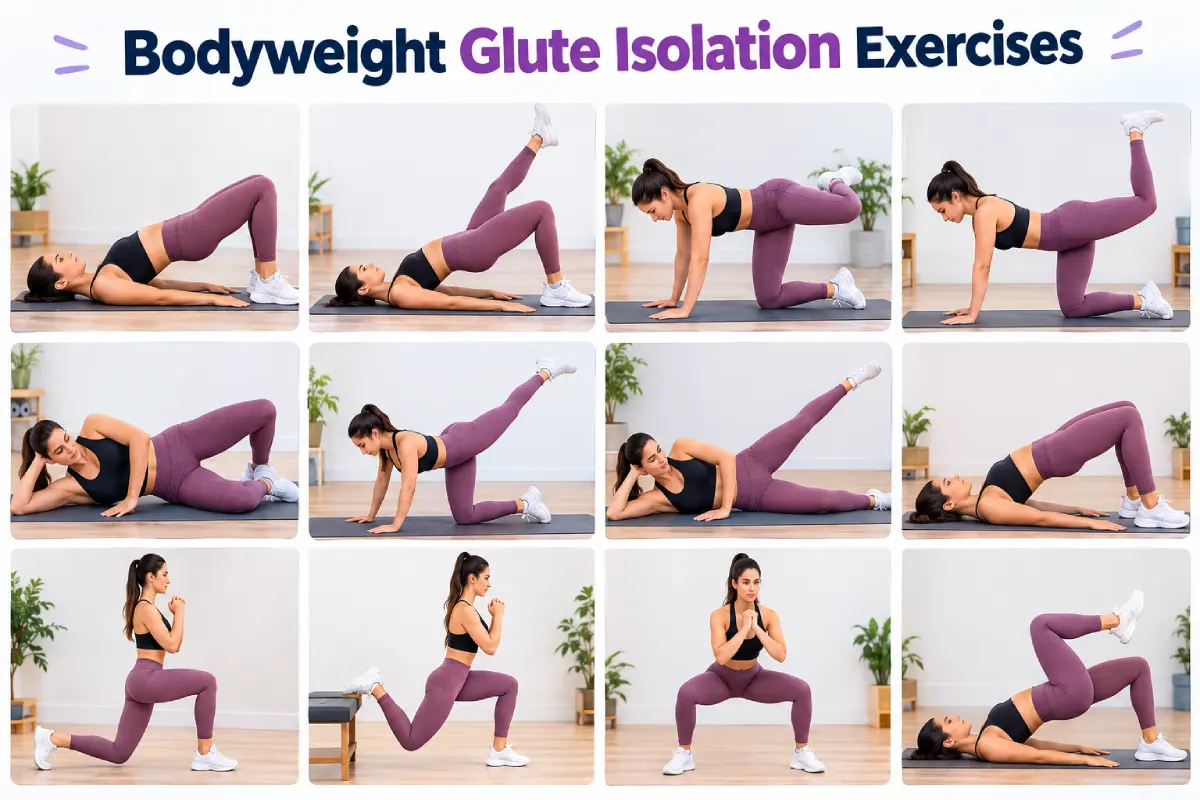
Bodyweight glute isolation exercises are one of the easiest methods to target the legs and glutes without equipment, whether you are new to exercising to bring up weak activation or looking for a supplementary bodyweight movement for already solid strength, increasing stability and control and of course, better movement and posture.
Glutes Isolation. As opposed to compound exercises, in the glutes isolation exercises the focus should be on putting more focus on the glutes. Bodyweight exercises, although not providing as much resistance as the weighted exercises, give good results when performed properly and with persistance.
What Are Bodyweight Glute Isolation Exercises?
Bodyweight glute isolation exercises are movements that primarily focus on the gluteal muscles:
- Gluteus maximus
- Gluteus medius
- Gluteus minimus
These exercises reduce assistance from surrounding muscle groups and encourage direct glute activation.
Common reasons people perform them include:
- Improving glute strength
- Supporting athletic performance
- Enhancing hip stability
- Assisting rehabilitation programmes
- Building a stronger foundation for squats and deadlifts
- Improving movement efficiency in daily activities
Why Glute Isolation Matters
A lot of time is spent by many people sitting. This could be another reason for lack of glute activation and adding some glute exercises into a workout may be a good way of maintaining strength and flexibility.
Potential benefits include:
| Benefit | How It Helps |
| Better hip stability | Supports movement control |
| Improved posture | Helps maintain proper alignment |
| Increased glute activation | Encourages stronger muscle engagement |
| Enhanced exercise performance | Supports squats, lunges, and running |
| Reduced muscular imbalances | Strengthens underused muscles |
Although these exercises will help strength improvements, the results will vary depending on how often you perform them, the type of exercises performed, your diet and rest, and your overall program.
Best Bodyweight Glute Isolation Exercises
Glute Bridge Exercise
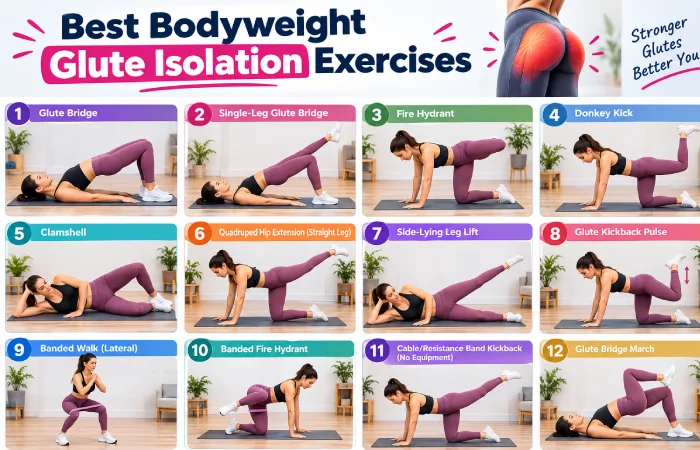
The glute bridge exercise is one of the most effective beginner-friendly movements for activating the glutes.
How to Perform It
- Lie on your back with knees bent.
- Place feet flat on the floor.
- Keep arms by your sides.
- Push through your heels.
- Lift hips until your body forms a straight line.
- Squeeze the glutes at the top.
- Lower slowly.
Recommended Sets
- Beginners: 2–3 sets of 10–15 reps
- Intermediate: 3–4 sets of 15–20 reps
Benefits
- Simple to learn
- Minimal joint stress
- Strong glute activation
- Suitable for home workouts
Donkey Kicks for Glutes
Donkey kicks for glutes target the gluteus maximus through hip extension.
How to Perform It
- Start on hands and knees.
- Keep your core engaged.
- Lift one leg behind you.
- Drive the sole of the foot upward.
- Pause briefly.
- Return under control.
Recommended Sets
- 2–4 sets
- 12–20 repetitions per leg
Benefits
- Excellent glute isolation
- Improves mind-muscle connection
- Requires no equipment
Fire Hydrant Exercise
The fire hydrant exercise primarily targets the gluteus medius.
How to Perform It
- Begin on all fours.
- Keep knees bent at 90 degrees.
- Lift one knee out to the side.
- Pause briefly.
- Lower slowly.
Recommended Sets
- 2–4 sets
- 12–20 repetitions per side
Benefits
- Improves hip stability
- Supports lateral movement strength
- Useful as a warm-up exercise
Single Leg Glute Bridge for Greater Challenge
Once standard glute bridges become easier, the single leg glute bridge can increase difficulty without adding equipment.
How to Perform It
- Lie on your back.
- Extend one leg straight.
- Push through the planted foot.
- Raise hips upward.
- Hold briefly.
- Lower slowly.
Benefits
- Increased unilateral strength
- Greater glute activation
- Improved balance and stability
- Helps identify side-to-side weaknesses
Suggested Volume
- 2–3 sets
- 8–15 reps per side
Home Glute Isolation Workout
If you’re looking for a simple home glute isolation workout, the following routine can be performed in a small space.
Beginner Routine
| Exercise | Sets | Reps |
| Glute Bridge | 3 | 15 |
| Donkey Kicks | 3 | 12 per side |
| Fire Hydrants | 3 | 12 per side |
| Single Leg Glute Bridge | 2 | 10 per side |
Rest 45–60 seconds between exercises.
Workout Workflow for Maximum Glute Activation
Step 1: Warm-Up
Perform:
- Hip circles
- Bodyweight squats
- Leg swings
Duration: 3–5 minutes
Step 2: Activation
Complete:
- Glute bridges
- Fire hydrants
Duration: 5 minutes
Step 3: Main Workout
Perform:
- Donkey kicks
- Single-leg glute bridges
Focus on controlled movement rather than speed.
4: Recovery
Finish with:
- Hip flexor stretches
- Figure-four stretch
- Light walking
Popular Bodyweight Glute Isolation Exercises
| Exercise | Primary Target | Difficulty | Best For |
| Glute Bridge | Gluteus Maximus | Easy | Beginners |
| Donkey Kicks | Gluteus Maximus | Easy | Muscle activation |
| Fire Hydrants | Gluteus Medius | Easy | Hip stability |
| Single Leg Glute Bridge | Multiple Glute Muscles | Moderate | Strength progression |
Common Mistakes to Avoid

Rushing Repetitions
Moving too quickly can reduce muscle engagement.
Overarching the Lower Back
Focus on lifting through the hips rather than extending the spine.
Ignoring Range of Motion
Controlled full-range movements often provide better activation.
Inconsistent Training
Results typically require consistent effort over several weeks.
What Results Can You Realistically Expect?
Bodyweight glute isolation exercises can help improve:
- Muscle activation
- Lower-body endurance
- Hip stability
- Exercise technique
- General glute strength
However, expectations should remain realistic.
Within 2–4 Weeks
You may notice:
- Better glute awareness
- Improved movement control
- Reduced difficulty performing exercises
Within 6–12 Weeks
Consistent training may contribute to:
- Increased strength
- Improved muscular endurance
- Enhanced exercise performance
Who Should Use These Exercises?
Bodyweight glute exercises may be suitable for:
- Beginners
- Home exercisers
- Travellers
- Athletes needing activation work
- Individuals returning to exercise after a break
Who May Need Additional Resistance?
- Advanced lifters
- Individuals pursuing maximum hypertrophy
- Athletes requiring higher strength adaptations
Some of these users could also use resistance bands, dumbbells or a barbell with bodyweight.
Advantages and Limitations
| Advantages | Limitations |
| No equipment required | Limited resistance |
| Beginner friendly | May become too easy over time |
| Can be performed anywhere | Slower muscle-growth potential |
| Low-impact options available | Requires progression for continued improvement |
| Supports mobility and activation | Less suitable for advanced strength goals |
Conclusion
Bodyweight to perform glutes isolation exercises is one of the easiest methods to lock in a strengthening stimulus without the use of equipment. The glute bridge exercise, the donkey kicks for glutes, fire hydrants and the single leg glute bridge are all excellent options for improving glutes activation, stability and base strength, all from a home gym setup. While there are inherent limitations to bodyweight training for the accomplished strength and hypertrophy athlete, it continues to be a great option for beginners, home exercisers and other such individuals endeavoring to increase glute function. Proper execution, consistent application and gradual escalation are the factors that determine the long-term viability of the bodyweight glute isolation exercise.