
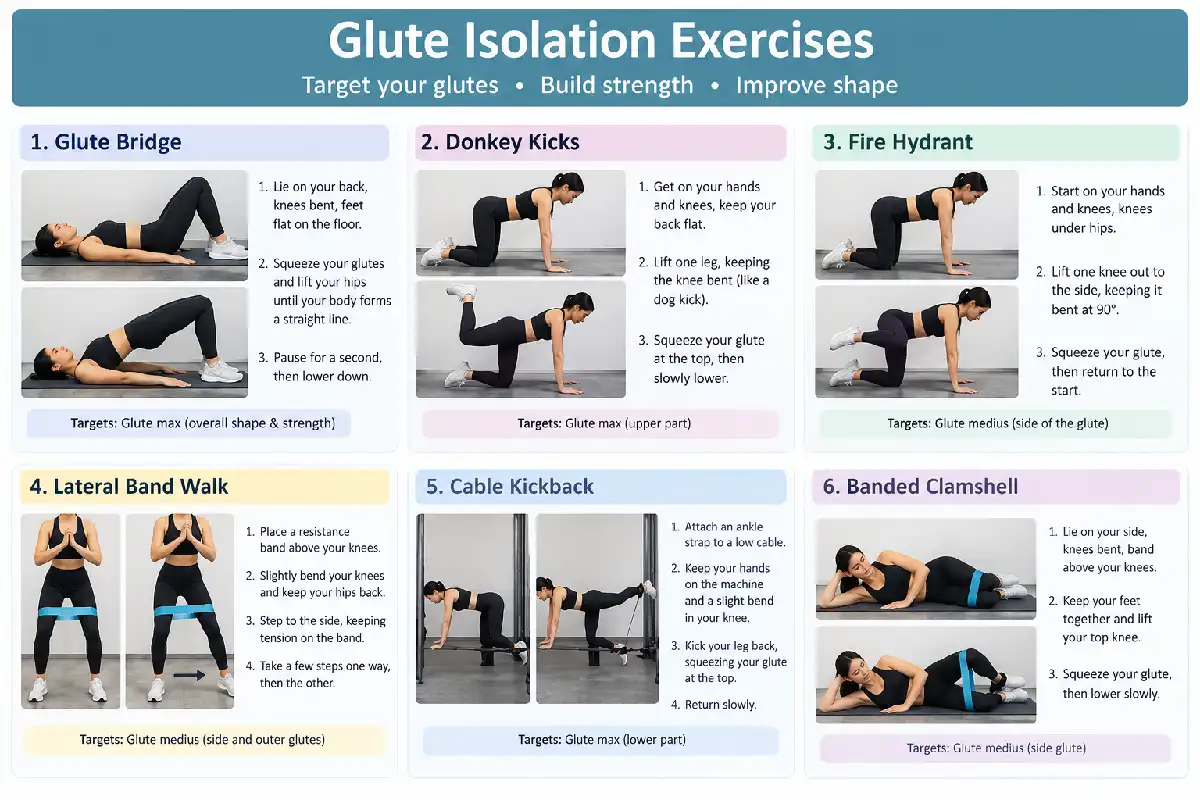
If you want stronger, more developed glutes, compound movements like squats, lunges and deadlifts can be a good option – but they shouldn’t be the only option. Glute isolation exercises enable you to really zone in on the muscles of the glutes without relying on other muscle groups too much.
Including isolation movements in your workout can help you enhance glute activation, increase muscular endurance, correct strength imbalances, and increase volume without over-relying on huge compound lifts.
There are three main muscles that compromise the glutes: the gluteus maximus, gluteus medius, and gluteus minimum. While all three work to mobilise and stabilise the hip there are some differences in what they do.
No matter if you’re hitting a complete gym you’re simply searching for how to do glutes exercises at home, there are many options. You’re able to train your glutes utilizing your own body weight, resistance bands, dumbbells, cable machines, or gym machines.
Here are the top glute isolation exercises, how to do them, how often you should train your glutes, and how to put together a killer glute’s workout.
What Are Glute Isolation Exercises?
Glute isolation exercises are movements designed to place greater emphasis on the glute muscles rather than distributing most of the workload across several major muscle groups.
Unlike compound exercises, which involve multiple joints and muscle groups, isolation movements generally use a simpler movement pattern and allow you to concentrate on contracting the target muscle.
For example, a squat trains the glutes along with the quadriceps, hamstrings, core, and other stabilizing muscles. A glute kickback, on the other hand, is designed to place much more direct emphasis on hip extension and the glutes.
Isolation exercises can be particularly useful when you want to:
- Increase glute training volume
- Improve your mind-muscle connection
- Practice controlled glute contractions
- Strengthen weaker areas
- Add variety to your lower-body workouts
- Train your glutes without lifting extremely heavy weights
- Finish a lower-body workout with targeted exercises
However, isolation exercises don’t necessarily need to replace compound movements. A balanced program can use both.
Considerate the Glute Muscles
Before choosing movements, it helps to understand what you are actually training.
1. Gluteus Maximus
The gluteus maximus is the most superficial of the three Gluck muscles. The glute maximus is the most important for hip postponement. The gluteus maximus is involved in movements like climbing stairs, rising from a sitting position, successively, & jump.
Many glute-focused exercises highlight this muscle.
Examples include:
- Glute bridges
- Hip thrusts
- Cable kickbacks
- Donkey kicks
- Reverse leg lifts
2. Gluteus Medius
This muscle is located on the outer side of the hip. Functions to abduct the hip and to stabilise the pelvis.
Moves that involve abducting the leg away from the midline will highlight this region.
Examples include:
- Side-lying leg raises
- Banded lateral walks
- Standing hip abductions
- Side leg lifts
- Cable hip abductions
3. Gluteus Miniums
The gluteus minimum muscle is one of the three “big glute muscles” The strengths in our body are sorted into a group of around a dozen which work in unison and then other smaller groups.
Aids in abducting and rotating the hip. Also functions in steadying the hips & pelvis.
Since the medius and minimums work together in most motions, an exercise that targets abduction will be able to work both.
Best Glute Isolation Movements
There are many ways to isolate or emphasize your glutes. The right excellent depends on your goals, gear, training experience, and comfort.
Here are some of the most useful options.
1. Glute Kickbacks
Glute kickbacks are extremely easy to perform when targeting the glutes.
You can do these on the floor with your body weight or add confrontation with a group or cable machine.
How to Perform Glute Kickbacks
- Start on your hands and knees.
- Brace your core.
- Keep one knee bent.
- Drive your foot upward and backward.
- Squeeze your glute at the top.
- Slowly return your leg to the starting position.
- Repeat before switching sides.
Avoid swinging your leg or excessively arching your lower back.
Recommended: 10–20 repetitions per side.
2. Hip Thrusts
Hip thrusts are a popular glute-focused exercise that allows you to use substantial resistance while maintaining a relatively straightforward movement pattern.
You can perform them with:
- Body weight
- Dumbbells
- Barbells
- Resistance bands
- Machines
How to Perform a Hip Thrust
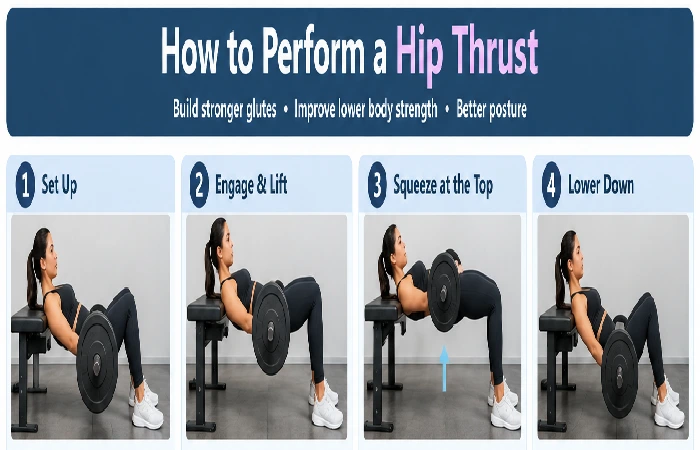
- Sit on the floor with your upper back supported against a stable bench.
- Position the resistance across your hips if using weight.
- Place your feet approximately shoulder-width apart.
- Brace your core.
- Drive through your feet and raise your hips.
- Squeeze your glutes at the top.
- Lower your hips under control.
Keep your ribs controlled and avoid turning the movement into excessive lower-back extension.
Recommended: 8–15 repetitions.
3. Glute Bridges
Glute bridges are an excellent option for beginners and people training at home.
They require little or no equipment, making them one of the easiest glute exercises at home.
How to Perform
- Lie on your back.
- Bend your knees.
- Place your feet flat on the floor.
- Brace your core.
- Push through your feet.
- Raise your hips.
- Squeeze your glutes at the top.
- Lower slowly.
For additional resistance, place a resistance band around your thighs or add a suitable weight across your hips.
Recommended: 12–20 repetitions.
4. Cable Glute Kickbacks
Cable kickbacks are one of the most useful cable glute exercises because the cable provides adjustable external resistance.
Attach an ankle strap to a low cable pulley and move your leg backward while keeping your torso stable.
How to Perform
- Attach an ankle cuff to a low pulley.
- Secure the cuff around one ankle.
- Face the cable machine.
- Hold the machine for balance if necessary.
- Brace your core.
- Move your working leg backward.
- Contract your glute.
- Slowly reappearance to the starting location.
Use a weight that allows you to uphold control through the entire undertaking.
Recommended: 10–15 repetitions per side.
5. Resistance Band Glute Kickbacks
Using resistance bands allows for glute training whenever you don’t have access to a gym.
This one’s definitely one of the most effective glute exercises using a resistance band you can do in your home workout.
Place a loop band around your thighs for some variations or step around the ankles if you prefer, then perform the controlled kickbacks.
Your Aim Should Not Be to Get the Band To The Extent As Much As You Can Move. Emphasize On Tension & Management of the Movement.
6. Side-Lying Leg Raises
Side-lying leg raises highlight the muscles on the outdoor of the hip, primarily the gluteus medius.
How to Perform
- Lie on your side.
- Keep your hips stacked.
- Straighten your upper leg.
- Keep your core engaged.
- Raise the top leg.
- Pause briefly.
- Lower it slowly.
Keep your pelvis stable rather than rolling backward.
Recommended: 12–20 repetitions per side.
7. Banded Lateral Walks
Banded lateral walks are excellent for targeting the strengths responsible for hip abduction.
They’re also useful as share of a warm-up or glute beginning exercises monotonous.
How to Perform
- Place a resistance band around your thighs or ankles.
- Slightly bend your knees.
- Push your hips back slightly.
- Take a controlled step sideways.
- Follow with the other foot.
- Continue for several steps.
- Repeat in the opposite direction.
Don’t allow your knees to collapse inward.
8. Standing Cable Hip Abduction
Cable side glute kickback is another handy cable movement to target the side glutes.
Step 2 Attach the ankle strap to the low pulley and move your leg outward working against the resistance.
Maintian a neutral spine when compensating so that the torso remains still. Do not lean too far.
Recommended: 10–15 controlled repetitions per side.
9. Donkey Kicks
Donkey kicks are a bodyweight exercise that can be done anywhere.
Begin on all fours, then drive one bent leg up towards the ceiling keeping your core engaged and stable.
Additionally, resistance bands can be used in place of the weight to make it harder.
Recommended: 12–20 repetitions per side.
10. Frog Pumps
Frog pump A ‘bodyweight’ glute workout that can be done at home.
FBI uses body positions to identify subjects of interest. Looking to build up your body language for interview room of behaviour of body position …lying – back – in – body … lie on your back with knees bent, keep the soles of your feet pressed together, open up your knees, and lift your hips.
Focus on controlled hip movement, not reaching for full range.
Recommended: 15–30 repetitions.
Best Gluteus Isolation Exercises designed for the Different Goals
Different exercises can highlight different aspects of glute exercise.
| Goal | Exercises |
| Glute max emphasis | Hip thrusts, glute bridges, kickbacks |
| Side glutes | Hip abductions, lateral walks, side leg raises |
| Home workouts | Glute bridges, donkey kicks, frog pumps |
| Resistance bands | Banded kickbacks, lateral walks, banded bridges |
| Cable training | Cable kickbacks, cable hip abductions |
| Learner training | Glute bonds, side leg raises, domestic ass kicks |
| Gym trials | Hip thrusts, cable kickbacks, hip abductions |
Rather than relying on one movement, consider combination exercises that Pullman the glutes done different crusade patterns.
Glute Activation Exercises: What Are They?
Glute activation exercises are usually low-load movements performed to help you establish control & consciousness of your glute muscles before or throughout a workout.
Common examples include:
- Glute bridges
- Banded lateral walks
- Clamshells
- Bodyweight kickbacks
- Side-lying leg raises
- Banded hip abductions
Activation work doesn’t need to exhaust your muscles.
A short start routine can be used before a lower-body test to help you make for heavier actions.
Example 5-Minute Gluteus Activation Monotonous
Perform:
- 15 glute bridges
- 12 side leg raises per side
- 15 banded lateral steps per side
- 12 donkey kicks per side
- 15 banded hip abductions
Perform one or two rounds depending on your workout.
Glute Exercises at Home
You don’t need a gym to train your glutes effectively.
If you are exercising at home, start with bodyweight movements and gradually introduce resistance.
Beginner Home Glute Workout
- Glute Bridges
3 sets × 15 reps - Donkey Kicks
3 sets × 12 reps per side - Side-Lying Leg Raises
3 sets × 15 reps per side - Frog Pumps
3 sets × 20 reps - Bodyweight Glute Kickbacks
2 circles × 15 reps per side
As the exercises develop easier, you can increase recurrences, add resistance bands, slow down the eccentric portion, or use an suitable external weight.
Resistance Band Glute Exercises
Confrontation bands are inexpensive, moveable, and useful for addition resistance to many glute movements.
Some effective resistance band glute exercises include:
- Banded glute bridges
- Banded hip thrusts
- Lateral walks
- Banded kickbacks
- Standing hip abductions
- Banded squats
- Frog pumps with a band
- Clamshells
One advantage of bands is that they can make home training more challenging without requiring large weights.
However, resistance bands are not automatically better than free weights or machines. They are simply another training tool.
Cable Glute Exercises
Cable machines allow you to adjust resistance and perform a variety of targeted movements.
Useful cable glute exercises include:
Cable Kickbacks
Focus on controlled hip extension and squeeze the glute at the end of the movement.
Cable Hip Abductions
Move the leg outward to emphasize the muscles involved in hip abduction.
Cable Pull-Throughs
The Cable pull-throughs involve hip extension and can complement other glute-focused movements.
Cable Reverse Lunges
Although swipes aren’t isolation exercises, cable confrontation can be combined into a broader glute-focused monotonous.
When using chains, order-controlled drive over simply cumulative the weight.
How Many Glute Isolation Exercises Should You Do?
No need to do all the glute exercises in one session
Depending on what else they are exercise, it’s quite possible that between 2 and 4 glute-centric exercises is enough for some folks.
For example:
Glute-Focused Gym Workout
- Hip thrust — 3 × 8–12
- Cable kickback — 3 × 10–15
- Cable hip abduction — 3 × 12–15
- Lined lateral walk — 2 × 15–20 steps per side
Your total training volume must account for other lower-body movements that also work the glutei.
How Often Should You Train Your Glutes?
A good compromise is to perform two or three glute-focused sessions. Most of the peoples are skilled of hitting their glutes more than once a week, as long as they have enough time to recover between a hard session.
Sessions a week, depending on the rest of your package, your experience, the intensity of your workout, & how well you recover.
For example:
Monday: Glutes + lower body
Wednesday: Upper body
Friday: Glutes + lower body
Another option is to add some shorter activation or accessory work on other days as needed to fill out your program.
Recovery is as important as training. With enough sleep, food and rest you will be able to maintain quality for the next.
How to Make Glute Isolation Exercises More Effective
Simply performing an exercise isn’t enough. Your technique and progression matter.
1. Use Controlled Repetitions
Avoid rushing through repetitions.
Control the both lifting & lowering phases.
2. Focus on Full, Comfortable Range of Motion
Move through a variety that you can control without recompensing with other strengths.
3. Increase Resistance Gradually
When an workout becomes consistently easy, reflect adding resistance or recurrences.
4. Avoid Excessive Momentum
Swinging your leg during bribes can make it harder to maintain the envisioned movement.
5. Keep Your Core Stable
A stable torso lets you to focus more effectively on the drive occurring at the hip.
6. Train Consistently
One run won’t dramatically change your physique. Consistent training over time is more important.
Common Mistakes When Performing Glute Isolation Exercises
Even simple movements can become less effective when system breaks down.
Using Too Much Weight
Heavy resistance isn’t useful if you can’t control the movement.
Moving Too Quickly
Fast repetitions can reduce your ability to maintain tension and control.
Arching Your Lower Back
During exercises such as kickbacks, excessive lower-back movement can compensate for limited hip movement.
Ignoring Other Muscle Groups
A glute-focused package should still consider the hamstring tendon, quads, calves, core, & other supporting muscles.
Changing Exercises Too Frequently
Development is easier to track when you achieve key movements reliably for enough time to recover.
Glute Isolation vs. Compound Exercises
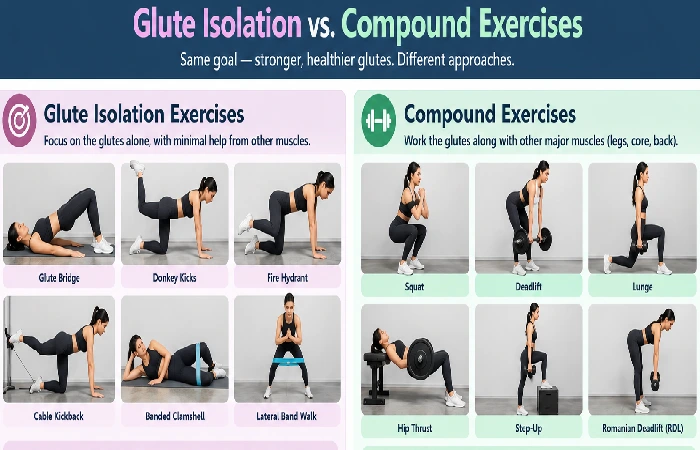
Both isolation and compound exercises can have a place in a well-rounded training program.
| Glute Isolation Exercises | Compound Exercises |
| More targeted | Train multiple muscle groups |
| Usually easier to control | Often allow heavier loads |
| Useful for accessory work | Useful for overall strength |
| Can be performed with lighter resistance | Usually involve several joints |
| Easy to add at the end of workouts | Often placed earlier in workouts |
For the example, you can perform the squat or Romanian deadlift as per the primary movement & then use this cable kickbacks or hip abductions as accessory exercises.
Can Glute Isolation Exercises Build Muscle?
Yes, appropriately programmed resistance training can contribute to muscle growth.
For muscle development, the important factors include:
- Progressive resistance
- Sufficient training volume
- Appropriate exercise selection
- Consistent training
- Adequate nutrition
- Recovery
- Good exercise technique
You don’t need to perform hundreds of repetitions or train your glutes every day.
Instead, focus on gradually improving your training over time.
Glute Isolation Exercises for Beginners
Beginners should start with movements they can perform safely and consistently.
A simple beginner routine could include:
Workout
Glute Bridges
3 × 12–15
Bodyweight Kickbacks
2 × 12–15 each side
Side-Lying Leg Raises
2 × 12–15 each side
Banded Lateral Walks
2 × 10–15 steps each direction
As your forte and coordination improve, you can slowly introduce more confrontation.
Glute Isolation Exercises for Advanced Lifters
Experienced lifters can use a combination of free weights, machines, cables, and groups.
A more advanced session might include:
Hip Thrust
3 × 8–10
Cable Kickback
3 × 10–15
Cable Hip Abduction
3 × 12–15
Machine Hip Abduction
3 × 12–20
Banded Lateral Walk
2 × 15–20 steps per side
Advanced workout should still prioritize technique & liberal overload rather than simply cumulative exercise amount.
FAQ’S
What are the top glute separation exercises?
The best gluteus exercises You can do for a strong bum include: Hip shoves Glute bridges Cable bribes Resistance-band bribes Hip abduction Side-lying leg raises Donkey kicks
Best Actions What exercises are best for you will depend on your gear, experience, & training goals.
Can I do glute isolation exercises at home?
YES. Here are numerous bodyweight exercises that target your glutes. Workouts like glute bridges, donkey kicks, side leg raises, frog pumps, & kickbacks can all be done without any gear.
Resistance bands can provide extra test.
Are glute isolation exercises better than squats?
They serve different purposes. Squats are compound exercises that train multiple muscles, while isolation movements allow you to place more direct emphasis on the glutes.
A program can include both.
How often should I do glute exercises?
Your ideal incidence depends on your overall training program & retrieval. Many people can join dedicated glute training two or 3 times per week.
Are resistance bands effective for glutes?
Resistance groups can provide useful resistance for exercises such as lateral walks, kickbacks, hip abductions, & glute bridges. They can be chiefly suitable for home workouts.
What are the best cable glute exercises?
Cable kickbacks and cable hip abductions are two common choices for targeted glute training. Cable pull-throughs can also be incorporated into a broader glute-focused program.
How long does it take to see glute growth?
Changes in muscle size and forte vary between individuals. Training constancy, genetics, nutrition, retrieval, training experience, and program project can all influence results.
Conclusion
How frequently must I do a glute isolation workout These exercises can be incorporated into your overall leg workout routine & targeted glute exercise. They will help you get a healthier workout of the glute muscles while serving to highlight other compound lifts, such as your squats, lunges, and deadlifts.
Used for the home exercises, begin with actions like gluteus bonds, donkey kicks, side leg raises, and resistance-band work. If you areworking out at the gym, cable kickbacks and hip abduction exercises can be incorporated.
The important thing is to find exercises that you can do with good procedure, gradually increase the intensity, & stay dedicated to your tests.
No matter what you are looking to get out of your training-strength, size, more movement, or just knowledge how to enjoy your glute workout-you will have so many choices to work with when you place a good, balanced program of glute-focused exercises into your routine.