
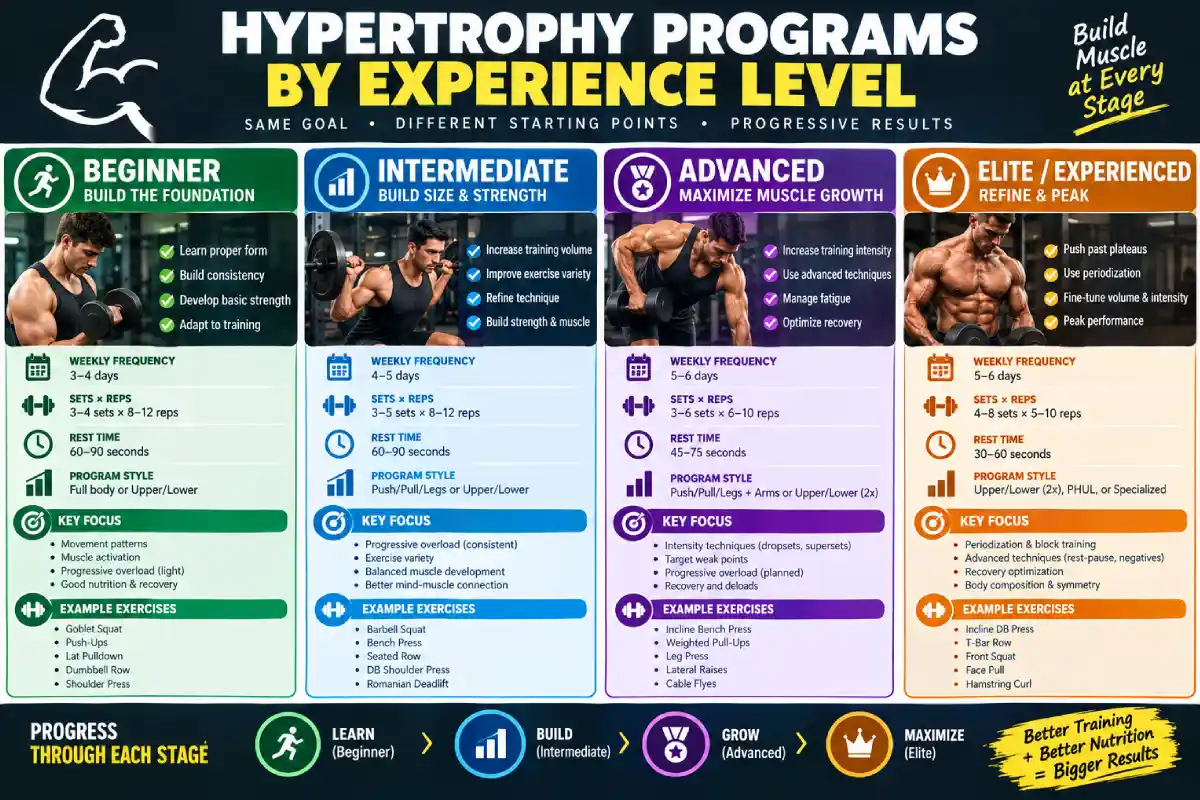
Gaining muscle is not just about copying what an advanced bodybuilder trains. Hypertrophy Programs based on Level of Experience are built based on how long a person has been training for, how well they recover and the appropriate dose of training stimulus they require to continue seeing results. A novice will thrive from just a reasonable training volume, whereas a more advanced athlete will benefit from more structured programming and recovery. Knowing this difference can help you a structure a program that suits your current situation.
What Are Hypertrophy Programs by Experience Level?
Hypertrophy programs by experience level are resistance-training plans tailored to different stages of lifting experience.
These programmes typically adjust:
- Weekly training volume
- Exercise complexity
- Training frequency
- Recovery requirements
- Progression methods
The goal is to provide enough training stimulus for muscle growth without creating unnecessary fatigue.
Why Training Experience Matters
Many people assume that more training always equals more muscle growth. In reality, the amount of training needed changes as experience increases.
Beginner Lifters
Beginners often respond quickly to training because nearly any structured resistance programme provides a new stimulus.
Intermediate Lifters
As adaptation occurs, progress slows. More thoughtful programming becomes necessary.
Advanced Lifters
Advanced trainees usually require greater training precision and recovery management to achieve smaller but meaningful improvements.
Hypertrophy Workout Plan Fundamentals

Regardless of experience level, most hypertrophy programmes share several principles.
Core Training Variables
| Variable | General Recommendation |
| Repetitions | 6–15 reps per set |
| Sets | 2–5 sets per exercise |
| Frequency | 2–6 training days weekly |
| Rest Periods | 60–180 seconds |
| Progressive Overload | Essential |
| Recovery | Essential |
The parameters listed above can be altered relative to one‘s goal, recovery ability, and experience.
Beginner Hypertrophy Program
Novices usually prefer more straightforward training structures where the primary goal is recovery and technique work, aimed at developing consistency.
Recommended Characteristics
- Full-body training
- Basic compound exercises
- Moderate volume
- 3–4 weekly sessions
- Simple progression model
Example Beginner Weekly Plan
| Day | Focus |
| Monday | Full Body |
| Tuesday | Recovery |
| Wednesday | Full Body |
| Thursday | Recovery |
| Friday | Full Body |
| Weekend | Active Recovery |
Benefits
- Easier recovery
- Faster skill development
- Efficient muscle stimulation
- Lower injury risk
Limitations
- Less exercise variety
- Lower overall volume
- May become insufficient after several months
Intermediate Hypertrophy Program
Intermediate hypertrophy program For those who have built regular training habits and have a basic level of strength.
At this stage, training volume and exercise selection often expand.
Typical Characteristics
- Increased weekly volume
- More exercise variety
- Planned progression
- Muscle-group specialisation
Example 4 Day Hypertrophy Program
A 4 day hypertrophy program is one of the most popular options for intermediate lifters.
| Day | Focus |
| Monday | Upper Body |
| Tuesday | Lower Body |
| Wednesday | Rest |
| Thursday | Upper Body |
| Friday | Lower Body |
| Weekend | Recovery |
Advantages
- Balanced recovery
- Effective training frequency
- Suitable for many schedules
- Supports long-term progression
Potential Drawbacks
- Requires more recovery than beginner plans
- May demand greater nutritional support
4 Day Hypertrophy Program vs Full Body Training
| Factor | Full Body Plan | 4 Day Split |
| Experience Level | Beginner | Intermediate |
| Weekly Frequency | 3 Days | 4 Days |
| Recovery Demand | Lower | Moderate |
| Exercise Variety | Moderate | Higher |
| Time Commitment | Lower | Moderate |
| Muscle Group Focus | General | More Specific |
Both approaches can support muscle growth when applied consistently.
Advanced Hypertrophy Training
An advanced hypertrophy program is generally recommended for individuals who are more advanced weightlifters and have been training with more consistency for a number of years:
At this level, progress usually becomes slower and more difficult to achieve.
Typical Characteristics
- High training volume
- Detailed progression systems
- Recovery monitoring
- Exercise periodisation
- Individual weak-point training
Common Goals
- Bringing up lagging muscle groups
- Improving symmetry
- Maximising muscle development
- Managing fatigue effectively
Important Consideration
Advanced training often requires more recovery attention than beginners realise. More volume is not automatically better if recovery cannot support it.
5 Day Hypertrophy Program
Many experienced trainees use a 5 day hypertrophy program to increase training volume while maintaining manageable session lengths.
Example Weekly Structure
| Day | Focus |
| Monday | Chest & Triceps |
| Tuesday | Back & Biceps |
| Wednesday | Legs |
| Thursday | Shoulders |
| Friday | Arms & Accessories |
| Weekend | Recovery |
Benefits
- Higher volume opportunities
- Greater muscle-group focus
- More exercise variety
- Flexible exercise selection
Limitations
- Increased recovery demands
- Greater scheduling commitment
- May not suit busy lifestyles
Comparison of Hypertrophy Programs by Experience Level
| Factor | Beginner | Intermediate | Advanced |
| Weekly Sessions | 3–4 | 4–5 | 5–6 |
| Training Volume | Low–Moderate | Moderate | High |
| Exercise Complexity | Basic | Moderate | Advanced |
| Recovery Requirements | Lower | Moderate | Higher |
| Progression Speed | Fast | Moderate | Slower |
| Programme Flexibility | Simple | Moderate | High |
This comparison highlights why training plans should evolve alongside experience.
Hypertrophy Programme Selection Workflow
Step 1: Assess Your Training History
Consider how long you have consistently trained.
Step 2: Evaluate Recovery Capacity
Assess sleep quality, nutrition, stress levels, and schedule demands.
Step 3: Choose Appropriate Frequency
Select a programme that fits your available time and recovery ability.
Step 4: Track Progress
Monitor strength gains, body measurements, and training performance.
Step 5: Adjust Gradually
Increase volume or complexity only when current training no longer produces results.
Recovery and Nutrition Considerations
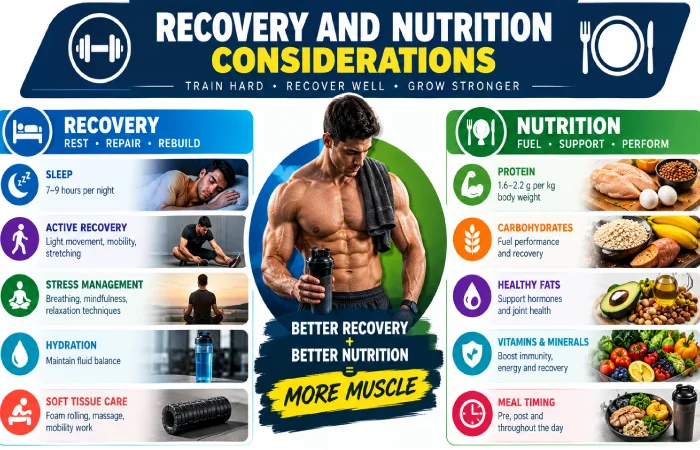
Training programmes work best when supported by proper recovery.
Prioritise:
- Adequate protein intake
- Sufficient calories
- Hydration
- Sleep quality
- Stress management
Recovery requirements generally increase alongside training volume.
Realistic Expectations for Muscle Growth
One of the most important aspects of hypertrophy training is managing expectations.
Beginner Stage
Often sees the fastest improvements.
Intermediate Stage
Progress continues but becomes more gradual.
Advanced Stage
Small improvements can represent significant achievement.
Typical Progress Expectations
| Experience Level | Expected Progress Rate |
| Beginner | Relatively Fast |
| Intermediate | Moderate |
| Advanced | Slower but Ongoing |
Common Mistakes When Choosing a Programme
Choosing Advanced Plans Too Early
Many beginners attempt programmes designed for experienced lifters.
Ignoring Recovery Capacity
Training volume should match recovery ability.
Constant Programme Switching
Frequent changes can make progress difficult to measure.
Copying Someone Else’s Routine
The best programme is usually the one that matches your current level and goals.
Frequently Asked Questions
What are hypertrophy programs by experience level?
These programs are the musclebuilding type that are based on your training experience, recovery ability and progression requirements. Beginners, intermediate and advanced lifters usually differ.
Is a 4 day hypertrophy program effective?
4 day hypertrophy programs are perhaps the most popular routine after the 3 day program1p7. It is for this reason that 4 day program allows more training volume to be accumulated with a short rest time.
What is an intermediate hypertrophy program?
An intermediate hypertrophy routine typically involves more volume, variation and progression methods than they would for a beginning program
Who should use advanced hypertrophy training?
Most advanced hypertrophy training is best suited for experienced lifters with established training traditions and good recovery habits.
Is a 5 day hypertrophy program better than a 4 day plan?
Not necessarily. The better option depends on recovery ability, available time, and training goals.
Conclusion
Hypertrophy Programmes by Experience Level will ensure training volume, frequency and recovery demands are appropriate for your current level of development. Beginners can often use a simple full-body program, while a 4 day hypertrophy program can increase volume and structure for an intermediate hypertrophy program. More advanced lifters may use a more advanced hypertrophy program or a 5 day hypertrophy program to avoid stagnation. Choosing an appropriate programme and setting expectations accordingly can enable long term hypertrophy.