

The type of Hypertrophy Exercises employed, training frequency, rest and workout structure can all affect your ultimate muscle growth journey. Exploring this guide to Hypertrophy Exercises & Workout Splits should help you to develop a more balanced and sustainable muscle growth program with less fear of overtraining. Regularly training three days a week or six, selecting the most effective exercises and workout split can help make your training systematised and efficient.
Why Exercise Selection Matters for Hypertrophy
Not all exercises provide the same training stimulus.
The most effective hypertrophy programmes usually include:
- Multi-joint compound exercises
- Single-joint isolation exercises
- Progressive overload strategies
- Balanced weekly training volume
It‘s not just about doing more; it‘s about selecting movements that harden and condition a bit while affording sufficient recuperation.
Best Exercises for Hypertrophy
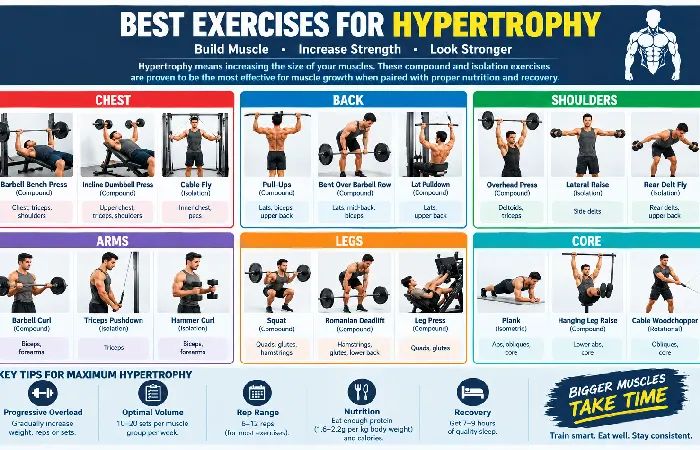
The most effective hypertrophy exercises are those which allow both progressive loading, high muscle activation and maintaing the same movement pattern.
Lower Body Exercises
- Squats
- Romanian Deadlifts
- Leg Press
- Walking Lunges
- Bulgarian Split Squats
Upper Body Exercises
- Bench Press
- Incline Dumbbell Press
- Pull-Ups
- Barbell Rows
- Overhead Press
Core Exercises
- Hanging Leg Raises
- Cable Crunches
- Planks
- Ab Wheel Rollouts
These exercises form the foundation of many muscle-building programmes.
Compound Exercises for Hypertrophy
What Are Compound Exercises?
Compound exercises for hypertrophy involve working with many joints and muscle groups.
Examples include:
| Exercise | Primary Muscles Worked |
| Squat | Quadriceps, Glutes, Core |
| Deadlift | Hamstrings, Glutes, Back |
| Bench Press | Chest, Shoulders, Triceps |
| Pull-Up | Lats, Biceps, Upper Back |
| Overhead Press | Shoulders, Triceps |
Benefits of Compound Exercises
- Efficient training sessions
- Greater total workload
- Improved strength development
- Easier progression tracking
Limitations
- Higher recovery demands
- Greater technical requirements
- Increased fatigue compared with isolation movements
Compound exercises often serve as the foundation of hypertrophy programmes.
Isolation Exercises for Hypertrophy
What Are Isolation Exercises?
Isolation exercises for hypertrophy focus primarily on a single muscle group.
Examples include:
- Bicep Curls
- Tricep Pushdowns
- Leg Extensions
- Leg Curls
- Lateral Raises
- Calf Raises
Benefits of Isolation Work
- Target specific muscles
- Address weak points
- Add training volume without excessive fatigue
- Improve muscle symmetry
Limitations
- Less overall workload than compound lifts
- Typically lower calorie expenditure
Most successful programmes use a combination of both exercise types.
Hypertrophy Workout Split Explained
A hypertrophy workout split determines how training is organised throughout the week.
The best split is usually the one that allows:
- Consistent attendance
- Adequate recovery
- Appropriate weekly volume
- Progressive overload
There is no universally perfect workout split.
Push Pull Legs Hypertrophy Split
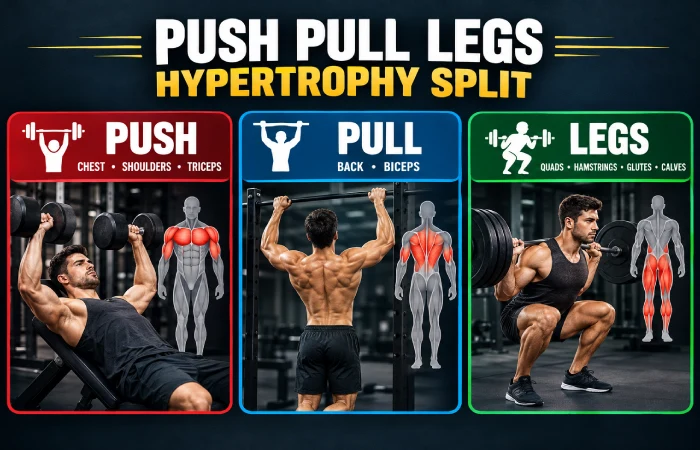
The push pull legs hypertrophy approach is one of the most popular training structures.
Push Day
Focuses on:
- Chest
- Shoulders
- Triceps
Example exercises:
- Bench Press
- Incline Press
- Overhead Press
- Tricep Extensions
Pull Day
Focuses on:
- Back
- Rear Delts
- Biceps
Example exercises:
- Pull-Ups
- Rows
- Face Pulls
- Bicep Curls
Leg Day
Focuses on:
- Quadriceps
- Hamstrings
- Glutes
- Calves
Example exercises:
- Squats
- Romanian Deadlifts
- Lunges
- Calf Raises
Advantages
- Balanced workload
- High exercise variety
- Suitable for intermediate and advanced lifters
Limitations
- Usually requires more weekly training days
- Recovery management becomes increasingly important
Upper Lower Hypertrophy Split
The upper lower hypertrophy split divides workouts into upper-body and lower-body sessions.
Upper Body Day
Includes:
- Chest
- Back
- Shoulders
- Arms
Lower Body Day
Includes:
- Quadriceps
- Hamstrings
- Glutes
- Calves
Sample Weekly Schedule
| Day | Workout |
| Monday | Upper Body |
| Tuesday | Lower Body |
| Wednesday | Rest |
| Thursday | Upper Body |
| Friday | Lower Body |
| Saturday | Rest |
| Sunday | Rest |
Advantages
- Suitable for beginners and intermediates
- Easier recovery management
- Balanced muscle frequency
Limitations
- Longer workout sessions
- Less exercise variety than some higher-frequency splits
Popular Hypertrophy Workout Splits
| Workout Split | Weekly Frequency | Recovery Demand | Suitable For |
| Full Body | 2–4 Days | Moderate | Beginners |
| Upper Lower | 4 Days | Moderate | Beginners to Intermediate |
| Push Pull Legs | 5–6 Days | High | Intermediate to Advanced |
| Body Part Split | 5 Days | Moderate | Experienced Lifters |
Each option can support muscle growth when training volume and recovery are appropriately managed.
Sample Hypertrophy Training Workflow
Step 1: Select Your Workout Split
Choose:
- Full body
- Upper lower
- Push pull legs
Step 2: Build Around Compound Movements
Prioritise:
- Squats
- Rows
- Presses
- Deadlifts
Step 3: Add Isolation Exercises
Include:
- Bicep curls
- Tricep work
- Lateral raises
- Calf exercises
Step 4: Track Progress
Monitor:
- Repetitions
- Sets
- Training loads
Step 5: Adjust Over Time
Increase:
- Weight
- Repetitions
- Training volume when appropriate
Performance Expectations
Many people expect rapid muscle growth after starting a new programme.
Realistically:
First Few Weeks
You may notice:
- Better exercise technique
- Improved coordination
- Initial strength increases
Several Months
Possible outcomes include:
- Increased muscle size
- Improved body composition
- Better training performance
Important Limitations
Results depend on:
- Genetics
- Nutrition
- Sleep
- Recovery
- Consistency
Even the best workout split cannot compensate for poor recovery habits or inconsistent training.
Common Mistakes to Avoid
Choosing Too Many Exercises
More exercises do not always mean better results.
Ignoring Recovery
Muscles require recovery to adapt and grow.
Programme Hopping
Constantly changing workout structures can make progress difficult to track.
Neglecting Compound Movements
Compound exercises often provide the foundation for efficient hypertrophy training.
Skipping Isolation Work
Isolation exercises can help address weaknesses and improve muscular balance.
Frequently Asked Questions
What are the best exercises for hypertrophy?
The most effective hypertrophy exercises are often thought to be multi-joint movements such as the squat, rowing, pressing and pulling.
Is a push pull legs hypertrophy split effective?
Yes. A push pull legs hypertrophy programme can facilitate muscle growth if training volume, recovery and progression is implemented appropriately.
What is the difference between compound and isolation exercises for hypertrophy?
The compound exercises work multiple muscle groups; the isolation exercises focus on one set muscle.
Is an upper lower hypertrophy split good for beginners?
I have noticed that many beginners find lower splits very effective because upper lower splits provide a balanced frequency and manageable recovery demands.
What is the best hypertrophy workout split?
The most effective hypertrophy training split is the one that you can stick to and at the same time allow your body to rest and recover while maintaining the stimulation for progressive overload.