
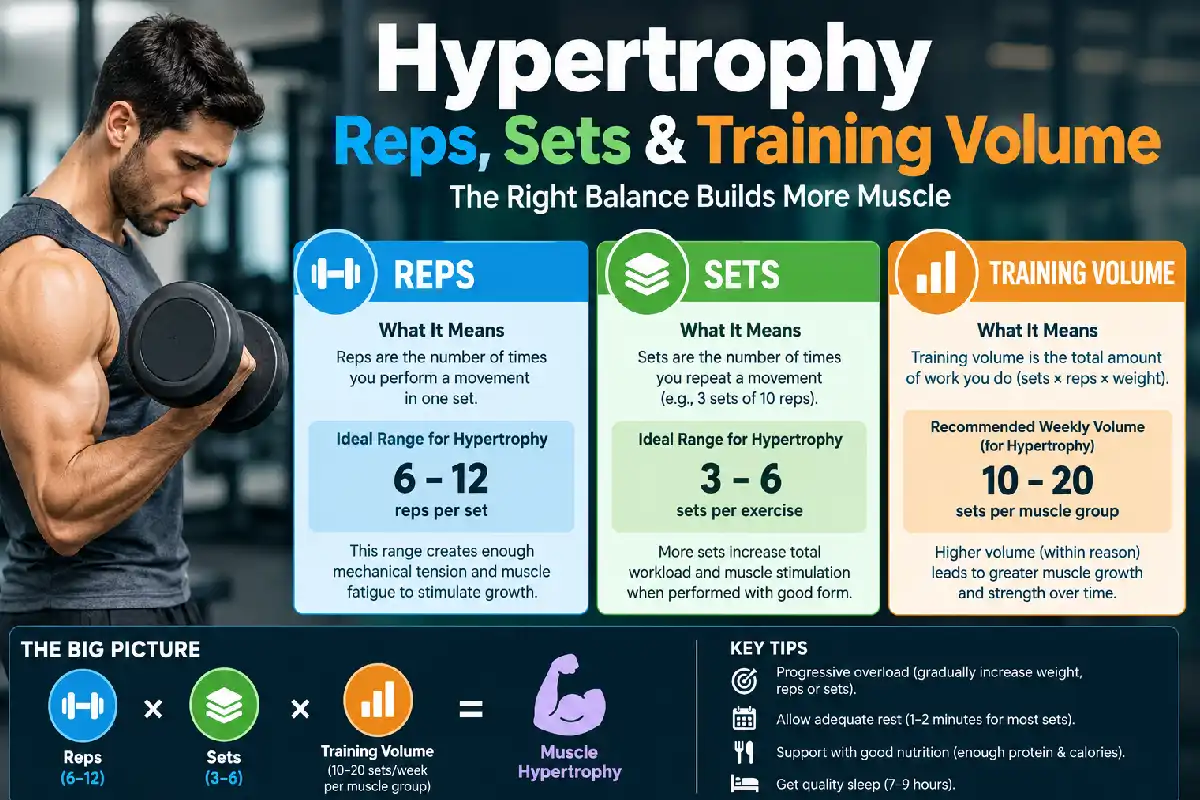
Muscle building is not just doing reps with weights. Your rep number, training volume and intensity will all affect your ability to build muscle and know about Hypertrophy Reps, Sets & Training Volume will help you tailor your program to prevent mistakes. So whether you are a beginner or an advanced lifter, it is crucial to take this into account and be aware of the workload and recovery ratio.
What Is Hypertrophy Training?
Hypertrophy training emphasizes the increase in size of muscle fibres through repetitive resistance training. In contrast to a strength or power or athletic training programme this type of a programme is aimed at muscle hypertrophy.
Key factors include:
- Training volume
- Rep ranges
- Exercise selection
- Recovery
- Nutrition
- Progressive overload
No single variable works alone. The best results usually come from combining these elements consistently over weeks and months.
Understanding the Hypertrophy Rep Range
One of the most discussed topics in muscle building is the ideal hypertrophy rep range.
It appears that there is no strictly defined rep range in which muscles can grow as long as there is intensity within the sets.
Common Rep Ranges
| Goal | Typical Reps Per Set |
| Maximal Strength | 1–5 |
| Strength & Size | 5–8 |
| Hypertrophy | 6–15 |
| Muscular Endurance | 15+ |
Most lifters will do the majority of their hypertrophy work in the 6 12 rep area, as this produces a relatively even combination of both mechanical tension and total training volume.
However, higher and lower rep ranges can also contribute to muscle growth when programmed appropriately.
Sets for Muscle Growth: How Many Do You Need?
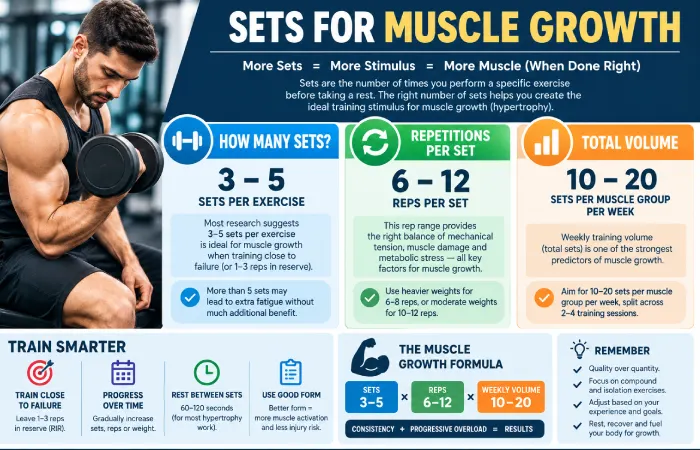
The number of sets for muscle growth affects the total stimulus your muscles receive.
General Guidelines
| Experience Level | Weekly Sets Per Muscle Group |
| Beginner | 8–12 |
| Intermediate | 10–18 |
| Advanced | 12–20+ |
These recommendations represent starting points rather than strict rules.
Factors that influence optimal set volume include:
- Recovery ability
- Training age
- Sleep quality
- Nutrition
- Exercise intensity
Adding more sets does not always produce better results. Excessive volume can eventually reduce recovery quality and training performance.
Training Volume for Hypertrophy Explained
What Is Training Volume?
Training volume for hypertrophy generally refers to the total amount of work performed.
A simple calculation is:
Sets × Reps × Weight Lifted
For example:
- 4 sets
- 10 reps
- 60 kg
Total volume = 2,400 kg
Although volume calculations can be useful, most lifters benefit more from tracking:
- Weekly sets per muscle group
- Exercise performance
- Recovery quality
Why Volume Matters
Training volume contributes to:
- Muscle stimulation
- Skill development
- Progressive overload opportunities
However, there is a point where additional volume produces diminishing returns.
Reps for Muscle Growth: Which Range Works Best?
Lower Reps (5–8)
Benefits:
- Heavier loads
- Strength development
- High mechanical tension
Limitations:
- Lower total repetitions
- Greater joint stress for some individuals
Moderate Reps (8–12)
Benefits:
- Traditional muscle-building range
- Balanced workload
- Easy progression tracking
Limitations:
- Not automatically superior to other ranges
Higher Reps (12–20)
Benefits:
- Increased metabolic stress
- Useful for isolation exercises
- Reduced joint loading
Limitations:
- Greater discomfort during sets
- Longer time under tension
The best approach often includes a mix of rep ranges across different exercises.
Rest Time for Hypertrophy
Why Rest Periods Matter
Appropriate rest time for hypertrophy allows muscles to recover enough to perform productive sets.
General Recommendations
| Exercise Type | Rest Time |
| Heavy Compound Exercises | 2–3 minutes |
| Moderate Compound Exercises | 1–2 minutes |
| Isolation Exercises | 30–90 seconds |
Examples:
- Squats: 2–3 minutes
- Bench Press: 2–3 minutes
- Bicep Curls: 45–90 seconds
- Lateral Raises: 30–60 seconds
Short rest periods are not always better. Excessively short recovery times may reduce performance and total training volume.
Hypertrophy Intensity: How Hard Should You Train?
Understanding Hypertrophy Intensity
Hypertrophy intensity indicates the difficulty of a set compared to one‘s maximum.
A common strategy is finishing sets with:
- 1–3 repetitions in reserve (RIR)
- Near-muscular failure on selected exercises
Signs of Appropriate Intensity
- Final repetitions feel challenging
- Technique remains controlled
- Performance improves over time
Signs Intensity May Be Too High
- Constant fatigue
- Declining performance
- Persistent soreness
- Increased injury risk
Finding the right balance is essential for long-term progress.
Sample Hypertrophy Training Workflow
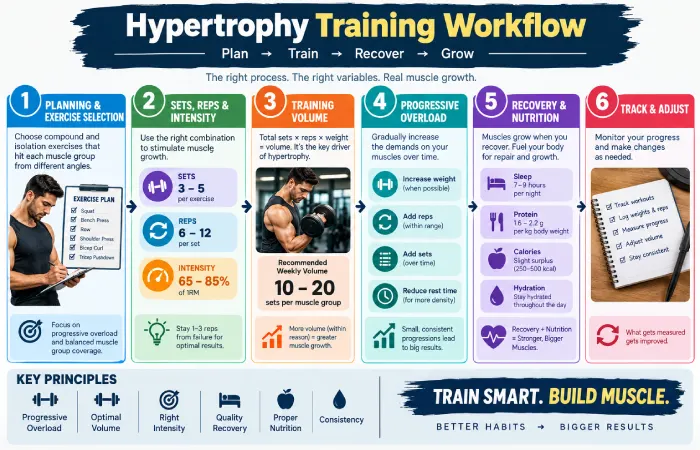
Step 1: Choose Exercises
Include:
- Squats
- Bench Press
- Rows
- Deadlifts
- Overhead Press
Step 2: Select Rep Range
Use:
- 6–10 reps for compound lifts
- 10–15 reps for isolation exercises
Step 3: Set Weekly Volume
Aim for:
- 10–20 weekly sets per muscle group
Step 4: Manage Recovery
Prioritise:
- Sleep
- Nutrition
- Hydration
Step 5: Apply Progressive Overload
Gradually increase:
- Weight
- Repetitions
- Sets
- Training quality
Different Hypertrophy Approaches
| Training Style | Rep Range | Volume | Recovery Demand |
| Low Rep Hypertrophy | 5–8 | Moderate | High |
| Traditional Hypertrophy | 8–12 | Moderate to High | Moderate |
| High Rep Hypertrophy | 12–20 | High | Moderate |
| Mixed Rep Training | 5–20 | Flexible | Moderate |
Each approach can support muscle growth when applied consistently.
Performance Expectations
Many people expect dramatic muscle growth within a few weeks.
Realistically:
During the First Month
You may notice:
- Improved technique
- Better workout performance
- Initial strength gains
After Several Months
Possible outcomes include:
- Increased muscle size
- Improved body composition
- Greater training capacity
Important Limitations
Muscle growth depends on:
- Genetics
- Nutrition
- Sleep
- Recovery
- Consistency
No rep range or volume strategy can overcome poor recovery habits.
Common Mistakes to Avoid
Doing Too Much Volume
More is not always better.
Ignoring Recovery
Muscles grow between workouts, not during them.
Constantly Changing Programmes
Frequent programme hopping can limit progress.
Training Too Light
Sets should be challenging enough to stimulate adaptation.
Training Too Heavy All the Time
Excessive intensity can reduce recovery quality.
Frequently Asked Questions
What rep range is optimal for hypertrophy?
The beginner to intermediate programmes tend to be around 6–12 reps, but bodybuilding is possible over a greater range of reps, if intensity and volume are balanced well.
What number of sets should I do for muscle growth?
Most will get by with 10–20 sets a week per muscle group, that is.
What is training volume for hypertrophy?
Training volume refers to the total amount of work performed through sets, repetitions, and load.
What is the rest period for hypertrophy?
Nearly all compound exercises, there should be a rest period of 1–3 minutes, while on isolation exercises there should be a significantly smaller recovery period.
How relevant is the intensity of hypertrophy?
Hypertrophy intensity is simply significant because one should not enter sets that are so hard that it compromises recovery.
Conclusion
Understanding Hypertrophy Reps, Sets & Training Volume will lead to a structured method in muscle development. The optimal hypertrophy rep range, sets for hypertrophy and training volume for hypertrophy will depend on the individual however good programmes are built around the principles of progressive overload, the right intensity, an adequate amount of recovery and a dedicated effort. Don‘t look for shortcuts, have a long term perspective on your progression and you will find that improvements can be more sustainable.