

Practicing musclebuilding? This is the time you want to use the phrase Hypertrophy Training Fundamentals instead of work harder goldenrule. Hypertrophy training is setting up a predictable stimulus to the muscle, using sets, intensity, exercise choice, and overtraining in a way that is still manageable for the muscles to recover. In India, as a lot of beginners get stuck because they are training in a haphazard manner and following random workout programs or “think muscle gain is just about lifting heavier”. It isn‘t. Muscle building is a science – with mechanics, standards of effort and time frames.
What is hypertrophy training?
Hypertrophy training is resistance training designed to increase muscle size. Instead of focusing purely on strength (max force), the main emphasis is on:
- sufficient training volume (enough hard sets)
- appropriate intensity/effort (working close enough to muscular failure)
- consistent progression over time
- exercises that reliably load the target muscles
Muscle hypertrophy explained (What actually changes)

Muscle hypertrophy means an increase in the size of muscle fibres. At a high level, your training creates:
- mechanical tension (the muscle has to work against a load)
- metabolic stress (a “burn” from repeated hard work—helpful, but not the only factor)
- enough overall stimulus to trigger cellular adaptation
But hypertrophy is not instantaneous. You are not “blowing up” for one day, and that‘s it. You‘re creating more space, for weeks and weeks. Realistic expectation: most beginners will see major changes within c. 8–12 weeks while training hard, having sufficient protein and sleeping. Gains in strength usually come a little faster than gains in size at first, but they tend to happen at the same rate.
Hypertrophy vs strength training
People often treat these as opposites, but they’re closely related.
- Strength training prioritises maximising force (often heavier loads, lower reps, longer rest, fewer total sets).
- Hypertrophy training prioritises maximising muscle growth stimulus (often moderate reps, manageable rest, and more total quality sets).
Key difference in practice
In hypertrophy training, you will generally be going for sets that are difficult for the active muscle group most of your sets will end with an RIR of about 0–3 for most of your “working sets”. This doesn‘t mean every set has to be a maximal effort, but it does mean that you‘re not usually working hard just to survive.
How hypertrophy works (The “inputs” that matter)
Think of hypertrophy training as four building blocks:
1) Training volume (hard sets)
More quality work generally helps—up to a point. For beginners, you don’t need extremely high volume, but you do need enough weekly hard sets per muscle group.
2) Intensity / effort (how hard each set is)
Effort matters because it helps create the stimulus. A set that feels easy doesn’t give the muscle a reason to adapt.
3) Progressive overload (gradually increasing something)
Progress can mean:
- more reps at the same weight
- slightly heavier weights
- better form that improves how the target muscle is loaded
- adding one extra set per week (carefully)
4) Recovery and consistency
Rest, sleep and food: Your muscles relax when you relax, when you sleep, and when you feed yourself you become a different person from when you‘re training. If you‘re always sore and not getting fitter, you‘re doing too much intensity, not enough recovery, or not alternating things enough.
Hypertrophy training for beginners A realistic starting plan
If you are beginning, your goal is to learn the movement patterns that constitute the exercise and to develop a simple routine that you can perform over and over again.
Beginner priorities
- Choose 2–4 movements per major muscle group (not 10).
- Keep technique stable (especially on compounds like squats, hinges, presses, and rows).
- Track performance in a simple way (reps/weight or reps-only).
- Stay consistent for at least 8–12 weeks before judging results.
Suggested effort approach
A practical target:
- Most sets: stop with ~1–3 reps in reserve
- Some sets (especially later in workouts): may go closer to failure
- Avoid constant max-effort every session, because fatigue can quietly sabotage progression
Muscle growth training principles (What to do week to week)
Below are principles that help your training feel structured rather than random.
Exercise selection: load muscles directly
A mix of:
- compound movements (e.g., squat/leg press, bench/push-up, row/pull-down)
- isolation movements (e.g., curls, lateral raises, triceps extensions)
Isolation work helps you focus on specific muscles when compounds don’t fully target them.
Range of motion: train through a safe, effective arc
Full or near-full ranges of motion are frequently effective training for hypertrophy, assuming proper technique is maintained and you keep the eccentric phase under control.
Tempo and control
Don’t turn your lifting into cardio. Focus on:
- controlled lowering
- stable, consistent rep speed
- avoiding momentum where it doesn’t help
Rest periods
For hypertrophy, rest often falls roughly between 60–120 seconds for most exercises, with longer rest for heavier compound lifts if needed for quality reps.
Weekly frequency
Often, 2 sessions per week per muscle group is a strong starting point for beginners and intermediates. Some people do better with 3 sessions, but the “right” frequency depends on recovery.
Hypertrophy Training vs Strength Training
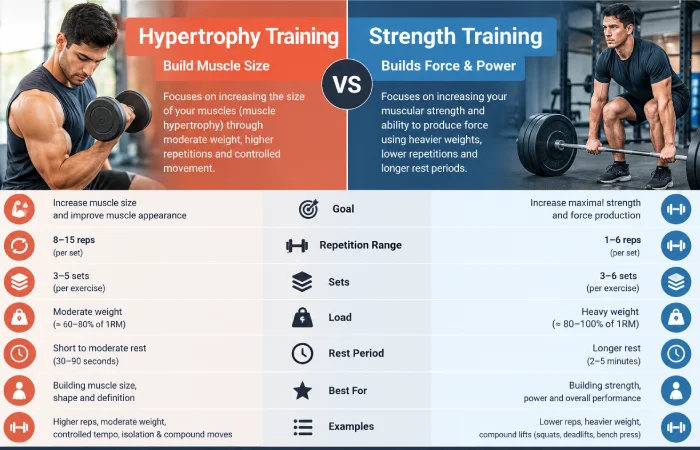
| Category | Hypertrophy Training | Strength Training |
| Primary goal | Muscle size | Max force / performance |
| Typical rep range | Often ~6–15 (varies) | Often ~1–6 (varies) |
| Rest time | Often ~60–120 sec | Often longer (especially for heavy sets) |
| Effort level | Commonly 0–3 RIR on many working sets | Often close to failure on top sets, but fewer overall “hard sets” |
| Progression focus | Reps/weight across more sets | Top-end weight and technique under heavier loads |
| Best for | People wanting visible body composition changes | Powerlifters/athletes needing maximal strength |
At-a-glance expectations management (So you don’t get misled)
What hypertrophy training can do:
- help increase muscle size and strength together
- improve shape, posture, and overall conditioning
What it cannot do:
- produce instant results
- work equally well if you skip recovery or under-eat protein
- guarantee the same visual timeline for everyone (genetics, sleep, stress, starting point)
Common reasons progxress stalls:
- no progressive overload (weights/reps never move)
- too few weekly hard sets
- low effort (sets feel easy)
- inconsistent schedule or poor sleep
- not enough protein or overall calories (if you’re trying to gain muscle)
Workflow section: How to build a hypertrophy plan (Simple step-by-step)
- Pick your muscles and frequency
Start with a whole-body or upper/lower split you can sustain 3–4 days/week. - Choose exercises
For each muscle group, select:- 1–2 compounds
- 1 isolation (optional for beginners, but useful)
- Set your weekly volume target
Start with something manageable (e.g., around 8–12 hard sets per week per muscle as an approximate starting point), then modify according to how you recover. - Use an effort rule
Most sets: finish around 1–3 RIR. Avoid turning every session into a maximum-effort day. - Progress every 1–2 weeks
Aim to add reps first, then add weight once you reach the top of your rep range for that exercise. - Review and adjust
If performance isn’t improving after 3–4 weeks, reduce unnecessary exercise changes and focus on volume + effort consistency.
Muscle growth training principles (Quick practical example)
Let’s say you train chest twice per week. A beginner-friendly structure could look like:
- Bench press or dumbbell press: 3 sets of 6–10 reps
- Incline press or push-ups: 2 sets of 8–12 reps
- Cable fly / dumbbell fly: 2 sets of 10–15 reps
If those sets stop feeling challenging, progression might mean:
- adding 1–2 reps per set over time
- then increasing weight while keeping the rep targets
FAQ
1) How many days per week should I train for hypertrophy?
Good beginner starting point. 3-4 days per week, each major muscle group(s) 2 times a week! You can do more as you get the hang of it. Just think in terms of consistency and recovery are what matter more than gym “max days”.
2) Should I train to failure for muscle growth?
You don’t need to train to failure every set. Many hypertrophy programmes include some sets close to failure (often within a few reps), but using failure too often can increase fatigue and reduce long-term progress.
3) What’s more important: volume or intensity?
Both matter. Volume provides the opportunity to build stimulus, and the effort/intensity ensures the stimulus is significant. If you want to choose a short-term fix, up the quality of effort (more traditional working sets) and that usually produces results more quickly than adding in pointless additional exercises.4) How long does it take to see muscle growth?
With regular training and decent protein + sleep, a significant majority of beginners may notice changes relatively early on at 8–12 weeks. Larger, more impressive changes may take many more months.
5) Can I do hypertrophy training at home without equipment?
Certainly, but it will be tougher and thus progress will be slower. Some options available are resistance band/ adjustable dumbbell/your body DIY versions (push-up progression, split squat/drag, weighted carries, etc.). The only rule is a few-to-many principle.
Conclusion:
Hypertrophy Training is effective when you have enough quality hard sets, work hard consistently, and keep progressing, and still give yourself ample time to recover. That‘s all there is to it it‘s not about complicated training routines or 100% maxes every workout. If you‘re new, try to build a plan you can stick to for month, we can monitor progress and make small changes. Building muscle is a long-term affair, but it can be fairly simple if you don‘t over-complicate.