
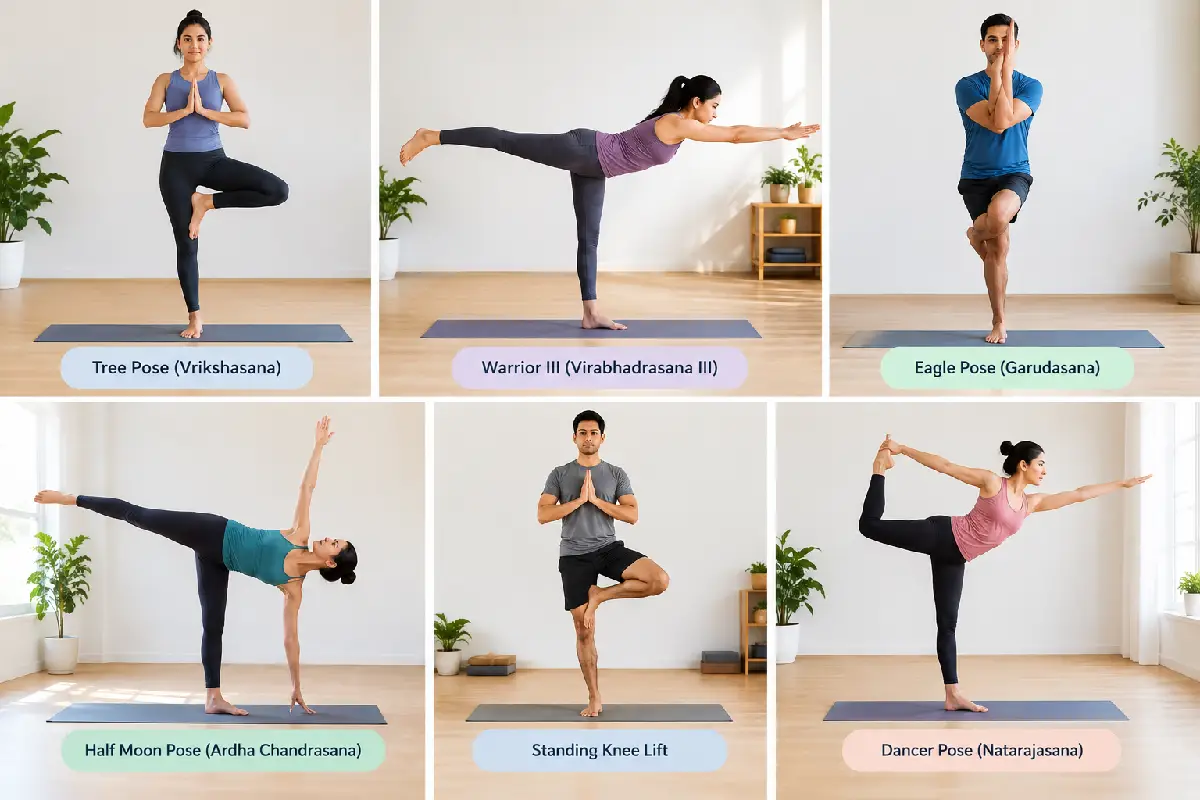
Balance is a part of fitness but it is often missed by new people. Doing Yoga Balance Poses for Beginners can help make posture, better coordination better focus and more awareness of the body. Other types of workouts focus on strength but balance training makes you use muscle groups while thinking about each movement.
The good news is that you don’t have to be flexible or have lots of yoga experience to start. Many easy poses, for beginners can be done at home with some space and maybe a mat.
Why Balance Matters in Yoga
Balance is more than standing on one leg. It requires cooperation between your muscles, joints, vision, and nervous system.
Potential benefits include:
- Better body awareness
- Improved posture
- Enhanced coordination
- Increased concentration
- Greater lower-body strength
- Better movement confidence
Beginner Yoga Balance Poses: What to Expect
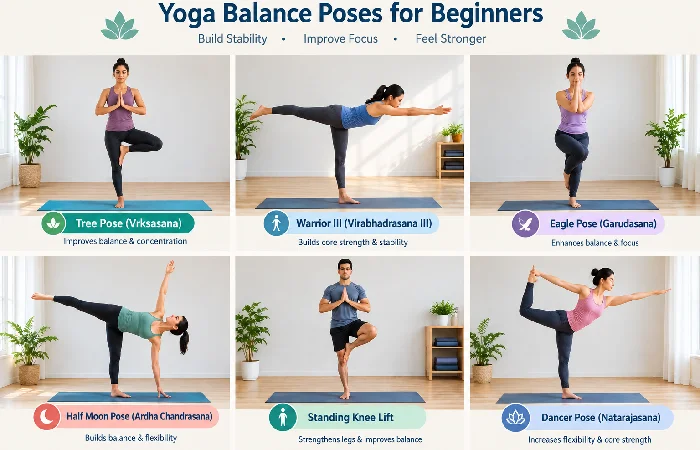
Realistic Expectations
| Timeframe | What You May Notice |
| 1–2 weeks | Improved awareness of posture |
| 3–4 weeks | Better stability in simple poses |
| 1–2 months | Increased confidence during balancing exercises |
| 3+ months | Improved coordination and control |
Essential Beginner Yoga Balance Poses
1. Mountain Pose (Tadasana)
Although appear very simple, the pose for instructing on alignment and distribution of weight.
How to do it:
- Stand with feet hip-width apart.
- Engage your core muscles.
- Keep shoulders relaxed.
- Distribute weight evenly across both feet.
- Breathe steadily.
Benefits:
- Improves posture
- Builds body awareness
- Creates a foundation for balancing yoga poses
2. Tree Pose (Vrksasana)
This is one of the most iconic yoga poses for balance.
How to do it:
- Stand tall.
- Shift weight onto one foot.
- Put the other foot on the calf or inside of the thigh.
- Thepleace in front of the chest.
- If locking the eyes with a distant point.
Benefits:
- Strengthens legs and ankles
- Improves concentration
- Develops balance confidence
Beginner Tip: Use a wall for support if needed.
3. Chair Pose (Utkatasana)
Chair Pose strengthens muscles that contribute to stability.
How to do it:
- Stand with feet together.
- Bend your knees.
- Lower hips as though sitting in a chair.
- Raise arms overhead.
Benefits:
- Strengthens thighs
- Builds core stability
- Improves balance control
4. Warrior III Preparation
This simplified version introduces single-leg balance safely.
How to do it:
- Stand tall.
- Shift weight onto one foot.
- Lean slightly forward.
- Extend the opposite leg behind you.
- Use a chair if needed.
Benefits:
- Develops balance
- Strengthens glutes
- Improves coordination
5. Standing Knee Raise
This is one of the most accessible easy yoga balance poses for beginners.
How to do it:
- Stand upright.
- Lift one knee towards the chest.
- Hold for several breaths.
- Repeat on the other side.
Benefits:
- Improves single-leg stability
- Enhances focus
- Strengthens supporting muscles
Beginner Balance Exercises to Support Yoga Practice
| Exercise | Main Focus | Difficulty |
| Single-leg stand | Balance awareness | Easy |
| Heel-to-toe walk | Coordination | Easy |
| Standing knee lifts | Stability | Easy |
| Tree Pose hold | Yoga balance | Moderate |
| Warrior III prep | Dynamic balance | Moderate |
A Simple Balance Training Workflow
Step 1: Warm Up
Spend 5 minutes on gentle stretches and mobility exercises.
Step 2: Practise Basic Standing Poses
Begin with:
- Mountain Pose
- Standing Knee Raise
- Tree Pose
Step 3: Progress Gradually
Move to:
- Chair Pose
- Warrior III Preparation
Step 4: Cool Down
Finish with deep breathing and gentle stretching.
Step 5: Stay Consistent
Aim for 2–4 sessions per week.
Common Mistakes During Balancing Yoga Poses
Many beginners struggle because of simple technique issues.
Looking Around Constantly
Focus on a fixed point to improve stability.
Holding Your Breath
Steady breathing supports concentration and control.
Rushing Progress
Advanced poses should not be attempted before mastering movements because Advanced poses rely on solid foundational movements.
Ignoring Core Engagement
Your core muscles play a major role in balance.
Safety Considerations for Beginners
Balance training should feel challenging but manageable.
Consider these tips:
- Practise near a wall when learning.
- Wear comfortable clothing.
- Use a yoga mat on a non-slip surface.
- Stop if you experience pain.
- Consult a healthcare professional before starting if you have medical concerns.
Comparing Popular Beginner Yoga Balance Poses
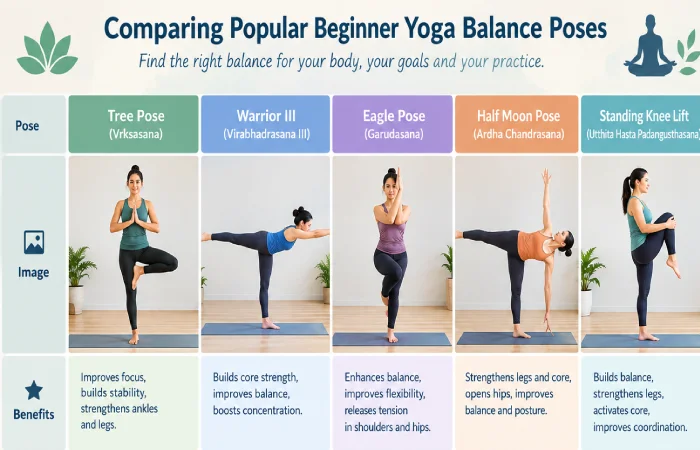
| Pose | Balance Challenge | Strength Requirement | Beginner Friendly |
| Mountain Pose | Low | Low | Yes |
| Standing Knee Raise | Low | Low | Yes |
| Tree Pose | Moderate | Low | Yes |
| Chair Pose | Moderate | Moderate | Yes |
| Warrior III Prep | Higher | Moderate | Intermediate Beginner |
This progression enables beginners to gain confidence prior to attempting more challenging poses.
Pros and Limitations of Beginner Balance Yoga
Advantages
- Minimal equipment required
- Suitable for most fitness levels
- Supports posture and coordination
- Can be practised at home
Limitations
- Progress may be gradual
- Results vary between individuals
- Some poses require modifications for injuries
- Consistency is necessary for improvement
Who Should Try Yoga Poses for Balance?
These exercises may suit:
- Yoga beginners
- Older adults seeking stability training
- Individuals improving coordination
- People wanting mindful movement practice
Not for all. Balance sufferers, recent injury or another illness, need expert advice.
Conclusion
Practicing Yoga Balance Poses For Beginners could be a way to become better at staying upright moving gracefully and focusing. Beginning with poses such as Mountain Pose Tree Pose and Standing Knee Raises enables freshman to gain a degree of confidence in a safe manner. Even though progress is different, for each person keeping at it every day and having goals is usually the best way to get better in the long run. Pay attention to getting better instead of trying to be perfect and your ability to balance will probably get stronger as time goes on.