
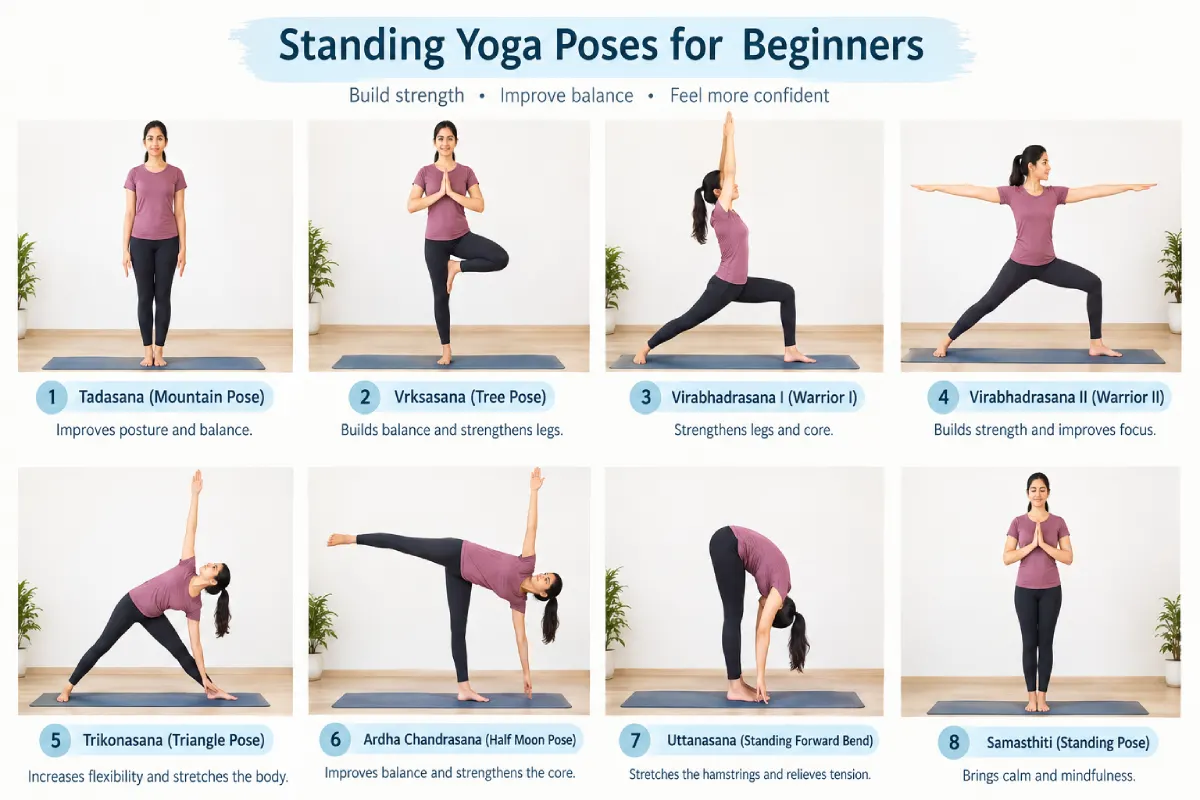
Starting yoga does not mean you have to be able to sit in positions or do advanced stretches. Standing yoga poses for beginners offer a way to learn the basics while staying upright and developing awareness of how your body moves. Standing positions can be especially useful, for beginners because they combine balance, posture and controlled movement. And Standing positions can be especially useful, for beginners because they combine balance, posture and controlled movement. They can also be adapted with a wall or chair when extra support is needed.
What Are Standing Yoga Poses?
Standing yoga poses are postures that you do while you are, on your feet. Some of them stay still. Some are part of a moving group of poses.
A beginner-friendly standing practice may include:
- Mountain Pose
- Chair Pose
- Warrior I
- Warrior II
- Triangle Pose
- Tree Pose
- Standing Forward Fold
- Wide-Legged Standing Forward Fold
You don’t have to learn everything all at. It is better to understand a things well instead of trying to go through a lot too quickly.
Beginner Standing Yoga Poses to Try
Mountain Pose
Mountain Pose or Tadasana is one of the standing yoga poses and a great place to begin.
Stand with your feet in a position that feels right. Keep your knees loose let your arms hang naturally and stretch up from the top of your head.
Breathe slowly. Pay attention to how you are standing.
Even though it seems simple Mountain Pose shows an idea: staying still can be a way to be really aware of your body.
Chair Pose
Chair Pose or Utkatasana adds a bit strength training.
Stand with your feet at a distance and bend your knees as if you are about to sit in an imaginary chair. Keep your chest up. Do not push yourself too far down.
Newcomers can use a chair, behind them for support or make the squat less deep.
Warrior I
Warrior I is a standing pose that uses a lunge- position with an upright body. Step one foot forward. Turn the back foot slightly outward. Bend the knee to a level that feels right for you making sure the back leg stays engaged. Bring your arms up if it feels right to do so. Do not focus on depth of the lunge, focus of the control of your balance and posture.
Warrior II
- The Warrior II is another way to build lower-body control and balance.
- Warrior II starts with a stance; turn one foot outwards and bend the knee on that side.
- Warrior II asks you to stretch your arms in directions while keeping your torso straight.
If the front knee, in Warrior II feels uncomfortable cut back on the depth of the bend. Change your stance a little.
Triangle Pose
Triangle Pose, also called Trikonasana brings a standing stance together with a soft side stretch. Best Triangle Pose starts with your feet spread wide; turn one foot outward and raise your arms. Triangle Pose encourages you to bend toward the front leg keeping the motion steady. It is okay if the lower hand does not touch the floor. A yoga block can bring the floor closer. Make Triangle Pose easier to hold.
Easy Standing Yoga Poses: A Beginner Workflow
Rather than practising each pose randomly, use a simple progression.
10-Minute Standing Yoga Routine
1 — Set up:
Choose a clear area with enough space to move. If balance is challenging, practise close to a sturdy wall.
2 — Centre yourself:
Begin with Mountain Pose for around one minute of comfortable breathing.
3 — Warm up:
Perform gentle standing movements, such as slow side bends or controlled shoulder movements.
4 — Build strength:
Practise Chair Pose for a few comfortable repetitions or short holds.
5 — Add movement:
Move through Warrior I and Warrior II on both sides.
6 — Work on mobility:
Try Triangle Pose with a block if necessary.
7 — Practise balance:
Finish the active portion with Tree Pose, using wall support when needed.
8 — Recover:
Return to Mountain Pose and take several relaxed breaths before finishing.
The entire routine can be adjusted according to your experience and available time.
Standing Yoga Exercises for Different Goals
| Goal | Suitable pose | Beginner approach |
| Posture awareness | Mountain Pose | Focus on relaxed alignment |
| Leg strength | Chair Pose | Use a shallow knee bend |
| Stability | Warrior II | Keep the stance comfortable |
| Mobility | Triangle Pose | Use a yoga block |
| Balance | Tree Pose | Use a wall for support |
| Gentle full-body movement | Warrior I | Avoid forcing the lunge |
How Long Should You Hold Standing Poses?
There is no single correct duration for every beginner.
You might initially hold an uncomplicated position for several comfortable breaths. More demanding poses can require shorter holds, while flowing movements may be repeated instead of held.
A good guideline is to put less emphasis on holding for a long time and more emphasis on control and breathing comfortably. If your technique begins to suffer when practicing on for longer, simply reduce the time.
Expectations: What Can Beginners Realistically Expect?
Standing yoga can support balance, mobility, body awareness and physical conditioning, but results are not instant.
A novice can often feel awkward or difference between right and left even in simple postures. This is not abnormal. A certain level of familiarity with the movement can normally be achieved given time through repeated, precise practice.
In addition, yoga should be viewed as just one component of total physical activity. If your main objectives are to acquire a substantial amount of muscular strength or to enhance your cardiovascular endurance, then it might be advantageous for you to add aerobic and resistance training to your yoga practice.
The objective is sustainable progress, not achieving an advanced pose as quickly as possible.
Safety Tips for Standing Yoga
Even easy standing yoga poses deserve attention to technique.
- Practise on a stable, non-slip surface.
- Keep a wall or sturdy support nearby for balance poses.
- Avoid locking your knees.
- Move gradually into stretches.
- Breathe normally rather than holding your breath.
- Stop if you experience sharp or unusual pain.
- Use blocks or other suitable modifications when helpful.
- Avoid comparing your range of motion with another person’s.
If you have an injury or health problem which affects balance or movements, then you might want to ask a relevant health professional what options there might be for modifying the exercises.
Pros and Limitations of Standing Yoga
Potential advantages:
- Requires little equipment
- Can develop balance and body awareness
- Offers opportunities to practise posture
- Can be modified for different ability levels
- Can fit into a short home routine
Limitations:
- Some poses can be difficult for people with poor balance
- Certain positions may need modification for injuries
- Yoga alone does not necessarily provide all forms of physical conditioning
- Flexibility and balance improvements require consistent practice
How to Progress Safely
Once you are comfortable with beginner positions, progression can be gradual.
You could increase your practice duration, explore gentle yoga flows or learn additional standing positions. Balance poses can become more challenging by reducing reliance on a wall, but this should only happen when you can maintain good control.
You can also experiment with props. A block can shorten the distance to the floor, while a wall can provide additional stability during balance work.
Progress is not necessarily about making every pose deeper. Better control, steadier breathing and improved confidence are also meaningful signs of development.
Conclusion
Basic standing yoga for beginners practiced include postures to familiarize with balance, flexibility, postural consciousness, and control: Mountain pose and gradually progress to Warrior postures, Triangle, and balancing postures such as Tree. Make sure the movements feel good use help if necessary and pay attention to being regular of trying to be perfect. Over time beginner standing yoga poses can fit well into a plan, for staying active and moving better.