
Last Updated: September 15, 2026
Cardio training is one of the ways to build fitness and endurance while staying lean and healthy. I believe you don’t need to do ten miles every day or do a workout at 100% effort to enjoy the benefits of cardio training. Walking, cycling, swimming, rowing, dancing and short workouts are all great ways to do cardio. They can be done at any time and in any location without special equipment or a large time commitment.
The choice of cardio training depends on your fitness level, experience, equipment, limitations and goals. If you are just starting out you may lean toward walking as part of your cardio training. If you are more advanced you may choose running intervals or high‑intensity interval training as part of your cardio training.
What Makes a Good Cardio Workout?
A good cardio workout includes:. It should be cardiovascularly challenging, yet manageable enough to do without difficulty. Cardio workout involves a sustained repeated movement of large muscle groups. Your heart and lungs have to work harder to supply your muscle group with oxygen because they are working harder.
A useful cardio session should consider:
- Intensity: How hard you are working.
- Duration: How long the session lasts.
- Frequency: How regularly you exercise.
- Recovery: How time you allow your body to recover.
- Fitness level: Whether the workout matches your ability.
- Enjoyment: Whether you are likely to keep doing it.
- Impact: How much stress the exercise places, on your joints.
The best exercise is not always the one. A workout that you can do safely and consistently is often more useful, than an exercise that leaves you exhausted or causes lasting soreness.
Best Cardio Workouts for Overall Fitness
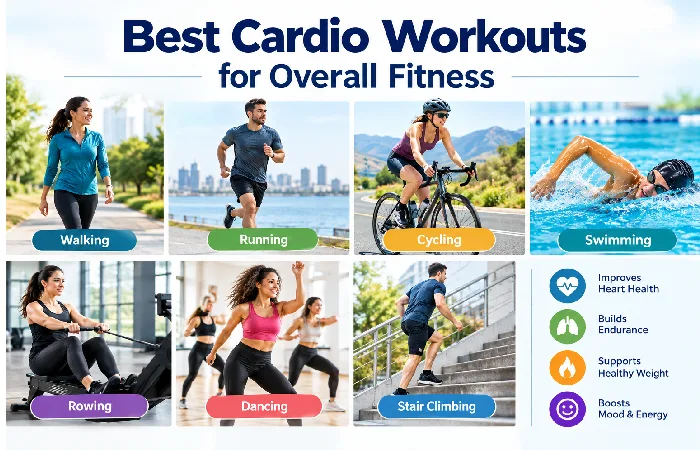
No one exercise is best for all cardio You can make any walking routine more challenging.
1. Brisk Walking
Walking is one of the most accessible cardio exercises.
A brisk pace can raise your heart rate without the impact that running has.
This brisk pace can be done outside on a treadmill or, in an indoor area.
Walking is particularly useful for:
- Beginners
- People returning to exercise
- Active recovery
- Longer cardio sessions
- Building a daily activity habit
- People who prefer low-impact exercise
Raise the speed and/or duration, or choose a steeper incline or a more difficult route.
2. Jogging and Running
Running gives a strong heart workout and needs only good shoes. New runners should not feel pushed to run all the time. A walk‑jog method can be a first step.
For example:
- Walk for five minutes.
- Jog gently for one minute.
- Walk for two minutes.
- Repeat several times.
- Finish with an easy five-minute walk.
As fitness improves, the jogging intervals can gradually become longer.
3. Cycling
Cycling can give you vigorous cardiovascular exercise. A Cycling also puts pressure on your joints than running.
Options include:
- Outdoor cycling
- Stationary bikes
- Spin-style workouts
- Recumbent cycling
- Cycling intervals
Resistance and speed can be adjusted to match your fitness level.
4. Swimming
Swimming gives a full-body workout that helps your heart and lungs. It is easier on the body, than running.
Different ways of swimming let you change the effort and work muscles. The way you swim is important.
New swimmers might get tired because they are not breathing or moving correctly. This is not just because their heart and lungs are not strong enough.
5. Rowing
Indoor Rowing combines heart pounding cardiovascular workout with whole body movement that engages your legs, hips, trunk and upper body. As resistance can be varied, it lends itself both to steady state training as well as shorter, high intensity intervals.
6. Dancing
Dance-based cardio can be an enjoyable way to accumulate aerobic activity.
You can use:
- Dance classes
- Follow-along workouts
- Aerobic dance
- Zumba-style sessions
- Freestyle dancing at home
7. Stair Climbing
Stair climbing raises the demand, on the heart and blood vessels. A Stair climbing also works the muscles in the legs and hips.
You can use:
- Staircases
- Stair-climbing machines
- Step platforms
Start with short intervals if you are not accustomed to climbing. The intensity can rise quickly.
Good Cardio Exercises by Intensity
Cardio does not have to be performed at one intensity all the time.
| Intensity | Example activities | Typical feel | Suitable use |
| Light | Easy walking, gentle cycling | Comfortable | Recovery and beginners |
| Moderate | Brisk walking, steady cycling | Breathing faster but controlled | General fitness |
| Vigorous | Running, fast cycling, hard rowing | Difficult to maintain conversation | Conditioning |
| High intensity | Short HIIT intervals | Very challenging | Advanced conditioning |
Let me share something, about The Talk Test. The Talk Test can help you measure how you can talk comfortably while you are doing activity. The Talk Test does not work well for singing. When you are doing activity The Talk Test shows that you can only say a few words before you need to pause.
Cardio Workouts for Beginners
Slogging out too quickly Beginners often make the mistake of starting too aggressively. You don’t have to do a whole hour on your first day.
Beginner Cardio Workout Example
20-minute session:
- 5 minutes: easy walking
- 8 minutes: brisk walking
- 2 minutes: slightly faster pace
- 3 minutes: comfortable walking
- 2 minutes: easy cool-down
As your fitness improves, you could increase the brisk portion or introduce short jogging intervals.
Cardio Workouts at Home
You don’t need a commercial gym to do effective cardio.
No-Equipment Home Cardio
Try combining movements such as:
- Marching in place
- Step-ups
- Bodyweight squats
- Alternating reverse lunges
- Low-impact jumping jacks
- Fast feet
- Mountain climbers
- Dancing
- Shadow boxing
A circuit could involve 40 seconds of movement followed by 20 seconds of easier activity or rest.
For beginners, low-impact versions are often preferable.
Example 25-Minute Home Cardio Workout
Warm-up — 5 minutes
- March in place
- Arm circles
- Easy step touches
- Gentle bodyweight movements
Main workout — 15 minutes
Complete three rounds:
- 45 seconds brisk marching
- 45 seconds bodyweight squats
- 45 seconds step-ups
- 45 seconds shadow boxing
- 60 seconds easy movement
Cool-down — 5 minutes
Start to slow your pace and include some mobility movements that are easy on your body. We are trying to make this a sustainable challenge for your cardiovascular system, not just drive yourself to the max.
Cardio Workouts for Weight Loss
Cardio for weight management cardio is part of your plan because it adds to your energy burn, but not because it solely causes fat loss.
Your body weight is driven by total energy intake and consumption as well as sleep, activity, genetics, medications and other personal factors.
So, the most effective cardio workouts for weight loss are those you can do indefinitely alongside proper nutrition and strength training.
Effective Options
Depending on your fitness level, useful choices include:
- Brisk walking
- Incline walking
- Cycling
- Jogging
- Swimming
- Rowing
- Dance workouts
- Circuit training
- Intervals
You do not need to exercise at maximum intensity to support weight management.
How Often Should You Do Cardio for Weight Loss?
There is no universal number of minutes that guarantees a particular amount of weight loss.
Instead, consider your overall weekly activity.
A practical approach could include:
- Several moderate cardio sessions
- Regular walking throughout the day
- Two or more strength-training sessions
- Adequate recovery
- A balanced eating pattern
Consistency matters more than trying to compensate for diet through extreme cardio sessions.
Low-Impact Cardio Workouts
Low-impact cardio reduces or eliminates repeated high-impact movements such as running and jumping.
This does not mean low-impact exercise is ineffective.
Useful options include:
- Walking
- Cycling
- Swimming
- Elliptical training
- Rowing
- Water aerobics
- Low-impact dance
- Marching workouts
Cardio Workouts for Endurance
Steady-State Cardio
Steady-state training involves maintaining a relatively consistent intensity.
Examples include:
- 30-minute brisk walk
- 40-minute easy cycling session
- 30-minute swim
- 20–30-minute easy jog
The intensity should be manageable enough to sustain for the planned duration.
Long, Easy Sessions
Longer sessions at a comfortable intensity can help you become accustomed to spending more time exercising.
Increase duration gradually rather than adding large amounts of training at once.
Tempo Training
Tempo sessions sit between easy endurance work and all-out intervals.
For example:
- 10-minute easy warm-up
- 10–15 minutes at a challenging but controlled pace
- 5–10-minute cool-down
This approach is more appropriate for people who already have a basic fitness foundation.
HIIT Cardio Workouts
High-intensity interval training, commonly called HIIT, alternates periods of harder exercise with recovery.
A basic structure might look like:
30 seconds: hard effort
60 seconds: easy recovery
Repeat: 6–8 rounds
Possible exercises include:
- Cycling
- Running
- Rowing
- Fast step-ups
- Bodyweight movements
Cardio Workout Workflow: How to Build Your Own Session
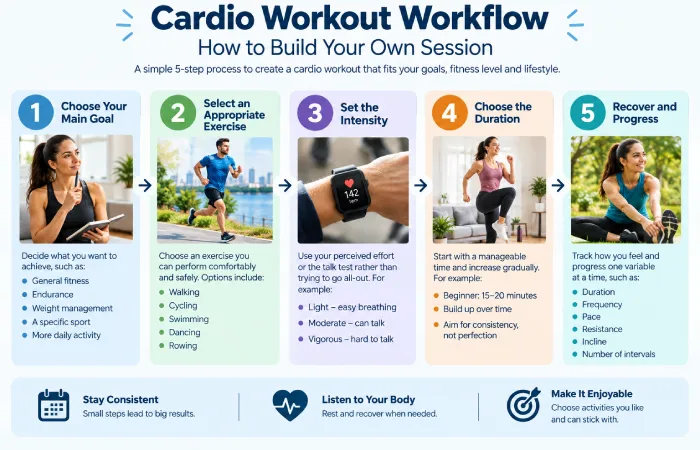
A useful cardio session can follow a simple five-step structure.
Step 1: Choose Your Main Goal
Decide whether you are training for:
- General fitness
- Endurance
- Weight management
- A specific sport
- Increased daily activity
Step 2: Select an Appropriate Exercise
Choose something you can perform comfortably and safely.
Walking may be better than running if you are new to exercise. Cycling or swimming may be preferable if you dislike impact.
Step 3: Set the Intensity
Use perceived effort or the talk test rather than trying to make every session maximal.
Step 4: Choose the Duration
Start with a manageable duration.
It is usually better to complete a realistic 20-minute workout consistently than to plan 60-minute sessions that you repeatedly skip.
Step 5: Recover and Progress
Track how you feel during and after training.
Progress one variable at a time, such as:
- Duration
- Frequency
- Pace
- Resistance
- Incline
- Number of intervals
This gives you a clearer idea of what is driving improvement.
How to Combine Cardio and Strength Training
Cardio and resistance training do things but they work well together. Cardio helps improve heart health and builds endurance. Strength training uses resistance to make muscles stronger and grow. Both are important, for a fitness routine.
A balanced weekly routine might include:
| Day | Example activity |
| Monday | Strength training |
| Tuesday | Moderate cardio |
| Wednesday | Rest or easy walking |
| Thursday | Strength training |
| Friday | Cardio intervals |
| Saturday | Longer easy cardio |
| Sunday | Rest or light activity |
This is an example. Training frequency should reflect your experience, schedule and recovery. If strength and cardio are performed in the session the order can depend on the primary goal. A person who prioritises strength may do resistance training first while a person who prioritises endurance may do cardio first. Strength is important. Cardio is also important.
Best Cardio Exercises: Comparison Table
| Exercise | Impact | Equipment | Beginner-friendly | Endurance potential | Intensity range |
| Walking | Low | None | Excellent | High | Low–moderate |
| Running | Higher | Shoes | Moderate | High | Moderate–vigorous |
| Cycling | Low | Bike | Excellent | High | Low–vigorous |
| Swimming | Low | Pool | Moderate | High | Moderate–vigorous |
| Rowing | Low | Rower | Moderate | High | Moderate–vigorous |
| Dancing | Low–moderate | None | Excellent | Moderate | Low–vigorous |
| Stair climbing | Moderate | Stairs | Moderate | Moderate | Moderate–vigorous |
| HIIT | Varies | Optional | Lower | Moderate | High |
No ranking in this table means one exercise is universally better. Suitability depends on the person performing it.
How Much Cardio Should You Do?
Public‑health guidelines you normally follow say that adults need to do least 150 minutes each week of moderate activity, such as walking quickly or 75 minutes each week of harder activity, such, as running. The public‑health guidelines also say that there are more benefits if the activity is more intense.
Exercise to strengthen muscles is a part of your weekly physical activity. You should include strengthening activity in the amount of physical activity you do each week. Of doing all of your exercise in one or two sessions some people prefer to spread out their activity throughout the week. This approach can be easier to manage for some people.
For example:
- 30 minutes of moderate cardio × 5 days = 150 minutes
- 25 minutes × 6 days = 150 minutes
- A combination of moderate and vigorous activity can also be used
These are broad guidelines, not a prescription for every individual.
How to Know If Your Cardio Is Working
Progress is not always reflected by body weight.
Depending on your goal, useful indicators can include:
- Lower perceived effort at the same pace
- Ability to exercise for longer
- Faster walking or running pace
- Improved cycling resistance
- Better recovery between intervals
- Lower resting heart rate over time in some individuals
- Improved exercise confidence
- Greater consistency
Expectations: How Quickly Will Cardio Improve Fitness?
I have seen that cardiovascular adaptations can happen quickly when someone starts exercising consistently but cardiovascular adaptations can vary in how fast they occur.
You may notice improvements in how exercise feels before measurable changes become obvious.
In the Early Weeks
You may experience:
- Less breathlessness during familiar activities
- Better exercise tolerance
- Improved confidence
- Reduced perceived effort
Over Several Months
With consistent training, you may develop:
- Greater endurance
- Improved ability to sustain higher workloads
- Better overall exercise capacity
- Improved performance in your chosen activity
Weight changes are less predictable because they depend on total energy balance and individual factors.
I find that it is not helpful to expect a specific number of pounds lost a precise amount of calories burned or a particular fitness improvement, from a workout. Fitness is highly individual.
Common Cardio Workout Mistakes
Doing Too Much Too Soon
Suddenly increasing how far you run or how much you do HIIT can lead to tiredness.
Progress gradually.
Making Every Workout High Intensity
Hard sessions are stressful on the body. Easy and moderate training can provide valuable cardiovascular work without the same level of fatigue.
Ignoring Recovery
Rest is part of training, not wasted time.
Sleep, nutrition and appropriate recovery between demanding sessions all matter.
Choosing Calories Burned as the Only Metric
Fitness trackers can estimate energy expenditure, but those estimates are not perfectly precise.
Use performance, consistency and how you feel as additional measures.
Skipping the Warm-Up
A gradual warm-up prepares you mentally and physically for the session.
Five to ten minutes of progressively faster movement is sufficient for many general workouts.
Neglecting Strength Training
If your goal is comprehensive fitness, cardio should not necessarily be your only form of exercise.
Resistance training can complement cardiovascular work.
How to Make Cardio More Enjoyable
The most technically effective workout is not useful if you consistently avoid it.
Try experimenting with:
- Different forms of exercise
- Music or podcasts
- Outdoor routes
- Training with friends
- Shorter sessions
- Exercise classes
- Goal-based challenges
- Different times of day
You can also rotate activities.
For example, walking on Tuesday, cycling on Thursday and swimming on Saturday can make your weekly routine less repetitive while developing cardiovascular fitness through different movements.
Good Cardio Workouts for Different Goals
| Goal | Useful cardio options | Main consideration |
| Beginner fitness | Walking, cycling, low-impact dance | Build consistency |
| Weight management | Walking, cycling, jogging, intervals | Combine activity with appropriate nutrition |
| Endurance | Walking, running, cycling, swimming | Gradually increase volume |
| Joint-friendly exercise | Swimming, cycling, elliptical, walking | Choose comfortable movement |
| Time-efficient conditioning | HIIT, intervals | Allow adequate recovery |
| General health | Mixed moderate cardio | Maintain regular activity |
When Should You Do Cardio?
There is no universally superior time of day for cardio.
The best time is generally the one that allows you to exercise consistently and perform comfortably.
Morning Cardio
Morning workouts may fit people who prefer exercising before work or other commitments.
Afternoon Cardio
Some people find they have more energy later in the day.
Evening Cardio
Evening exercise can work well if it does not interfere with sleep or other responsibilities.
Consistency is more important than chasing a supposedly perfect workout time.
Cardio Before or After Strength Training?
There is no single answer.
If your primary goal is improving strength, completing demanding resistance exercises before cardio may help you preserve energy for lifting.
If endurance performance is the priority, cardio may come first.
Another option is to perform cardio and strength training on separate days.
For people who simply want general fitness, the order can often be based on convenience and personal preference.
Safety Tips for Cardio Exercise
A few simple habits can make cardio training more manageable.
Start Gradually
Allow your body time to adapt.
Use Suitable Equipment
Comfortable footwear and properly adjusted equipment can improve the exercise experience.
Stay Hydrated
Fluid requirements vary based on temperature, duration and sweat loss.
Pay Attention to Warning Signs
Normal exercise discomfort is different from severe or unusual symptoms.
Stop exercise and seek medical attention when appropriate if you experience symptoms such as chest pain, fainting or severe unexplained breathlessness.
Give Yourself Recovery Time
You do not have to train hard every day to make progress.
Can Cardio Be Done Every Day?
Light activities such as comfortable walking can often be incorporated frequently.
More demanding workouts require more consideration.
Doing intense HIIT or hard running every day may leave insufficient time for recovery, especially for beginners.
A varied routine that includes easier days can be more sustainable.
Good Cardio Workouts Without a Gym
A gym membership is not necessary for cardiovascular fitness.
You can build an effective routine around:
- Walking
- Running
- Cycling
- Hiking
- Swimming
- Stair climbing
- Dancing
- Home circuits
- Jump-rope workouts, where appropriate
The key is choosing activities that provide an appropriate cardiovascular challenge and fit your circumstances.
Frequently Asked Questions
What are good cardio workouts for beginners?
Cardio for Beginners Good cardio exercises include power walking, gentle riding, low-impact dance aerobics, swimming and running walk-jog routines. Begin with something easy and build up to more difficult as the ease of your workout.
What is the best cardio workout for weight loss?
Best Cardio Workouts for Weight Loss There isn’t any best cardio workout for weight loss. Walks, bike rides, runs, swims and HIT routines all burn calories, but performance depends on total activity, diet and individual factors.
How long should a cardio workout last?
It can be only for a short or long period of time depending on your fitness level and to what extent you want to go with your cardio exercises. If you are starting out then you can go for 15-20 minutes and if you are a pro then you can go even longer.
Are cardio workouts at home effective?
Yes. Walking, dancing, step-ups, cycling, low-impact circuits and other home exercises can provide useful cardiovascular training without a gym.
Is walking considered cardio?
Yes. Brisk walking can be a moderate-intensity cardiovascular activity when it raises your heart rate and breathing sufficiently.
Is HIIT better than steady-state cardio?
Not necessarily. HIIT can provide a time-efficient, high-intensity stimulus, while steady-state cardio is useful for building aerobic volume and may be easier to recover from. Both have a place in a balanced programme.
How often should I do cardio?
Public-health guidance generally recommends at least 150 minutes of moderate aerobic activity or 75 minutes of vigorous aerobic activity per week for adults. Individual training needs can differ.
Final Takeaway
It’s easy to assume that the hardest cardio workout is going to be the most effective but in reality, your best workout is the one that is suitable for your current fitness levels, helps you achieve your goals and that you can do consistently. Whether you’re running, cycling, walking, swimming, jogging, rowing, dancing, doing high intensity interval training (HIIT), or some combination of these, doing the workout appropriately can improve your cardiovascular fitness. Doing lower intensity workouts in the beginning is more beneficial than trying to do an hour of walking or running every day and increase your time gradually, and experienced exercisers should consider longer endurance based sessions or carefully planned intervals.
For weight loss, cardio is an important component of a comprehensive weight loss plan that is based on good nutrition, on your feet as much as possible, strength training, sleep and rest. For endurance athletes, consistency and progression are more valuable than for marathon runners to bring their “A game” to the starting line.