
Last Updated: September 14, 2026
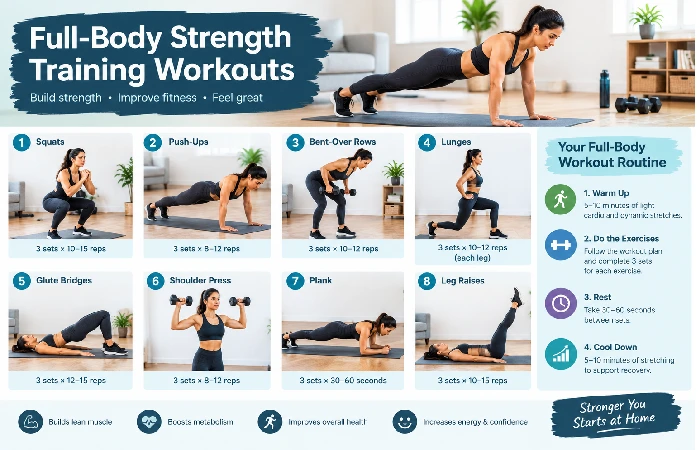
Strength training does not always need workout plans or long hours at the gym. For people Full-Body Strength Training Workouts offer a smart and powerful way to build overall strength. These workouts make sure every major muscle group gets attention.
This can be at home or at the gym. Starting with a total body strength training workout is a good way to establish the basics, It makes you feel good and is good for you in the long run. It also fits professionals who don’t have much time. Anyone wanting an effective training programme will find this method helpful.
Why Full-Body Strength Training Works
The full-body approach is a way to train multiple muscle groups. The full-body approach lets you train muscle groups times each week so you do not need to work out every day.
Potential benefits include:
- Improved muscular strength
- Better movement efficiency
- Balanced muscle development
- Time-efficient workouts
- Increased calorie expenditure during training
- Improved functional fitness
- Greater flexibility in scheduling
Full-body programmes are often the ideal solution for most entry- and intermediate-level trainers to combine enough weekly training volume with sufficient ability to recover from training.
Full Body Strength Workout at Home
One advantage of full-body training is its flexibility. Many effective workouts can be performed with minimal equipment or bodyweight alone.
Sample Full-Body Workout
| Exercise | Sets | Repetitions |
| Bodyweight Squats | 3 | 10–15 |
| Push-Ups | 3 | 8–12 |
| Glute Bridges | 3 | 12–15 |
| Bent-Over Rows | 3 | 10–12 |
| Reverse Lunges | 3 | 10 per leg |
| Plank | 3 | 30 seconds |
This workout works the muscle groups. This workout stays easy for fitness levels.
Benefits of Home-Based Training
- Convenience
- Lower cost
- Flexible scheduling
- Minimal equipment requirements
- Suitable for beginners
Upper Body Strength Workout at Home
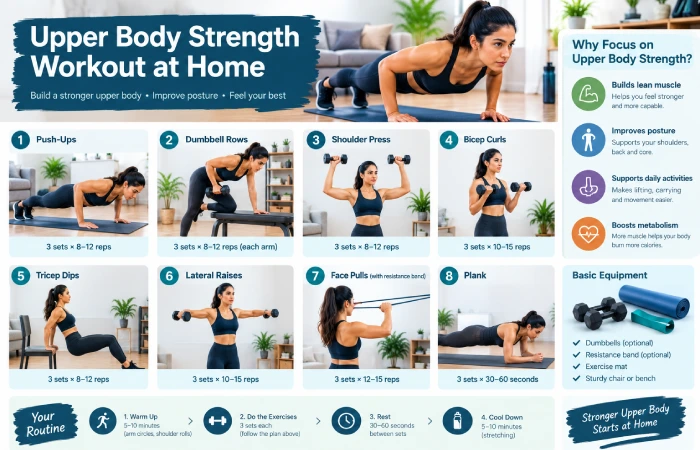
Building upper-body strength is both functional and practical.
Key Upper-Body Exercises
Push-Ups
Targets:
- Chest
- Shoulders
- Triceps
Resistance Band Rows
Targets:
- Upper back
- Lats
- Biceps
Pike Push-Ups
Primarily challenge shoulder strength.
Chair Dips
Help develop triceps and shoulder stability.
Upper-Body Training Tips
- Prioritise proper form
- Use controlled movements
- Gradually increase repetitions
- Balance pushing and pulling exercises
Lower Body Strength Workout at Home
The lower body contains some of the largest muscles in the body.
Important Lower-Body Exercises
| Exercise | Primary Muscles |
| Squats | Quadriceps, Glutes |
| Lunges | Legs and Glutes |
| Step-Ups | Legs and Balance |
| Glute Bridges | Posterior Chain |
| Calf Raises | Calves |
Why Lower-Body Strength Matters
Lower-body training supports:
- Walking
- Running
- Balance
- Athletic performance
- Everyday movement
Consistent lower-body training can improve both strength and mobility.
Leg Strength Workout at Home
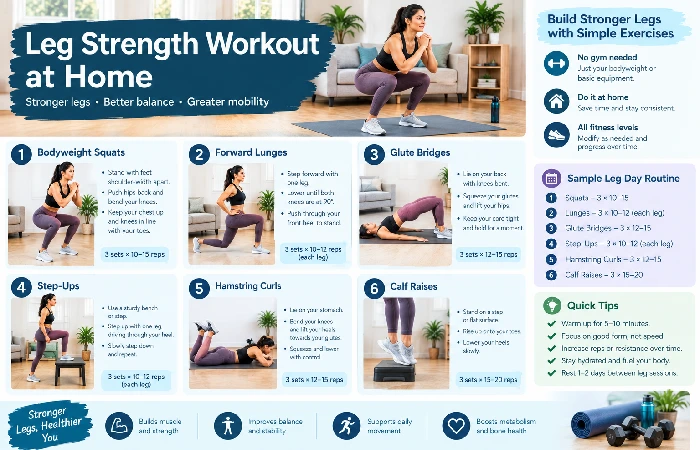
Lower-body workouts engage various muscles groups, and but some moves will help you build up your stamina and strength in your legs.
Effective Leg Exercises
Split Squats
Challenge each leg independently.
Walking Lunges
Improve strength and coordination.
Wall Sits
Build muscular endurance.
Single-Leg Step-Ups
Enhance balance and lower-body control.
Progression Ideas
As exercises become easier:
- Increase repetitions
- Add additional sets
- Slow movement tempo
- Use advanced exercise variations
Core Strength Workout at Home
Your core is central to providing stability and controlling your movements.
Core Training Exercises
| Exercise | Focus Area |
| Plank | Full Core |
| Side Plank | Obliques |
| Bird Dog | Stability |
| Dead Bug | Core Control |
| Mountain Climbers | Dynamic Core Strength |
Benefits of Core Training
A stronger core may contribute to:
- Improved posture
- Better movement efficiency
- Enhanced balance
- Greater exercise stability
Core training supports nearly every major movement pattern used in strength training.
Full-Body vs Split Training Programmes
I often hear many people wonder if full-body workouts are better, than routines.
Comparison Table
| Feature | Full-Body Training | Split Training |
| Training Frequency | 2–4 Days Weekly | 4–6 Days Weekly |
| Session Focus | Entire Body | Specific Muscle Groups |
| Beginner Friendly | Excellent | Moderate |
| Time Efficiency | High | Moderate |
| Recovery Balance | Good | Variable |
| Flexibility | High | Moderate |
Advantages & Disadvantages Neither is better or worse. It just depends on the goal, goal, past experience, and schedule.
Full-Body Strength Training Workflow
Step 1: Warm Up Properly
Perform 5–10 minutes of light movement and mobility exercises.
Step 2: Start With Compound Exercises
Examples include:
- Squats
- Push-ups
- Rows
- Lunges
Exercises involve working groupings of muscles.
Step 3: Add Core Work
Include one or two core-focused movements.
Step 4: Focus on Quality Repetitions
Maintain proper technique throughout each set.
Step 5: Progress Gradually
Increase:
- Repetitions
- Sets
- Resistance
- Exercise complexity
Step 6: Recover Adequately
Allow sufficient rest between training sessions.
Common Full-Body Training Mistakes
Training Too Frequently
Recovery remains essential for strength development.
Ignoring Technique
Using improper form during exercise can minimize the positive effects and heighten the risk of injury.
Neglecting Core Training
Core strength supports many major movement patterns.
Using Too Much Weight Too Soon
Progressive overload should occur gradually.
Skipping Lower-Body Exercises
All of the major muscle groups should be equally toned.
Expectations Management: What Results Are Realistic?
Strength development occurs gradually.
Early Improvements (Weeks 1–4)
Many beginners notice:
- Better exercise technique
- Improved coordination
- Increased confidence
- Reduced movement discomfort
Intermediate Improvements (Months 2–6)
Consistent training may contribute to:
- Increased strength
- Improved muscular endurance
- Better movement quality
- Enhanced fitness levels
Long-Term Expectations
Long-term progress depends on:
- Consistency
- Recovery
- Nutrition
- Sleep quality
- Training quality
Results vary significantly between individuals.
Who Should Use Full-Body Strength Training Workouts?
Full-body programmes may be particularly useful for:
- Beginners
- Busy professionals
- Students
- Home exercisers
- Individuals returning to training after a break
Advanced athletes may also use full-body sessions depending on their specific goals.
Conclusion
Full Body Strength Training Workouts provide a way to add strength training to your daily routine. These include body-strength-workout-at-home leg-strength-workouts-at-home core-strength-workouts-at-home and full-body-strength-workouts-at-home. Each of these workouts helps build strength in areas and fits well into a balanced effective fitness plan. No matter if you are following a multiple strength workout program, an advanced strength training workout program or a beginner strength workout plan consistency is key. Stay focused, on using form and keep your goals realistic.