

Starting with an exercise routine can be exhilarating for a couple of days and then frustrating when daily tasks interrupt the routine. An ideal starting point for motivation for beginners is definitely not about having the energy to perform an activity before each fitness session. It is about formulating achievable habits that support repetition of exercise even when a desire to carry it out is absent.
If weight loss, muscular gain or simply being fit (as opposed to lethargic, unfit and lacking enthusiasm) are the goals, there is absolutely no need to revolutionize your lifestyle in an instant.
A sustainable exercise start can prove much more effective than a demanding and impossible exercise schedule. If you’re new to health and exercise, explore our Fitness Motivational Quotes Hub for inspiration that can help you stay committed from day one.
Why Fitness Motivation Matters When You Are Starting
Most beginners encounter four problems: They don’t know what exercises to do, feel it might look stupid/foolish, they get sore, they have neither the time nor the ability to give all those suggestions a chance.
The answer to this does not mean to push himself harder. But to push less in the beginning.
Someone who wouldn’t normally exercise would do e.g. 3 x weekly sessions of 20-30 minutes with a fast walk, an introductory strength session and or class.
Fitness Motivation for Beginners: Start With a Simple Goal
A fuzzy idea of “getting fit” can be hard to put into action. A specific goal provides a measure for you to aim toward.
Consider goals such as:
- Walk for 25 minutes three times a week.
- Complete two beginner strength sessions each week.
- Enhance the total push ups you are able to do for a period of time.
- Take a short walk after work on four days each week.
- Follow a beginner workout programme for one month.
Your first goal does not need to be impressive. It needs to be achievable enough that you can repeat it. Gym & Workout Quotes
Focus on Process Goals
A process goal describes something you can control.
For example:
Outcome goal: Lose 10 pounds.
Process goal: Complete three planned workouts each week and increase daily movement.
weight and body composition may fluctuate throughout your life for a variety of reasons, and setting process-oriented goals may seem less frustrating as a beginner; also, it allowed for the possibility of an award for a substantial physical transformation to happen.
Beginner Gym Motivation Quotes
A good quote is not a substitute for a workout, but it can make a good reference point of your why when you’re thinking about skipping a workout.
Here are some original beginner gym motivation quotes:
- “You do not have to be fit to begin; beginning is how you become fitter.”
- “A short workout still counts when the alternative is doing nothing.”
- “Progress starts with the session you almost skipped.”
- “Build the habit first. Build the intensity later.”
- “Your first workout is an introduction, not a final exam.”
Maintain those inspiring quotes within reach of your view (phone notes, training log/workout journal, etc.) in places you can view and remind yourself of often. Most novice learners are concerned about their health and body composition. Therefore these Weight Loss Motivation Quotes a valuable source of encouragement.
Starting Fitness Journey Quotes for New Exercisers
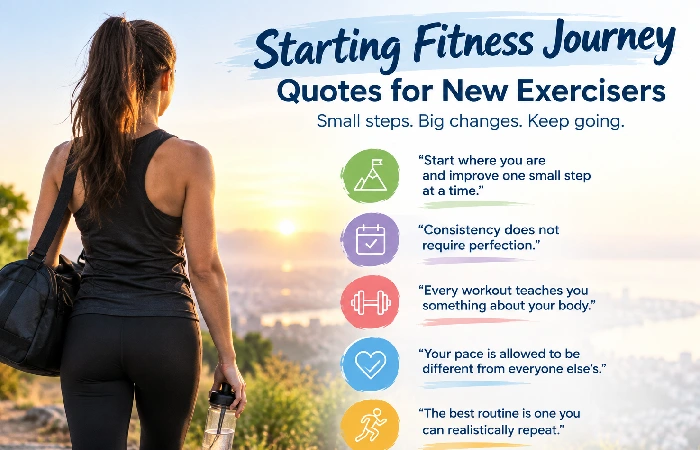
These starting fitness journey quotes can help reinforce a realistic mindset:
- Begin where you stand now, and change only one small thing at a time.
- Consistency does not have to equal perfection.
- Each exercise provides an education of your own body.
- It is okay to go your own pace.
- A perfect routine is an exercise that you’ll actually do.
The most important message is simple: you are not competing with someone else’s starting point.
A Beginner Workout Motivation Workflow
Motivation becomes easier to manage when you have a repeatable process.
Step 1: Choose the days
Pick two or three days that realistically fit your schedule.
Step 2: Decide what you will do
Remove uncertainty before the workout starts.
Step 3: Prepare in advance
Put your training clothes out, prepare your water bottle or organise your gym bag.
Step 4: Use a minimum target
Tell yourself all you need to do is begin by 10 minutes. Maybe after starting you’ll be able to decide to carry on too.
Step 5: Record the session
Mark down the exercise, duration and your physical condition during the session in your calendar.
Step 6: Review weekly
Instead of judging one difficult day, look at your overall consistency.
Here, you take the motivation for your workout for beginners to something real that you’re doing and not something to be searched every morning.
As your confidence grows, these Muscle Building & Strength Quotes can inspire you to take your training to the next level.
Exercise Motivation for Beginners: Make Exercise Easier to Repeat
By far, one of the easiest yet most effective ways of improving a beginner’s workout motivation is by removing unnecessary friction from the experience:
If the gym is 45mins away, this could also be problematic. A closer gym, or home workout/outdoor walk could be sustainable for you.
Think about:
- Convenience – is it accessible at home or work?
- Preference – do you like walking, cycling, lifting, swimming or classes?
-
Commitment – is it realistic to fit it in?
- Social – would you be more motivated with a friend?
- Stimulation – would you want to mix exercises?
Exercise doesn’t need to be a particular way either. Your preferred starting point should be the one that suits you-having regard to your aptitude, interests and situation at the time.
How to Stay Motivated When You Do Not Feel Like Exercising
Motivation can come and go. Well, all of these other factors-sleep, stress, work, daily chores-are going to wear down your motivation.
On low-energy days, consider reducing the session rather than automatically cancelling it.
For example:
Planned workout: 40-minute gym session
Lower-energy version: 15-minute walk plus a few simple mobility exercises
The habit persists, yet not all of your sessions need to be fierce. Actually rest is equally as important. If you’re extremely exhausted, ill, and/or over a very long time in pain you are most likely to resolve your issue by kicking back and also coping with it.
One of the biggest challenges for beginners is staying consistent, which is why these Discipline and Consistency Quotes are worth reading.
Fitness Consistency Quotes
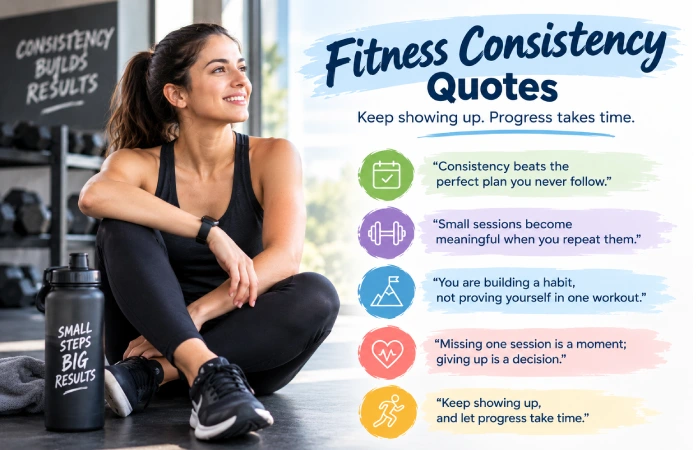
Consistency is one of the most useful concepts for a beginner because fitness develops over time.
Try these fitness consistency quotes as reminders:
- “Consistency beats the perfect plan you never follow.”
- “Small sessions become meaningful when you repeat them.”
- “You are building a habit, not proving yourself in one workout.”
- “Missing one session is a moment; giving up is a decision.”
- “Keep showing up, and let progress take time.”
These are best viewed as mindset prompts rather than promises of specific results.
A Simple Beginner Fitness Routine
A new exerciser does not necessarily need a complicated programme.
A basic week could look like this:
| Day | Beginner activity | Main purpose |
| Monday | 20–30-minute brisk walk | Cardiovascular activity |
| Tuesday | Rest or gentle movement | Recovery |
| Wednesday | Beginner full-body strength session | Strength |
| Thursday | Rest | Recovery |
| Friday | 20–30-minute walk or cycling | Cardiovascular activity |
| Saturday | Optional enjoyable activity | Movement and enjoyment |
| Sunday | Rest or gentle walking | Recovery |
The following is just a sample and actual frequency and exercise selection need to be changed to suit individual goals, level of fitness and time availability.
What Progress Should Beginners Expect?
Do Not Expect Dramatic Changes Immediately
One of the biggest motivation problems for beginners is expecting visible results within days.
Fitness adaptations take time. Early progress may be less visible but still meaningful.
You might notice:
- Exercises feel less unfamiliar.
- You recover more comfortably between sessions.
- Walking or climbing stairs feels easier.
- You can perform more repetitions.
- Your technique improves.
- You feel more confident in the gym.
- Exercise becomes easier to fit into your routine.
These changes can occur before obvious changes in appearance.
Avoid Comparing Your Progress With Others
Fitness transformations on social media are almost always very stylized. The photo rarely shows the full journey, training history, genetics, nutrition, or sleep and what was required of that person to make that change.
We advise comparing your current ability to where you were.
So, if a month ago you could walk for 15 minutes, and now you can do it fairly comfortably for 25, this is progress even though that does not stand up to someone else’s achievements.
Common Beginner Motivation Mistakes
Trying to Do Too Much
Starting with six workouts per week may sound productive, but it can be difficult to sustain if you are currently inactive.
Treating Motivation as Permanent
You will have motivated days and unmotivated days. A good routine needs to function during both.
Expecting Perfection
Missing a workout does not erase previous progress. Return to your schedule at the next practical opportunity.
Using Exercise as Punishment
Exercise can support health and fitness without being treated as punishment for eating certain foods or missing a target.
Ignoring Recovery
Training is only one part of fitness. Rest, sleep, nutrition and gradual progression also matter.
How to Build Long-Term Workout Motivation
Long-term motivation often develops from seeing exercise become part of your identity and routine.
Instead of saying:
“I need motivation to exercise.”
Try thinking:
“I am someone who makes time for regular movement.”
That shift can make the process feel less dependent on temporary enthusiasm.
Small incentives can be built around the habit as well: Listen to a good podcast while you walk; work out with a buddy or explore a new jogging trail; try new things that actually turn out to be fun. The idea isn’t to make every single workout super interesting. The goal is to make it possible and rewarding enough to keep doing.
When Should Beginners Increase Workout Difficulty?
Progress should generally be gradual.
If a particular routine has become comfortable and your technique is sound, you may consider increasing one variable at a time, such as:
- Duration
- Resistance
- Repetitions
- Distance
- Exercise complexity
- Training frequency
There is no need to increase everything simultaneously.
For strength training especially, beginners should prioritise learning good technique and controlling movements before chasing heavier weights.
If you have an existing medical condition, significant pain or concerns about starting exercise, consider discussing an appropriate activity level with a qualified healthcare professional. Once you start achieving fitness milestones, use our Fitness Social Media Captions to share your progress and inspire others.
A Practical Motivation Checklist
Before each week begins, ask yourself:
- What days can I realistically exercise?
- What type of movement do I enjoy?
- What is my minimum workout on a busy day?
- What progress can I measure besides body weight?
- Have I allowed enough time for recovery?
- What might make this week’s workouts easier to complete?
Answering these questions can turn motivation into planning.
Final Thoughts on Fitness Motivation for Beginners
Motivation to begin working on your fitness does not require you feel exhilarated by physical activity on an hourly basis. A more healthy relationship involves achievable milestones that match your personal rhythms and establishing reliability.
It is fine if your first session is a bit clunky. It is fine if you’re not consistent in week one. Just aim for the next manageable session. Focusing on finishing each session with reasonable expectations can create a fitness habit, increase comfort levels over time, and yield a better understanding of yourself.