
This Article is part of the Muscle Gain
What Is Home Muscle Building?
Building muscle at home is when you do exercises that help make your muscles stronger in your home to make your muscles grow. You do this by doing things that make your muscles work hard like lifting weights or using machines and this helps make your muscles bigger and stronger over time. Muscle building at home is a way to get fit and healthy without having to go to a gym. Home muscle building is, about making your muscles work hard so that they can grow and get stronger.
Unlike traditional gym training, home workouts often rely on:
- Bodyweight exercises
- Resistance bands
- Adjustable dumbbells
- Household workout equipment
- Progressive training methods
Muscles are constantly subjected to training stimulus, and then given adequate time to recover and repair, they will continue to grow, whether this is in a commercial gym or a home training environment.
Benefits of Building Muscle at Home
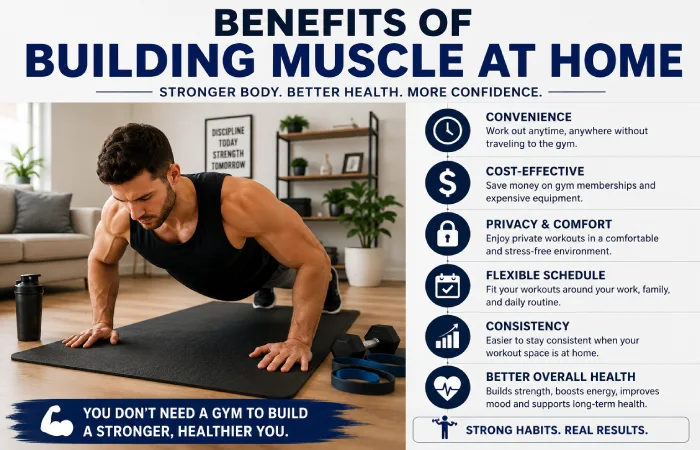
Home workouts offer several practical advantages.
Convenience
You can train according to your own schedule without travelling to a gym.
Lower Cost
Many effective home workouts require little or no equipment.
Privacy
Some beginners feel more comfortable learning exercises in a private environment.
Consistency
Removing travel time can make it easier to maintain a regular training routine.
Flexibility
You can also build work-out into the structure of working school and family routine if training from the comfort of home.
Build Muscle at Home: The Science Behind Muscle Growth
Muscle growth (hypertrophy) occurs when muscles adapt to training stress.
Three primary factors contribute to muscle development:
| Factor | Description |
| Mechanical Tension | Resistance placed on muscles during exercise |
| Muscle Damage | Small disruptions in muscle fibres caused by training |
| Metabolic Stress | Build-up of fatigue and muscle burn during exercise |
To build muscle at home effectively, your training should gradually become more challenging over time.
Bodyweight Muscle Building Exercises
But to really grow there are other better bodyweight exercise variations.
Upper Body Exercises
- Push-ups
- Incline push-ups
- Diamond push-ups
- Pike push-ups
- Chair dips
Lower Body Exercises
- Squats
- Bulgarian split squats
- Lunges
- Step-ups
- Glute bridges
Core Exercises
- Planks
- Side planks
- Leg raises
- Mountain climbers
- Bicycle crunches
Resistance Band Muscle Growth Training
Resistance bands provide an affordable way to increase workout intensity.
Benefits of Resistance Bands
- Portable and lightweight
- Suitable for all fitness levels
- Adjustable resistance
- Joint-friendly training option
Effective Resistance Band Exercises
| Exercise | Primary Muscles Worked |
| Band Squats | Legs and glutes |
| Band Rows | Back and biceps |
| Band Chest Press | Chest and triceps |
| Band Shoulder Press | Shoulders |
| Band Deadlifts | Posterior chain |
Research suggests resistance bands can produce muscle activation levels comparable to traditional weight training when used correctly.
Home Muscle Workout Routine for Beginners
The following workout can be performed three times per week.
Workout A
- Push-ups – 3 sets of 8–15 reps
- Bodyweight squats – 3 sets of 12–20 reps
- Resistance band rows – 3 sets of 10–15 reps
- Glute bridges – 3 sets of 15 reps
- Plank – 3 sets of 30 seconds
Workout B
- Lunges – 3 sets of 10 reps per leg
- Pike push-ups – 3 sets of 8–12 reps
- Resistance band deadlifts – 3 sets of 12 reps
- Mountain climbers – 3 sets of 20 reps
- Side plank – 3 sets per side
Home Muscle Building Workflow
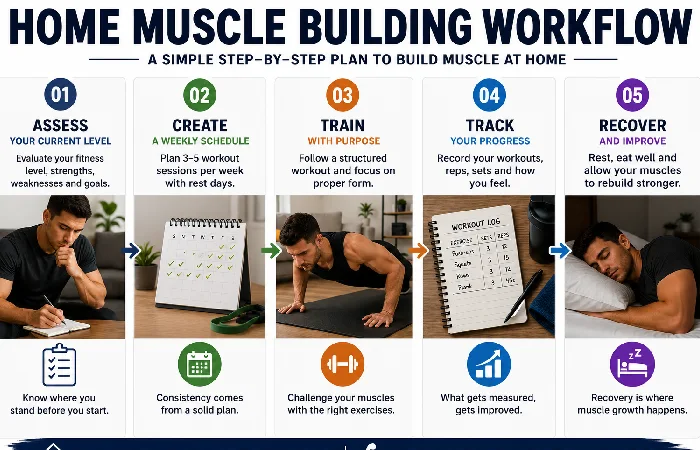
Step 1: Assess Your Current Fitness Level
Determine how many repetitions you can perform with good form.
Step 2: Create a Weekly Schedule
Aim for three to five resistance-training sessions per week.
Step 3: Track Progress
Record exercises, repetitions, and sets.
Step 4: Increase Difficulty
Add resistance, repetitions, or exercise variations over time.
Step 5: Recover Properly
Allow muscles adequate rest between training sessions.
Nutrition for Muscle Growth at Home
Training alone is not enough. Nutrition plays a major role in muscle development.
Protein Intake
Protein provides the building blocks required for muscle repair.
Good protein sources include:
- Chicken
- Fish
- Eggs
- Greek yoghurt
- Cottage cheese
- Beans
- Lentils
Carbohydrates
Carbohydrates support workout performance and recovery.
Examples include:
- Rice
- Oats
- Potatoes
- Whole grains
- Fruit
Healthy Fats
Healthy fats support hormone production.
Examples include:
- Nuts
- Seeds
- Avocados
- Olive oil
Hydration
Drink sufficient water throughout the day to support recovery and performance.
Home Training vs Gym Training
| Factor | Home Training | Gym Training |
| Cost | Lower | Higher |
| Convenience | Excellent | Moderate |
| Equipment Variety | Limited | Extensive |
| Privacy | High | Moderate |
| Progressive Overload | Moderate | Excellent |
| Travel Time | None | Required |
Both approaches can support muscle growth when training principles are applied correctly.
Realistic Expectations for Home Muscle Building
One of the most common misconceptions is expecting dramatic changes within a few weeks.
Realistic expectations include:
- Improved strength within 2–4 weeks
- Noticeable muscle definition within 8–12 weeks
- Significant physique changes within several months of consistent effort
Results vary based on:
- Age
- Genetics
- Training experience
- Nutrition quality
- Recovery habits
Patience and consistency are essential.
Common Mistakes to Avoid
Training Without Progression
Repeating the same workout indefinitely can slow progress.
Ignoring Recovery
Muscles grow during recovery, not during workouts.
Poor Nutrition
Insufficient protein can limit muscle development.
Inconsistent Training
Occasional workouts rarely produce long-term results.
Focusing Only on One Muscle Group
Balanced training promotes overall strength and reduces injury risk.
Advantages and Limitations of Home Muscle Building
Advantages
- Cost-effective
- Convenient
- Flexible scheduling
- Beginner-friendly
- Minimal equipment required
Limitations
- Less equipment variety
- Harder to perform heavy progressive overload
- Limited access to specialised machines
- Self-motivation required
Understanding these limitations helps set realistic goals.
Conclusion
Home muscle building is a way to get stronger and feel better. You can do this by using your body weight to build muscle and by using resistance bands to help your muscles grow. It is also important to eat food that’s good for you and to follow some basic training rules. If you do all these things you can get good results without having to go to a gym.
The main things to remember are to do your muscle building exercises all the time be patient and do not expect to get results fast. If you have a plan, for your muscle building workouts at home and you follow it you will probably get results than if you just work out really hard sometimes. Home muscle building is something you should think about doing for a time not just for a little while. You should try to get a little each day make sure you rest when you need to and remember that home muscle building takes time.