
Introduction
If you’re just starting with strength training or are not seeing the results you desire from your workouts, deciding which workout splits to use could be the missing piece of the puzzle. By creating a proper workout schedule you ensure each of your muscle groups are getting adequate stimulation to develop, while simultaneously being allowed time to recover. Here you will find an explanation of the different kinds of workout splits like the popular upper lower workout split, and if a push day or upper body day is superior for you and we will compare push vs upper body and how you would perform a full body vs upper body workout depending on your training goal.
This is for the individual who is ready to get more results from their workout training.
This workout guide will demonstrate exactly what the best workout split would look like and give advice on which would work for the best upper body training. Choosing the right workout split is an important part of a successful training program. Explore our Upper Body Workout Guide for complete workout plans, exercises, and training strategies.
This Article is part of the Home Workout
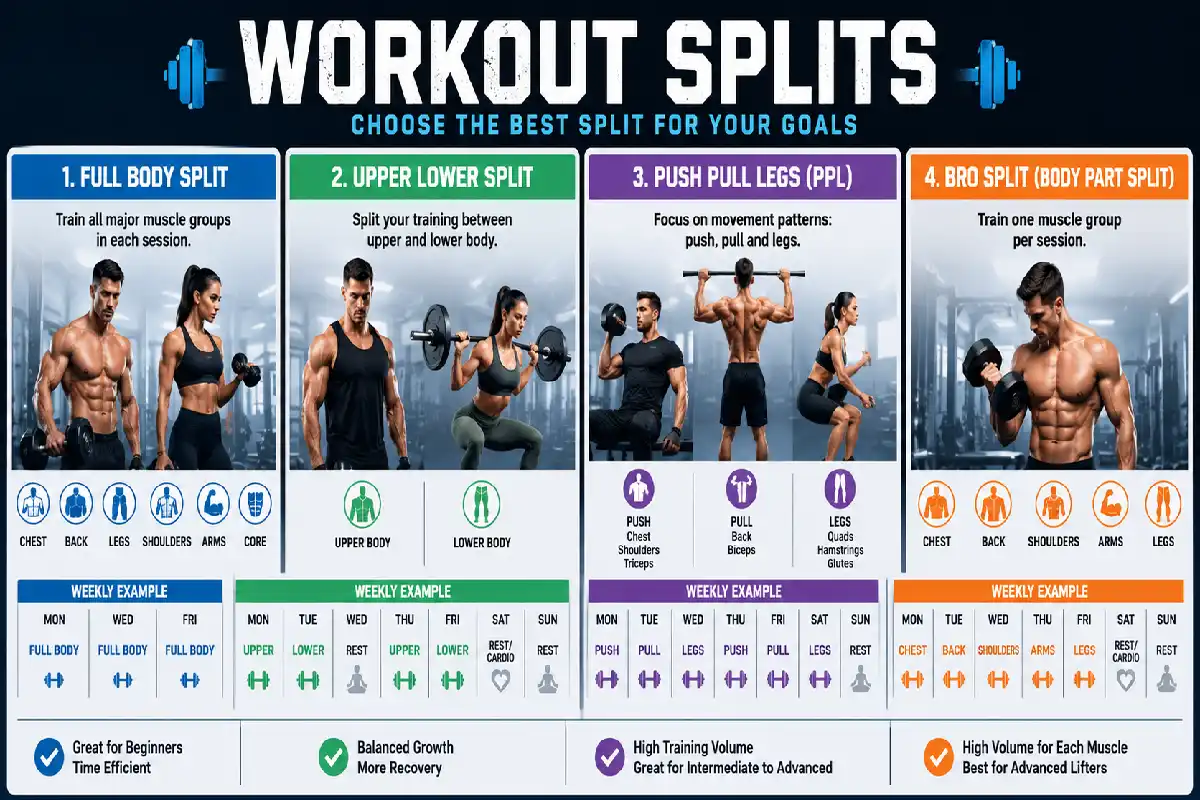
What Are Workout Splits?
Workout splits are training the schedules that divide your weekly workouts into the specific muscle groups or drive patterns.
Instead of training every power in every session, a split allows you to focus on selected muscles while others recover.
Common workout splits include:
- Full Body Split
- Upper Lower Split
- Push Pull Legs (PPL)
- Body Part Split (Bro Split)
- Hybrid Workout Split
Each has advantages depending on training frequency and goals. A well-designed workout split should provide enough training volume and recovery for every major muscle group. Learn more in our Upper Body Muscle Groups Guide.
Why Workout Splits Matter
Following a structured workout split offers several benefits.
Better Recovery
Muscles require recovery to repair and grow.
Improved Performance
Training fewer muscle groups per session allows greater intensity.
Progressive Overload
Workout splits make it easier to increase weights over time.
Balanced Development
Proper planning reduces neglected muscle groups.
Lower Injury Risk
Adequate rest helps prevent overtraining. The effectiveness of any workout split depends on selecting the right exercises for each training session. Explore our collection of Upper Body Exercises to build a balanced routine.
Types of Workout Splits
1. Full Body Workout Split
A full body workout trains all major muscle groups during one session.
Example:
- Squats
- Bench Press
- Bent-over Rows
- Shoulder Press
- Romanian Deadlift
- Core Work
Best For
- Beginners
- Busy professionals
- Fat loss
- Three training days per week
Pros
- High calorie burn
- Frequent muscle stimulation
- Simple programming
Cons
- Longer sessions
- Can become tiring
2. Upper Lower Workout Split
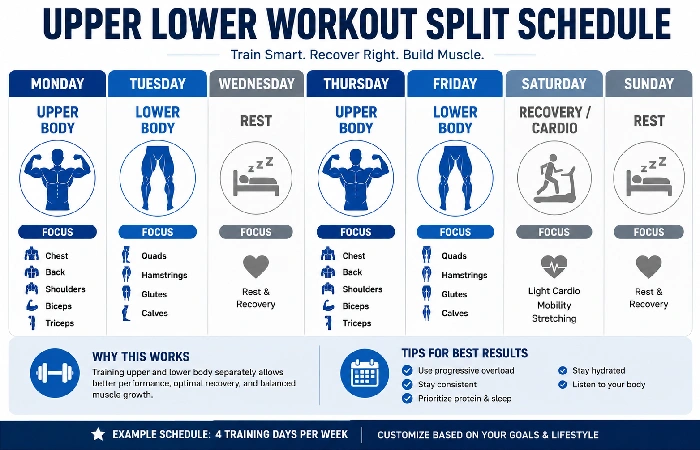
The upper lower workout split divides training into upper-body and lower-body sessions. Even when training at home, following a structured workout split can improve consistency and long-term progress. Follow our Home Upper Body Workouts Guide for practical workout ideas.
Example Weekly Schedule
| Day | Workout |
| Monday | Upper Body |
| Tuesday | Lower Body |
| Wednesday | Rest |
| Thursday | Upper Body |
| Friday | Lower Body |
| Weekend | Recovery |
Upper body sessions include:
- Chest
- Back
- Shoulders
- Biceps
- Triceps
Lower body sessions include:
- Quads
- Hamstrings
- Glutes
- Calves
Benefits
- Excellent recovery
- Balanced muscle growth
- Flexible schedule
- Ideal for intermediate lifters
Push Day vs Upper Body Day
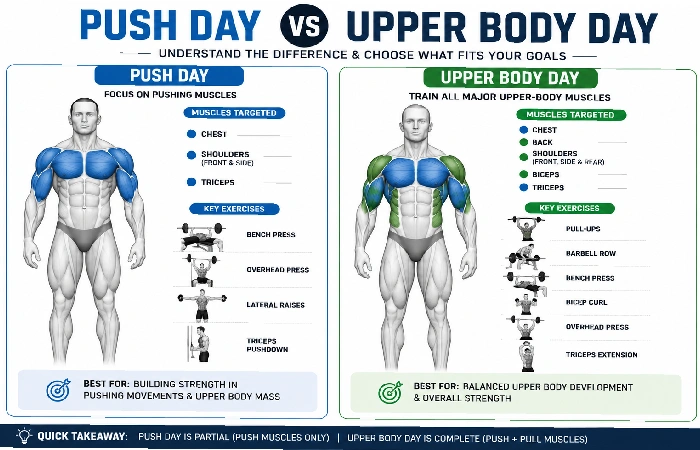
Many people confuse push day vs upper body day, but they are different. Gym-based workout splits allow you to take advantage of machines, free weights, and progressive overload techniques. Learn more in our Gym Upper Body Workouts Guide.
| Feature | Push Day | Upper Body Day |
| Chest | ✔ | ✔ |
| Shoulders | Front & Side | Full Shoulders |
| Triceps | ✔ | ✔ |
| Back | ✘ | ✔ |
| Biceps | ✘ | ✔ |
| Workout Length | Shorter | Longer |
| Recovery | Easier | Moderate |
Push Day
Focuses only on pushing muscles.
Exercises include:
- Bench Press
- Incline Press
- Overhead Press
- Lateral Raises
- Triceps Pushdowns
Upper Body Day
Trains all upper-body muscles together.
Exercises include:
- Bench Press
- Pull-ups
- Barbell Rows
- Shoulder Press
- Bicep Curls
- Triceps Extensions
Which Is Better?
Choose Push Day if:
- Following Push Pull Legs
- Training 5–6 days weekly
- Want higher training volume
Choose Upper Body Day if:
- Training 3–4 days weekly
- Want balanced development
- Prefer shorter weekly schedules
Full Body vs Upper Body Workout
The debate around full body vs upper body workout depends largely on your weekly training frequency.
| Factor | Full Body | Upper Body |
| Frequency | 3 Days | 2–4 Days |
| Time Per Session | Longer | Moderate |
| Muscle Recovery | Excellent | Excellent |
| Beginners | Excellent | Good |
| Muscle Growth | High | High |
| Strength | Excellent | Excellent |
Choose Full Body If
- You’re a beginner.
- You have limited training days.
- Your goal is overall fitness.
Choose Upper Body If
- You already train lower body separately.
- You want more upper-body volume.
- You’re following an Upper Lower split.
Best Upper Body Workout Schedule
A balanced upper body workout schedule targets all major muscles evenly.
Monday – Upper Body A
- Bench Press
- Pull-ups
- Overhead Press
- Barbell Row
- Triceps Pushdown
- Hammer Curl
Thursday – Upper Body B
- Incline Dumbbell Press
- Lat Pulldown
- Dumbbell Shoulder Press
- Seated Cable Row
- Face Pull
- Preacher Curl
Aim for:
- 3–4 sets per exercise
- 8–12 repetitions
- Progressive overload each week
How to Choose the Right Workout Split
Consider these factors:
Training Experience
| Experience | Recommended Split |
| Beginner | Full Body |
| Intermediate | Upper Lower |
| Advanced | Push Pull Legs |
Weekly Availability
| Days Available | Recommended Split |
| 2–3 Days | Full Body |
| 4 Days | Upper Lower |
| 5–6 Days | Push Pull Legs |
Fitness Goal
| Goal | Best Split |
| Fat Loss | Full Body |
| Muscle Gain | Upper Lower |
| Strength | Upper Lower |
| Bodybuilding | Push Pull Legs |
Common Workout Split Mistakes
Avoid these mistakes:
- Skipping leg workouts
- Ignoring recovery
- Doing excessive volume
- Not tracking progress
- Poor exercise selection
- Neglecting warm-ups
- Changing programs too often
Tips for Better Results
- Train consistently.
- Prioritise compound exercises.
- Sleep 7–9 hours nightly.
- Eat enough protein.
- Stay hydrated.
- Increase weights gradually.
- Include rest days.
- Proper workout splits can help maximize training volume while allowing enough recovery for muscle growth. Discover proven methods in our Upper Body Muscle Building.
Sample Weekly Workout Splits
Option 1 (3 Days)
- Monday – Full Body
- Wednesday – Full Body
- Friday – Full Body
2 (4 Days)
- Monday – Upper
- Tuesday – Lower
- Thursday – Upper
- Friday – Lower
Option 3 (6 Days)
- Monday – Push
- Tuesday – Pull
- Wednesday – Legs
- Thursday – Push
- Friday – Pull
- Saturday – Legs
Frequently Asked Questions
What are workout splits?
Workout splits are weekly training plans that divide exercises by muscle groups or movement patterns to improve recovery, consistency, and muscle development.
Is the upper lower workout split good for muscle growth?
Yes. The upper lower workout split is one of the most effective programmes for building muscle because it balances training volume with adequate recovery.
What is the difference between push day vs upper body day?
A push day focuses only on pushing muscles such as the chest, shoulders, and triceps, while an upper body day trains all upper-body muscles, including the back and biceps.
Which is better: full body vs upper body workout?
A full body vs upper body workout comparison depends on your schedule. Full-body workouts suit beginners and those with limited training days, while upper-body workouts work well in structured split routines.
How many days should an upper body workout schedule include?
Most people benefit from an upper body workout schedule performed two times per week within an upper-lower split for balanced strength and muscle growth.
Strength gains often depend on balancing workout intensity with recovery time. Explore our Upper Body Strength Training Guide for effective programming strategies.
Conclusion
One of the most fundamental aspects of any training programme involves deciding on how you’re going to structure your workout splits. Although there is no ‘correct’ way for everyone, choosing a workout split that complements your recovery capabilities, fitness experience, and training days each week will enable you to remain consistent and make further progress over time. If you’re just starting, then a full body training programme is likely the best approach.
Intermediates tend to see a great response from an upper and lower split, whilst advanced trainers can benefit from training at higher volumes through an push pull and legs split.
Knowing whether it’s push day vs upper body day, or a full body vs upper body workout, helps to devise an effective plan that suits your individual objectives. Having a comprehensive plan with proper diet and effective recovery methods alongside a solid upper body workout split and progressive overload will aid to long-term strength, muscle gain and progress. The right workout split can increase training frequency and support calorie-burning goals. Learn more in our Upper Body Fat Burning.