
Last Updated: May 21, 2026
What Is a Goblet Squat?
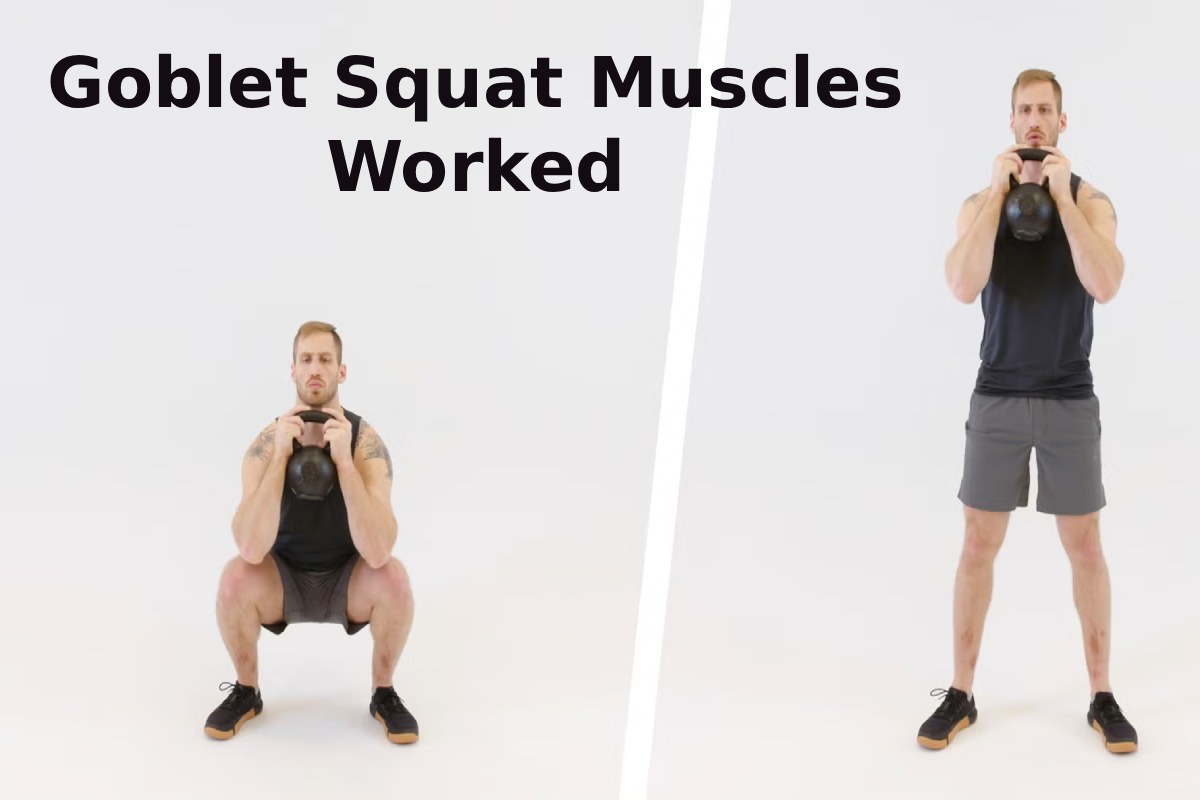
A goblet squat is a type of squat in which you receive a weight (such as a dumbbell or a kettlebell) at the level of the chest when squatting down and then stand straight again. The name is after the manner in which you carry around the weight: like you are holding a goblet in your chest as you move. This stance (which is front loaded) will assist your body to be more upright and it may easier to learn the appropriate squat mechanics and it also helps to avoid the strain on your lower back that other types of squats may cause.
Goblet Squat Muscles Overview
Goblet squat is a lower-body workout that involves using several muscles simultaneously. The weight being in front of the chest enhances the level of core engagement and prompts an upright position of the torso.
Primary Muscles Worked
These muscles do most of the work during the movement:
1. Quadriceps
Located at the front of the thighs, the quadriceps extend the knees as you stand up from the squat.
Role: Main driving force when rising.
2. Gluteus Maximus
The largest muscle in the hips.
Role: Extends the hips and powers the upward movement.
3. Adductors (Inner Thighs)
Help stabilize the legs during descent and ascent.
Role: Assist in hip stability and control.
Secondary / Supporting Muscles
These muscles assist and stabilize:
4. Hamstrings
Support hip extension and knee stability.
5. Core Muscles (Abs & Obliques)
The front-loaded weight forces your core to brace throughout the movement.
Role: Maintain balance and protect the spine.
6. Erector Spinae (Lower Back)
Keeps the spine neutral and upright.
7. Calves
Assist in ankle supplementing, especially at the bottom of the squat.
8. Upper Back (Traps & Rhomboids)
Help hold the weight close to the chest and maintain posture.
Goblet Squat Benefits
| Benefit | How It Helps | Why It Matters |
| Improves Squat Form | Front-loaded weight keeps chest upright | Teaches proper squat mechanics for beginners |
| Builds Lower Body Strength | Targets quads, glutes, hamstrings | Develops strong legs and hips |
| Increases Core Activation | Weight held at chest engages abs | Improves stability and posture |
| Safer for Lower Back | Less spinal compression than barbell squat | Reduces injury risk for beginners |
| Enhances Mobility | Encourages deep squat position | Improves ankle and hip flexibility |
| Beginner-Friendly | Simple setup with dumbbell/kettlebell | Easy to learn and perform |
| Supports Fat Loss | Works large muscle groups | Burns more calories |
| Improves Posture | Promotes upright torso position | Reduces forward rounding |
| Functional Strength | Mimics natural sitting movement | Helps in daily activities |
| Great for Home Workouts | Requires minimal equipment | Convenient and space-efficient |
Muscle Activation Compared to Other Squats
According to recent research, the goblet squat shows balanced muscle activation compared to other squat styles:
| Muscle Group | Goblet Squat Activation (%MVIC) | Notes |
|---|---|---|
| Quadriceps | ~60% | Strong work because of upright posture |
| Glutes | ~58% | Helps with hip extension |
| Hamstrings | ~50% | Assists motion and stability |
| Erector Spinae | ~50% | Stabilizes lower back |
MVIC = Muscle activation as a percentage of maximum effort during contraction.
This shows that the goblet squat works many key muscles with balanced effort, making it a versatile full-body movement.
How to Do a Goblet Squat — Step-by-Step Guide
A goblet squat is a great exercise for building leg strength, improving posture, and strengthen proper squat form. It is often easier to learn than other weighted squats because the weight is carry in front of your chest, helping you stay balanced and upright.
1. Stand Tall and Ready
• Stand with your feet about shoulder-width apart.
• Hold a dumbbell or kettlebell close to your chest with both hands, elbows pointing down.
• Keep your chest up and spine neutral (not bow forward).
2. Brace Your Core
Before you start the squat, take a small breath in and tighten your core muscles. Think of pulling your belly button slightly toward your spine. This supports your lower back during the squat.
3. Start the Descent
• Begin the squat by pushing your hips slightly back and bending your knees as if you are going to sit in a chair.
• Keep the weight close to your body; don’t let it drift forward.
• Make sure your knees track over your toes, not collapsing inward.
4. Lower to Comfortable Depth
• Lower yourself until your thighs are at least parallel to the floor, or as deep as your body comfortably allows while keeping good form.
• A good cue is to lower until your elbows lightly touch the inside of your knees — this helps ensure proper depth and knee alignment.
5. Stand Back Up
• Push through your heels (not your toes) to stand back up.
• Keep your chest tall and core engaged as you rise.
• Exhale as you finish the upward movement.
6. Repeat With Control
• Perform the movement slowly and with control.
• Good beginners start with 2–3 sets of 10–15 repetitions.
Goblet Squat vs Barbell Squat
| Feature | Goblet Squat | Barbell Back Squat |
|---|---|---|
| Skill Level | Beginner-friendly | Intermediate–Advanced |
| Load Capacity | Moderate | High |
| Core Activation | High | Moderate |
| Spinal Load | Lower | Higher |
| Mobility Demand | Moderate | Higher |
The goblet squat is excellent for:
-
Beginners
-
Warm-ups
-
Accessory work
-
Conditioning circuits
What Is a Good Goblet Squat Weight for a Woman?
A “good” goblet squat weight depends on experience level, strength, body weight, and goals (fat loss, toning, strength, or athletic performance). There isn’t one perfect number — but there are helpful general guidelines.
| Experience Level | Suggested Weight | Reps Range | Goal Focus |
| Beginner | 5–10 kg (10–20 lbs) | 10–15 reps | Learn form & build base strength |
| Early Intermediate | 10–18 kg (20–40 lbs) | 8–12 reps | Muscle toning & strength |
| Advanced | 18–30+ kg (40–65+ lbs) | 6–10 reps | Strength & power development |
Conclusion
The goblet squat is a highly effective, beginner-friendly, and research-supported lower-body exercise. It builds strength, improves mobility, enhances posture, and supports overall functional fitness.
Whether you’re training at home with a dumbbell or in the gym with a kettlebell, incorporating goblet squats into your routine can dramatically improve lower-body development and movement quality.